Published August 31, 2026
Table of Contents
- What the Doolittle Method Actually Is
- G.M. Doolittle and 20 Years of Development
- The Wax Cell Cup Innovation
- The Grafting Process Step by Step
- Why This 1888 Technique Still Underlies Modern Queen Rearing
- Doolittle vs. Modern Grafting Tools and Systems
- Doolittle vs. Graft-Free Methods
- The Real Skill Requirement
- Who Should Learn the Doolittle Method
- Starter and Finisher Colonies Explained
- Why Larva Age Precision Matters So Much
- How Grafting Tools Evolved From Doolittle’s Original
- Lighting and Working Conditions for Successful Grafting
- How to Actually Make Wax Cell Cups Doolittle’s Way
- Realistic Acceptance Rate Expectations
- Practicing Before Grafting for Real
- Best Season for Doolittle-Style Grafting
- Tracking Grafting Results Over Time
- Common Mistakes
What the Doolittle Method Actually Is
The Doolittle method is the original systematic grafting technique for queen rearing, developed by G.M. Doolittle and published in his 1889 book “Scientific Queen Rearing,” involving manually transferring very young worker larvae into hand-formed wax queen cell cups to trigger queen development. It’s not simply one historical technique among many — it’s the foundational method that essentially all modern grafting-based queen rearing, including the commercial plastic cup systems and grafting tools covered in our other guides, ultimately descends from.
G.M. Doolittle and 20 Years of Development

Doolittle spent more than two decades reviewing existing queen-rearing methods, testing his own refinements, and evaluating results before finishing his book on Christmas Day, 1888 — a genuinely long, methodical development process rather than a technique he arrived at quickly. This extended real-world testing period is part of why the method proved durable enough to remain foundational to queen rearing well over a century later, a rare achievement for any beekeeping technique from that era.
The Wax Cell Cup Innovation
Doolittle’s most significant specific contribution was his method of forming artificial queen cell cups from wax by dipping a shaped wooden rod (often fashioned from a rake handle) repeatedly into melted beeswax, building up layers to create a cup shape closely mimicking a natural queen cell’s dimensions. This dipped-wax-cup technique solved a real practical problem earlier grafting attempts struggled with — giving bees a cup shape and material they readily accepted and built out naturally, rather than fighting an artificial structure the colony was inclined to reject or under-develop.
The Grafting Process Step by Step
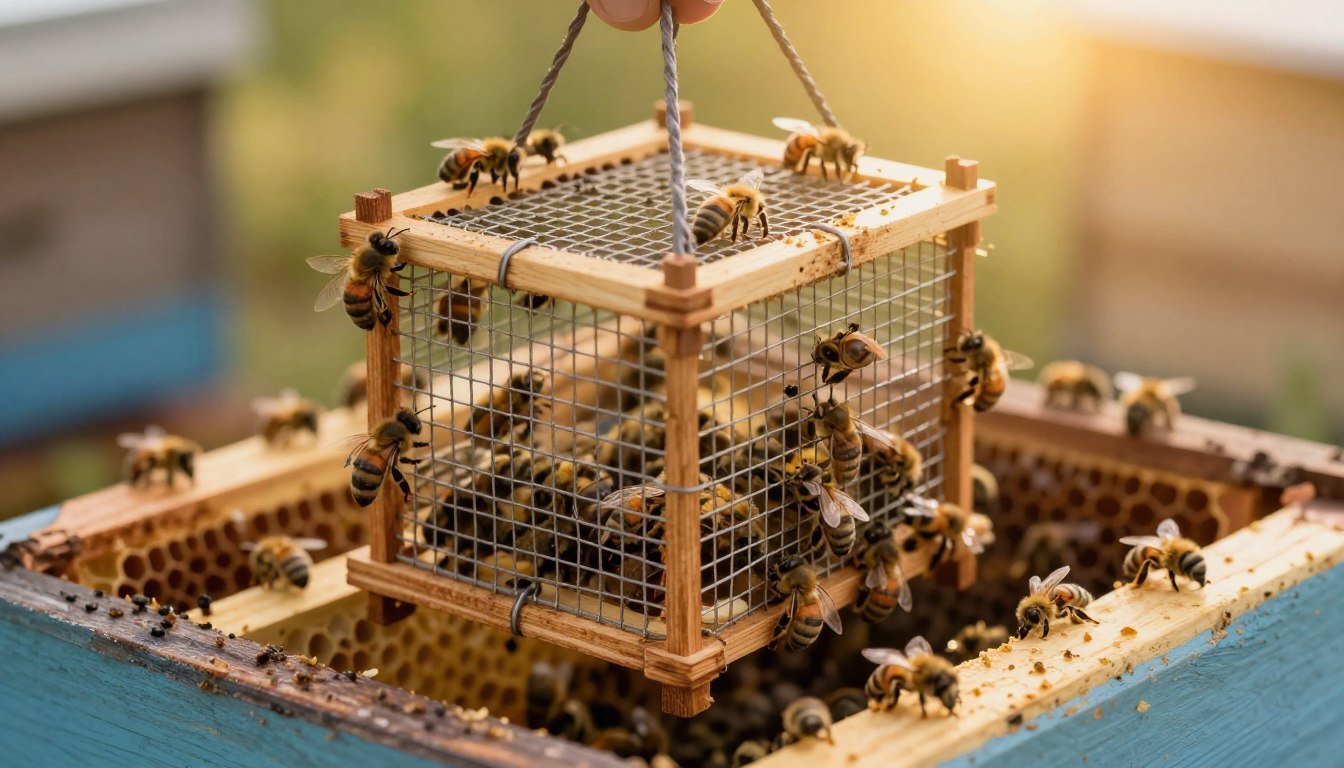
The core process involves selecting worker larvae under 24 hours old (young enough that they haven’t yet been committed to worker-caste development), gently lifting each larva on a small tool along with a portion of its royal jelly, and placing it into a prepared wax cup, which is then introduced into a queenless “starter” colony that accepts and begins feeding the grafted larvae as potential queens. Precision matters throughout — larva age, handling gentleness, and starter colony strength all directly affect how many grafts the colony actually accepts and develops into viable queen cells.
Why This 1888 Technique Still Underlies Modern Queen Rearing
Nearly every modern grafting-based queen-rearing approach — whether using Doolittle’s original wax-dipped cups, modern plastic cell cups, or the grafting tools compared in our dedicated buying guide — follows the same fundamental sequence Doolittle systematized: selecting young larvae, transferring them into artificial cups, and letting a queenless starter colony raise them as queens. Understanding this lineage gives real context for why grafting-based methods share so much common structure despite superficial equipment differences across a century and a half of incremental refinement.
Doolittle vs. Modern Grafting Tools and Systems
| Factor | Doolittle (Original) | Modern Grafting Tools |
|---|---|---|
| Cell cup material | Hand-dipped beeswax | Injection-molded plastic (typically) |
| Consistency | Varies with dipping skill | Highly uniform manufacturing |
| Cost | Essentially free (wax + rod) | Modest purchase cost for tools/cups |
| Learning curve | Requires learning wax-dipping too | Cup-making step eliminated |
Modern grafting tools genuinely improve on Doolittle’s original approach in consistency and convenience, covered in depth in our queen grafting tools comparison, but the underlying skill of accurately selecting and transferring young larvae — the hardest part of grafting regardless of cup type — remains essentially unchanged from Doolittle’s original technique.
Doolittle vs. Graft-Free Methods
Unlike graft-free techniques such as the Miller method or Alley method, which avoid handling individual larvae entirely by manipulating comb or foundation strips instead, the Doolittle method requires directly transferring larvae by hand — a more physically delicate process, but one that offers more precise control over exactly which larvae become queens and typically produces a higher yield of queen cells per cycle than graft-free approaches.
The Real Skill Requirement
The genuine learning curve in the Doolittle method isn’t understanding the concept — it’s developing the fine motor skill to consistently lift a nearly microscopic, delicate larva without injuring it, a skill that improves meaningfully with practice but does involve a real failure rate for beginners during the first several grafting sessions. New practitioners should expect lower acceptance rates initially and treat early attempts as skill-building rather than expecting immediate high-yield results.
Who Should Learn the Doolittle Method
Beekeepers wanting maximum control over larva selection and higher queen-cell yield per cycle, and those interested in understanding queen rearing at its most foundational level before adopting more modern convenience tools, are the strongest fits for learning Doolittle’s original technique. A beginner primarily wanting reliable results with minimal skill investment may be better served starting with modern plastic cell-cup systems or a graft-free method, and returning to the original wax-cup technique later as a skill-building exercise.
Starter and Finisher Colonies Explained
Doolittle’s system, still followed in modern grafting practice, distinguishes between a “starter” colony — typically a strong, genuinely queenless colony that accepts and begins feeding freshly grafted larvae with enthusiasm — and a “finisher” colony, which may be either queenless or have the queen separated behind an excluder, that completes the cell-building and capping process over the following days. Using this two-stage approach, rather than relying on a single colony for the entire cycle, generally produces higher-quality, more consistently well-fed queen cells than a single-colony approach manages on its own.
Why Larva Age Precision Matters So Much
Worker and queen larvae are genetically identical at the earliest stage — caste is determined entirely by what and how much they’re fed, not genetics — but that window for successfully redirecting a larva toward queen development closes quickly, generally within the first 24-36 hours after hatching, which is why Doolittle’s method specifically emphasizes grafting the youngest visible larvae rather than any larva that happens to be convenient to reach. Missing this window even slightly reduces both acceptance rates and the resulting queen’s eventual quality, since a larva grafted too late has already received comparatively less of the royal-jelly-rich feeding regimen that produces a fully developed queen.
How Grafting Tools Evolved From Doolittle’s Original
Doolittle himself used a simple sharpened matchstick or similar improvised tool to lift larvae, and while modern grafting tools have since evolved into purpose-made Chinese, German, and Swiss-style implements offering finer control and reduced larva damage risk, the underlying hand-eye coordination challenge Doolittle faced remains essentially the tool-independent core skill every grafter still has to develop. A beginner using a basic, inexpensive tool can achieve results comparable to someone using premium equipment once the fundamental technique is mastered — the tool helps, but doesn’t replace the skill.
Lighting and Working Conditions for Successful Grafting
Good, bright, indirect lighting (natural daylight or a strong dedicated lamp) and a comfortable, steady working position make a genuine practical difference in grafting success, since accurately seeing and lifting a nearly translucent, millimeter-scale larva without injuring it is difficult under poor lighting even with an otherwise correct technique. Many experienced grafters also work with a headband magnifier or dedicated grafting station specifically to reduce eye strain and improve visual precision during longer grafting sessions.
How to Actually Make Wax Cell Cups Doolittle’s Way
Making traditional wax cell cups involves melting pure beeswax to a specific working temperature, dipping a smoothly rounded wooden or metal form (roughly the diameter of a pencil, tapered slightly) repeatedly into the melted wax — typically 8-10 dips — cooling briefly between each dip to build up layered thickness, then gently twisting and removing the finished cup once cooled. While largely superseded by plastic cups for convenience, this technique remains completely viable today at essentially zero material cost, and some beekeepers specifically prefer wax cups since bees sometimes show a stronger natural acceptance preference for wax over plastic.
Realistic Acceptance Rate Expectations
Experienced grafters using the Doolittle technique with good technique and strong colonies typically see acceptance rates in the range of 70-90% of grafted larvae successfully developing into capped queen cells, while beginners often start considerably lower, sometimes below 50%, during their first several attempts. Tracking your own acceptance rate over successive grafting sessions is a genuinely useful way to measure real skill improvement objectively, rather than relying on subjective impressions of how the process felt.
Practicing Before Grafting for Real
Many beekeepers new to grafting practice the physical lifting motion on non-viable material first — old, discarded larvae or even a soft substitute like a grain of cooked rice — to build the fine motor coordination needed before attempting real grafts on larvae you actually intend to develop into queens. This low-stakes practice step, costing nothing but a bit of time, meaningfully reduces the number of real larvae wasted during the genuine early learning-curve period every new grafter goes through.
Best Season for Doolittle-Style Grafting
Grafting is generally most successful during a colony’s natural buildup period in spring, when drone populations are adequate for later queen mating and nectar/pollen flow supports strong colony feeding of both the starter/finisher colonies and the eventual grafted cells, though skilled practitioners can extend the window into early summer depending on regional conditions. Attempting to graft during a dearth or when drone populations are inadequate for mating undermines the whole process regardless of how well the grafting itself is executed.
Tracking Grafting Results Over Time
Keeping simple records of graft dates, acceptance counts, and eventual queen performance helps you identify genuine patterns in your own results — whether certain source colonies, times of day, or weather conditions correlate with higher acceptance — turning what can otherwise feel like an inconsistent, frustrating skill into a more systematically improvable one over successive seasons.
Common Mistakes
Selecting larvae that are too old (visibly curled or larger than a comma shape) dramatically reduces the chance the colony accepts and properly develops them as queens, since caste commitment happens very early in larval development. Handling larvae roughly or exposing them to temperature extremes or drying out during the transfer process damages delicate tissue invisibly, reducing acceptance without an obvious cause. Using a weak or genuinely queenless-but-poorly-provisioned starter colony undermines even a technically perfect graft, since the starter colony’s own strength directly determines how well it can actually raise the grafted larvae.
Sources
Historical development and technique details reflect G.M. Doolittle’s original 1889 publication “Scientific Queen Rearing” and subsequent published beekeeping education resources documenting the method’s development and legacy.
FAQ
Is the Doolittle method still used today?
Yes — nearly all modern grafting-based queen-rearing methods, including those using plastic cell cups and modern grafting tools, follow the same fundamental larva-selection-and-transfer sequence Doolittle systematized in 1888.
Do I need to make my own wax cell cups like Doolittle did?
No — modern plastic cell cups have largely replaced hand-dipped wax cups for convenience and consistency, though the wax-dipping technique remains a viable, essentially free option some beekeepers still use.
How is the Doolittle method different from graft-free techniques?
Doolittle’s method requires directly handling and transferring individual larvae, while graft-free techniques like the Miller or Alley methods manipulate comb or foundation strips instead, avoiding larva handling entirely at some cost to yield and precision.
Is grafting difficult to learn?
It has a genuine learning curve specifically around the fine motor skill of lifting delicate larvae without injury; beginners should expect lower acceptance rates initially, improving meaningfully with practice.
What equipment do I need to try the Doolittle method?
At minimum, a grafting tool (even a simple sharpened matchstick works, as Doolittle originally used), wax or plastic cell cups, a queenless starter colony, and a strong finisher colony — no specialized commercial hardware is strictly required to get started.
How old was G.M. Doolittle when he developed this method?
Doolittle spent over two decades developing and refining the technique before publishing his book in 1888, reflecting a genuinely long, methodical testing process rather than a quickly arrived-at idea.