Making a jar or two of creamed honey in your kitchen is a hand-mixing job; making 50, 250, or 650 pounds of it consistently is an equipment decision, and the right tool depends almost entirely on your batch size. This site’s existing guide to the Dyce method covers the home-scale process and seeding ratio — this one is about the actual equipment producers use once they’re past mixing honey in a stand mixer bowl.
Key Takeaways
- The Dyce method — developed by Elton Dyce in the 1930s and still the industry-standard technique — works by blending fine seed crystals into liquid honey and holding it cool (roughly 50-57°F) until it sets into a smooth, spreadable texture instead of coarse crystals.
- At true production scale, the equipment is purpose-built stir tanks: slow-turning mixers with powerful motors that incorporate minimal air, sized for batches from around 100 up to 650+ pounds, sold by suppliers like Fritz in Germany.
- Betterbee sells a home-and-small-producer creamed honey kit with published Dyce method instructions — a realistic entry point between hand-mixing a single jar and investing in an industrial tank.
- A genuinely common mid-scale DIY solution among small commercial producers is a large stainless bowl mounted on a lazy-susan base, stirred with a drill bit on a flexible shaft powered by a small motor — a real, documented workaround, not a theoretical one.
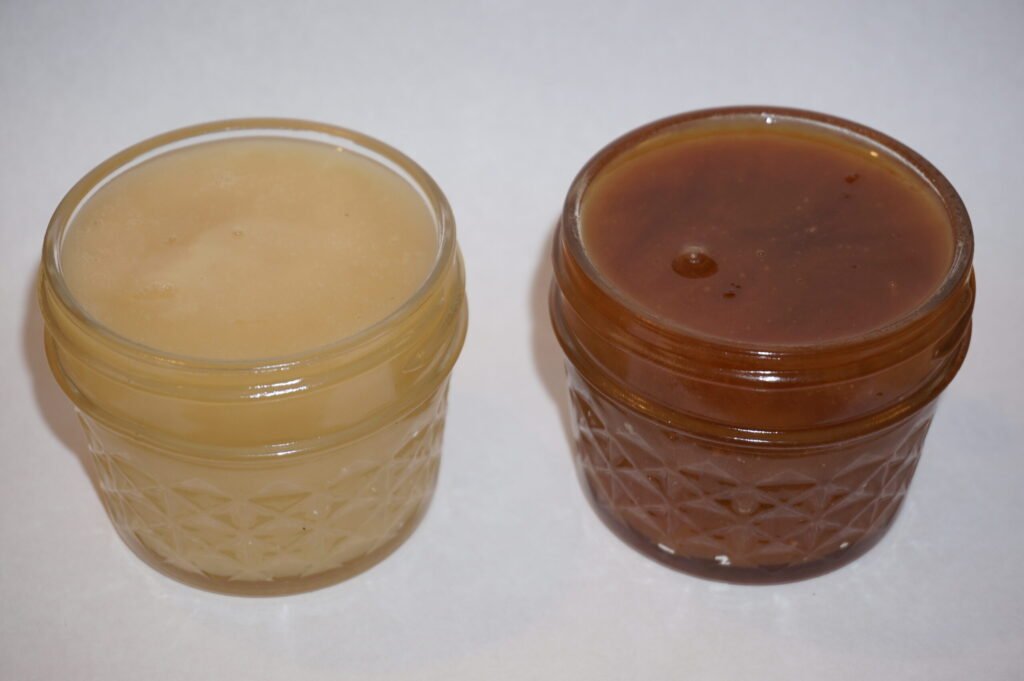
- Minimizing air incorporation during mixing matters at every scale — too much air whipped into the batch shows up as a lighter color and a less dense, less smooth final texture than proper creamed honey should have.
Table of Contents
- The Dyce Method, Briefly
- Equipment by Batch Size
- What to Look for When Buying a Stir Tank
- Common Equipment Mistakes
- Frequently Asked Questions
The Dyce Method, Briefly
Elton Dyce patented the core process behind virtually all commercial creamed honey in the 1930s: instead of letting honey crystallize randomly into coarse, gritty sugar crystals, you deliberately seed liquid honey with a small percentage of finely ground crystals (either store-bought creamed honey or crystallized honey run through a grinder), mix it thoroughly, and hold the mixture at a controlled cool temperature — commonly cited around 50-57°F — for one to two weeks. The fine seed crystals control the crystallization process, producing the smooth, spreadable texture creamed honey is known for instead of the coarse grain honey naturally forms if left alone. This site’s seeding ratio guide covers the exact ratios and home-kitchen process in more depth; this guide picks up where that one leaves off — once you’re mixing more honey than a stand mixer bowl can reasonably hold.
Equipment by Batch Size
The right equipment genuinely depends on how much you’re making at once, and jumping straight to industrial equipment for a small operation wastes money just as surely as trying to hand-mix a 300-pound batch wastes time:
- Single jars to a few gallons: A stand mixer on its lowest speed, or hand-stirring with a paddle, works fine. This is the scale covered in this site’s seeding ratio guide.
- Small commercial batches (roughly 50-100 lbs): Betterbee and similar beekeeping suppliers sell creamed-honey kits and standalone mixing equipment sized for this range, along with published Dyce method instructions — a realistic first equipment purchase for a producer selling at farmers markets or through a small retail account.
- Mid-scale DIY (100-300 lbs): A documented, genuinely used workaround among small producers is a large stainless steel bowl mounted on a homemade lazy-susan base, stirred with a drill bit chucked onto a flexible shaft and powered by a small wall-mounted motor. It’s inexpensive to build from parts and scales well past what a stand mixer can handle.
- Full commercial scale (100-650+ lbs per batch): Purpose-built stir tanks from suppliers like Fritz in Germany are designed specifically for this job — slow rotation speed, minimal air incorporation, and motor and blade assemblies powerful enough to move a thick, viscous batch without straining. Glass-lined, double-walled reactor tanks (the same basic design Dyce himself used for early testing) are also used at this scale for better temperature control.
What to Look for When Buying a Stir Tank
- Slow mixing speed, not high speed. The goal is thorough blending of seed crystals through the batch without whipping air into it — a mixer built for this job runs slower than you’d expect for how thick the honey is.
- Minimal air incorporation by design. Look specifically for equipment marketed for honey or viscous-food mixing rather than a generic industrial mixer, since blade shape and tank geometry both affect how much air gets folded in.
- Temperature control, not just a mixing motor. Since the Dyce method depends on holding a specific cool temperature range for one to two weeks, a jacketed or insulated tank — or a dedicated cool room to store the tank in during the set period — matters as much as the mixer itself.
- Motor power matched to your actual batch size. An underpowered motor struggling against a thick, cold honey batch will wear out fast or stall; size the equipment to your real batch weight, not just your budget.
- Cleanability. Stainless steel construction with no hard-to-reach seams matters for the same food-safety reasons it matters on an extractor — dried honey residue is difficult to fully clean out of complex geometry.
Common Equipment Mistakes
The most common failure at any scale is mixing too fast or too long, which whips excess air into the batch — the result is a lighter, almost foamy-looking product with a less dense, less smooth mouthfeel than proper creamed honey, even when the seed ratio and temperature were both correct. The second most common mistake is undersizing the mixer’s power for the batch weight, which either stalls the motor or produces uneven mixing where some of the batch never gets fully seeded, leaving pockets that crystallize coarsely instead of smoothly. Skipping temperature control entirely — mixing correctly but then storing the batch somewhere too warm during the one-to-two-week set period — undoes the process just as thoroughly as skipping the seeding step in the first place.
Frequently Asked Questions
What’s the difference between the Dyce method process and the equipment needed to scale it up?
The Dyce method itself — seeding liquid honey with fine crystals and holding it cool — is the same at any scale. What changes is the tool used to mix it: a spoon or stand mixer for a few jars, versus a purpose-built stir tank with a powerful, slow-turning motor for hundreds of pounds at once.
Do I need an industrial stir tank to make creamed honey commercially?
Not necessarily at first. Many small producers start with a home-scale kit (like those sold by Betterbee) or a DIY setup like a stainless bowl on a lazy-susan base with a drill-and-flexible-shaft stirrer, and move to a purpose-built tank only once batch size justifies the investment.
Why does air incorporation matter when mixing creamed honey?
Whipping air into the batch during mixing produces a lighter-colored, less dense final texture instead of the smooth, spreadable consistency creamed honey is supposed to have — it’s a real quality issue, not just cosmetic.
What temperature should creamed honey be held at while it sets?
Commonly cited as roughly 50-57°F for one to two weeks, based on the original Dyce method — equipment or storage space that can hold this range consistently matters as much as the mixer itself.
Can I build my own creamed honey mixing equipment?
Yes — a documented, real approach among small producers uses a large stainless bowl on a homemade lazy-susan base with a drill bit on a flexible shaft as the stirrer, powered by a small motor. It’s a genuine mid-scale option between hand-mixing and buying an industrial tank.
Readers interested in the underlying source can consult National Honey Board.