A UK charity called Caring for God’s Acre has spent two decades making a case that sounds strange at first: some of the best surviving pollinator habitat in Britain is sitting inside churchyards and cemeteries, precisely because burial ground has spent generations quietly escaping the plough, the herbicide sprayer, and the fertilizer spreader that transformed almost everything around it. The same logic is now producing measurable results at cemeteries in the United States — including one calculation putting real annual savings at $2,380 per five-acre plot converted from mowed lawn to meadow, alongside a documented 63% jump in arthropod density once mowing stops.
Key Takeaways
- Caring for God’s Acre, a UK national charity since 2000, works across more than 25,000 burial grounds, promoting wildflower meadow management specifically because old, unimproved grassland has become rare everywhere else.
- Since the 1940s, over 97% of Britain’s old unimproved grassland has been lost to development, plowing, and agricultural intensification — burial grounds are one of the few landscape types that were largely spared.
- A parallel “Living Churchyards and Cemeteries” scheme encourages UK communities to manage grassland, woodland edges, and even lichen-covered gravestones as deliberate wildlife habitat.
- In the U.S., Brooklyn’s Green-Wood Cemetery runs an active experimental meadow project testing native grass and wildflower mixes under different mowing regimes.
- Research cited by the Xerces Society found a 63% increase in total arthropod density in unmown meadow areas compared to mown ones, while Newark’s Parks and Cemetery Department documented roughly $2,380 in annual savings per five-acre plot converted to meadow.
Table of Contents
- Why Burial Grounds Became Accidental Habitat
- Caring for God’s Acre and the UK Model
- The “Living Churchyard” Approach
- Green-Wood Cemetery’s American Experiment
- What the Data Actually Shows
- Could Your Local Cemetery Do This?
- Frequently Asked Questions
Why Burial Grounds Became Accidental Habitat
The core insight behind this whole movement isn’t that cemeteries are special sites for wildlife by design — it’s that they were left alone. Since the 1940s, more than 97% of Britain’s old, unimproved grassland has disappeared, plowed under, developed, or converted to intensively managed, fertilized, herbicide-treated turf and farmland. Burial grounds are one of the few categories of land that mostly escaped that transformation, for reasons that have nothing to do with conservation: nobody plows a grave, sprays it with the same intensity as a farm field, or redevelops it the way they might a vacant lot. That combination of long-term stability and low chemical input, maintained by accident for generations, is exactly the recipe conservationists spend enormous effort and money trying to recreate deliberately elsewhere.
Caring for God’s Acre and the UK Model
Caring for God’s Acre became a registered national charity in 2000, and its work spans more than 25,000 burial grounds across the UK — everything from small rural medieval churchyards to sprawling Victorian city cemeteries. Its practical guidance is refreshingly specific rather than aspirational: improving wildflower meadow areas through scything and raking off cut grass at the right time of year, and critically, waiting until wildflowers have actually set seed before cutting at all. That timing detail matters enormously and is easy to get backward — cutting on a standard lawn-care schedule, before seed has set, can quietly eliminate the very plants a meadow restoration is trying to establish, undoing the effort in a single afternoon of well-intentioned mowing.
The “Living Churchyard” Approach
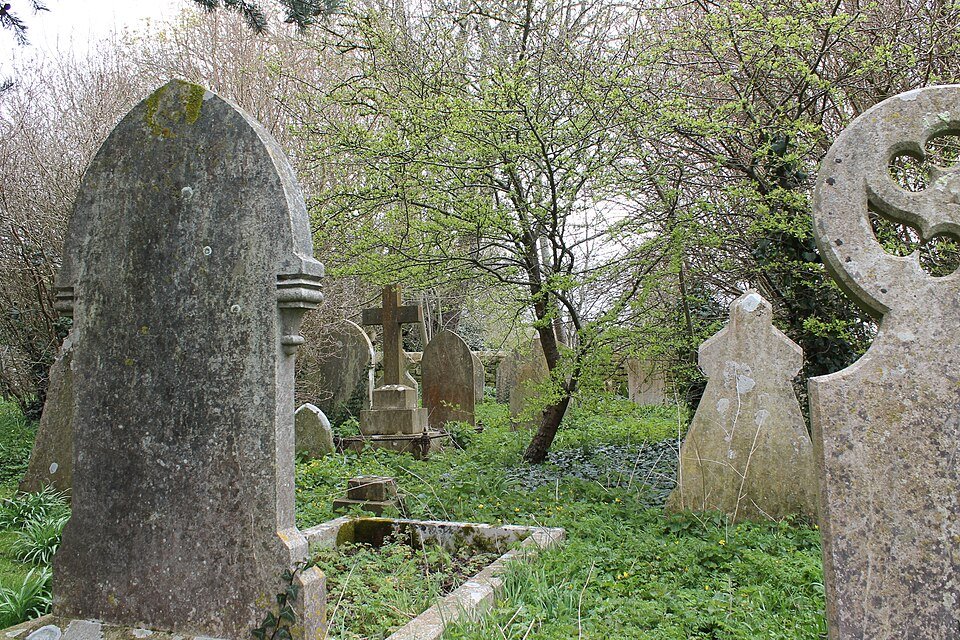
A related national initiative, often referred to as the Living Churchyards and Cemeteries scheme, widens the lens beyond just grass. It encourages local communities to manage a churchyard’s full range of micro-habitats deliberately: grassland left for wildflower meadow, woodland edges, walls, hedges, and shrub patches, and even gravestones themselves, valued for the rare or unusual lichen species that colonize old, undisturbed stone over decades. Sites are sometimes further enhanced with bird and bat boxes or deliberately left woodpiles — treating a churchyard not as one habitat type but as a small mosaic of several, each supporting different wildlife.
The scheme’s own framing captures the mindset shift required: churchyards “have many habitats which can be managed sympathetically for wildlife” — areas of grassland for wildflower meadows, patches of woodland, walls, hedges, shrubs, and gravestones with rare lichen species among them, treated as assets to protect rather than untidiness to correct.
Green-Wood Cemetery’s American Experiment
The same logic has a genuine, active American counterpart. Green-Wood Cemetery in Brooklyn, New York — a 478-acre historic burial ground — runs an experimental meadow project with multiple sections seeded with different combinations of native grasses and wildflowers, specifically designed to test how each mix responds to different mowing pressures. Rather than leaving everything entirely unmanaged, the approach uses one carefully timed annual mow, cut high — 8 to 10 inches — using a weedwacker or hedge trimmer rather than standard mowing equipment, specifically to leave enough plant material behind for nesting pollinator habitat and to preserve seed heads that replenish the meadow’s own seed bank the following year.
What the Data Actually Shows
| Metric | Finding | Source context |
|---|---|---|
| Change in arthropod density | +63% in unmown vs. mown areas | Research cited by the Xerces Society on reduced-mowing meadow management |
| Annual cost savings | ~$2,380 per 5-acre plot per season | City of Newark Parks and Cemetery Department, wildflower meadow conversion |
| Staff time redirected | ~70 hours per season, per plot | Same Newark program calculation |
| UK unimproved grassland lost since 1940s | Over 97% | Caring for God’s Acre / conservation land-use data |
What makes this data genuinely persuasive rather than just feel-good is the cost side of the ledger. A cash-strapped municipal cemetery department has a much easier internal argument to make when reduced mowing isn’t framed purely as an environmental gesture, but as a documented way to cut both mowing labor hours and equipment costs while improving habitat value — a rare case where the economically cheaper option and the ecologically better one point the same direction.
Could Your Local Cemetery Do This?
The barrier to entry for a cemetery or churchyard considering this approach is lower than most habitat restoration projects, precisely because the land is already there, already stable, and often already under-resourced for intensive mowing anyway. The practical starting point mirrors Caring for God’s Acre’s own guidance: identify a section that doesn’t need to look manicured for active grave visitation, reduce mowing frequency there, and — critically — hold off on cutting until seed has set at the end of a growing season, rather than reverting to a standard biweekly mowing schedule out of habit. This is the same underlying principle behind other reduced-intervention approaches this site covers, including No Mow May and the broader case for pesticide-free lawn care — the mechanism (more forage, less disturbance) is identical, only the setting changes.
Frequently Asked Questions
What is Caring for God’s Acre?
A UK national charity, established in 2000, that promotes conservation-minded management of burial grounds across the country, working with more than 25,000 sites.
Why are cemeteries and churchyards good for pollinators specifically?
Because they’ve largely avoided the plowing, herbicide use, and fertilizer application that eliminated most old unimproved grassland elsewhere — over 97% of it has disappeared in the UK since the 1940s.
Is there an American version of this kind of project?
Yes — Green-Wood Cemetery in Brooklyn, New York runs an active experimental meadow project testing native grass and wildflower mixes under different mowing regimes.
Does reduced mowing in cemeteries actually save money?
In at least one documented case, yes — Newark’s Parks and Cemetery Department calculated about $2,380 in annual savings and 70 redirected staff hours per five-acre plot converted to meadow.
When should meadow areas actually be mowed?
After wildflowers have set seed, typically at the end of the growing season — mowing too early, on a standard lawn schedule, can eliminate the wildflowers a meadow restoration is meant to establish.