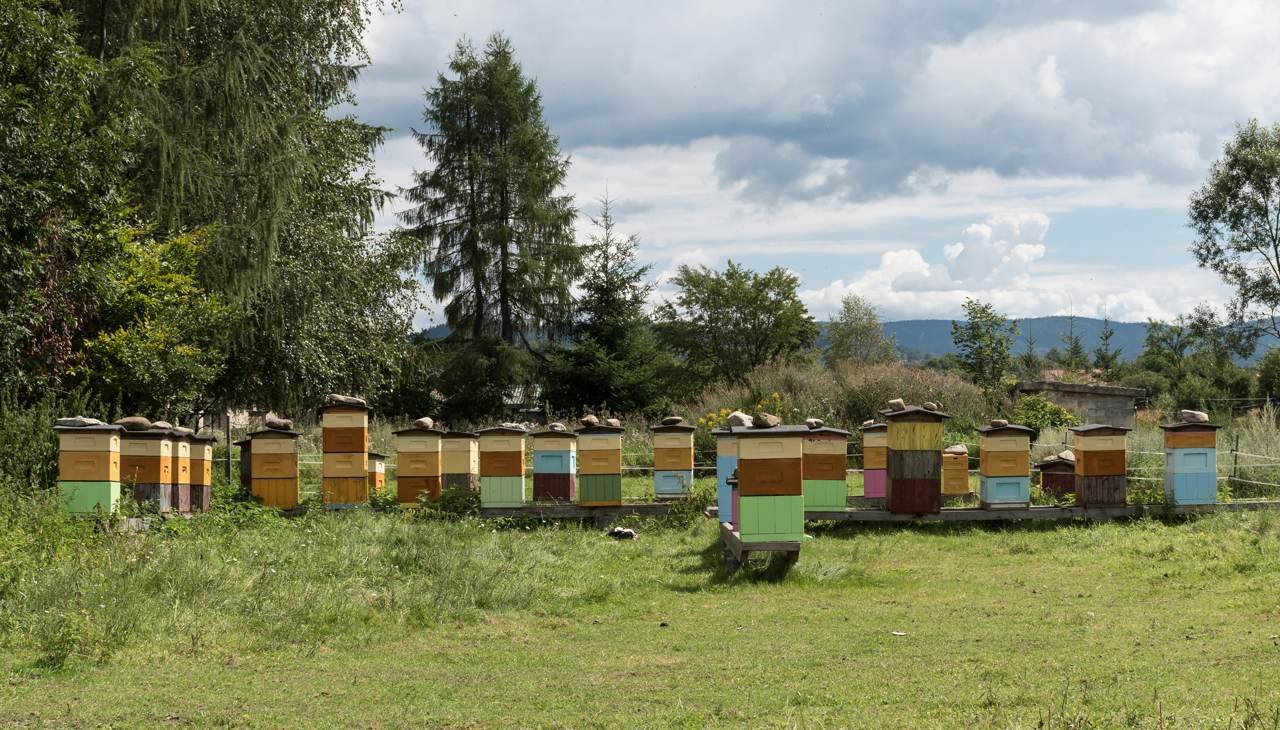
Regenerative apiary siting means treating bee forage the way rotational grazing treats pasture — moving or spreading hives across more than one location so no single patch of land is asked to feed the same colonies, at the same density, year after year. Most beekeeping advice on “choosing a site” only covers the one-time decision of where to first put your hives. This is the part that comes after: what happens to that same land after three, five, or ten seasons of supporting the same bees, and how a genuinely regenerative beekeeper plans around it instead of just hoping the forage holds up.
Key Takeaways
- Honey bees will fly up to about 5 km to forage, but the food that actually sustains a colony through a full season needs to exist within roughly 1 mile (about 1.6 km) of the hive, per Mid-Atlantic Apiculture Research and Extension Consortium (MAAREC) guidance — a much smaller area than the maximum flight range suggests.
- A single fixed apiary site run at high hive density for years can measurably thin out the same nearby bloom it depends on, especially where forage diversity was already narrow to begin with.
- Rotational siting — splitting an operation across two or more yards, or resting a site’s surrounding forage periodically — is the direct beekeeping equivalent of rotational grazing in regenerative agriculture.
- The clearest warning signs of an over-taxed site are declining honey yields at stable colony counts, increased robbing behavior, and bees ranging visibly farther than in prior seasons.
- This is a genuinely different question from “how do I pick a good apiary site” (covered elsewhere on this site) — it’s about what to do with a site you’ve already been using for years.
Table of Contents
- What “Regenerative” Actually Means for Apiary Siting
- The Real Forage-Radius Numbers
- Borrowing “Carrying Capacity” From Range Management
- Signs Your Site Is Being Over-Taxed
- Fixed Single-Site vs. Rotational Siting
- Building a Practical Rotation Plan
- How This Plays Out at Different Operation Sizes
- A Seasonal Rotation Checklist
- Frequently Asked Questions
What “Regenerative” Actually Means for Apiary Siting
In row-crop agriculture, “regenerative” usually means practices like no-till planting, cover cropping, and rotational grazing — all built around the same core idea: don’t extract from the same patch of land at the same intensity indefinitely, because the land’s capacity to keep producing is itself a resource that can be depleted. Beekeeping rarely gets discussed in these terms, but the underlying math is the same. A hive doesn’t just sit on land; it draws down a real, finite quantity of nectar and pollen from everything within its practical foraging range, season after season, from the same surrounding acreage.
Most site-selection advice, including on this site’s own climate-resilient beekeeping practices guide, focuses on picking a good spot once: sun exposure, wind shelter, water access, forage diversity at the time of setup. That’s necessary but incomplete. A genuinely regenerative approach treats the surrounding forage base as a resource to be managed over years, not a fixed asset you evaluate once and then stop thinking about.
The Real Forage-Radius Numbers
Honey bees are capable of flying roughly 5 km (about 3 miles) from the hive to forage, but capability isn’t the same as what actually sustains a colony economically. According to guidance from the Bees for Development Resource Centre, a diverse range of melliferous (nectar- and pollen-producing) flowering plants within a 2–3 km radius is what genuinely supports healthy foraging through a season, and the Mid-Atlantic Apiculture Research and Extension Consortium (MAAREC) is more conservative still, noting that nectar and pollen sources need to be available within roughly 1 mile of the hives throughout the foraging season for a colony to do well without excessive travel cost.
That gap between “can fly 5 km” and “actually needs forage within 1 mile” is the whole problem with treating a single site as a permanent, unlimited resource. Bees will range farther when forage close to home thins out, but foraging farther costs more energy per trip and returns less net nectar — which is exactly the mechanism behind declining yields at an aging, unrotated site, well before the point where a colony would visibly starve.
Borrowing “Carrying Capacity” From Range Management
Range and pasture management has a long-established concept for exactly this problem: carrying capacity, the maximum grazing pressure a given piece of land can sustain indefinitely without degrading. Apiary siting doesn’t have an equally standardized metric, but the underlying idea transfers directly — every site has some practical ceiling on how many colonies it can support at a given forage density before yields per hive start to erode, even if no formal number for that ceiling exists for your specific location. Treating a site as having an assumed unlimited carrying capacity, rather than an unknown-but-real one, is the actual mistake a purely one-time siting decision makes.
This matters more for beekeeping than it might first appear, because unlike a pasture showing visible overgrazing, an over-taxed apiary site gives few visible warning signs at the land level — the flowers are often still there, just supporting more colonies than the surrounding forage base can fully sustain. The signal shows up in colony performance data long before it shows up in the landscape itself, which is exactly why tracking yield per hive by site, described below, matters more here than it would in visibly overgrazed rangeland.
Signs Your Site Is Being Over-Taxed
- Falling honey yields at a stable or growing colony count. If hive numbers haven’t dropped but the crop has, shrinking effective forage radius is one of the more likely explanations, alongside weather and disease.
- More robbing behavior during dearth periods. When nearby forage runs thin, colonies increasingly target each other’s stores instead, which shows up as more frequent robbing incidents at the same site over successive seasons.
- Foragers ranging visibly farther, later in the day. This is harder to observe directly, but longer average foraging trip times (bees leaving earlier, returning later) is a documented behavioral response to local forage scarcity.
- New hives added to the same yard perform worse than the established ones did in their first year. This is one of the more reliable practical signals — it suggests the site itself, not the bees, has changed.
Fixed Single-Site vs. Rotational Siting
| Factor | Fixed Single-Site Apiary | Rotational / Multi-Site Apiary |
|---|---|---|
| Forage pressure over time | Concentrated on the same acreage every season; risk compounds year over year | Spread across two or more locations, allowing each site’s forage to recover between heavy-use periods |
| Setup and access effort | Lower — one location to maintain, inspect, and secure | Higher — requires a second (or third) site, transport, and often a host-land agreement |
| Resilience to a local bad season | Low — a local forage failure, spray event, or land-use change affects the whole operation | Higher — a problem at one site doesn’t necessarily hit colonies at another |
| Best suited for | A hobbyist with 1–3 hives on genuinely forage-rich land with no density pressure | Sideliners and growing operations, or any site already showing over-taxed signs above |
| Regenerative framing | Comparable to continuous, unrotated grazing on one pasture | Comparable to rotational grazing — deliberately resting land between use cycles |
Building a Practical Rotation Plan
A rotation plan doesn’t require a large operation or many locations — even a two-site rotation is a meaningful improvement over a single permanent yard for anyone running enough hives to notice density pressure. The practical steps:
- Map real forage within 1 mile of each candidate site, not just what’s visible from the yard itself — a windshield survey of bloom in the surrounding square mile through a full season is worth more than a single spring assessment.
- Track yield per hive by site and by year, not just total operation yield. A slow per-hive decline at one site, isolated from overall numbers, is the earliest real signal that a rotation is overdue.
- Identify a genuine second site before you need one — a host-land agreement with a neighboring farm, orchard, or landowner, arranged well ahead of the season it’s needed, rather than scrambled together after yields have already dropped.
- Rotate on a multi-year cycle, not a seasonal one. Forage recovery for a heavily-foraged patch is a multi-season process, not something that resets over a single winter.
- Stagger hive density rather than moving everything at once if a full second site isn’t realistic yet — even reducing colony count at a pressured site while a second location gets established spreads the load.
AgriFutures Australia’s Honey Bee & Pollination Program covers the underlying site-selection factors that any rotation plan still needs to get right at each location — forage diversity, water access, and sun exposure — in the short video below.
“Availability of plentiful forage over the whole season is critically important for the bees and for beekeepers who hope to make a honey crop.” — Bees for Development Resource Centre
How This Plays Out at Different Operation Sizes
A backyard beekeeper with two or three hives on a suburban quarter-acre is very unlikely to personally exhaust the forage within a mile — there’s usually enough residential landscaping, street trees, and neighboring gardens to support a small colony count almost indefinitely without deliberate rotation. The calculation changes once an operation reaches the point where multiple beekeepers, or one beekeeper’s growing hive count, are drawing on the same limited forage base — a common small-farm or community-apiary scenario. At that scale, informal coordination (simply knowing how many other hives already sit within range) becomes as important as anything done at your own site, since carrying capacity is a property of the land and forage, not of any one beekeeper’s operation alone.
A sideliner running 20–50 hives across what was originally a single yard is the most common case where rotation stops being optional and starts being the actual determinant of whether yields hold steady year over year. This is also the point where a second host-land agreement, arranged with a neighboring farm or landowner well before it’s urgently needed, pays for the modest extra transport and coordination effort many times over in avoided yield decline.
A Seasonal Rotation Checklist
- Early spring: walk each site’s 1-mile radius and note what’s actually blooming, not what bloomed last year.
- Mid-season: log per-hive weight or yield trends at each site separately.
- Late season: compare this year’s per-hive numbers at each site against its own prior years — not against other sites, which may differ for unrelated reasons.
- Off-season: if any site shows two consecutive years of decline unrelated to weather or disease, plan a rotation or density reduction before the next active season, not during it.
Frequently Asked Questions
How many hives can one site actually support before forage becomes a problem?
There’s no single number — it depends entirely on local forage diversity and density within about a mile of the site. The more useful practice is tracking per-hive yield over multiple years at the same site rather than relying on a fixed hive-count rule of thumb.
Is forage rotation only relevant for commercial or migratory beekeepers?
No — a hobbyist with a handful of hives on a small or forage-limited property can see the same per-hive decline over years that a larger operation would, just at a smaller scale. The principle scales down; a “second site” for a hobbyist might just mean a friend’s larger property a few miles away.
How is this different from just picking a good apiary site in the first place?
Initial site selection is a one-time decision made with the information available at setup. Forage rotation is an ongoing management practice that assumes even a well-chosen site’s surrounding forage capacity can change over years of use, and plans for that ahead of time.
What’s the fastest sign that a site needs to be rotated or rested?
A declining yield per hive at a stable colony count, isolated to one site, checked against that site’s own prior-year numbers rather than compared to other locations.
Can planting more forage at the existing site solve the problem instead of rotating?
It can help, but it’s not a full substitute — adding forage takes seasons to establish and still concentrates all colony pressure in one place. Combining added plantings with at least a partial rotation or density reduction is more resilient than relying on new plantings alone.
For the underlying site-selection factors this rotation planning builds on, see MAAREC’s apiary location guidance.