NASA has sent bees into orbit at least four separate times since 1982, and the results range from a genuine failure that killed every bee aboard to a successful demonstration that honeybees can build normal honeycomb in zero gravity. These are real, documented spaceflight experiments — not a thought experiment — and they’ve quietly shaped what’s known about how insects handle weightlessness.
Key Takeaways
- The first attempt, aboard Space Shuttle Columbia’s STS-3 mission in March 1982, ended badly: all 14 honeybees aboard died before returning to Earth, after post-flight analysis found their sugar-water solution had been diluted too much for them to get adequate nutrition in microgravity.
- Two years later, STS-41-C (April 1984) succeeded where STS-3 failed: 3,300 honeybees built normal, well-formed honeycomb in orbit, and the colony’s queen laid 35 eggs — though none hatched, likely due to temperature control problems aboard the module.
- A planned carpenter bee experiment, designed by Liechtenstein students to study whether bees would chew differently shaped tunnels in zero gravity, was lost entirely in the Space Shuttle Columbia disaster on February 1, 2003 (STS-107), which killed all seven crew members and ended the experiment before it produced any data.
- The most recent bee spaceflight experiment, aboard SpaceX CRS-15 in June 2018, sent five alfalfa leafcutting bee cocoons to the International Space Station — designed entirely by Team NESS, a group of Illinois high school students, to study flight patterns and movement once the bees emerged in microgravity.
- None of these experiments involved keeping bees in orbit permanently or as part of any operational space program — each was a short-duration science payload, most lasting under a month.
Table of Contents
- 1982: The First Attempt Ends in Failure
- 1984: Honeycomb Built in Zero Gravity
- 2003: An Experiment Lost With Columbia
- 2018: High Schoolers Send Bees to the ISS
- Why NASA Actually Studies Bees in Microgravity
- All Four Missions, at a Glance
- Frequently Asked Questions
1982: The First Attempt Ends in Failure
The first bees in space flew aboard Space Shuttle Columbia’s STS-3 mission in March 1982, as part of a NASA-sponsored student research program (NASA and the National Science Teachers Association ran a “Shuttle Student Involvement Project” that flew several youth-designed science experiments). Fourteen worker honeybees were sent up specifically to observe insect flight behavior in weightlessness. The mission didn’t go as planned: all fourteen bees died before the shuttle returned to Earth. The post-flight analysis, documented in NASA’s own technical report on the experiment, attributed the deaths to an overly diluted sugar-water solution that left the bees without adequate nutrition, combined with habitat and food-access design issues rather than any fundamental problem with bees surviving microgravity itself.
1984: Honeycomb Built in Zero Gravity
Two years later, NASA tried again with a much larger, better-designed experiment aboard STS-41-C, flown on Space Shuttle Challenger in April 1984. This time, 3,300 honeybees flew in a purpose-built enclosure, and the results were genuinely striking: the colony built honeycomb structures that were essentially indistinguishable from normal comb built under Earth gravity, demonstrating that bees don’t need gravity as a reference to construct the hexagonal comb geometry they’re known for. The colony’s queen even continued laying eggs in orbit — 35 of them — though none successfully hatched, an outcome researchers attributed most likely to temperature regulation problems in the flight hardware rather than gravity itself. Compared to the STS-3 failure two years earlier, this mission is generally treated as the real proof that honeybees can survive and function in orbit under the right conditions.
2003: An Experiment Lost With Columbia
Not every bee spaceflight experiment produced data — one of them ended in tragedy before it could. STS-107, the final flight of Space Shuttle Columbia, carried a student-designed payload as part of an international education program (the Space Technology and Research Students initiative, with contributing student teams from Australia, China, Israel, Japan, Liechtenstein, and the United States). Among those experiments was one designed by students at a Liechtenstein secondary school to study carpenter bees — insects that don’t build hives but instead chew narrow tunnels into wood to house their eggs — testing whether the tunnels they excavated in microgravity would differ in shape from tunnels built on Earth. The experiment was scheduled to run 15 days. It never returned any results: Columbia disintegrated during reentry on February 1, 2003, killing all seven crew members. The loss is remembered first and foremost as a human tragedy, and the incomplete bee experiment is a small, secondary footnote to it — but it’s a real part of this history, and the only one of these four missions where no scientific outcome was ever recorded.
2018: High Schoolers Send Bees to the ISS
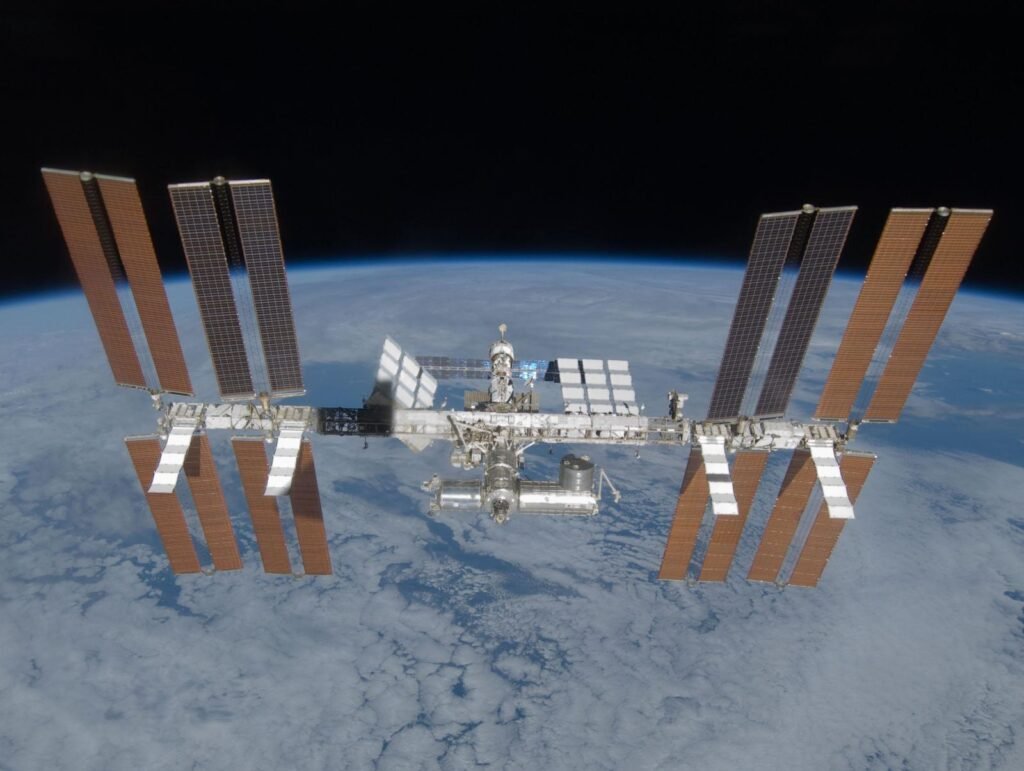
The most recent chapter is also the most unusual: NASA and SpaceX’s CRS-15 cargo resupply mission, launched June 29, 2018, carried five alfalfa leafcutting bee (Megachile rotundata) cocoons to the International Space Station — an experiment designed entirely by Team NESS, a group of high school students from Illinois. The bees, still in cocoon form at launch, were expected to emerge once aboard the station, and cameras aboard the ISS documented their movement, flight patterns, and general behavior in microgravity over roughly a month, giving researchers (and the student team itself) direct video observation of how a solitary, non-colonial bee species — genuinely different from the honeybees flown in the 1980s missions — adapts its flight and orientation without gravity to reference. The project ran through the ISS National Lab’s education pipeline, which regularly flies student-designed experiments to the space station as a genuine, functioning research platform rather than a symbolic gesture.
Why NASA Actually Studies Bees in Microgravity
These experiments aren’t just novelty payloads. Understanding how insects that rely on gravity-referenced behaviors — building geometrically precise comb, navigating by sensing “up” and “down,” coordinating flight — adapt to its complete absence has real value for basic biology and for any future plan involving long-duration life support or closed ecological systems in space. Bees are also simply a well-understood, well-studied model organism on Earth, which makes any behavioral change observed in orbit easier to interpret against a large existing body of ground-based research. The heavy involvement of student teams across several of these missions (the STS-107 Liechtenstein students, Team NESS in 2018) also reflects a real, intentional NASA education strategy — flying genuine, unmodified science experiments designed by young researchers, not simplified demonstrations, as a way to build real scientific literacy rather than just marketing interest in space.
Interestingly, despite this decades-long history of flying real bees to orbit, current practical space-agriculture research takes a different, more cautious approach for actual food production. Researchers designing crop lists for long-duration bioregenerative life-support systems — the kind that would let astronauts grow real food on the way to Mars or on a lunar base — have deliberately favored crops that don’t need insect pollination at all: self-pollinating grains like wheat, rice, and barley, and root crops like sweet potatoes. When a flowering crop that does need pollination is grown, astronauts currently pollinate it by hand, using a small brush or by gently shaking the plant to distribute pollen, rather than maintaining a live pollinator population. It’s a pragmatic choice given how much can go wrong keeping any live animal population healthy in a spacecraft, as the 1982 bee mortality shows — though some researchers have floated the idea that a future long-duration greenhouse could eventually justify the added complexity of real bees again.
All Four Missions, at a Glance
| Mission | Year | Species / count | Outcome |
|---|---|---|---|
| STS-3 (Columbia) | 1982 | 14 honeybees | All 14 died — diluted sugar solution, inadequate nutrition |
| STS-41-C (Challenger) | 1984 | 3,300 honeybees | Built normal honeycomb; queen laid 35 eggs (none hatched) |
| STS-107 (Columbia) | 2003 | Carpenter bees | Lost in the Columbia disaster; no data ever recorded |
| SpaceX CRS-15 (ISS) | 2018 | 5 alfalfa leafcutting bee cocoons | Emerged and were observed via camera for about a month |
Frequently Asked Questions
Has NASA actually sent bees into space?
Yes, at least four separate times: 1982 (STS-3, 14 honeybees, all died), 1984 (STS-41-C, 3,300 honeybees, successfully built honeycomb), 2003 (STS-107, carpenter bees, lost in the Columbia disaster before producing data), and 2018 (SpaceX CRS-15, five leafcutting bee cocoons sent to the ISS).
Can bees build honeycomb in zero gravity?
Yes — the 1984 STS-41-C mission demonstrated this directly. The 3,300 honeybees aboard built comb that was essentially indistinguishable from comb built under normal Earth gravity, showing that bees don’t rely on gravity as a reference for the hexagonal geometry of comb construction.
Did any bees die during NASA’s space experiments?
Yes. All 14 honeybees aboard the 1982 STS-3 mission died before the shuttle returned to Earth, due to a sugar-water solution that was diluted too much to provide adequate nutrition in microgravity — a design and habitat problem rather than a fundamental barrier to bees surviving spaceflight, as the 1984 mission’s success later showed.
What happened to the carpenter bee experiment on the Columbia disaster mission?
It was never completed. The experiment, designed by Liechtenstein secondary school students to study whether carpenter bees would bore differently shaped tunnels in microgravity, was aboard Space Shuttle Columbia when it disintegrated during reentry on February 1, 2003, killing all seven crew members. No data from the experiment was ever recovered.
Who designed the most recent bee spaceflight experiment?
Team NESS, a group of high school students from Illinois, designed the 2018 experiment that sent five alfalfa leafcutting bee cocoons to the International Space Station aboard SpaceX’s CRS-15 cargo mission, studying the bees’ flight and movement patterns once they emerged in microgravity.
Why does NASA study bees specifically, rather than other insects?
Bees are an unusually well-studied model organism on Earth, which makes it easier to interpret any behavioral changes observed in microgravity against a large existing body of ground research. Their gravity-referenced behaviors — precise comb geometry, orientation, and flight coordination — also make them a genuinely useful test case for how insects adapt to weightlessness.
This is covered in more depth by the Smithsonian National Air and Space Museum.