Beekeeping west of the Cascades comes down to one variable almost every other U.S. region doesn’t have to manage as its primary threat: persistent winter and spring moisture, not cold. Puget Sound, the Willamette Valley, and the coastal strip from Bellingham to Eugene rarely see the deep sustained freezes that define Upper Midwest or mountain-climate beekeeping, but they do deliver five to seven months a year of grey, wet, low-light weather that keeps colonies clustered, prevents cleansing flights, and can rot out a poorly ventilated hive faster than cold ever would. Get moisture management and the region’s oddly-timed nectar calendar right, and Pacific Northwest colonies are genuinely easier to overwinter than most; get either wrong, and a hive can look fine at Thanksgiving and be a puddle of mold by February.
This guide covers what actually distinguishes maritime Pacific Northwest beekeeping from the rest of the country: the real moisture-versus-cold distinction, the region’s specific nectar flow calendar (including the spring dearth almost nobody warns new beekeepers about), a regional pollination opportunity most general beekeeping content never mentions, how bee stock choice plays out in a cool damp climate, and why “Pacific Northwest” beekeeping advice changes completely the moment you cross the Cascades.
Key Takeaways
- The defining challenge west of the Cascades is moisture control during a long, mild, wet winter — not cold tolerance, which matters far less here than in the Midwest or mountain West.
- The region has a distinct nectar flow calendar: hazelnut catkins in mid-February, bigleaf maple in early spring, a real spring dearth in April into early May, a strong Himalayan blackberry flow from late May through July, and fireweed carrying many hives through August.
- Oregon’s Willamette Valley grows roughly 90% of the world’s commercial meadowfoam crop, and it requires honey bee pollination at contracted rates — a genuine regional income and forage opportunity most beekeeping guides never mention.
- “Pacific Northwest climate” usually means the wetter, milder area west of the Cascade crest; the high-desert country east of the Cascades is a different climate entirely, closer to the short-summer, cold-winter zone than to Puget Sound or the Willamette Valley.
- Research on warming autumns and winters shows longer bee flight seasons can skew overwintering colonies toward an older bee population and raise spring-loss risk — a trend regional beekeepers are already watching, not just a future concern.
Table of Contents
- Moisture, Not Cold: The Region’s Real Winter Challenge
- The Pacific Northwest Nectar Flow Calendar
- The Spring Dearth Nobody Warns New Beekeepers About
- Meadowfoam: A Regional Pollination Opportunity
- Choosing Bee Stock for a Cool, Wet Climate
- West of the Cascades vs. East of the Cascades
- Wildfire Smoke and Late-Summer Considerations
- Local Associations and Extension Resources
- Frequently Asked Questions
Moisture, Not Cold: The Region’s Real Winter Challenge
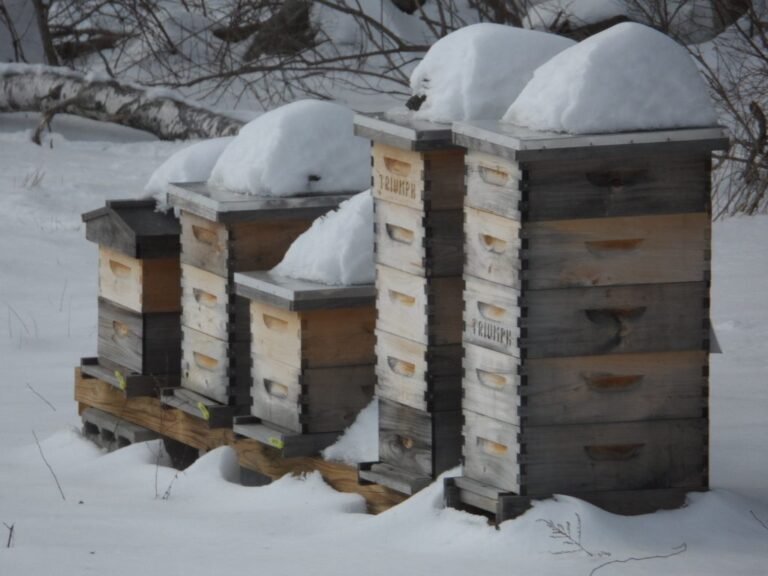
West-side Pacific Northwest winters are mild by national standards — Seattle and Portland both average lows in the upper 30s°F, and hard sub-20°F stretches are the exception, not the rule. That mildness is exactly what makes the region deceptive for beekeepers moving here from colder states: the instinct is to prepare for cold, when the actual killer is trapped condensation. A cluster that survives -20°F in Minnesota with a dry cavity can die from chilled, waterlogged bees in a 35°F Seattle hive where warm, moist air rising from the cluster condenses on a cold inner cover and drips back down onto the bees.
The practical response regional beekeepers converge on is largely the same regardless of hive style: elevate hives well off wet ground on stands, tilt them slightly forward so any condensation runs out the entrance rather than pooling on the bottom board, and prioritize upper ventilation — a moisture quilt, an upper entrance, or a simple shim with an absorbent material — over insulation alone. Wrapping a hive tightly without addressing airflow can make the moisture problem worse, not better, by sealing humid air inside. Because the region’s overcast stretches can run for a week or more without a single flight day, feeding fondant or dry sugar through late winter is common practice here even in years that never get seriously cold, simply because prolonged no-fly weather burns through stores that a shorter, colder-but-clearer winter elsewhere wouldn’t.
This isn’t just anecdotal regional practice — it tracks with a broader pattern researchers are now documenting. A study on warming autumns and winters found that as flight-permissive weather extends later into the year, the overwintering cluster’s age structure skews toward older foragers, which correlates with higher spring colony loss even when the winter itself wasn’t unusually cold (Overwintering Honey Bee Colonies research, PMC). A mild, foraging-friendly Pacific Northwest winter with sporadic warm breaks is close to the exact pattern that study describes — one more reason regional beekeepers should think about the cluster’s age and food security through the whole wet season, not just its cold tolerance in January.
The Pacific Northwest Nectar Flow Calendar
The maritime Northwest’s nectar calendar doesn’t follow the generic “spring buildup, summer flow, fall dearth” pattern taught in most beginner beekeeping material — it has its own distinct rhythm shaped by an unusually early start and a mid-spring gap.
| Timing | Forage source | Notes |
|---|---|---|
| Mid-to-late February | Hazelnut catkins | Wind-pollinated, but a genuinely useful early pollen source after a long dearth; Oregon’s Willamette Valley is a major U.S. hazelnut-growing region. |
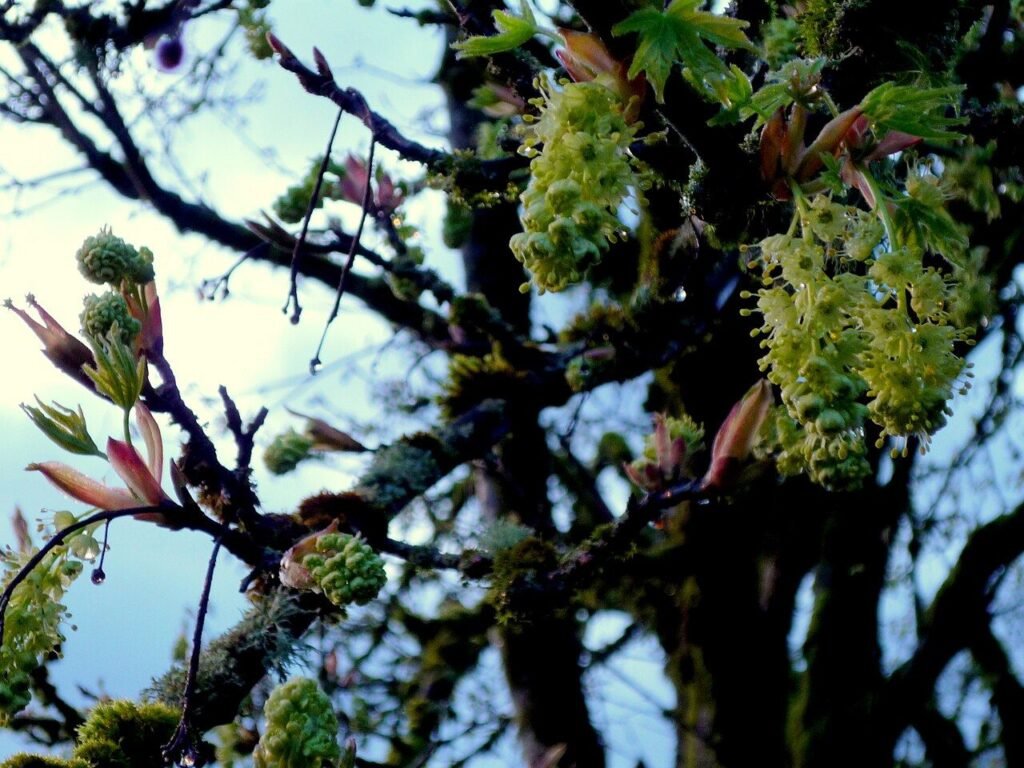
| Late February–March | Bigleaf maple | One of the region’s most significant early nectar sources; a strong bloom can produce a light, mild honey and jump-starts colony buildup. |
| April–early May | Spring dearth | A real gap between the maple flow ending and blackberry starting — see below. |
| Late May–July | Himalayan blackberry | The region’s most reliable major flow; wild blackberry grows so densely along roadsides and forest edges that most U.S. blackberry honey comes from here. |
| Late June–mid-August | Fireweed | Often the season’s final significant flow; some beekeepers move hives toward clear-cuts and hillsides specifically to work it. |
| Into late October | English ivy (urban areas) | An invasive ornamental, but a genuinely useful late-season pollen and nectar source for urban and suburban hives. |
Two things are worth noting about this calendar. First, several of its biggest flows — blackberry especially — are weather-dependent in a way that can catch beekeepers off guard: a stretch of unusually dry years from 2017 through 2019 caused blackberry nectar flow failures across parts of the region, cutting honey production in years that looked, on paper, like they should have been strong (documented by regional beekeeping clubs tracking multi-year flow data). Second, the calendar is genuinely different on the coast versus inland valleys versus higher elevations, so a beekeeper’s own multi-year notes on bloom timing for their specific yard will always beat a generic regional calendar — this one is a starting point, not a substitute for local observation.
The Spring Dearth Nobody Warns New Beekeepers About
New Pacific Northwest beekeepers are usually warned about winter moisture. They’re rarely warned about the April-to-early-May gap that follows it — and it catches more first-year colonies off guard than winter itself. Once the bigleaf maple flow tapers off, there’s frequently a multi-week stretch before blackberry gets going in earnest, and colonies that built up aggressively on a strong maple flow can burn through stores fast during this window, particularly if late-season cold snaps or extended rain (both common in a Pacific Northwest April) shut down flying on top of the forage gap.
The practical fix is straightforward but easy to skip: check stores by hefting the hive (or doing an actual frame-by-frame inventory) in mid-to-late April rather than assuming a colony that looked strong in March is still fine six weeks later, and be ready to feed 1:1 syrup or provide drawn comb of stores if the colony is light going into May. This single gap — more than winter cold, and arguably more than any other single factor — is where colonies that survived the wet season are lost heading into what should be the easiest part of the year.
Meadowfoam: A Regional Pollination Opportunity Most Guides Never Mention
This is the detail that most general “beekeeping by region” content simply doesn’t have, because it’s genuinely specific to this one valley: Oregon’s Willamette Valley produces roughly 90% of the world’s commercial meadowfoam (Limnanthes alba) seed crop, grown for a specialty oil used in cosmetics. Meadowfoam is entirely bee-pollinated — it sets essentially no seed without insect pollination — and growers typically contract around two honey bee colonies per acre during its narrow two-to-four-week bloom window in May and early June, according to Oregon State University Extension’s own pollination research (OSU Extension EM 8666, Pollination and Seed Set in Meadowfoam).
For a Willamette Valley beekeeper, that’s a real, findable local pollination-contract opportunity that doesn’t show up in national almond- or blueberry-focused pollination guides — and even for a beekeeper who never takes a meadowfoam contract, it’s worth knowing the crop is there: it blooms right in the middle of the region’s spring dearth window described above, and a nearby meadowfoam field can measurably ease that gap for colonies within flight range. The honey itself is distinctive too — beekeepers who do work meadowfoam describe it as having a soft, almost marshmallow-like flavor, different from anything else on the region’s forage calendar. This is exactly the kind of concrete, checkable local detail worth confirming directly with OSU Extension or a Willamette Valley grower cooperative before assuming availability in any given year, since acreage planted varies with seed-oil market demand.
Choosing Bee Stock for a Cool, Wet Climate
There’s no honey bee subspecies formally bred or certified specifically for “Pacific Northwest conditions,” and any claim otherwise should be treated skeptically. What regional beekeepers do report, consistently enough to be worth mentioning, is that Carniolan-derived stock tends to build up explosively on an early maple flow and forages in cooler, damper conditions somewhat more readily than some other lines, while Russian-derived stock is often chosen specifically for cooler, wetter climates and tends toward more conservative early buildup — which can actually be an advantage given the region’s real spring dearth described above, since a colony that doesn’t over-expand on the maple flow has less mouths to feed through the gap that follows it. Italian stock remains widely kept in the region too and performs fine, though beekeepers sometimes note it can be slower to shut down brood rearing heading into the wet season, which matters more for winter stores management than for survival itself.
None of this amounts to a strict rule, and locally-adapted survivor stock from an established regional queen breeder — selected over multiple seasons for actually wintering well in local conditions, moisture tolerance included — will generally outperform any generalization about subspecies. Buying nucs or queens from a breeder operating in the same maritime climate, rather than importing stock bred for a hot, dry, or continental-cold region, is the more reliable strategy than picking a race off a chart.
West of the Cascades vs. East of the Cascades
“Pacific Northwest beekeeping” almost always means the mild, wet, maritime climate described throughout this guide — Puget Sound, the Willamette Valley, and the coastal strip — because that’s where most of the region’s commercial and hobbyist beekeeping actually happens. But the Cascade crest marks a genuine climate boundary, not just a scenic one. East of the Cascades, in Washington’s Columbia Basin and Oregon’s high desert country, the climate flips to dry, higher-elevation, and far more seasonally extreme, with real cold winters and low year-round precipitation. Forage there shifts accordingly — bitterbrush and rabbitbrush rather than blackberry and fireweed — and the operative beekeeping challenges (winter cold tolerance, minimal rather than excess moisture, irrigation-dependent agricultural forage) look much closer to the short-summer, cold-winter mountain-climate pattern than to anything described in this guide. A beekeeper relocating from Seattle to Bend or Spokane should treat it as a genuinely different climate zone requiring different preparation, not a minor variation on the same regional advice.
Wildfire Smoke and Late-Summer Considerations
Late-summer wildfire smoke has become a recurring feature of Pacific Northwest beekeeping in recent years, and it overlaps directly with the tail end of the fireweed flow described above. Oregon State University’s Forestry Extension notes that smoke can interfere with the polarized-light navigation bees use to orient themselves and can trigger colonies to treat heavy smoke as a fire-danger signal, reducing foraging activity and prompting defensive clustering behavior even when the actual fire is many miles away (OSU Extension, How Do Wildfires Affect Bees?). Practically, this means a run of heavy smoke days in August or September can cost a colony real foraging time during what’s otherwise a productive stretch, on top of whatever direct air-quality stress it adds. There’s no special hive modification that fixes this — the standard response is simply to make sure colonies go into a smoky stretch with adequate stores already on hand, the same way they’d need to going into any other multi-day no-fly period, and to avoid unnecessary hive manipulation on the worst air-quality days.
Local Associations and Extension Resources
Because bloom timing, moisture severity, and even blackberry flow strength vary meaningfully within the region year to year, connecting with local, current information beats relying on any general guide, including this one. Washington State University runs an active WSU Bee Program with regional extension offices, and has partnered with county beekeeping associations in Lewis, Snohomish, and Walla Walla counties to offer apprentice-level courses through the Washington State Beekeepers Association’s Master Beekeeper Program. Oregon State University Extension similarly publishes region-specific beekeeping and pollination research, including the meadowfoam study referenced above. Local clubs — Puget Sound Beekeepers Association, the Oregon State Beekeepers Association, and county-level clubs throughout both states — are typically the fastest way to get current, hyperlocal answers on this year’s bloom timing, since they track conditions in real time in a way no static guide can.
For the legal side in Idaho, see Idaho beekeeping laws and registration.
Frequently Asked Questions
Is the Pacific Northwest a good climate for beekeeping?
Yes, generally. Mild winters mean less cold-tolerance pressure than in the Midwest or mountain West, and the region has a genuinely strong nectar calendar from bigleaf maple through blackberry and fireweed. The trade-off is that winter and spring moisture management takes the place of cold tolerance as the main seasonal challenge.
Do Pacific Northwest bees need less winter preparation than colder regions?
They need different preparation, not necessarily less. Ventilation and moisture control typically matter more here than insulation against cold, and the region’s long stretches of flightless, overcast weather mean stores can run low even in a winter that’s never seriously cold.
What’s the biggest nectar flow in the Pacific Northwest?
Himalayan blackberry is generally the region’s most significant and reliable flow, running from late May through July, though it can fail in unusually dry years — as happened across parts of the region from 2017 through 2019.
Is beekeeping different on the coast versus the Willamette Valley versus east of the Cascades?
Yes. Coastal and Puget Sound/Willamette Valley beekeeping share the same general mild, wet maritime pattern described in this guide. East of the Cascades is a genuinely different, dry, higher-elevation climate with cold winters and different forage, closer to a short-summer mountain-climate pattern.
Can hobbyist beekeepers get involved in meadowfoam pollination in Oregon?
It’s worth asking. Willamette Valley meadowfoam growers contract pollination at roughly two colonies per acre during the May–early June bloom window; availability and grower contacts vary by year, so contacting OSU Extension or a local grower cooperative directly is the way to find current opportunities.
Related Reading
Image credits: Photo: Chris Light, CC BY-SA 4.0, via Wikimedia Commons.