
Last Updated September 16, 2026
The Bee Buddy is a real, patented Australian device — but it is not a lever-operated machine that lifts a whole loaded super off the ground. It’s a wheeled inspection-and-extraction trolley built to keep honey frames off your back and off the ground entirely, so you never have to bend, carry, or set a loaded frame down in the first place. That distinction matters, because “hive lifter” searches usually turn up a different category of product entirely, and the two get confused constantly — including, it turns out, in earlier coverage on this page.
Key Takeaways
- The Bee Buddy is made by Bees & Trees Nominees in Australia (patent application PCT/AU2022/051014) — a mobile trolley for inspection, extraction, and frame storage, not a device that hoists a full super off the ground.
- A separate, unrelated US product called the Beehive Lifter (beehivelifters.com, Corcoran, MN) is the device that actually does that job — a two-wheeled, lever-and-crank hand truck priced $1,250–$1,850 that rolls under a hive and lifts entire boxes.
- A full deep super can weigh 80–100 lbs; a medium runs 50–60 lbs and a shallow 35–40 lbs — the real reason any of this equipment exists.
- Michigan State University’s AgrAbility program has built free, open-source lifting devices for injured and disabled beekeepers, including a 300-lb-capacity self-propelled lifter and a battery-winch swarm trap lifter built for Heroes to Hives instructor Gary Brown.
- Neither product’s price is one-size-fits-all: the Bee Buddy’s cost isn’t publicly listed and ships from Australia; the Beehive Lifter ships across the US and Canada with a 10-year warranty.
Table of Contents
- What the Bee Buddy Actually Is
- How It Works and What It’s Designed For
- Bee Buddy vs. “Beehive Lifter”: Two Different Tools, Often Confused
- Why Hive-Lifting Equipment Exists: The Real Weight Numbers
- The Beehive Lifter: Specs, Price, and Capacity
- University and Nonprofit-Built Alternatives
- Cost vs. Injury-Prevention Value
- Who Should Consider Which Option
- Availability and Buying Considerations
- Common Mistakes
- FAQ
What the Bee Buddy Actually Is
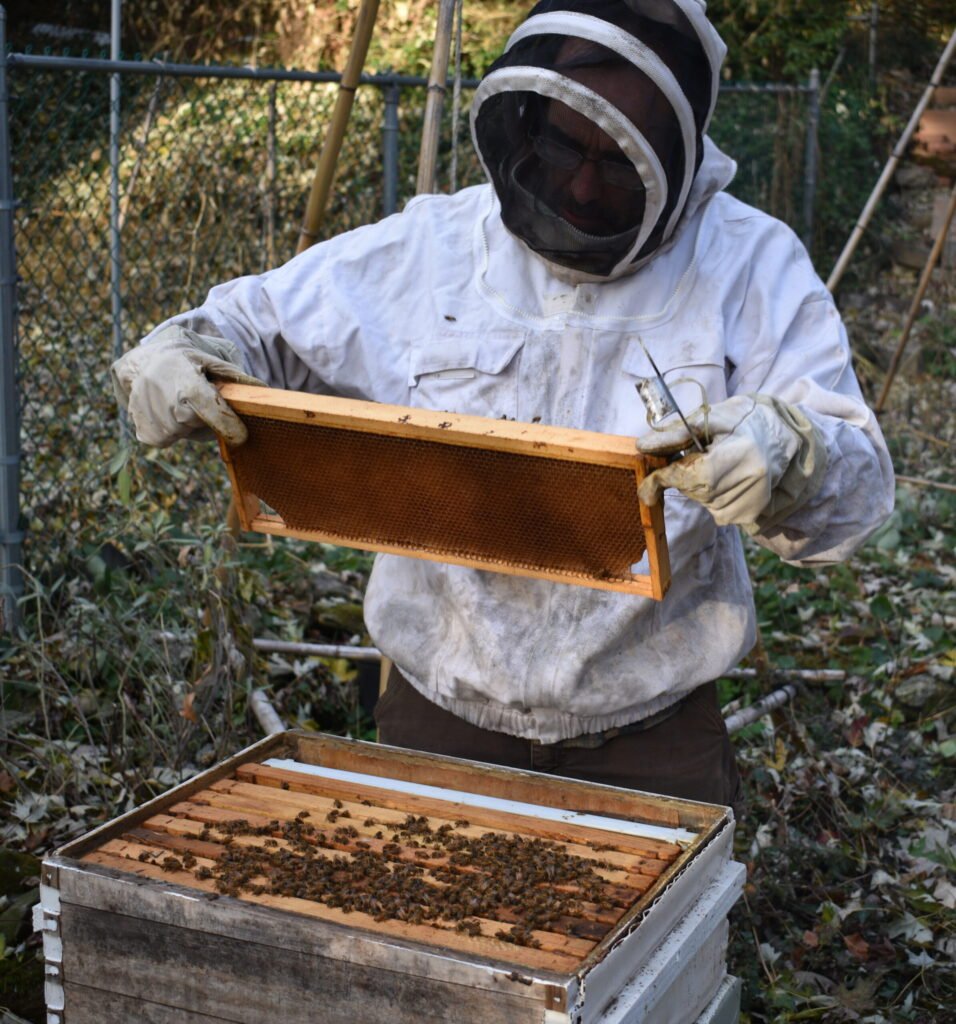
The Bee Buddy is manufactured by Bees & Trees Nominees, an Australian company operating as thebeebuddy.com.au, and covered by international patent application PCT/AU2022/051014. It’s described by the manufacturer as an all-in-one mobile inspection and extraction trolley: frames come out of the hive, go straight into an airtight compartment on the trolley, and stay upright and secured through inspection, transport, uncapping, and extraction — whether you’re running a manual or electric extractor, and whether you’re processing one frame or thirty. The manufacturer states explicitly that it is not designed to be used as a hive body itself.
How It Works and What It’s Designed For
Bees & Trees Nominees markets the Bee Buddy around a specific occupational-health argument: it’s built to remove the lifting, twisting, and carrying motions involved in pulling frames, moving them to a processing area, and setting them back down — the same repetitive strain that a growing number of beekeeping-adjacent disability and veteran programs (see our guide to adaptive equipment for beekeeping with limited mobility) are specifically trying to design around. Beyond inspection and extraction, the manufacturer lists hive relocation and swarm collection as additional uses, plus a biosecurity-oriented design intended to simplify colony health checks and reduce cross-contamination risk between hives — relevant if you’re also managing emerging mite threats that spread partly through shared equipment.
Bee Buddy vs. “Beehive Lifter”: Two Different Tools, Often Confused
Here’s the source of the confusion: a completely separate US product is actually called the “Beehive Lifter,” made by a small manufacturer in Corcoran, Minnesota, and it does the job most people picture when they search for a “hive lifter” — rolling under an entire loaded box and cranking or button-lifting the whole thing off the stack, no frame-by-frame handling involved. The two products solve adjacent but different problems, and neither is a substitute for the other.
| Factor | Bee Buddy | Beehive Lifter |
|---|---|---|
| What it lifts | Individual frames, into a trolley compartment | An entire loaded super or hive body at once |
| Primary use case | Inspection, extraction, frame storage | Repositioning/stacking whole boxes on a stand or trailer |
| Manufacturer & origin | Bees & Trees Nominees, Australia | Beehive Lifters, Corcoran, MN, USA |
| Published price | Not publicly listed | $1,250 (manual) – $1,850 (electric, extra-tall) |
| Rated capacity | Not applicable (frame-based, not whole-box) | 250 lbs (300 lbs with optional rails) |
Why Hive-Lifting Equipment Exists: The Real Weight Numbers
Both products exist because of the same underlying problem: honey is heavy, and beekeeping involves lifting it repeatedly, in awkward postures, often for an entire harvest season at a time. A fully loaded deep super commonly weighs 80–100 lbs; a medium super runs 50–60 lbs, and a shallow around 35–40 lbs. Individual frames add up fast too — a single frame can carry several pounds of bees, honey, and comb, and a full inspection means pulling and replacing many of them by hand, one at a time. That cumulative strain is well documented as a source of real back, shoulder, and hand injury among beekeepers managing more than a hive or two, which is precisely why programs like Michigan State University’s AgrAbility initiative treat lifting aids as assistive technology rather than a convenience purchase.

The Beehive Lifter: Specs, Price, and Capacity
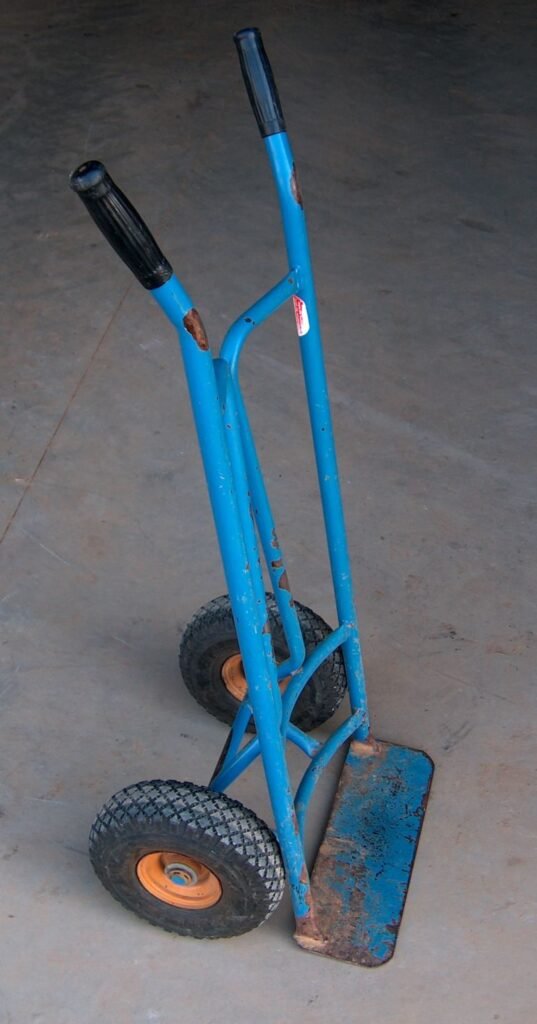
If what you actually want is a device that rolls under a full box and raises it off the ground, the Beehive Lifter is the more directly relevant product for most US beekeepers. Manual (two-wheel) models start at $1,250; electric push-button models run $1,700, with a taller “Electric Max” version at $1,850, plus a $75 accessory rail kit that raises rated capacity from 250 to 300 lbs. The frame is heavy-gauge steel, hand-built in the US, ships in 15–20 business days across the US and Canada, and carries a 10-year limited warranty. Operation is simple in principle: roll the base under the hive, lift via hand-crank or electric button, then lower the stack back down without a direct lift at any point — though as with any mechanical aid, it still takes a short, deliberate learning period before it feels natural on a heavy, real-world load.
University and Nonprofit-Built Alternatives
Commercial products aren’t the only lifting solutions with real engineering behind them. Michigan State University’s mechanical engineering capstone course, working through the university’s AgrAbility program in partnership with the veteran-beekeeper training nonprofit Heroes to Hives, has built at least two purpose-designed lifting devices free for beekeepers to replicate. In spring 2022, a five-student team built a self-propelled beehive lifting mechanism rated to carry 300 lbs over uneven apiary terrain. In April 2024, a follow-up capstone team presented a portable swarm trap lifter — a battery-powered winch system that raises a trap three to seven feet — built specifically for Gary Brown, a Heroes to Hives program instructor whose back injury limits his ability to climb a ladder or move heavy equipment unassisted. MSU has published the build plans publicly as the “Bee Environment Elevation System” (BEES). Separately, the National AgrAbility Project (a USDA National Institute of Food and Agriculture-supported program) catalogs the Beehive Lifter itself in its assistive-technology toolbox for exactly this population — older beekeepers and beekeepers with back, strength, or upper-extremity limitations. If you’re weighing lifting equipment because of a disability or physical limitation rather than pure convenience, these programs, and our own guide to beekeeping for veterans and therapy programs, are worth checking before buying anything.
The swarm trap lifter was built for AgrAbility client and Heroes to Hives program instructor Gary Brown, who has a back injury that limits his ability to climb a ladder or move heavy equipment.
Cost vs. Injury-Prevention Value
A $1,250–$1,850 hand truck, or an undisclosed Bee Buddy price plus international shipping, is a real expense to weigh against a hobby with one or two hives. But measured against the cost of a genuine back or shoulder injury — lost work time, medical costs, and for a commercial operation, real income disruption if the injury limits your ability to keep doing physical hive work — the calculation shifts quickly for anyone doing this at volume. For a beekeeper managing dozens of colonies through a harvest season, or a beekeeper already managing a physical limitation, injury prevention alone can justify either purchase well beyond simple convenience.
Who Should Consider Which Option
If your actual pain point is pulling and replacing individual frames during inspection or extraction — the repetitive bending, twisting, and setting-down motion — the Bee Buddy’s trolley-and-compartment design targets that specific task, provided you’re prepared to order from Australia and don’t need a published price up front. If your pain point is instead moving whole loaded boxes — off a hive stand, onto a truck bed, between stacks during extraction — the US-made Beehive Lifter is the more directly applicable tool, and it’s the device most “hive lifter” searches are actually trying to find. If cost is the real barrier rather than the concept itself, the MSU AgrAbility build plans are free and specifically designed for injured or aging beekeepers to replicate with local fabrication help. A hobbyist managing one or two hives with occasional, infrequent lifting may reasonably skip all three and rely on working with a lifting partner instead.
Availability and Buying Considerations
Confirm shipping cost and lead time to your location before committing to either product: the Bee Buddy ships from Australia and its manufacturer doesn’t publish pricing on its public site, so budget time to contact them directly for a quote; the Beehive Lifter ships from Minnesota within the US and Canada on a stated 15–20 business day timeline. For either device, confirm the rated weight capacity actually covers your heaviest realistic load — a fully loaded deep super packed with capped honey can exceed a lighter-duty device’s limit, and exceeding it risks both equipment failure and the safety benefit you bought the tool for in the first place. See our guide to ratchet straps for moving hives for securing loaded boxes once they’re on a vehicle, a complementary step to either lifting method.
Common Mistakes
Assuming any hive-lifting device eliminates all lifting risk, and abandoning careful technique entirely once you own one, can still result in dropped loads or strain from improper use of the equipment itself. Confusing the two product categories covered here — buying a frame-handling trolley when what you actually needed was a whole-box lifter, or the reverse — wastes real money on a tool that doesn’t solve your specific task. And for either device, skipping a check of terrain and workspace layout before buying means discovering the limitation only after the equipment has already arrived.
Sources
Product and capacity details verified directly against the manufacturers’ own current sites: Bees & Trees Nominees / Bee Buddy and Beehive Lifters. MSU capstone project details verified against Michigan State University AgrAbility’s project writeup. Assistive-technology cataloging verified against the National AgrAbility Project, a USDA National Institute of Food and Agriculture-supported program. See also our guide to keeping bees while on disability benefits for related accommodation questions.
FAQ
Is the Bee Buddy the same product as the “Beehive Lifter”?
No. The Bee Buddy is an Australian frame-handling inspection and extraction trolley made by Bees & Trees Nominees. The Beehive Lifter is an unrelated US-made hand truck, made by a Minnesota manufacturer, that lifts an entire loaded super or hive body at once. They solve different problems and aren’t interchangeable.
How much does a Bee Buddy cost?
The manufacturer doesn’t publish a price on its public website. You’ll need to contact Bees & Trees Nominees directly for a current quote and shipping cost from Australia.
How much does a Beehive Lifter cost?
As of the manufacturer’s current pricing, the manual two-wheel model starts at $1,250, the electric model is $1,700, and the taller Electric Max version is $1,850, with an optional $75 rail kit that raises capacity from 250 to 300 lbs.
How much does a full honey super actually weigh?
A fully loaded deep super commonly weighs 80–100 lbs, a medium runs 50–60 lbs, and a shallow around 35–40 lbs — repeated lifting at that weight, especially in awkward hive-work postures, is a well-documented source of back and shoulder injury.
Are there free or lower-cost alternatives to a commercial hive lifter?
Yes. Michigan State University’s AgrAbility program has published open build plans for a battery-winch swarm trap lifter and a self-propelled, 300-lb-capacity beehive lifting mechanism, both developed specifically for injured or disabled beekeepers through its Heroes to Hives partnership.
Is a hive-lifting device worth it for a hobbyist with one or two hives?
Not necessarily. Their value is clearest for beekeepers doing frequent, repeated heavy lifting across many colonies, or anyone managing an existing back, shoulder, or mobility limitation. A hobbyist with occasional lifting may reasonably rely on careful manual technique or a lifting partner instead.
Further Reading
- Beekeeping With Limited Mobility: Adaptive Equipment and Techniques
- Electric vs. Manual Honey Extractor: Which One by Hive Count
- Wax Moth Traps: Complete Buying Guide
- Dakota Gunness Uncapper: Complete Guide to This Chain-Flail Uncapping Machine
Image credits: Photo: Ich, Wikimedia Commons, CC BY-SA 4.0; Photo: MarkusHagenlocher, Wikimedia Commons, CC BY-SA 3.0; Photo: Celinebj, Wikimedia Commons, CC BY-SA 4.0.