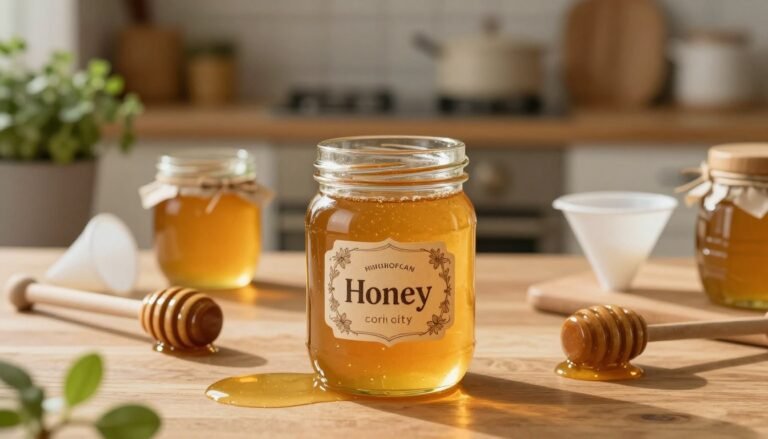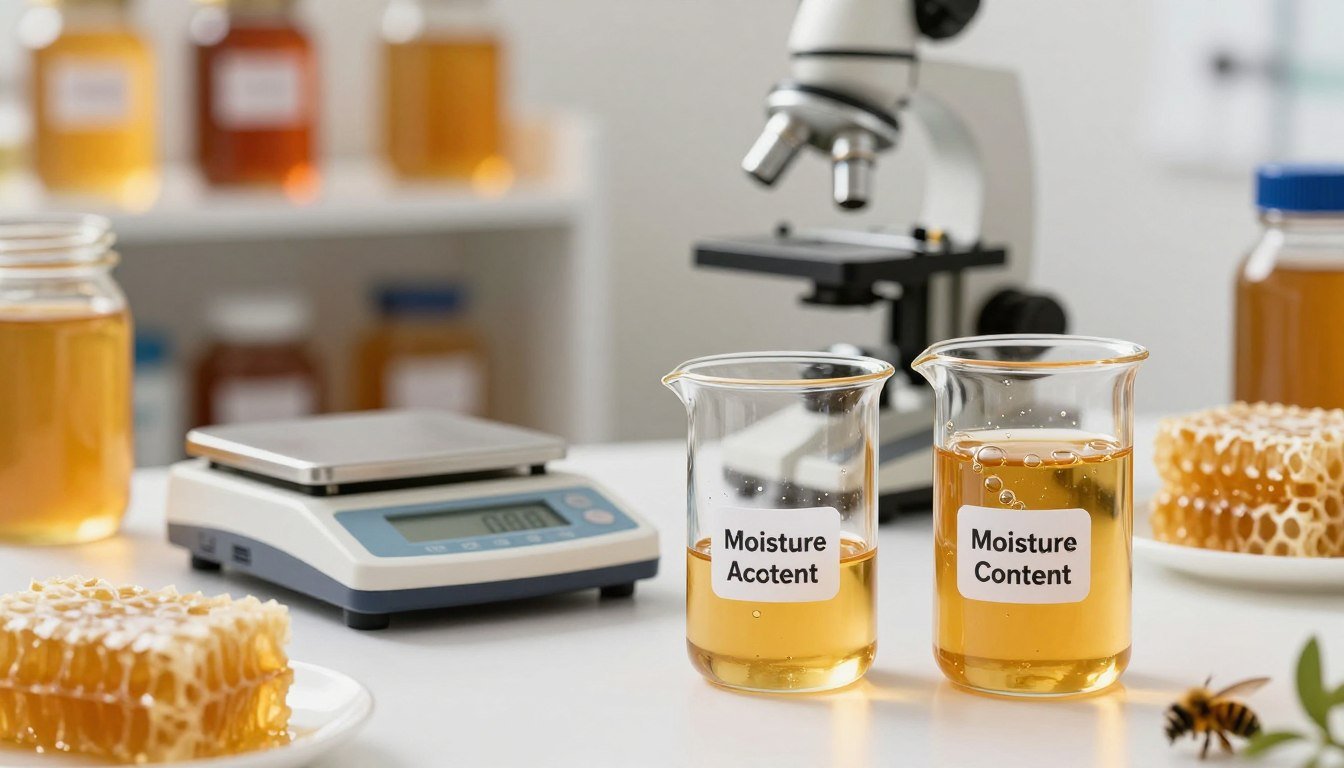
Producers and lab managers must know why two similar-sounding measurements lead to different outcomes. This short guide explains how measuring total moisture and measuring free water affect shelf life, safety, and product quality.
Moisture content is the total amount of liquid present. It helps assess weight and regulatory limits.
Water activity shows how that liquid behaves for microbes and chemical change. Low numbers mean better stability and less risk of spoilage.
Consider common foods: apples hold about 84% moisture, strawberries 92%, cucumbers 96%, while peanut butter has only 2% moisture. These examples show why both measures matter for safety and quality.
For deeper grading rules and how levels influence standards, see the USDA and industry notes at honey grading standards.
Key Takeaways
- Moisture content measures total liquid; it affects weight and labeling.
- Water activity measures free liquid that supports microbes and reactions.
- Both metrics are required for reliable safety and consistent quality.
- High moisture or high activity raises spoilage risk; low levels improve shelf life.
- Manufacturers must test both to meet standards and protect consumers.
Defining Moisture Content in Food Products
Moisture content is the percent of total weight that comes from liquid. Manufacturers use that percent to convert raw weight into dry weight. This helps with yield calculations and cost control.
Calculating total weight
Calculating Total Weight
Producers subtract the dry mass from the batch weight to compute percent liquid. That figure determines net yield and packaging quantities.
Importance for Yield
Keeping percent levels steady prevents under- or over-estimating final units. Excess liquid lowers product quality and can cause clumping or texture changes.
- Percent liquid shows the amount suppliers charge for by weight.
- Accurate measurement preserves product quality and safety.
- Production plans use dry weight for consistent batch sizing.
| Impact | High Percent | Low Percent | Control Measure |
|---|---|---|---|
| Yield | Lower usable yield | Higher dry yield | Adjust drying or formulation |
| Pricing | May overpay for free liquid | Fairer raw material cost | Contract specs on percent |
| Quality | Clumping, texture loss | Stable texture | Process controls and testing |
| QA Checks | More microbial risk if unchecked | Better predictability | Routine sampling and analysis |
For a deeper guide on measurement methods and how these numbers affect safety and shelf life, see the industry primer on measurement differences.
Understanding Water Activity and Microbial Safety
The ratio between vapor pressure in a food and that of pure water predicts microbial risk. This measure tells whether liquid inside a product is free enough to support bacterial or fungal growth.
Water activity measures the energy and availability of liquid inside a matrix. Foods with high values need controls because microbes use that available liquid to multiply.
If a product shows a value above 0.85 it usually requires refrigeration or an effective barrier to stop pathogen growth. Manufacturers must track these levels to protect shelf life and consumer safety.
- It explains how much water is available for microorganisms, unlike simple moisture percent.
- Pure water scores 1.00; low numbers mean greater resistance to spoilage and longer life.
- Controlling available liquid extends shelf life without relying only on cold storage.
Comparing Water Activity in Honey vs Moisture Content
High sugar formulations can hold lots of liquid yet leave almost none available for microbes.
Take jam or honey: both show high percent liquid by weight, yet sugars bind much of that supply. That lowers microbial access and gives a safe shelf life despite high measured percent.
By contrast, a cracker has low percent and low microbial availability. That keeps it crisp and shelf-stable without added barriers.
Key differences matter for safety and quality. Quantity tells cost and yield. Availability predicts spoilage risk.
- High percent does not always equal high microbial access.
- Both tests are needed to assess shelf life and formulation.
- Use both activity moisture content metrics to meet industry standards.
| Product Type | Percent Liquid | Microbial Availability | Typical Outcome |
|---|---|---|---|
| Honey / Jam | High | Low | Stable, long shelf life |
| Cracker | Low | Low | Crisp, shelf-stable |
| Fresh Fruit | High | High | Perishable |
For method details and how labs handle these metrics, read the industry primer on measurement differences or follow honey curing notes at practical curing guidance.
Why Quantity Does Not Equal Quality
Measuring total liquid by weight gives a narrow view of product performance. Moisture content is a tally, not a predictor of microbial risk or nutrient changes.
Limitations matter. A rise in percent liquid can lower the glass transition temperature and change texture fast. That shift alters mouthfeel, handling, and shelf appearance.
The Limits of a Single Metric
Relying only on moisture content is a common error. It ignores how available liquid affects microbial growth and chemical decline.
- Manufacturers use percent liquid for weight and pricing but it does not predict long-term safety or consistency.
- Adding sugar or salt can alter activity moisture without changing total percent, so stability may improve or worsen.
- Producers should pair quantity tests with availability and stability assays to protect safety and quality.
The Role of Water in Microbial Growth
Microbial risk depends on how much free liquid is available, not just the total percentage. That distinction guides how manufacturers control spoilage and pathogens in food products.
Bacteria Thresholds
Bacterial survival drops as available liquid falls. Many common bacteria, including Pseudomonas and Escherichia, struggle when the water activity range is reduced toward 0.95–1.00.
Drying or adding solutes lowers available liquid and limits bacterial growth. This is a primary tool for product safety.
Yeast and Mold Sensitivity
Yeasts and molds tolerate lower levels of available liquid than many bacteria.
Osmophilic yeasts, such as Saccharomyces rouxii, can grow around 0.65–0.60, so products with high sugar may still support some yeast or mold.
Pathogen Inhibition
Managing the amount of water available is key to pathogen control. Monitoring water activity across batches helps maintain safety and quality.
- Microbial growth tracks the available liquid, making measurement essential.
- Lowering available liquid inhibits many bacteria but may leave yeast risk.
- Regular testing keeps products consistent and safe.
| Organism | Typical Threshold (aw) | Control Strategy | Outcome |
|---|---|---|---|
| Pseudomonas / E. coli | ~0.95–1.00 | Drying, solutes, packaging | Inhibited with proper control |
| Saccharomyces rouxii (osmophilic yeast) | ~0.60–0.65 | Lower available liquid, preservatives | May still grow at high sugar |
| Molds | ~0.80–0.90 (varies) | Moisture control, barriers | Growth reduced with low aw |
For linked guidance on how floral source and pH influence these parameters, see floral source and pH influences.
How Food Manufacturers Measure Moisture
Manufacturers rely on precise lab steps to turn raw sample weight into actionable moisture figures.
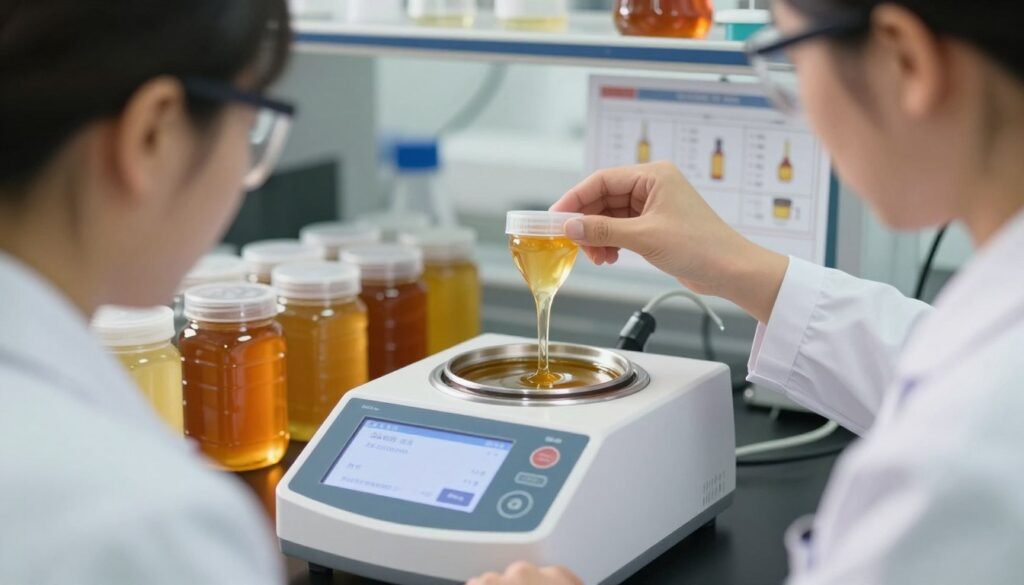
A common approach is loss-on-drying. Teams heat a weighed sample until the mass stabilizes. The percent lost gives a fast, high-precision measure of total moisture content.
Incoming raw ingredients are tested at receipt. This prevents overpaying for free liquid and keeps batch yields predictable.
- Measuring moisture is standard across the food industry to verify weight and raw specs.
- Methods range from handheld meters for quick checks to lab ovens or Karl Fischer titration for tight tolerances.
- Accurate data helps optimize drying steps and retain desired texture and appearance in the final product.
- Consistent measurement maintains safety and repeatable quality across production runs.
- Effective control boosts yield and protects profit while meeting regulatory levels.
Tip: Pair routine plant checks with periodic lab verification to catch drift and protect batch integrity.
Standard Methods for Determining Water Activity
Accurate determination of how available liquid behaves inside foods depends on precise lab instruments used by quality teams.
Chilled mirror instruments are the preferred method for high-precision measurement in the food industry. They measure equilibrium vapor pressure against a cold surface and deliver traceable, repeatable readings that labs rely on for safety and shelf-life modeling.
Capacitance sensors offer a lower-cost alternative for routine checks on the production floor. They provide faster results but can trade off some precision versus chilled mirror devices.
Standardized methods help manufacturers predict microbial risk and maintain product quality. Using industry-recognized protocols ensures consistency across batches and supports regulatory compliance.
- Specialized instruments are required for reliable measurement.
- Chilled mirror devices supply the highest accuracy for labs.
- Capacitance systems suit rapid screening on the line.
- Method choice depends on required precision and facility needs.
The Science of Moisture Sorption Isotherms
Moisture maps turn complex lab data into clear visuals that guide shelf‑life choices.
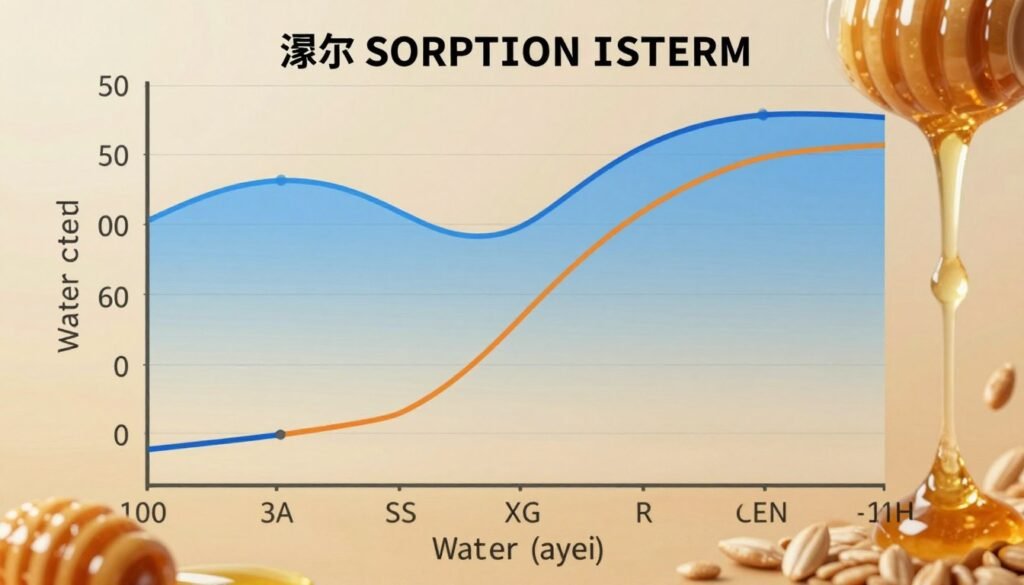
Moisture sorption isotherms graph how moisture content and water activity change at a constant temperature. These curves show the link between percent liquid and available vapor pressure for a product.
Isotherms give teams a visual tool to predict when clumping or loss of texture will start during processing. They also help estimate shelf life and flag zones where microbial growth becomes likely.
New automated systems speed this work. What once took weeks of desiccator steps now completes faster with controlled humidity chambers and software. That makes routine mapping practical for the food industry.
- Visual mapping: Clarifies complex sorption behavior.
- Risk planning: Predicts texture shifts and microbial thresholds.
- Process control: Guides formulation and storage decisions.
| Use | Key Insight | Benefit |
|---|---|---|
| Product development | Relation of moisture content to stability | Faster reformulation with predictable texture |
| Quality control | Identify critical humidity ranges | Reduced batch failures and recalls |
| Shelf‑life modeling | Estimate safe storage limits using water activity levels | Accurate expiration dating and reduced waste |
Managing Shelf Life Through Water Control
Shelf life often hinges on how a product binds its free liquid, not just the total percentage on a label.

Food manufacturers lower available liquid to slow microbial growth and chemical changes. One common method is adding solutes such as salt or sugar. These ingredients bind free liquid and reduce the chance of spoilage.
Products with a water activity between 0.60 and 0.85 usually do not require refrigeration. They still face a limited shelf life due to yeast and mold. Controlling both moisture content and water activity levels helps keep texture and quality steady over time.
- Reduce available liquid: use solutes or dry processing.
- Monitor levels: routine checks prevent batch drift.
- Design packaging: barriers can extend storage life.
| Strategy | Effect on water activity | Refrigeration need | Notes |
|---|---|---|---|
| Add sugar | Decreases | Often not needed | May change sweetness and texture |
| Add salt | Decreases | Often not needed | Useful for savory products |
| Drying or coating | Decreases | Often not needed | Preserves crispness and reduces risk |
| Barrier packaging | Maintains levels | Depends on product | Extends shelf life without reformulation |
For practical steps to calibrate tests and optimize safety, see guidance to optimize food safety and tips on packaging and labeling for shelf stability.
Impact of Sugar and Solutes on Water Availability
Sugars and salts act like molecular magnets, trapping free liquid and limiting spoilage. When solutes bind molecules, the amount of available liquid for microbes falls even if the total percent stays high.
This binding changes chemical behavior and preserves texture. Low water activity is achieved when the liquid is held tightly by molecular bonds. The result is a stable product with slower microbial growth and fewer chemical changes.
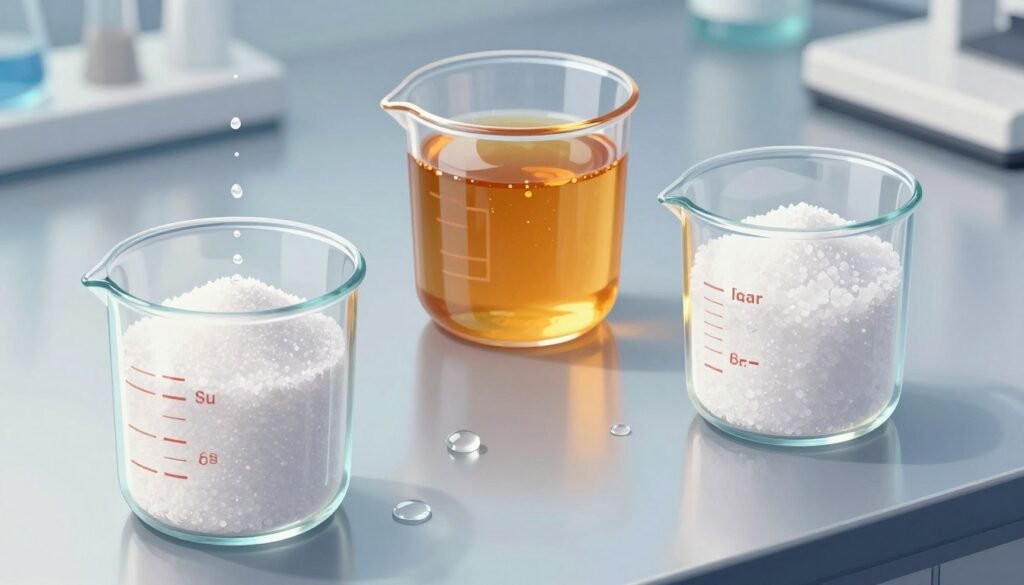
Manufacturers use solutes to design low water activity systems that extend shelf life without refrigeration. Understanding how sugar and salt interact with available liquid helps teams tune sweetness, saltiness, and mouthfeel while limiting spoilage.
- Solutes reduce the amount available for microbes and reactions.
- High total percent does not guarantee microbial risk when solutes bind liquid.
- Designing formulas with correct solute levels preserves texture and stability.
| Solute | Effect on Available Liquid | Typical Outcome | Notes |
|---|---|---|---|
| Sugar | Strongly binds molecules | Long shelf life, viscous texture | May invite osmophilic yeasts; monitor levels |
| Salt | Reduces free fraction | Stable savory products | Adjust for flavor and safety |
| Glycerol / polyols | Binds and retains softness | Soft texture, low spoilage | Useful in confections and fillings |
For practical testing methods and purity checks that help validate these formulations, see how to test honey purity at.
Selecting the Right Instrumentation for Your Facility
Choosing the right test instruments determines how reliably a plant meets lab specs and shelf targets.

Use a dedicated Kett moisture meter on the line to monitor end points during drying. This tool helps operators stop processing at the correct stage and protect final product weight and texture.
Match that meter with a separate analyzer for available liquid to confirm final safety and expected shelf life. Instant analyzers let teams maximize yield while avoiding failures when measuring availability.
- Critical choice: instruments must track both percent and availability to meet industry standards.
- Process control: Kett meters identify drying end points for consistent product batches.
- Safety check: a dedicated analyzer verifies water activity levels and supports shelf-life claims.
- Cost control: reliable measurement saves materials and prevents rejected lots.
Invest in traceable instruments, train staff on method use, and schedule routine calibration. These steps keep measurements reliable and products consistent across every run.
Conclusion
For manufacturers, the real win is balancing total percent readings with measures that forecast microbial risk.
Moisture content tells you how much liquid is present, while water activity predicts microbial growth and shelf life. Use both tests to protect texture, flavor, and safety across distribution.
Apply accurate instrumentation, routine checks, and clear QA limits. That approach prevents growth of bacteria and spoilage organisms and supports consistent life span claims.
For a detailed correlation study see moisture and water activity correlation, and for practical field checks read test honey moisture without an instrument.
FAQ
What is the difference between water activity and moisture content?
Moisture content measures the total weight of liquid present in a product. Water activity measures how much of that liquid is available to support microbial growth and chemical reactions. The two give different insights: one is quantity, the other is availability for microbes and quality changes.
How do you calculate total weight for moisture content?
Moisture content is typically determined by drying a sample to constant weight and comparing wet and dry masses. Laboratories use gravimetric ovens or moisture analyzers to report percent moisture on a wet- or dry-weight basis.
Why does moisture content matter for yield?
Moisture affects product weight and cost. Higher liquid levels increase gross weight, which changes yield calculations and pricing. Accurate moisture data helps processors set formulas and control packing weights.
How does water activity relate to microbial safety?
Water availability directly influences microbial growth. Low availability suppresses bacteria, yeasts, and molds. Measuring availability helps predict shelf life and determine necessary preservation steps like drying, adding solutes, or refrigeration.
Can two products with the same moisture percentage have different microbial risks?
Yes. Solutes such as sugar or salt bind liquid and reduce availability. A syrup and a loaf might share similar percent moisture but show different levels of microbial growth risk due to differing availability.
Why is amount of liquid not the same as quality or safety?
Total liquid does not indicate how much free liquid supports spoilage. Quality and safety depend on free liquid, formulation, pH, and processing. Relying solely on moisture percentage can mislead risk assessments.
What are the limitations of moisture metrics?
Moisture percentage ignores binding effects, temperature dependence, and packaging interactions. It also fails to predict shelf life reliably without paired availability data and sorption behavior.
At what thresholds do bacteria, yeasts, and molds grow?
Bacteria typically need higher availability than yeasts and molds. Many bacteria require availability above about 0.90, yeasts often grow above 0.85, and molds can grow at lower levels near 0.70, though factors like pH and preservatives change those limits.
How do solutes like sugar and salt affect microbial growth?
Solutes bind liquid and reduce availability to microbes. High sugar or salt concentrations lower effective availability even when total liquid is substantial, inhibiting many spoilage organisms and pathogens.
What laboratory methods do manufacturers use to measure moisture?
Common methods include loss-on-drying ovens, Karl Fischer titration for low moisture, infrared moisture analyzers, and near-infrared spectroscopy for rapid on-line checks. Choice depends on product matrix and required accuracy.
How is water availability measured in industry?
Water availability is measured with water activity meters that detect equilibrium relative humidity above a sample. These instruments report a dimensionless value from 0 to 1 and are standard for safety and shelf-life testing.
What are sorption isotherms and why do they matter?
Sorption isotherms map the relationship between relative humidity and equilibrium moisture for a product at a fixed temperature. They predict how products gain or lose liquid during storage and help design packaging and humidity controls.
How can manufacturers manage shelf life through liquid control?
Strategies include drying, formulary changes (adding humectants or preservatives), modifying packaging to limit humidity exchange, and controlling storage conditions. Combining availability and moisture data guides effective interventions.
How do sugar and other solutes modify liquid availability?
Sugars, salts, and polyols bind free liquid via osmotic effects and hydrogen bonding. These solutes reduce equilibrium relative humidity and lower the availability value even when measured moisture remains high.
What instrumentation should a facility select for monitoring availability and moisture?
Choose calibrated water activity meters and validated moisture analyzers appropriate for your product. For production lines, consider fast NIR systems and continuous environmental monitors for humidity and temperature.