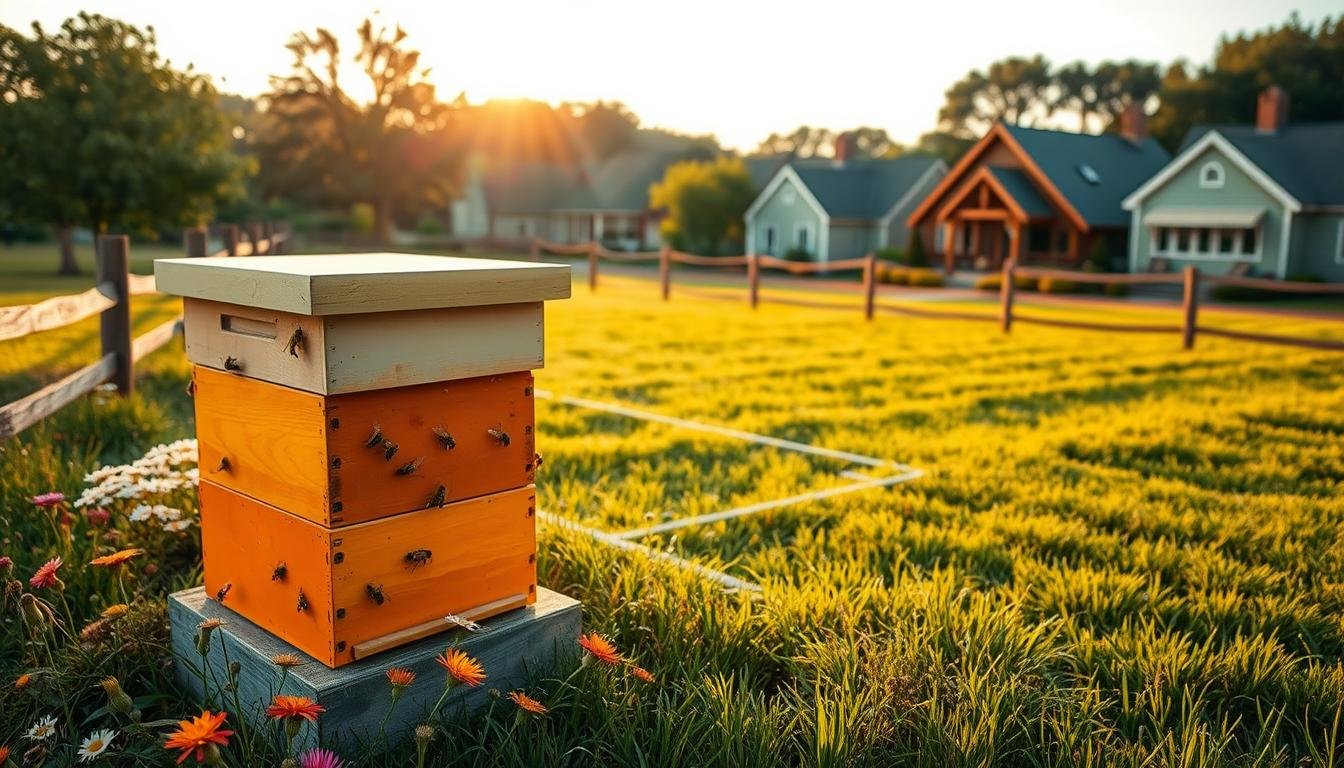
Finding a safe spot for an apiary means balancing bee behavior, human safety, and local rules. A typical hive footprint is about 22 inches by 16 inches, yet you need roughly five feet of working space around it. Multiple hives should sit at least three feet apart.
Place boxes on stable stands about 18 inches high and aim entrances east or southeast. Screen or plant barriers to lift flight paths and ease relations with a nearby property owner. In some towns, lot size and setbacks limit apiary size; see practical siting guidance at choosing an apiary location.
Start small with one to four hives while you study foot traffic and sun exposure. Thoughtful siting improves honey yield, boosts pollination, and lowers risk. For expansion tips and staging multiple yards, consult a beekeeping expansion guide.
Key Takeaways
- Safe distance blends hive layout, flight patterns, and local law.
- Provide at least five feet of work space and three feet between boxes.
- Orient entrances away from busy paths and add screening where useful.
- Start with few colonies to learn site dynamics and neighbor management.
- Comply with setbacks, lot rules, and practical siting for a friendly backyard apiary.
Understanding safe setbacks and neighbor-friendly beekeeping today
Safe distance in a backyard blends legal setbacks, entrance orientation, and practical barriers that reduce contact between bees and people. Start with local rules, then think about flight lines and where visitors walk.
Define it as the mix of required setbacks, the way you point the hive entrance, and any screen or barrier that lifts flight paths above head height. Bees form a visible corridor roughly ten feet in front of the entrance; pointing that corridor away from walkways lowers chances of unwanted encounters.
- Lot size and property lines often set legal minimums; some cities add registration or placement rules.
- Setbacks from a road or right-of-line exist to reduce conflicts at boundaries.
- Barriers work both as required compliance and as neighbor-friendly screening that raises flight paths.
Practical checklist
Audit traffic patterns, avoid placing the hive near patios or common paths, and allow enough space for safe inspections. For more on workspace and spacing, see hive space guidance and consult local resources like a beekeeping resource guide for rules that affect urban suburban yards.
How to check local rules before placing your hive
Start your site plan by researching city codes and any association rules that govern keeping bees.
Setbacks, lot minimums, and hive limits
Begin with municipal code sections that cover setbacks, minimum lot size, and the allowed number of hives. Some cities tie the number of hives to lot area. Cary, NC, for example, sets a 6,000 sq ft minimum and a 10-foot setback from the property line.
HOAs, permits, and registration
Review HOA bylaws for placement mandates and screening rules. Check whether your city requires hive registration or a permit. Local beekeepers and state associations often explain how inspectors enforce standards and what paperwork is expected.
Using fences and screens for elevated flight paths
Use a fence or dense barrier where ordinances require raised flight lines. A screen also improves neighbor comfort and helps a small lot meet rules while keeping equipment accessible.

| Rule | Typical Requirement | Action |
|---|---|---|
| Minimum lot | 3,000–6,000 sq ft | Measure parcel and compare with code |
| Setback from line | 5–10 feet | Map distances and adjust site |
| Number of hives | Limits based on lot | Plan colony count before purchase |
| Registration/permit | Varies by city | Contact local ag office or inspector |
- Document a simple site plan showing distances from line and structures.
- Confirm equipment storage rules and update checks annually.
Site planning: positioning the hive for safety, space, and compliance
A clear site plan starts by mapping the work area, sun, wind, and likely foot paths around each hive.
Recommended workspace
Set an 8′ x 8′ pad for one or two units and keep at least five feet of clear space on all sides for inspections. Place boxes three feet apart when you run multiple hives so equipment and a beekeeper can move safely.
Entrance direction, traffic, and screening
Point the hive entrance east or southeast where possible and away from heavy foot traffic. Bees form a visible flight band in front of the entrance, so use screens or shrubs to lift that route above eye level and out of sightlines.
Water, sun, shade, and stands
Provide a shallow water source near the hive so bees prefer it over a pool or patio. Morning sun helps early foraging, while afternoon shade reduces heat stress in hot months.
Set hives on an 18-inch stand to keep them off wet ground and make lifting frames easier. Keep boxes level side-to-side with a slight forward tilt for drainage. Add windbreaks of fencing or trees that block cold gusts without sealing off airflow.
- Map access routes and leave garden paths clear for smooth inspections.
- Stagger entrance angles for multiple colonies to reduce drifting.
How Close Beehives Can Be to Neighbors
Local setback rules set the baseline; practical workspace and barrier choices make the rest manageable.
Start by measuring property lines and city setbacks. Where codes allow, aim for at least 10 feet from a boundary on small lots. Add a 5-foot buffer around each hive for safe inspections and gear movement.
Keep multiple hives three feet apart to limit drift and give you room during inspections. An 8′ x 8′ pad handles one or two hives comfortably in most yards.
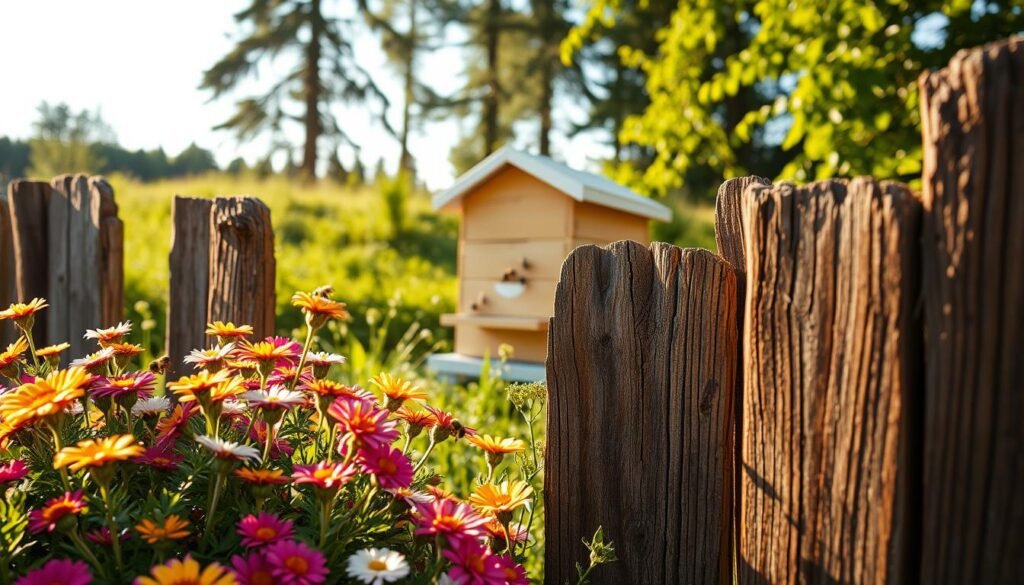
Using barriers to reduce perceived proximity
A tall, dense fence or screen near the entrance lifts flight lines above head height and eases neighbor concern. Orient the hive so the traffic corridor points toward open sky, away from patios and play areas.
“Even modest screening cuts direct sightlines and lowers complaints more than extra distance alone.”
- Use local setbacks first, then add working space.
- On tight lots, combine fence, entrance angle, and setback for safer operations.
- Tell a neighbor your plan; communication builds trust.
| Requirement | Common Guidance | Practical Action |
|---|---|---|
| Setback from line | Up to 10 feet | Measure and place hive accordingly |
| Working space | 5 feet around hive | Maintain clear pad for inspections |
| Between hives | 3 feet | Reduce drifting and allow access |
| Screening | Tall, dense fence | Elevate flight paths and block sightlines |
For detailed siting diagrams and placement tips, review a concise guide on beehive location.
Real-world scenarios: small yards, urban/suburban lots, and shared spaces
In tight urban plots, small changes in orientation and barriers make a big difference for safety and comfort.
Small backyard with kids and dogs
Face the entrance away from play areas and give a few feet of clear space for inspections. A screen or low hedge lifts flight lines above head height and cuts direct sightlines.
Provide a shallow water source right next to the hive so bees prefer that over a pool. A small fountain or tray with stones keeps foragers occupied and reduces pool visits.
Set simple household rules: keep children supervised near the yard, watch dogs during peak activity, and avoid mowing across the corridor. If a swarm appears, explain that it is temporary and call a local beekeeper if needed.
Urban side yard with fences and tight property lines
Use a tall, dense fence to redirect flights upward and away from windows. Angle the hive toward open air rather than a narrow path between house and fence.
For shared spaces, plan inspections when fewer people are outside. Keep a small tool caddy and water at hand so adjustments do not force you through busy walkways.
- Expect visible activity within about ten feet of the entrance; small shifts change how bees disperse across the yard.
- Reevaluate placement after the first warm week of the season and tweak barrier height or angle if people report issues.
“Bearding and visible activity often look alarming but usually signal a healthy colony; calm handling and simple barriers ease most concerns.”
| Scenario | Key step | Practical tip |
|---|---|---|
| Backyard with kids | Move entrance away from play area | Install screen; keep a 3–5 ft clear zone |
| Pool nearby | Provide nearby water | Use shallow trays or fountain with stones |
| Narrow side yard | Raise flight path | Tall fence and slight hive rotation toward open space |
Conclusion
A tidy site plan pairs local rules with placement choices that keep bee traffic out of living areas. Aim for an 8′ x 8′ working pad, leave five feet around each hive, and keep three feet between units. Use an 18-inch stand, level the box with a slight forward tilt, and provide a nearby water source so foragers skip pool visits.
Good beekeeping balances safety, yield, and neighborhood goodwill. Use screening and entrance angle to lift flight paths. Confirm setbacks and registration, track equipment, and consider planting nectar sources. For placement diagrams and rules, see a concise guide on beehive location and read about broader beekeeping benefits. Check your layout each season and offer a jar of honey when you brief a neighbor.
FAQ
What does "safe distance" for a hive mean in a backyard?
Safe distance means placing a colony so bees fly predictably, avoid frequented paths, and comply with local rules. It balances flight paths, property lines, and neighbor use of yards, pools, or patios. Proper placement reduces sting risk and nuisance while letting bees forage effectively.
What factors determine how far a hive should be from a property line?
Factors include municipal setbacks, lot size, the number of hives, nearby foot traffic, and landscape features like trees or fences. Flight direction, sun exposure, and where neighbors gather (pools, patios, gardens) also shape the ideal distance.
Where do I find local rules about setbacks, hive limits, and registration?
Check your city or county municipal code, zoning office, or health department website. Homeowners associations (HOAs) and local beekeeping clubs like those affiliated with the American Beekeeping Federation can also point to permits or registration requirements.
Can fences or screens let me place a hive closer to a neighbor?
Yes. A tall solid barrier or dense shrub line can force bees to fly upward and over, which effectively raises the flight path and reduces interactions near a neighbor’s yard. Many ordinances allow reduced setbacks when such flight barriers are present.
How should I orient the hive entrance to reduce conflicts?
Aim the entrance away from high-traffic areas, toward open flight corridors like a garden or trees. Slight elevation and a short flight path leading upward encourage bees to clear human activity zones quickly.
How much workspace do I need around a hive for safe inspections?
Keep an area of at least a few feet clear on the work side so you can maneuver boxes and equipment. If you run multiple hives, leave enough aisle space to move between them safely and to avoid blocking entrances.
Where should I place water near a hive to keep bees off neighbors’ pools and patios?
Provide a dedicated water source with floating corks, rocks, or a shallow tray near the hive but away from neighbor amenities. This draws foragers to the hive area and reduces visits to pools, birdbaths, or outdoor faucets.
What is recommended for hives in small yards with children or dogs?
Use barriers, orient the entrance upward, and sit the hive on a raised stand. Limit hive number and place the colony where kids and pets rarely play. Communicate with family and neighbors about hive behavior and safety measures.
Are there different rules for urban versus suburban lots?
Yes. Urban codes often set stricter setbacks and hive counts, while suburban areas may be more lenient. Always verify local ordinances and consider how dense housing and shared spaces affect bee flight and neighbor comfort.
How do sun, shade, and wind affect hive placement near neighbors?
Morning sun helps bee activity early, while afternoon shade keeps hives cooler in hot weather. Windbreaks reduce hive stress and drifting. Balance microclimate needs with neighbor locations to minimize bee traffic near living areas.
Can I keep multiple colonies on a small lot safely?
You can with careful planning: stagger entrances, increase flight height with barriers, and maintain adequate workspace. More colonies mean more traffic, so ensure neighbors are informed and local rules permit multiple hives.
How close is acceptable if an ordinance specifies a property-line setback?
Follow the exact setback distance in the ordinance. If the rule allows reduced setbacks with mitigation, add a compliant fence or dense planting and document the modifications. When in doubt, consult local code enforcement.
What should I tell a neighbor worried about a hive near their yard?
Explain hive placement strategies: entrance direction, water provision, barriers, and the generally non-aggressive nature of honey bees when not disturbed. Offer contact information and invite them to observe from a safe distance or meet with a local beekeeper.
Does placing a hive on a stand change how close it can be to people or property lines?
Raising a hive encourages upward flight and can reduce bee presence at human height. Many ordinances consider elevated flight paths when allowing closer placement, but confirm local code for specific allowances.
What practical yard layouts help keep bees away from neighbors’ patios and pools?
Put the hive behind solid screening, aim the entrance toward a garden or tree line, and provide a nearby water source. Use natural barriers like hedges to send bees above human activity zones and away from patios or pools.