Published November 26, 2025 · Last Updated August 26, 2026
This introduction connects chromosome biology to practical hive decisions. It frames how a clear grasp of bee genetics guides breeding, disease control, and colony management across a U.S. beekeeping season.
Honey bees use haplodiploidy: females develop from fertilized eggs and carry 32 chromosomes (2n=32), while males come from unfertilized eggs and carry 16 (n=16). This reproduction system shapes how traits pass through a colony.
Relatedness matters: full sister workers often share about 75% of their genes because they inherit all genes from the same father and half on average from the queen. That pattern changes behavior and colony outcomes.
Modern breeding in the U.S. focuses on disease resistance, especially varroa, and on predictable honey yield and temperament. The 2006 honey bee genome map (~240 million base pairs, ~10,000 genes) opened the door to marker-informed selection that builds on classic selection methods.
This guide will turn biology into actions: choosing drone sources, reading brood patterns, and aligning queen mating with long-term goals for resilient colonies.
Key Takeaways
- Haplodiploidy sets the reproductive baseline: females 2n=32, males n=16.
- High sister relatedness (~75%) influences colony behavior and trait expression.
- Breeding aims now favor disease control, temperament, and consistent honey production.
- Genome resources enable marker-informed selection alongside traditional methods.
- Practical decisions—drone choice, brood assessment, queen strategy—translate genetics to results.
How to Use Bee Genetics to Guide Better Beekeeping Decisions
Translate hereditary principles into simple, repeatable steps for your apiary.
Start with clear goals: set priorities for behavior, honey output, and resistance. Choose stock and drone sources that match those aims over time. Queens mate with more than 10 males and store sperm for years, so initial choice shapes worker cohorts for multiple seasons.
Use practical checks. If colony temperament slips, consider whether the queen’s multi-father worker mix or unknown drone input caused the shift. Requeen with tested lines rather than quick fixes.
Match principles to management
- Allocate space to test daughter queens and track honey yield, hygienic scores, and brood quality by number and season.
- Boost drone saturation from breeder queens since drones pass 100% of their genes to daughters.
- Schedule requeening when drone numbers are strong so mating number and diversity are maximized.
“Treat shotgun brood patterns as a genetic warning sign and adjust drone sources to restore diversity.”
| Goal | Action | Metric |
|---|---|---|
| Gentle behavior | Use tested queens, limit unknown drones | Incidents per inspection |
| Stable honey | Match queen line to local forage, time supering | Pounds per colony |
| Resistance | Retain queens showing hygienic traits, rear drones from breeders | Varroa drop and survival rate |
Document every change and link decisions to KPIs. For more background on matching stock and drone planning, see understanding bee genetics and resilient hives.
Bee genetics 101: Haplodiploidy and why drones have no fathers
Sex in these insects hinges on fertilization: eggs that stay unfertilized become males. This system, called haplodiploidy, differs from XY sex systems in many species and shapes colony dynamics.
Unfertilized eggs, haploid drones, and parthenogenesis
An unfertilized egg develops into a haploid drone. That male carries one set of 16 chromosomes.
Because no sperm contributes DNA, a drone has a mother but no father. He still has a grandfather through his mother.
Fertilized eggs, diploid females, and colony roles
Fertilized eggs become diploid females—workers or queens—with two sets (32) of chromosomes. The extra set creates recombined traits from both parents.
That recombination makes female offspring genetically diverse and helps the colony adapt.
Chromosome counts: 16 vs. 32 and what that means for traits
Remember the counts: drones = 16, females = 32. Drones transmit an intact haploid genome to daughters, so a drone’s contribution is uniform.
Practical note: a sudden rise in drones often signals more unfertilized eggs. For beekeepers, that hints at queen age, mating success, or seasonal sex allocation.
“Tracking brood composition—workers versus drones—turns abstract chromosome facts into actionable hive checks.”
- Haplodiploidy defines sex by fertilization, not sex chromosomes.
- Chromosome sets (16 vs. 32) determine how traits pass and mix.
- Drone genomes are predictable; maternal input is recombined and variable.
From genes to the colony: Relatedness, supersisters, and behavior
Relatedness inside a hive reshapes how individual actions add up to colony outcomes.
Why full sister workers share ~75% of their genes
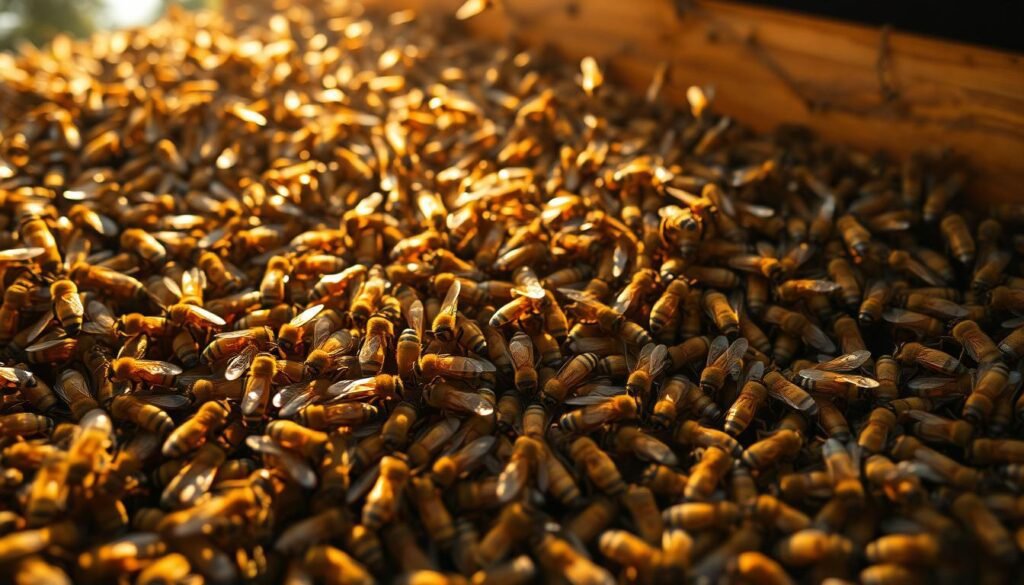
Full sister workers share about 75% of their DNA because they get a full set from their father and a mixed set from their mother.
The father’s haploid contribution is identical for daughters, while the queen’s chromosomes recombine each generation.
Father-driven “selfish” vs. queen-driven altruistic behaviors
Studies show that some paternal gene variants push selfish acts, like individual reproduction or guarding bias.
Queen-derived genes more often favor altruism that benefits the whole colony.
“Patrilines create behavioral diversity that stabilizes colony tasks across seasons.”
- Multiple fathers make distinct worker patrilines with different tendencies for foraging, guarding, and brood care.
- Watch abrupt behavior shifts—these can signal changes in patriline mix, not just environment or disease.
- Sample and score workers by task to link patterns to father lines before changing queens.
| Observation | Likely genetic cause | Action |
|---|---|---|
| Sudden increase in aggressive behavior | Higher proportion of certain patrilines | Assess patriline mix; consider controlled mating |
| Uneven foraging patterns | Task bias by paternal genes | Source calmer drones; requeen with tested line |
| Stable brood care | Strong queen-driven altruistic genes | Retain queen and monitor seasons |
Sex determination in honey bees: the csd gene in practice
The complementary sex determiner (csd) acts as the molecular switch that sets male or female pathways in honey bee embryos.
Alleles, inbreeding risk, and diploid drone elimination
The csd locus carries multiple alleles. When a fertilized egg inherits two different alleles, it follows female development. If both alleles match, the embryo develops as a diploid male.
Inbred matings raise the chance that fertilized eggs receive identical csd alleles. Workers detect and remove diploid drone brood, which wastes time and resources.
- Practical note: queens and drone sources both supply csd alleles; diversify both to reduce matches.
- More allele diversity in the mating population lowers the number of wasted eggs and stabilizes brood development.
- Track the number of distinct drone sources and favor lines known for allele variety when rearing drones.
Shotgun brood pattern as a field sign of genetic issues
A scattered or “shotgun” brood pattern often signals culling of diploid drones rather than just disease or poor nutrition.
Inspect brood closely. If many empty cells appear among recent sealed brood, suspect csd homozygosity and related matings.
“Culling diploid males reduces short-term hive strength and can cut honey flow performance during peak nectar.”
Action steps: spread apiaries, diversify drone yards, and keep brood records by queen and location. Time queen replacement to avoid repeating risky mating windows and protect colony productivity.
Inside the queen: meiosis, recombination, and diverse eggs
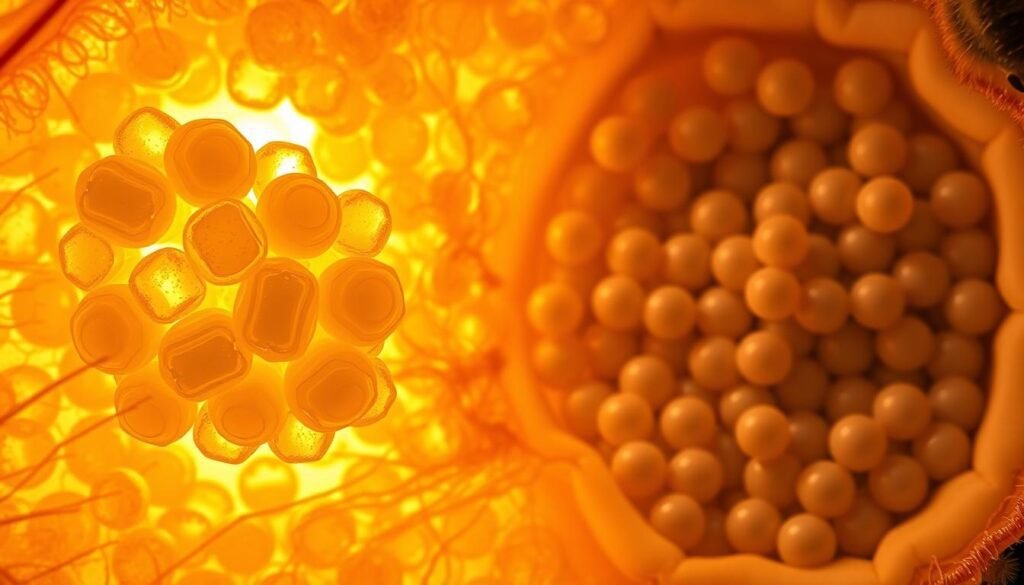
Meiosis inside the queen is the biological engine that turns one maternal genome into many distinct eggs. The reduction division halves chromosomes so each egg carries one set of 16 chromosomes. This process creates the raw variation that drives colony adaptability.
Independent assortment and crossing over
During meiosis, chromosomes segregate randomly. That independent assortment shuffles maternal and paternal genes into different eggs.
Crossing over (recombination) swaps DNA between paired chromosomes. The result is eggs with novel gene combinations not present in the queen herself.
High recombination rates and practical effects
Honey bee females show exceptionally high recombination rates compared with many animals. That intensity boosts trait variability among sisters from a single queen.
Practical outcome: diverse eggs produce workers with a wider range of skills—foraging, hygiene, and disease response—helping the colony face changing forage and pest pressures.
“Even one well-chosen queen can generate broad trait variation; selection must look across multiple brood cohorts.”
- Document brood performance by cohort and season to spot favorable gene combinations.
- Remember paternal DNA from drones is uniform; maternal reshuffling creates most within-colony diversity.
- Use mating management and culling alongside records to steer long-term stock improvement.
Inside the drone: incomplete meiosis and identical sperm
Male drones produce sperm that are nearly identical because their germ cells start with only one set of 16 chromosomes.
Reproduction in drones bypasses a full reduction division. With a single haploid set, crossing over does not occur. Each sperm carries the same genetic package from that drone.
This matters on the yard. When queens mate, every sperm from one drone delivers an unchanged genome to daughters. Saturating a mating zone with preferred drones raises the odds queens pick those genomes.
Contrast this with queens: maternal meiosis creates diverse eggs. Paternal input stays uniform, so selecting quality males is a direct way to steer traits in worker cohorts.
Practical steps: rear abundant drones from standout breeder lines, match drone maturity to queen flights, and monitor drone health. Poor nutrition or mites cut mating success even if the gene is fixed.
“Careful drone management is a cost-effective lever to improve daughter performance.”
- Track which yards produce the best drones and allocate resources accordingly.
- Plan numbers and timing so desired sperm are available when queens fly.
How queens create diversity: mating flights, spermatheca, and sperm use
A queen’s mating flights and stored sperm are the core tools she uses to shape colony diversity. She leaves the hive several times and mates with roughly 10–25 drones on those flights. That high mating number builds a multi-father worker population that stabilizes behavior and task coverage.
Polyandry and multi-father worker cohorts
Polyandry creates patrilines: groups of workers that share the same father. Each patriline can show different tendencies for foraging, hygiene, and temperament.
More fathers raise the odds the colony contains workers suited to varied seasons and stressors.
Spermatheca, long-term storage, and egg fertilization
The queen stores sperm in the spermatheca and can use it for years. Back in the hive she lays about 2,000 eggs per day and decides, egg by egg, whether to fertilize them.
This real-time control lets the queen balance caste and workforce size across time to match seasonal demands.
“A diverse pool of fathers buffers the colony against disease and shifting forage.”
- Time queen rearing so mating aligns with abundant, selected drones.
- Monitor brood pattern, laying rate, and worker traits to read sperm health and diversity.
- Boost desired sperm representation with drone floods from trusted yards and limit unknown drone drift.
Practical note: requeen periodically when performance or stored sperm diversity declines to reset the genetic baseline and protect honey production and colony resilience.
Turning larvae into queens or workers: nutrition meets genetics
What nurses feed a young larva sets a cascade of molecular switches that shape its adult role. Nutrition during the first days of development interacts with inherited potential to determine caste.
Royal jelly and the epigenetic limitation of worker traits
All larvae get royal jelly for about three days. Continued feeding after day three suppresses worker gene programs and redirects development toward a queen.
The underlying genotype stays the same. Epigenetic marks change which genes are active. That altered gene expression, not a new genome, builds differences in physiology and behavior.
- Management: strict feeding windows during grafting improve queen yield.
- Honey flow and nurse numbers affect the colony’s ability to stock royal jelly and rear quality queens.
- Watch larval food amounts and cell appearance as quick proxies for success.
“Nutrition unlocks potential; genes provide the range.”
Track emergence timing and early performance of new queens to refine your grafting and feeding. Emergency queens often underperform because nutrition and timing limit optimal gene activation. Use these checks to turn genetic potential into reliable results.
Building a practical breeding plan for U.S. beekeepers
A compact, repeatable plan helps turn objectives into resilient stock and measurable gains.
Stepwise approach:
- Define target traits: temperament, honey production, and varroa resistance.
- Source top breeder queens and rear matching drones to flood mating areas.
- Time mating to drone abundance and favorable weather windows.
Avoiding inbreeding and managing drone sources
Space mating yards, rotate sites across years, and keep multiple drone yards to lower related matings.
Practical tip: rear drones from trusted stock so a drone passes consistent genetics to daughters.
Selecting for resistance and desired behavior
Prioritize resistance traits, especially varroa-associated behavior, and pair selection with reduced-treatment goals.
Balance traits; don’t overselect one at the cost of overall colony robustness.
Testing daughter queens and tracking outcomes
Open mating creates variation. Test daughter queens for the target traits before expanding a line.
- Graft from top queens, rear matching drones, and label mating nucs to track patrilines.
- Record brood pattern, survival, behavior, and honey metrics for data-driven culling.
“Expand only lines that repeatedly express desired traits over seasons.”
Modern advances: genome insights, Page-Laidlaw breeding, and future tools
Genomic maps have turned trait hunting into a focused, practical task for apiary breeders. The 2006 sequencing (≈240 million base pairs, ~10,000 genes) let researchers match field traits to specific dna regions. This made trait mapping and marker-informed selection realistic for the yard.
From genomic maps to marker-informed selection
Marker-informed selection bridges classic selection and modern molecular tools. Breeders use validated markers to increase accuracy without losing real-world testing.
Benefit: faster progress for honey yield and behavior while keeping field practicality.
Closed Population Breeding Program (CPBP) and stock improvement
The Page-Laidlaw CPBP provides a structured, closed approach to improve stock across generations. It keeps lines controlled, tracks pedigrees, and reduces unwanted gene flow.
Programs like Susan Cobey’s New World Carniolan work and USDA Hilo show how CPBP sustains improvement at commercial scale.
Prospects for gene-informed resistance with minimal chemical inputs
Growing concern for honey purity pushes reduced chemical use. Gene-informed selection can raise natural disease tolerance and cut treatments.
Tools remain limited: mapping points the way, but validated assays and lab partnerships are needed to turn markers into yard decisions.
“Use markers as a guide, not a replacement for careful field evaluation.”
- Partner with labs and use validated tests before changing breeding plans.
- Maintain multiple lines inside a CPBP to avoid over-narrow selection.
- Follow ethical and regulatory guidance on gene editing; consider public acceptance.
Roadmap: start small—pilot marker tests, track outcomes, and scale successful pairings. Stay current with resources such as Honey Bee Genetics and Breeding for updates from Page and others.
Conclusion
,
A queen’s mating choices and stored sperm shape colony resilience. Use this fact to guide practical apiary steps that boost honey production and stable behavior.
Keep drone management intentional: rear males from trusted lines so desired genomes flood mating areas. Drones pass an identical set to daughters, so targeted drone yards pay dividends for worker traits.
Guard against inbreeding. Shotgun brood and diploid drone loss cut productivity. Spread mating sites, track brood, and test daughters over time to avoid repeated errors.
Next steps: plan mating windows, document outcomes, and work with local breeders or CPBP-style programs. Over time, these actions improve colony health, honey yield, and multi-generation stock quality.
FAQ
What are the basic principles of bee genetics and why do they matter to beekeepers?
Honey bee inheritance follows haplodiploidy: unfertilized eggs become haploid males and fertilized eggs become diploid females. This structure affects relatedness, colony behavior, and how traits spread. Understanding these principles helps beekeepers choose breeding strategies that improve honey yield, temperament, and disease resistance.
How can genetic principles guide everyday hive management decisions?
Match goals to actions: select queens from colonies with the behavior or resistance you want, manage drone sources to avoid inbreeding, and monitor brood patterns for signs of genetic problems. Breeding plans that prioritize reproductive diversity and clear selection criteria yield steadier improvements than ad hoc replacements.
Why do drones have no fathers, and how does haplodiploidy work?
Drones develop from unfertilized eggs and are haploid, carrying only the queen’s single set of chromosomes. Females come from fertilized eggs and carry genetic material from both parents. This difference explains why males lack fathers and why relatedness among workers is asymmetric compared with diploid species.
How do chromosome counts affect traits in honey bees?
Workers and queens are diploid with paired chromosomes; drones are haploid with a single set. That setup means some recessive traits can appear more readily through males, and selective breeding must account for how alleles express across haploid and diploid stages.
Why do full sister workers share about 75% of their genes?
Because queens mate with many drones, daughters may share the same father (full sisters). Full sisters receive identical paternal genes (since drones are haploid) and on average half their maternal genes, raising relatedness to roughly 75%. This influences colony cooperation and conflict.
What is the csd gene and why is it important for sex determination?
The complementary sex determiner (csd) gene controls female development. If an individual is heterozygous at csd it develops as female; homozygosity can produce diploid males that colonies often remove. Maintaining csd allele diversity prevents harmful diploid-drone production and reduces brood losses.
What does a shotgun brood pattern indicate about colony genetics?
Irregular, spotty brood may signal inbreeding, csd problems, or queen failure rather than only disease. When many brood cells are empty or contain dead larvae, evaluate queen mating diversity and possible genetic issues along with pathogens and nutrition.
How does recombination inside the queen boost colony diversity?
During meiosis the queen’s chromosomes shuffle through independent assortment and crossing over. This creates unique egg genotypes, which, combined with mating with many drones, greatly increases the genetic variation among workers and the colony’s adaptive capacity.
Why do honey bees have high recombination rates compared to other insects?
High recombination amplifies genetic combinations passed to workers, enhancing colony-level variation and resilience. This biological feature supports rapid selection on colony traits and is one reason traditional selective breeding can be effective.
What is unique about sperm production in drones?
Drone meiosis is incomplete in the sense that all sperm produced are genetically identical because they come from a haploid precursor. That results in clonal sperm sets, so a drone passes identical paternal genomes to all offspring he sires.
How do queens create diverse worker cohorts through mating behavior?
Queens mate with 10–25 drones on mating flights. They store mixed sperm in the spermatheca and selectively use it over years. Multiple fathers in a brood create subfamilies with varied traits, smoothing colony function and enabling selection on desirable behaviors.
How does nutrition interact with genetics to determine queen versus worker development?
Larval diet, especially prolonged feeding with royal jelly, triggers epigenetic pathways that produce queens regardless of genotype. Genetics set potential, but nutrition and care direct developmental fate, so rearing practices shape caste outcomes alongside heredity.
What practical steps help U.S. beekeepers avoid inbreeding and improve stock?
Use diverse, unrelated drone sources, employ controlled mating yards or instrumental techniques when feasible, rotate breeding queens, and track pedigrees. Combine field performance selection—temperament, honey, varroa resistance—with periodic outcrossing to maintain vigor.
How should beekeepers select for disease resistance like varroa tolerance?
Select colonies that naturally control mite levels through hygienic behavior, grooming, and brood breaks. Test daughters of candidate queens because exceptional mothers don’t always produce identical offspring; monitor multiple generations and environments before fixing traits.
What modern tools aid trait mapping and breeding programs?
Genomic maps, marker-assisted selection, and closed population breeding programs improve precision. Programs such as Page-Laidlaw–style selection and genomic screening can accelerate gains while minimizing chemical inputs by targeting natural resistance mechanisms.
Can gene-informed approaches reduce chemical use in apiaries?
Yes. By selecting for heritable resistance traits and using marker information, beekeepers can breed stocks that suppress pests and pathogens, lowering reliance on miticides and antibiotics. Integrating genetics with integrated pest management yields the best long-term results.