A “zombie bee” is a honey bee that has been parasitized by a tiny fly, Apocephalus borealis, whose larvae grow inside the bee’s abdomen and eventually kill it — but not before hijacking its behavior, driving the bee to abandon its hive at night and stagger toward artificial lights until it collapses and dies. First documented in honey bees in 2012 by San Francisco State University biologist John Hafernik, the phenomenon is now tracked nationwide through a citizen-science project called ZomBee Watch, which asks anyone who finds a disoriented bee under a porch light to collect it and see what emerges.
Key Takeaways
- Apocephalus borealis, nicknamed the zombie fly, is a native North American phorid fly that normally parasitizes bumble bees and wasps but was found in 2012 to also attack honey bees.
- A female fly lays eggs inside a bee’s abdomen; the larvae feed internally, and infected bees leave the hive at night, fly erratically toward lights, and die within hours, after which fly pupae emerge from the bee’s body.
- The discovery was made by accident, when SF State professor John Hafernik collected dead bees to feed a praying mantis and later found fly pupae had emerged from the forgotten specimens.
- ZomBee Watch, a citizen-science project run by SF State, the university’s Center for Computing for Life Sciences, and the Natural History Museum of Los Angeles County, has logged parasitism records from California and beyond since 2012.
- Parasitism rates found in surveyed hives are typically well under a quarter of a colony and vary heavily by region and season, so a zombie fly find is a genuine data point, not evidence of an imminent colony collapse.
Table of Contents
- What the Zombie Fly Actually Is
- How a Bee Becomes a “ZomBee”
- An Accidental Discovery in a Praying Mantis Cage
- ZomBee Watch: Tracking It Nationwide
- Should Beekeepers Actually Worry?
- Frequently Asked Questions
What the Zombie Fly Actually Is
Apocephalus borealis is a small phorid fly native to North America, part of a genus whose members are best known as parasitoids of ants and other insects — not, historically, of honey bees. Before 2012, entomologists knew it primarily as a parasite of bumble bees and paper wasps. It was San Francisco State University biology professor John Hafernik and colleagues who first documented, in a 2012 peer-reviewed study in PLOS ONE, that the same fly readily attacks the Western honey bee (Apis mellifera) as well, expanding its known host range into one of the most economically important insects in North America.
A female zombie fly lands on a foraging or hive-guarding bee and, using a needle-like ovipositor, injects eggs directly into the bee’s abdomen. From that point, the bee is functioning as an unwilling incubator, though it typically shows no obvious external sign of infection for days.
How a Bee Becomes a “ZomBee”
The larvae that hatch inside the bee feed on its internal tissues as they develop, and it’s during this stage that infected bees start behaving strangely. Where a healthy worker bee is almost strictly diurnal — foraging by day and staying inside the dark hive at night — a parasitized bee will leave the colony after dark and fly toward the nearest bright light source, circling it with an uncoordinated, disoriented flight pattern before eventually landing, walking in circles, and dying, usually within a few hours. This nocturnal, light-seeking behavior is where the “zombie” nickname comes from, and it’s genuinely unusual: almost nothing else makes a healthy honey bee leave the hive at night.
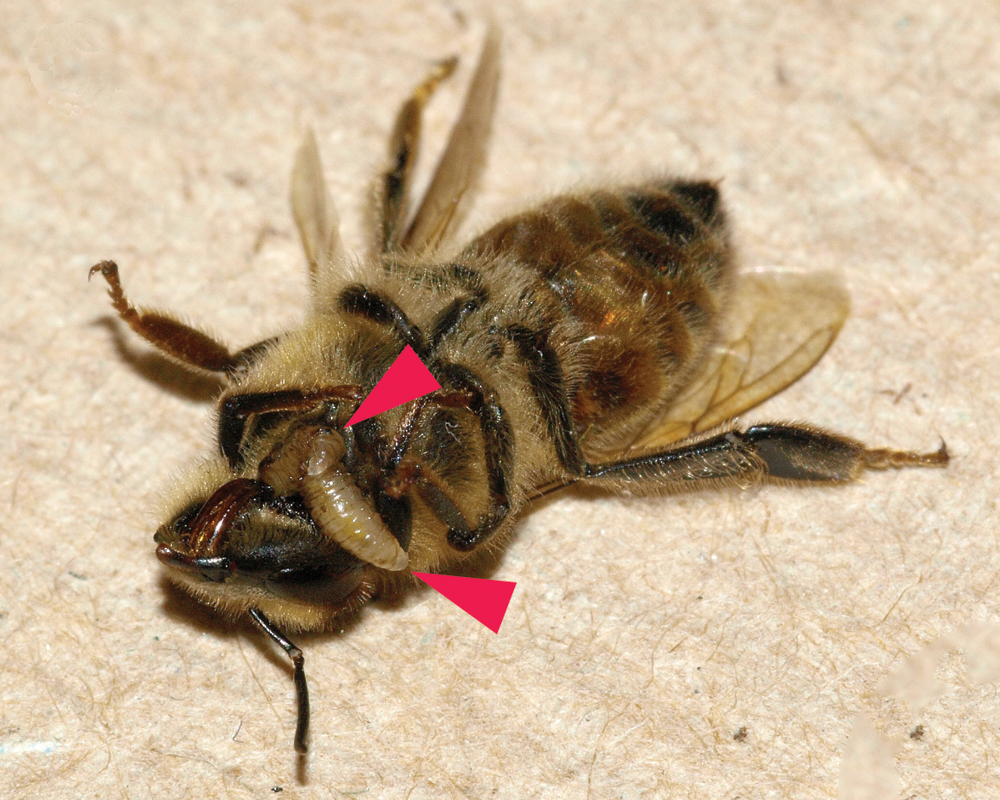
Roughly a week after a parasitized bee dies, up to a dozen brown, pill-shaped fly pupae emerge from the gap between the bee’s head and thorax, and adult zombie flies emerge from those pupae a few weeks later, ready to seek out new hosts. This grim but visually distinctive life cycle — a dead bee “giving birth” to fly pupae — is exactly what let ordinary citizen scientists confirm cases without any lab equipment: collect a suspicious bee, put it in a container, and watch what happens over the next several weeks.
An Accidental Discovery in a Praying Mantis Cage
The discovery itself has an almost absurd origin story. Hafernik was collecting dead bees from underneath a light fixture on the SF State campus to feed a pet praying mantis, and simply left a container of them sitting in his office for about a week. When he came back to it, he found that dark, pill-shaped fly pupae had emerged from several of the bees — an outcome he hadn’t been looking for and didn’t initially expect. Follow-up dissections and lab-reared samples confirmed the pupae belonged to Apocephalus borealis, and subsequent fieldwork found parasitized bees at multiple sites around the San Francisco Bay Area, in South Dakota, and later in other regions of North America.
ZomBee Watch: Tracking It Nationwide
Rather than rely solely on academic fieldwork, Hafernik’s team built ZomBee Watch, a citizen-science project sponsored by San Francisco State University’s Department of Biology and Center for Computing for Life Sciences, together with the Natural History Museum of Los Angeles County. The project asks volunteers to do exactly what Hafernik did by accident: collect bees found dead or dying near outdoor lights (or set up a simple light trap near an apiary), hold them in a clear container, and check periodically for fly pupae. Participants upload photos and observations to the project’s website, building a public, mapped dataset of where and when parasitism is actually occurring — data that would be far more expensive and slower to gather through professional survey work alone.
A short KQED Science documentary, ZomBees: Flight of the Living Dead, follows Hafernik’s original SF State research and shows the behavior itself on camera — bees leaving the hive after dark and gathering, disoriented, under a porch light. It’s worth watching in full to see how distinct the behavior looks in practice compared to a bee’s normal daytime activity.
Should Beekeepers Actually Worry?
The honest answer is: it’s worth knowing about, but it isn’t currently considered a major driver of colony loss the way Nosema or Varroa are. In the original SF State surveys, parasitism rates in sampled hives varied widely by site and season, and in most colonies only a minority of foragers tested were affected. Apocephalus borealis also isn’t unique to honey bees — its long-standing hosts are bumble bees and paper wasps — so a beekeeper finding a few zombie bees isn’t necessarily looking at a honey-bee-specific epidemic so much as a generalist native parasite that happens to have added a new, abundant host to its list. That said, the fly’s true regional distribution and long-term impact on managed colonies are still being mapped, which is exactly the gap ZomBee Watch’s crowdsourced data is meant to help close. Beekeepers who want to contribute real data rather than just wonder can set up a simple light trap near the apiary and report findings directly through the project.
It’s also worth keeping this parasite in perspective alongside the other things already competing for a colony’s attention, from hornet predation to the dozens of pests and pathogens covered in this site’s broader bee disease guide — a zombie fly infestation is one more data point to track, not a reason for alarm on its own.
Frequently Asked Questions
What is a zombie bee?
A “zombie bee” is a honey bee parasitized by the fly Apocephalus borealis, whose larvae develop inside the bee’s abdomen. Infected bees leave the hive at night and fly erratically toward lights before dying, a behavior pattern that gave rise to the nickname.
Can zombie flies infect humans or pets?
Apocephalus borealis is a parasite specific to bees and some wasps; it poses no infection risk to humans, pets, or other mammals.
How common are zombie bees in a typical hive?
Parasitism rates vary significantly by location and season. In the original San Francisco Bay Area surveys, only a portion of sampled hives tested positive, and within positive hives only a minority of bees were typically affected — it is not considered a leading cause of colony loss compared to Varroa mites or common bee diseases.
How can I check if my hive has zombie bees?
Collect bees found dead or disoriented near outdoor lights near your apiary, place them in a clear, ventilated container, and check over the following one to three weeks for small brown fly pupae emerging from the bee’s body — the same method used by ZomBee Watch citizen scientists.
Who discovered that zombie flies parasitize honey bees?
San Francisco State University biology professor John Hafernik and colleagues documented the discovery in a 2012 study published in PLOS ONE, after noticing fly pupae emerging from honey bees he had collected for an unrelated purpose.