Published September 2, 2026
The largest honey bee species on Earth doesn’t live in a hive at all, in the sense any Western beekeeper would recognize: it builds a single massive comb hanging fully exposed in open air, often dozens of feet up a cliff face or tree, defended by a colony genuinely capable of coordinated mass attacks serious enough to have killed people who’ve disturbed it. The giant honey bee has never been successfully domesticated the way Western and Asian honeybees have, yet it remains ecologically and economically significant across its native range, sustaining a genuine, still-practiced tradition of high-risk wild honey hunting. This guide covers what the giant honey bee actually is, why its single-comb, open-air nesting makes it fundamentally undomesticable, its real defensive danger, and how it differs from the closely related, even more extreme species associated with “mad honey.”
Table of Contents
- What the Giant Honey Bee Actually Is
- A Single, Massive, Fully Exposed Comb
- Why It Has Never Been Successfully Domesticated
- Genuinely Dangerous Coordinated Defense
- Traditional Wild Honey Hunting
- A Closely Related, Even More Extreme Species: Apis laboriosa
- Giant Honey Bee vs. Western and Asian Honey Bees
- A Genuine Research Subject for Understanding Honey Bee Evolution
- A Genuinely Different Approach to Colony Temperature Control
- Conservation Status and Regional Pressures
- Common Mistakes
- Frequently Asked Questions
What the Giant Honey Bee Actually Is
The giant honey bee (Apis dorsata) is genuinely the largest of the currently recognized honey bee species, native to South and Southeast Asia, including India, Nepal, Indonesia, the Philippines, and much of the surrounding region. It’s a genuinely distinct species from both the Asian honey bee and the Western honey bee already covered on this site, and unlike either of those two managed species, Apis dorsata has essentially never been successfully kept in a movable-frame hive or box the way beekeepers manage Apis mellifera or Apis cerana colonies worldwide.
A Single, Massive, Fully Exposed Comb
The defining structural trait of giant honey bee colonies is genuinely unlike anything covered elsewhere on this site: rather than building multiple parallel combs inside an enclosed cavity, a giant honey bee colony constructs a single, large, vertically hanging comb entirely in the open, typically suspended from a tall tree branch, cliff overhang, or tall building ledge, sometimes located dozens of feet above the ground. The exposed comb can grow genuinely enormous, sometimes several feet across, densely covered by a defensive curtain of adult worker bees clustered across its surface.
Why It Has Never Been Successfully Domesticated
This single-comb, fully open-air nesting behavior is precisely why Apis dorsata has resisted every serious historical attempt at domestication: the species is instinctively wired to build in open, exposed locations rather than accepting an enclosed cavity like a hive box, and colonies also tend to relocate entirely, abandoning a nest site and rebuilding elsewhere, in response to disturbance or seasonal forage changes in a way that makes stable, long-term hive management genuinely impractical. This stands in sharp contrast to Apis mellifera and Apis cerana, both of which naturally nest in enclosed cavities and adapted readily to human-provided hive boxes as a result.
Have modern researchers made any progress toward domesticating Apis dorsata despite this history?
No widely adopted breakthrough has changed this fundamental limitation; the species’ deeply instinctive preference for open-air nesting and its tendency toward seasonal migration remain significant, unresolved barriers that continue to separate it from the two honey bee species that have been successfully managed in hives for centuries.
Genuinely Dangerous Coordinated Defense
Giant honey bee colonies are known for a genuinely intense, coordinated defensive response when disturbed, with large numbers of worker bees capable of pursuing a perceived threat over a considerable distance and delivering numerous stings in a short period. This defensive intensity is well-documented enough in the scientific and medical literature that disturbing a giant honey bee nest is treated as a genuine safety hazard in regions where the species is common, with documented cases of serious injury and death resulting from accidental or deliberate nest disturbance, making this one of the more legitimately dangerous species covered anywhere on this site rather than an exaggerated or overstated risk.
Traditional Wild Honey Hunting
Because giant honey bee colonies can’t be domesticated, honey from this species is harvested entirely from wild nests, and in parts of Nepal, India, and elsewhere across its range, this has sustained a genuine, still-practiced traditional occupation: honey hunters climbing tall handmade ladders or ropes to reach nests built high on cliff faces, using smoke to calm the colony before cutting away sections of the exposed comb. This practice carries real, well-documented physical risk, both from the height involved and from the colony’s defensive response described above, and it represents a genuinely significant cultural and economic tradition in the communities where it’s still carried out, rather than simply a historical curiosity.
A Closely Related, Even More Extreme Species: Apis laboriosa
It’s worth being precise here rather than conflating two related but genuinely distinct species: the Himalayan giant honey bee (Apis laboriosa), found at higher elevations in the Himalayan region specifically, is a separate species from Apis dorsata, though it shares the same general single-comb, cliff-nesting, undomesticated lifestyle. Apis laboriosa is specifically the species most closely associated with Nepal’s famous high-altitude “mad honey” hunting tradition, where honey collected from certain rhododendron-heavy forage areas can contain grayanotoxin, a naturally occurring compound capable of producing intoxicating or even dangerous effects in people who consume enough of it. This grayanotoxin honey phenomenon is specific to particular regional forage conditions rather than a trait of the bee species itself, and it’s a distinct topic from the giant honey bee’s general biology and behavior covered in the rest of this guide.
Giant Honey Bee vs. Western and Asian Honey Bees
| Trait | Giant Honey Bee (A. dorsata) | Western Honey Bee (A. mellifera) | Asian Honey Bee (A. cerana) |
|---|---|---|---|
| Nest structure | Single exposed comb, open air | Multiple combs, enclosed cavity | Multiple combs, enclosed cavity |
| Domesticated? | No | Yes, worldwide | Yes, across native Asian range |
| Colony behavior when disturbed | Highly coordinated, intense defense | Varies by subspecies/breeding | Generally more defensive than Western bees |
| Native range | South/Southeast Asia | Originally Europe/Africa, now global | Asia |
A Genuine Research Subject for Understanding Honey Bee Evolution
Beyond its cultural and economic significance, Apis dorsata has drawn substantial scientific interest as a comparative subject for understanding how the broader honey bee genus evolved, since its open-nesting, single-comb lifestyle likely represents a form closer to the ancestral honey bee nesting strategy than the enclosed-cavity nesting seen in Apis mellifera and Apis cerana. Studying how such a fundamentally different nesting strategy shapes colony defense, thermoregulation, and swarming behavior gives researchers a genuinely useful natural comparison point for understanding why enclosed-cavity nesting eventually became the dominant strategy in the species that were later successfully domesticated.
A Genuinely Different Approach to Colony Temperature Control
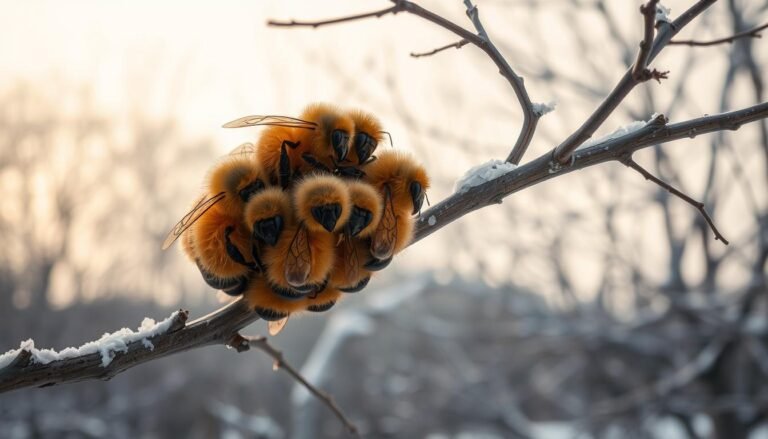
Without an enclosed cavity to help buffer temperature the way a hive box does, giant honey bee colonies rely on a distinctive collective behavior to manage heat and defend the exposed comb: workers cluster densely across the comb’s surface and can coordinate synchronized body movements, sometimes described as a visible “shimmering” wave rippling across the entire bee-covered surface, believed to serve both a thermoregulatory function and a defensive signal to potential predators or threats. This visible, coordinated colony-wide behavior is genuinely unique among the honey bee species covered on this site and reflects just how differently Apis dorsata has adapted to a fully exposed nesting lifestyle.
Conservation Status and Regional Pressures
While not currently classified as broadly endangered, Apis dorsata populations face genuine regional pressures in parts of its range, including habitat loss from deforestation, pesticide exposure, and unsustainable over-harvesting of wild nests in some areas, all of which can meaningfully affect local population stability even where the species remains widespread overall. Because the species can’t be managed in hives to supplement or buffer wild population losses the way honeybee species can, its long-term status in any given region is tied more directly to the health of surrounding wild habitat than is the case for domesticated honey bee species.
Common Mistakes
The most common mistake is assuming the giant honey bee could theoretically be managed in a standard hive box the way other honey bee species are, when its instinctive open-air, single-comb nesting behavior has consistently defeated every serious domestication attempt. Another mistake is confusing Apis dorsata and Apis laboriosa as the same species simply because both are giant, undomesticated, cliff-nesting honey bees, when they’re genuinely distinct species with different geographic ranges. People also sometimes assume “mad honey” is a trait of the giant honey bee species generally, when it’s specific to certain regional forage conditions primarily associated with Apis laboriosa rather than the bee species as a whole.
Is the “shimmering” defensive behavior effective against real predators like hornets?
Yes, research on this behavior has documented it as a genuinely effective deterrent specifically against hornet attacks, with the coordinated visual and physical disturbance across the comb surface helping repel hornets attempting to prey on individual bees or the colony, making it a legitimate, functional defense mechanism rather than a purely cosmetic display.
How physically large is an individual giant honey bee worker compared to a Western honeybee?
Individual Apis dorsata workers are noticeably larger than Apis mellifera workers, generally regarded as the largest workers among all recognized honey bee species, though the more dramatic size difference most people notice is the sheer scale of the colony’s single comb structure rather than individual body size alone.
Do giant honey bees interact or compete with Apis cerana colonies in regions where their ranges overlap?
Both species can be found foraging in the same general region across parts of South and Southeast Asia, but they occupy meaningfully different ecological niches given the giant honey bee’s open-air single-comb nesting versus the enclosed-cavity nesting of Apis cerana, so direct nest-site competition between the two is limited even where their foraging ranges overlap.
Does giant honey bee venom carry any greater medical risk than Western honeybee venom on a per-sting basis?
The venom itself isn’t generally described as dramatically more potent per individual sting than Western honeybee venom; the genuine danger comes primarily from the sheer number of stings a coordinated colony defense can deliver in a short period, making total venom exposure, rather than any single sting’s unusual toxicity, the more significant medical concern in serious encounters.
Are there any recognized subspecies or regional variants of Apis dorsata?
Yes, researchers have documented regional variation across the species’ wide geographic range, and some taxonomists have proposed additional related giant honey bee species or subspecies distinctions within certain regions, reflecting the genuinely broad and ecologically varied territory Apis dorsata occupies across South and Southeast Asia.
Do local beekeeping regulations in countries where Apis dorsata lives address wild nest removal or protection?
Regulations vary considerably by country and region, with some areas placing restrictions on unsustainable wild nest harvesting specifically to protect local pollinator populations, while enforcement and specific rules differ enough across the species’ broad range that anyone considering interaction with a wild colony should check current local regulations rather than assuming a single uniform standard applies everywhere.
For a look at the opposite extreme within the same open-nesting honey bee lifestyle, see this site’s guide to the dwarf honey bee, the world’s smallest honey bee species, which shares the single-exposed-comb nesting strategy but is genuinely far gentler and less defensive.
Frequently Asked Questions
How large can a single giant honey bee colony’s comb actually get?
Established combs can grow to several feet across and several feet tall, representing a genuinely massive single structure compared to the individual frame-sized combs found in a managed Western honey bee hive.
Do giant honey bees pollinate crops the way managed honeybees do?
Yes, giant honey bees are recognized as significant wild pollinators across their native range, contributing meaningfully to both wild plant and agricultural crop pollination despite never being formally managed for that purpose the way honeybee colonies are elsewhere.
Is giant honey bee honey commercially sold outside its native region?
Some wild-harvested giant honey bee honey does reach broader specialty and export markets, though supply remains inherently limited by the difficulty and danger of wild harvesting compared to conventional managed honey production.
Why do giant honey bee colonies sometimes migrate to a completely new nest site?
Colonies are believed to relocate in response to a combination of factors including seasonal forage availability, disturbance, and possibly predation pressure, a genuinely distinctive behavior among honey bee species that further complicates any attempt at stable, long-term hive management.