Last Updated September 13, 2026
Natural colony reproduction divides one hive into two. This process can seed heavy mite loads when feral colonies collapse nearby. That risk makes swarm prevention a community concern in the United States.
Managed beekeeping balances honey yield, pollination power, and long-term health. Allowing unchecked swarming often costs beekeepers productive workforce and invites mite-bomb rebounds that hurt neighboring apiaries.
Practical control mimics nature with fewer downsides. Timely space, added supers before congestion, and a fresh young queen lower urge for a split. Strategic moves like reversing deeps, early supering with drawn comb, and the Demaree method keep the brood nest efficient and reduce cells that signal swarming.
Expectations: start checks weeks before peak spring flow. Watch for crowded brood frames, backfilled brood, and queen cell formation. Follow a clear inspection cadence and act decisively to protect winter survival and honey stores.
Key Takeaways
- Unmanaged swarms can create mite-bomb events and weaken regional apiaries.
- Creating space and refreshing the queen cut swarming pressure.
- Splitting offers control with lower winter loss than wild casts.
- Regular, early inspections prevent last-minute crises.
- Techniques like Demaree, reversing deeps, and early supering work well.
What swarming is and why it matters for your hive and community
A hive splits when a colony follows an instinctual plan to reproduce. This is normal in nature but conflicts with a beekeeper’s goals for steady honey production, disease control, and predictable colony counts.
Natural reproduction versus managed goals
When a large group leaves, foragers and nurses go with the departing queen. That loss reduces brood care and cuts honey collection during peak nectar flow.
Many backyard keepers would rather let a spring cast go than manage an extra box. Still, only 8%–24% of new colonies survive winter, so letting them go often wastes resources.
Risks for hives and neighbors
Unmanaged swarms often settle in attics or outbuildings. These nuisance colonies can trigger expensive removals and neighbor complaints.
- Lost yield: fewer foragers means less honey at flow time.
- Mite rebounds: feral colonies can amplify Varroa, then collapse and return mites to managed apiaries.
- Community strain: removals and nuisance colonies harm local support for beekeeping.
A simple split — three frames of brood, one of food, bees on them, plus the old queen — mimics natural casting but keeps more workers in the original box. Timing matters: act before queen cells are far along to prevent irreversible momentum.
Think of swarm control as both good husbandry and a civic duty. Practical action protects your hives, your neighbors, and long-term beekeeping in your location. For hands-on methods, see swarm prevention tips and a full swarming preparation guide.
Swarm season in the United States: timing, nectar flow, and regional cues
In much of the United States, primary swarming runs with the earliest nectar flows each spring. Primary activity typically falls between March and May, giving new colonies time for growth before winter.
Secondary departures can follow weeks later if populations surge or queens are superseded during a strong flow.
Primary and secondary patterns
- Primary swarms appear with early nectar and warm days; secondary swarms may occur later in the season.
- Multi-day rain traps workers inside the hive, speeding resource storage and backfilling of brood cells.
- Local factors — elevation, microclimate, forage — shift peak time by location; watch your bloom calendar.
Practical checks: inspect every five to six days during build-up to find queen cells before capping. Keep drawn frames ready in boxes so the colony can expand upward rather than cast away workers.
“Record first drone brood, first drone flights, and first major nectar flow each year to refine your timing.”
Key drivers of swarming inside the colony
Small changes in brood area pressure can quickly shift a healthy colony toward reproductive behavior. Crowding in the brood nest first limits the queen’s laying options. When she finds few empty cells, workers read that as a signal to prepare new queens and divide.
Brood nest congestion and back-filled comb
Backfilling happens when nectar or honey fills former brood cells. That reduces space for eggs and forces the colony into a reproductive posture. Polished cells with no eggs are an early flag.
Declining queen pheromones and queen age
An aging queen emits weaker pheromones, so cohesion drops. Even a strong queen cannot fully counteract reduced signal spread when the hive is packed.
Poor ventilation and entrance airflow
Stuffiness raises temperature and humidity near the brood. Restricted entrance airflow makes the colony feel overfull and nudges reproductive behavior.
Population growth during rainy weeks
Extended wet spells keep foragers home. Quick influx of workers and stored nectar can shift available space into scarcity within days. Because these factors build over time, early action and added space save lost honey and frames.
Why Bees Swarm and How to Stop It
The most reliable path is a planned split that moves three frames of brood plus one frame of food and the old queen into a new box. This mimics a natural cast, keeps more foragers working, and preserves workforce for honey collection.
Add space early. Put supers on before brood cells fill. That stores incoming nectar above the brood nest and removes the crowding cue that triggers a swarm.
Requeening with a young, well-mated queen strengthens chemical cohesion. Pair requeening with early supering so the new queen has open cells for laying.
- Root causes: congestion, weak queen signal, poor ventilation — act by adding boxes, requeening, or increasing airflow.
- Rearrange: reversing deeps moves the cluster down and encourages upward expansion of the brood nest.
- Advanced: Demaree and brood separation lower reproductive pressure without losing workers.
Check for queen cells often during nectar flow. Early detection makes interventions far more effective. For deeper reading and resources, see this beekeeping resources guide.
How to inspect for swarming signs before it’s too late
A steady inspection rhythm during spring keeps queen cells developing out of sight. Inspecting often gives you a narrow window to act before a capped cell becomes irreversible.
Cadence: five-to-six-day tip-up checks
Make a checklist and visit hives every five to six days during peak buildup. This cadence matches the typical cell development timeline and exposes changes within days.
Record notes by box and by frame. Compare entries week by week so trends show before urgent action is needed.
Spotting queen cells, drone cells, and crowded frames
Tip the brood boxes and scan bottom bars and frame edges. Look for charged queen cells, lots of drone comb, and brood backfilled with nectar.
Check density: if frames are packed across multiple boxes and workers are “boiling over,” treat that as high risk for an imminent split.
- Action cue: any capped queen cell shortens your available time; act immediately.
- Flow response: during rapid nectar inflow, super up quickly to open the brood area.
- Nurse bees: excess nurses high in the box often indicate brood-shift opportunities for a Demaree move.
| Sign | Action window | Recommended response |
|---|---|---|
| Open queen cells | days | Monitor closely; prepare split or Demaree |
| Capped cell | days (short) | Act immediately: split or requeen |
| Backfilled brood & packed frames | weeks | Super up, reverse deeps, or add boxes |
Create space early: supering, reversing deeps, and drawn comb strategy
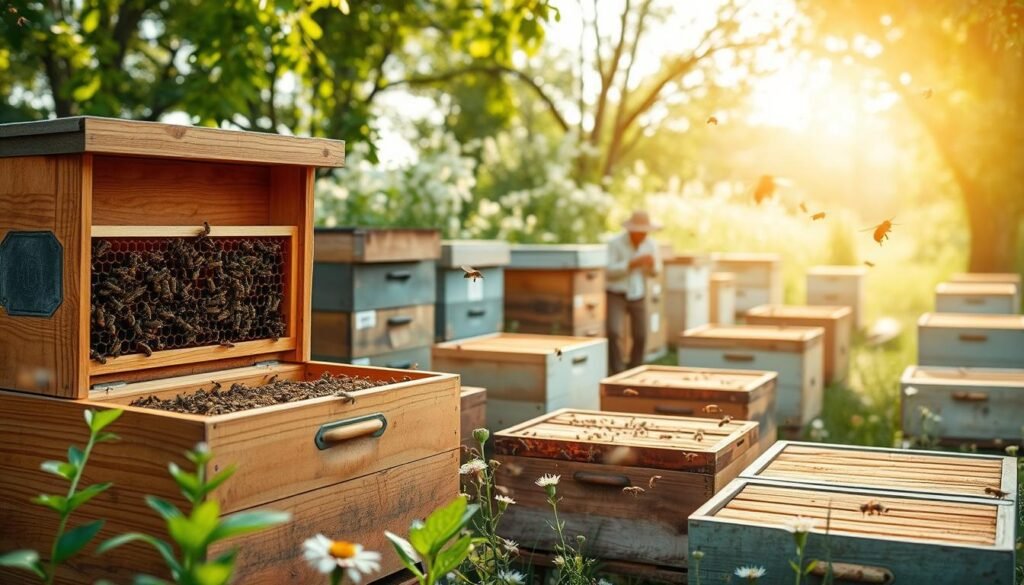
Giving colonies usable room ahead of spring bloom keeps brood healthy and foragers productive. Simple, timed moves prevent back-filled comb and reduce pressure for a split.
Reverse the deeps to open the brood nest
In spring, reversing deep boxes drops the cluster lower and shifts storage upward. This opens the brood nest and gives the queen fresh cells for laying.
Super up early with drawn comb
Supering before heavy nectar arrives lets foragers store honey in ready comb rather than filling brood cells. Use drawn comb whenever possible; even cull-target comb helps short-term capacity.
Add supers in pairs and arrange frames smartly
Add supers in pairs when drawn comb is available so the colony expands evenly. Reconfigure frames to place open drawn cells at brood margins. Put any bare foundation in outer positions to avoid chilling brood while increasing usable volume.
- Staged boxes: keep extra boxes ready for your local flow.
- Immediate use matters: bees need accessible comb more than raw volume.
- Less disruption: proactive space management cuts the need for drastic intervention later.
Ventilation and entrance management to reduce hive congestion
When internal heat and moisture rise, the colony interprets the change as crowding even if boxes are present. Poor airflow makes the hive feel full and increases the chance of a swarm impulse.
Heat and humidity cues matter. Warm, humid air near the brood raises perceived density. Bees respond by building queen cells or moving cluster position. Excess moisture from stored honey can intensify the effect.
Practical entrance adjustments: widen the main entrance during strong flows. Add an upper vent or small shims to let warm air escape. Ensure moving air passes above the brood without creating drafts that chill open brood.
- Reassess ventilation each time you add a box; airflow paths change as the stack grows.
- Pair ventilation upgrades with available drawn comb so upper boxes read as usable space.
- Watch for heavy bearding on warm evenings — a clear sign internal air management lags demand.
| Quick check | What to watch | Action |
|---|---|---|
| Entrance traffic | Normal flow or clogged | Open entrance slightly |
| Fanning behavior | Excessive at board | Add upper vent |
| Internal moisture | Dew on frames | Improve airflow, replace wet frames |
Remember: ventilation helps but does not replace giving real space. Use both measures together and check changes over short time intervals for best results.
Requeening for swarm prevention and stronger colonies
A planned requeening in July can reset hive dynamics and raise winter survival rates.
Benefits of a young queen: a young queen emits stronger pheromones, which improves colony cohesion and lowers the urge to split. Strong chemical signals keep workers unified and reduce queen cell production.
Mid-summer timing and winter preparation
Requeening in mid-summer builds more fat winter bees; studies show roughly 3,000 extra long-lived workers when done in July. Plan the swap so the new queen lays early enough for two brood cycles—about 42 days before first freeze.
- Brood break synergy: the pause in brood rearing helps mite control; pair it with oxalic acid when other miticides are unsuitable.
- Sourcing: purchased mated queens, locally bred queens, or allowing the hive to rear a new queen each carry trade-offs in temperament and acceptance.
- Follow-up: track acceptance, laying pattern, and temperament; inspect cells and brood after several weeks.
Note: requeening improves cohesion but does not replace good space management or ventilation. For a practical split method that keeps workforce levels, see swarm control split.
Splits that satisfy the swarm impulse without losing bees
A clean, well-timed split gives a crowded hive room to breathe while keeping most workers productive.
Simple split recipe:
Make a basic split
- Move three frames of brood plus one frame of food with adhering bees into a new box with clean frames.
- Place the old queen on those frames so the new unit is queen-right from the start.
- Give the new boxes an entrance oriented away from the parent hive and set them a few yards apart to reduce drift.
Alternatives and timing
Walk-away splits are easy: leave both units queenless long enough for the new one to raise a queen. They need mature drones nearby; drones reach readiness roughly 12 days after emerging.
Queen cell splits use a charged cell from a strong hive when timing fits the reproductive cycle. A healthy queen cell can head a split with minimal intervention.
Purchased queen splits offer quick, reliable requeening. Introducing a mated new queen shortens uncertain days and reduces chances of failed mating flights.
| Split type | Pros | Cons |
|---|---|---|
| Simple (old queen) | Keeps workforce; immediate laying | Requires frames and careful transfer |
| Walk-away (raise queen) | Low cost; natural queen | Needs local drones; longer queenless period |
| Purchased queen | Fast, predictable | Cost, potential acceptance issues |
Follow-up: recheck the new units within 3–7 days for signs of queen-right status and again after ~14 days for steady brood pattern. Proper splits reduce crowding and lower swarming pressure during critical flow.
For guidance on discerning cell types before using one, see identifying queen cell types.
Advanced swarm control: Demaree method and brood separation
Moving open brood away from the queen draws nurse attention upward and relieves brood-nest pressure without sacrificing the field force.
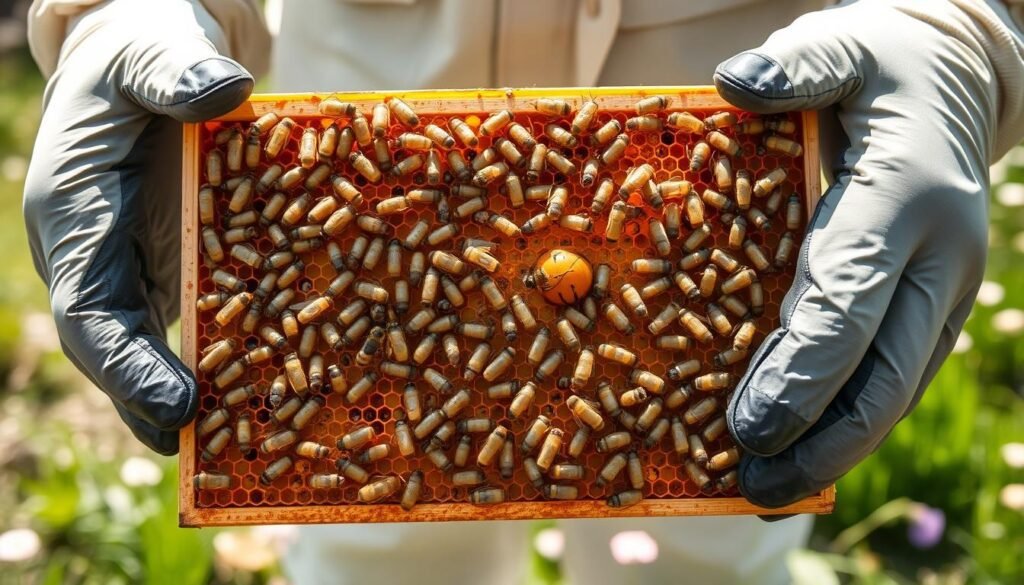
Demaree setup: confine the queen below in a clean lower box. Place one box of honey or an empty spacer above, then add a top box containing open brood and fresh frames. This vertical gap keeps the queen separated while keeping adult workers united.
How it works in practice
Nurse bees follow open brood. When you lift young brood above, nurses move up and reduce crowding around the queen. That change lowers cues that trigger queen cell production.
Rotation, timing, and handling cells
Rotate every 7–9 days during peak flow. Move capped brood down and eggs or young larvae up. Repeat across several weeks as needed to maintain relief.
- Cull upper queen cells if you want one queen.
- Transplant cells into mating nucs for new queens.
- Or leave a single managed cell for a two-queen setup; reunite or cull the old queen after the honey flow.
“Demaree preserves foragers and can be repeated to carry a hive through peak reproductive pressure.”
| Step | Purpose | Timing |
|---|---|---|
| Queen confined below | Stops laying pressure near open brood | Immediate |
| Open brood lifted | Draws nurse bees upward | Day 0 |
| Rotate capped/down | Maintain stimulus; swap developing stages | Every 7–9 days |
| Manage queen cells | Cull, reuse, or create dual-queen unit | As discovered |
Recordkeeping and calendar reminders are essential. Accurate notes help hit each rotation on time. Demaree complements early supering and good ventilation for best results.
Double-screen boards and last-minute interventions
A double-screen installed between boxes separates cohorts and often halts an imminent cast. This tool creates a vertical split that keeps the queen in the lower section while letting scent and heat cross. The barrier blocks direct contact so the group most likely to depart becomes isolated above.
Quick vertical split when charged cells appear
Rapid-response steps: place a screened board between the two boxes, move the queen and three frames of stores below, then restore feed if needed. Leave enough food and room in the lower box so the queen remains content.
- Board function: blocks bee contact while allowing heat and scent exchange.
- Disrupts age classes: younger bees stay above; nurses follow open brood, removing the core leaving cohort.
- Entrances: give separate entrances for upper and lower units to cut drift and confusion.
Follow up for several days. Verify queen-right status above and below, then decide whether to cull an extra queen or reunite units. Use this only as a last resort when earlier space, ventilation, or Demaree moves failed.
| Step | Purpose | Check after |
|---|---|---|
| Install double-screen | Separate cohorts | 24–48 hours |
| Isolate queen below | Calm reproductive drive | 3–5 days |
| Manage cells | Remove or move to nuc | Within a week |
Brood nest engineering: comb building and frame placement
Small, deliberate changes at the brood margins can steer building energy into new comb rather than extra queen cells. This technique opens usable space near the center without chilling open brood.
Opening nest sides to trigger wax-making
Cut away roughly one-third of foundation on the side frames and recenter that frame. The small gap at the brood edge prompts workers to draw fresh comb on the exposed margins.
Do this three to four weeks before peak swarm season so the hive can build and rebalance. Best results come when temperatures are steady and nectar is available.
- Modify frames carefully at the bench; avoid tearing central cells.
- Return the altered frame to the brood periphery with the cut edge toward the center.
- Keep open drawn comb rotated into supers or outer positions as they fill with honey.
Benefits: targeted comb building reduces backfilling pressure and preserves egg-laying lanes for the queen. Track which frames were modified and note build-out rates for future planning.
Integrate this move with early supering, reversing deeps, or Demaree rotations to stay ahead of congestion and protect long-term colony health.
How to find and handle the queen when management requires it
Spotting the queen’s retinue and wake gives a clear clue to her location. Look for a dense five-inch circle of bees on top bars or a narrow wake where a moving queen parts the cluster. Avoid heavy smoking; calm hands and light movement work better.
Reading the frame:
Retinues, wake patterns, and thorax cues
Search slowly along each frame edge. Retinue clusters of workers and a smooth trail often point to a queen nearby.
The queen’s thorax is noticeably bald and shiny from cell measuring. Use that cue to tell her apart from large, fuzzy drones.
Queen excluder-assisted finding and caution with virgins
A simple excluder method helps: shake frames gently above an excluder so most workers pass through while the queen remains. This is a low-skill, fail-safe capture workflow.
Warning: newly emerged virgins may slip through an excluder. Avoid aggressive hunting for at least two weeks after emergence.
- Quick workflow: remove an outer frame, move briskly, and keep frames over the hive to prevent losses.
- Safe handling: cage by the thorax only, include four to five nurse bees to feed her, and never compress the abdomen.
- Practice: mark drones first when learning marking techniques; it lowers risk before you attempt queen marking.
“Reliable queen handling opens advanced moves like splits, requeening, and Demaree execution.”
For planning larger moves and equipment checks, see beekeeping expansion tips.
What not to do when colonies are preparing to swarm
Acting on wishful thinking during buildup wastes the narrow window for effective intervention. Don’t rely on luck when signs appear. Quick, correct moves win; hopeful waiting loses precious time.
Common mistakes and why they fail
Cutting visible queen cells only delays an outcome. Colonies maintain backup cells and rebuild rapidly. Removing one or two open cells often buys hours, not days.
Delays cost time. A capped cell becomes irreversible very fast. Waiting while you hope for the best reduces options and raises winter risk.
Entrance excluders can trap drones and worsen congestion. Slimmed queens sometimes squeeze past the barrier, so excluders do not reliably stop a swarm but can raise brood-area stress.
Excessive smoking or rough inspections also harm the queen and can increase departure odds. Likewise, stripping too many resources from the brood nest misaligns age structure and reduces nurse capacity.
- Replace passive tactics with a concrete plan: inspections, early supering, requeening.
- Use splits, Demaree, or reversible moves rather than cosmetic fixes.
- Prepare equipment and written checklists before flow begins.
| Wrong action | Why it fails | Better response |
|---|---|---|
| Cutting visible cells | Colony rebuilds backups | Plan split or Demaree |
| Relying on hope | Wastes critical time | Inspect every 5–6 days |
| Entrance excluder only | Traps drones, may not hold queen | Improve space and ventilation |
| Over-smoking | Stresses queen | Work calmly with minimal smoke |
Bee breeds, location, and management style: tailoring your prevention plan
A beekeeper’s choice of breeder lines shapes colony temperament, productivity, and swarm tendencies. Select stocks that match your local climate. Some strains show low reproductive drive but less honey output; others produce heavily yet need firm management.
Match queens to winter severity. In cold regions pick lines with high overwintering strength. In mild areas favor productive lines that build fast during spring flows.
Adjust inspections and space creation by bloom timing, not by calendar. Urban, suburban, rural locations have different nuisance risks and retrieval chances; record outcomes by stock and method.
- Choose queen sources for traits you need: gentleness, productivity, or low reproductive drive.
- Document which hive setups, supers, and comb practices yielded best results.
- Balance goals: increase colonies when you want more stock; prioritize honey yield when market matters.
For season-specific checklists see seasonal tasks. Good records help beekeepers refine plans each spring and improve success year after year.
If they swarm anyway: safe retrieval, rehiving, and community relations
A paused cluster on a tree or structure gives a short window for safe capture and rehiving. Act calmly. Prepare equipment and notify neighbors before you work.
Capturing a cluster and starting a new box
Field checklist: gloves, veil, sheet, nuc or box, bucket, gentle brush, and a light smoker if needed.
- Cover area with a sheet and use a soft shake or brush to move bees into a waiting box.
- Watch for the queen: if workers march into the box and regroup, you likely have her.
- Provide drawn frames when possible; drawn comb speeds honey storage and comb building.
Transport and placement: set the new hive on a stable stand in shade. Give a small entrance and water nearby. Move the box only after bees calm, usually a few days.
Community steps: tell neighbors the cluster is temporary, describe your plan, and reassure them about safety. Check local rules and HOA policies before rehiving in dense areas.
| Action | Why | Timing |
|---|---|---|
| Use drawn frames | Encourages fast comb work | Immediate |
| Confirm queen | Ensures colony cohesion | During capture |
| Log event | Tracks source and prevention | Same day |
“A prompt, polite response protects neighbors and turns a cast into a productive new hive.”
Conclusion
A clear, practiced routine prevents last-minute crises and preserves honey stores.
Anticipate spring, inspect on a five-to-six-day rhythm, and act before visible bearding appears. Prioritize space by adding supers and keeping the brood nest open; a strong queen reduces pressure, while planned splits or Demaree moves handle stubborn congestion.
Document dates, frames of brood, and any charged cells. Mid-summer queen refreshes create better winter bees and aid mite control. Treat this as a program: manage causes not symptoms, keep equipment ready, and refine plans for your local forage and microclimate.
Steady practice protects honey, keeps the hive healthy, and builds neighborhood goodwill.
FAQ
What is swarming and why does it matter for my hive and neighborhood?
Swarming is the honey bee colony’s natural reproduction process when a large group, led by the old queen, leaves to form a new colony. It matters because you can lose a large portion of your workforce and honey stores, neighbors may be alarmed, and stray colonies can spread pests like Varroa mites if not managed. In beekeeping, preventing or managing swarms protects production and community safety.
How does natural colony reproduction differ from managed beekeeping goals?
Wild colony reproduction prioritizes splitting when conditions are favorable. Managed beekeeping aims to keep colonies strong, harvest honey, and control pests. That often requires interventions—adding space, requeening, or making splits—to satisfy the bees’ reproductive impulse while retaining bees and stores.
When is swarm season in the United States?
Primary swarms typically occur in spring during major nectar flows, with regional timing from early spring in the south to late spring in northern states. Secondary swarms or casts can appear later in the season when colonies stay populous and resources continue. Local climate and forage influence exact timing.
What colony conditions trigger swarming?
Key drivers include a congested brood nest, back-filled comb with nectar or honey, declining queen mandibular pheromone from an aging queen, poor ventilation, and rapid population increases after rainy weeks. Any combination can prompt the colony to initiate queen cells and prepare to depart.
How often should I inspect hives in spring to catch swarm signs early?
Perform cadence checks every five to six days during peak swarming season. That interval matches the queen cell development timeline and lets you spot and act on queen cells, packed frames, and other early symptoms before emergence.
What should I look for during inspections to spot impending swarming?
Look for queen cells on the edges or bottom of frames, crowded brood frames, many hanging bees, and heavy stores back-filling the brood area. Drone comb alone is not always a sign, but multiple sealed queen cells mean action is urgent.
How can I create space to prevent swarming?
Add drawn comb supers early, reverse deep brood boxes to open the nest, and give supers in pairs when combs are drawn. Providing accessible, familiar comb lets foragers store nectar outside the brood nest and reduces the pressure to swarm.
What is reversing deeps and why does it help?
Reversing deeps means switching the position of lower and upper brood boxes so nurse bees move down and create room in the brood nest. It interrupts congestion, encourages wax building, and reduces the urge to create queen cells.
When should I add supers and what kind should I use?
Super up early when you see increased nectar flow or the colony begins filling frames. Use supers with drawn comb when possible; foundation-only supers can work but take time. Adding two supers together prevents creating a tight bottleneck at a single box.
How does ventilation and entrance management reduce swarm pressure?
Improving airflow lowers hive temperature and humidity, helping to disperse queen pheromone and reducing crowding near the entrance. Wider entrances or screened bottom boards during hot spells can cut congestion and the bees’ drive to abscond.
Why requeen for swarm prevention and when is the best timing?
Young queens produce stronger, more consistent queen mandibular pheromone (QMP), which suppresses queen cell production. Mid-summer requeening also helps create a brood break that benefits Varroa control and produces robust winter bees. Replace old, inconsistent queens before peak swarm season.
How do splits satisfy the swarm impulse without losing bees?
Splits mimic the natural swarm by creating a new nucleus colony from frames of brood, food, and either the old queen or a new queen cell. A properly made split reduces internal pressure, preserves foragers and stores, and yields two managed colonies instead of an uncontrolled swarm.
What are simple split methods I can use?
Simple options include walk-away splits (move frames and the queen to a new hive), queen-cell splits (allow a new queen to emerge in the new unit), or purchasing a mated queen for introduction. Each method suits different skill levels and seasonal conditions.
What is the Demaree method and when should I use it?
The Demaree method separates the queen from most brood by moving frames and using boxes to mix nurse bee distribution. It reduces swarming instinct without removing foragers. Use it when queen cells are present but you want to keep colony strength intact during flows.
How can brood nest engineering help prevent swarming?
Strategic frame placement encourages comb building and brood expansion where you want it. Opening the brood nest sides, providing drawn comb, and shifting frames can stimulate wax production and move the brood pattern to relieve overcrowding.
How do I find and handle the queen safely during management?
Learn to read the frame—retinues of attendants, wake patterns, and thorax shape guide your search. Use a gentle approach, smoke lightly, and consider queen excluder-assisted finding or marking queens. Avoid rough handling, especially with virgin queens present.
What should I avoid doing when colonies prepare to swarm?
Do not simply cut out queen cells and hope the problem disappears—bees will raise more. Relying solely on entrance excluders or cosmetic fixes fails if the underlying congestion or weak QMP remains. Take proactive measures like adding space or splitting.
How do breed, location, and management style influence prevention plans?
Different honey bee strains vary in swarming tendency; location affects nectar flows and season length; management intensity changes options available. Tailor interventions—earlier supering, regular requeening, or routine splits—based on breed and site specifics.
What if my colony swarms anyway — how do I retrieve and rehive a swarm?
Prioritize safety and neighbors. If a swarm lands within reach, use a box with frames or foundation and gently shake or brush the cluster inside. Keep the new hive near where the swarm landed for a day so scouts return. Contact local beekeeping clubs or experienced beekeepers if assistance is needed.
When are last-minute interventions useful, and what are they?
When swarming is imminent, options include double-screen boards, vertical splits, or temporarily blocking queen cell development long enough to implement a split. These are stop-gap tactics and work best combined with longer-term swarm control practices.
How should I time rotations, removing or using queen cells during a nectar flow?
Timing matters: manage queen cells based on their development stage and the flow. Removing cells too late wastes effort; rotating frames and moving open brood up can redirect nurse bee activity during a flow. Make changes between five- to seven-day windows to stay ahead of queen emergence.
Can managing comb and frame placement trigger wax-making and reduce swarming?
Yes. Placing available space and foundation adjacent to brood stimulates wax building. Encourage comb drawing by using drawn frames and by orienting resources where nurse bees can easily access them, which eases pressure in the brood nest.
What community considerations should I keep in mind if a swarm appears?
Notify neighbors and local extension or beekeeping groups when swarms are present. Prompt retrieval and rehiving protect public safety and reduce the chance of swarms establishing feral, untreated colonies that can spread pests to other apiaries.