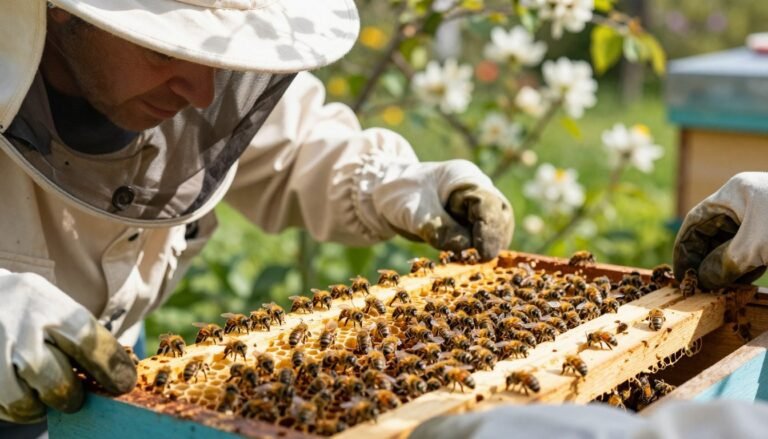
Modern beekeepers must monitor mite levels to keep hives healthy and productive. Since Varroa destructor arrived in the U.S. in the late 1980s, apiary management has changed. Regular checks help you act when counts approach a dangerous threshold.
Nonlethal methods like the sugar shake let you count mites while keeping the vast majority of your colony safe. This approach reduces reliance on harsh chemicals that can build up in wax and honey. For a durable option, consider tools such as the Varroa Easy Check or a standard alcohol wash for comparison.
Understanding exposure thresholds and sampling methods lets you protect colonies and preserve honey yields. Follow a repeatable plan so you can spot trends and choose intervention only when needed.
Key Takeaways
- Monitor mite levels regularly to protect colony health and honey production.
- Use nonlethal assays like the sugar shake to minimize harm while getting reliable data.
- Compare methods—sugar roll, alcohol wash, and tools like the Easy Check—for your operation.
- Know your threshold to decide when control measures are truly necessary.
- Maintain records and repeat checks to track trends and reduce chemical reliance.
Understanding the Varroa Mite Threat
Small, fast-breeding parasites can turn a strong hive into a fragile one in a single season. Beekeepers must grasp life stages and impacts to act before damage is irreversible.
The Reproduction Cycle
Female varroa enter brood cells just before capping. They lay eggs that develop into adults in about ten days.
Adult females live roughly two months. That gives them time to reproduce multiple times in one season.
Impact on Colony Health
The growing mite population weakens honey bee larvae and adult workers. Infected colonies show lower weight in hatching bees and shorter queen life.
Phoretic mites ride on the abdomen of a bee to feed on hemolymph. This is the main way viruses, like deformed wing virus, spread through colonies.
| Stage | Duration | Where | Colony effect |
|---|---|---|---|
| Reproductive | ~10 days | Brood cells | New mites increase load |
| Phoretic | Days to weeks | On adult bee | Spreads disease |
| Adult female | ~60 days | Hive-wide | Multiple reproductive cycles |
- Monitor thresholds to catch exponential growth early.
- Act fast when counts threaten colony survival.
Why Beekeepers Prioritize Varroa Testing Without Killing Bees
Early detection gives beekeepers the clarity to act with care. Regular, nonlethal sampling reduces stress on hives and guards honey production.
Commercial operations report that colonies often struggle after exposure to neonicotinoid-treated crops. Combined pesticide exposure can weaken the immune system of a honey bee and raise overall colony risk.
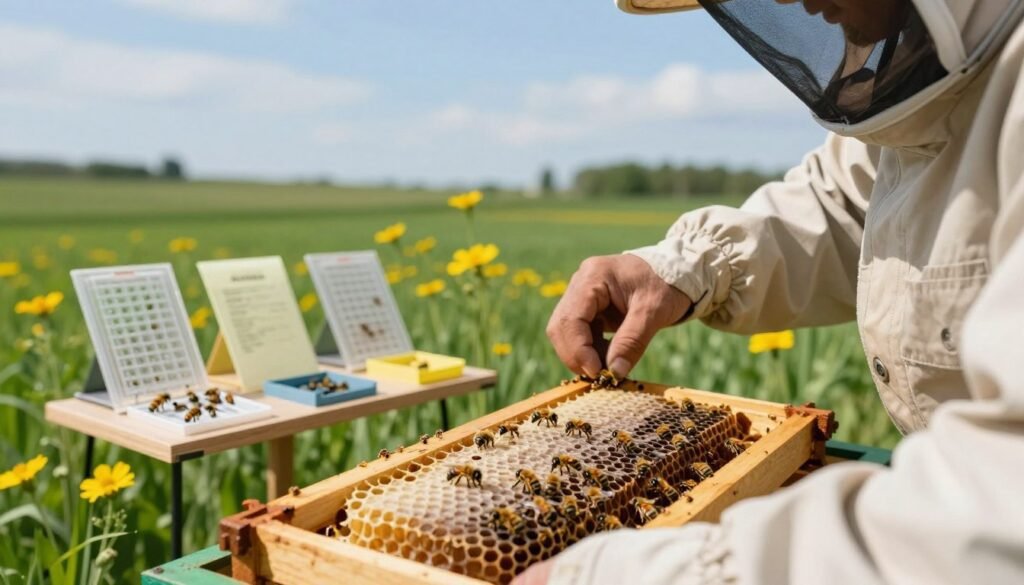
Research by Dr. Marion Ellis and Dr. Reed Johnson highlights how multiple chemicals interact inside hives. Their work supports the move away from synthetic miticides toward integrated, sustainable management.
“Multiple pesticides can create a toxic stew that lowers resilience in colonies.”
Practical advantages:
- Less chemical buildup in wax and honey.
- Ability to track counts on paper and act only when needed.
- Healthier hives over the year and better long-term productivity.
Beekeepers who monitor regularly are better prepared to manage mites and other threats. For guidance on recognizing resistance signs in a hive, see resistance signs.
Essential Equipment for Non-Lethal Monitoring
Start your non-lethal monitoring by choosing a reliable jar and a snug lid that keeps sample handling safe.
Proper gear reduces stress on honey bees and improves count accuracy. A sturdy jar, a lid fitted with mesh or drilled holes, and a reusable screen make routine checks fast and clean.
Selecting the Right Jar and Mesh
Use a jar that is easy to hold and simple to clean. Many beekeepers choose durable plastic or glass containers for long-term use.
- Lid holes: Aim for 50–70 holes sized about 3–4 mm each to let sugar or alcohol pass while keeping the bee sample contained.
- Mesh: Choose fine mesh that retains the bee but allows debris and liquid to move through.
- Tools: Consider a purpose-built unit like the Varroa EasyCheck for quicker, repeatable counts.
| Item | Specification | Benefit |
|---|---|---|
| Jar | Durable plastic or glass, 1–2 L | Easy to clean and reuse, stable grip |
| Lid | 50–70 holes, 3–4 mm each or fitted mesh | Accurate separation, prevents escapes |
| Mesh/Filter | Fine stainless or nylon mesh | Retains bees, passes sugar/alcohol |
| Specialized tool | Varroa EasyCheck style unit | Saves time, improves repeatability |
Proper preparation of your monitoring jar is the first step in managing mite levels in colonies. Using consistent methods and quality gear gives reliable numbers you can trust.
For a comparison of common sample methods and trade-offs, see the sugar roll vs alcohol wash guide.
Preparing Your Hive for Accurate Mite Counts
Prepare the hive carefully to get a clear snapshot of mite levels and colony health. Begin by locating brood frames where worker activity is highest. Focus on the center of the cluster for a representative sample.
If you spot the queen on the frame you’ve chosen, gently return her to the hive. A safe queen reduces stress and keeps the brood pattern steady. A consistent brood pattern is a strong sign the queen is laying well.
Gather all equipment before opening the brood box so the hive stays open for as little time as possible. Move slowly and use a gentle touch when collecting the sample to limit agitation in the colonies.
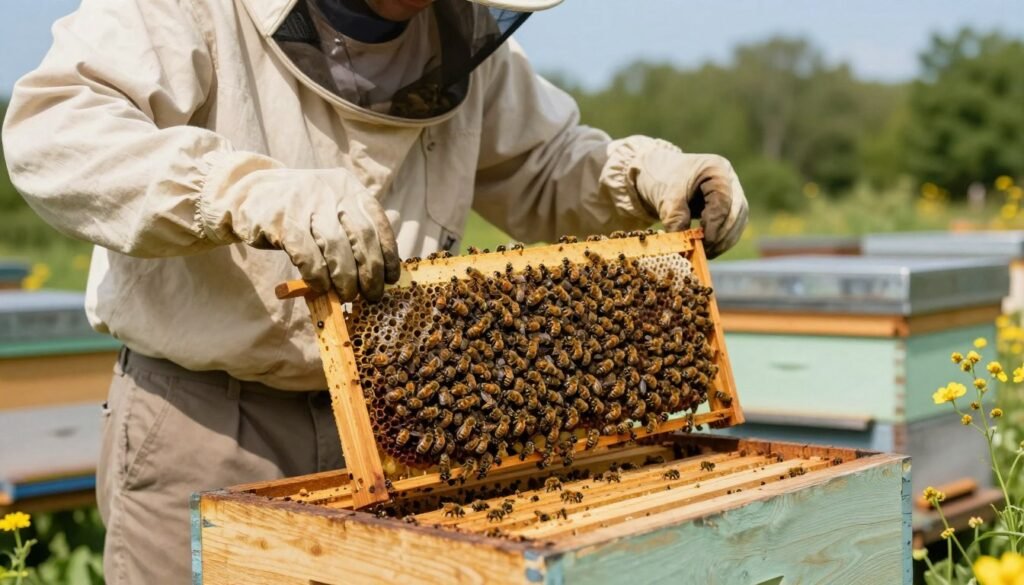
“Work quickly, calmly, and efficiently to protect honey and colony health.”
Wear proper protective clothing and focus on the cluster center when sampling. A well-prepared hive gives more reliable counts and helps beekeepers make informed choices for long-term hive care.
Performing the Sugar Roll Method
Simple gear and steady hands make the sugar shake method practical and kind for regular checks. Gather a jar, a lid with mesh, and a gentle smoker if needed. Aim to collect about 300 bees from the brood area for a representative sample.
Step-by-Step Application
- Place the ~300 bee sample into the jar and secure the lid.
- Add a heaped tablespoon of icing sugar or powdered sugar.
- Vigorously rotate the jar for 2 minutes so the sugar coats the bees and dislodges mites.
- Wait 2–3 minutes, then rotate a second time for another 2 minutes.
- Remove the lid and count mites on the screen or in a shallow dish. Record the number and sample size.
Managing Humidity Challenges
High moisture makes powdered sugar clump and reduces effectiveness. Work on a dry day or in a sheltered spot to limit wind and dampness.
Releasing Sampled Bees
After counting, release the live bee sample near the hive entrance so they can return. If you prefer maximum accuracy, an alcohol wash at 70% will detach more mites but is lethal to the sample.
| Step | Time | Note |
|---|---|---|
| Collect sample | 5 min | ~300 bees from brood frames |
| First rotation | 2 min | Coats bees with sugar |
| Rest | 2–3 min | Let mites loosen |
| Second rotation & count | 2 min | Count mites; release bees |
Keep records and compare counts over time. For guidance on follow-up checks and post-control monitoring, see the post-treatment mite count guide.
Evaluating Alternative Non-Lethal Techniques
Exploring multiple sampling methods helps match your approach to local climate and colony size. Different methods trade speed for precision and welfare. Choose the one that fits your operation and goals.

CO2-based approaches are gaining attention. They can loosen mites without harming a large share of the sample. Early studies suggest better counts in some conditions, but units and technique matter.
- Powdered sugar (sugar shake) works well in dry weather but loses accuracy in high humidity.
- Alcohol wash remains the most consistent method for precision, though it sacrifices a small bee sample.
- Consider time per hive, needed precision, and hive numbers when picking a method.
Be consistent across your hives and season to track trends. Try two methods side-by-side on a few hives to see which fits your climate and colony size.
“Stay open to new tools and published work; ongoing research refines what works best for monitoring and care.”
For more on recent CO2 research and evolving methods, see this recent CO2 study. Consistent sampling gives the data you need to keep colonies healthy and productive.
Interpreting Your Results and Economic Thresholds
Clear interpretation of your sample count turns numbers into timely action for hive health. Record the count, sample size, and date each time you check a hive. Consistent notes give beekeepers the trend data needed to decide if and when to treat.
Determining When to Treat
Most guides set the economic threshold at 3 mites per 100 bees. Finding more than that means the colony is at risk and likely needs treatment to protect honey production and brood health.
Thresholds change by season and region. Compare your results to local recommendations and recent research. If counts are high, act quickly: mites spread rapidly between hives and colonies.
| Metric | Action | Notes |
|---|---|---|
| >3 mites /100 bees | Treat | Consider control suited to season and colony strength |
| 1–3 mites /100 bees | Monitor | Increase check frequency and record results |
| 0–1 mites /100 bees | No immediate action | Keep scheduled checks |
If you suspect a severe infestation, call the Exotic Plant Pest Hotline at 1800 084 881 for help. For method context, see reconnaissance sampling and guidance on how to read an alcohol wash mite count.
Good recordkeeping and prompt, measured treatment choices safeguard your hive and the long-term health of your bees.
Managing Mite Populations Sustainably
Long-term apiary health depends on mixing cultural steps, mechanical aids, and targeted treatments to keep mite levels below the critical threshold.
Breeding for resistance is a goal many researchers pursue. Selecting stock with hygienic behavior and mite-tolerant traits reduces pressure across the year.
Cultural practices help now: brood breaks, timed splits, and requeening can lower mite reproduction without heavy chemicals. A screened bottom board adds a simple mechanical layer to trap falling mites and improve ventilation.
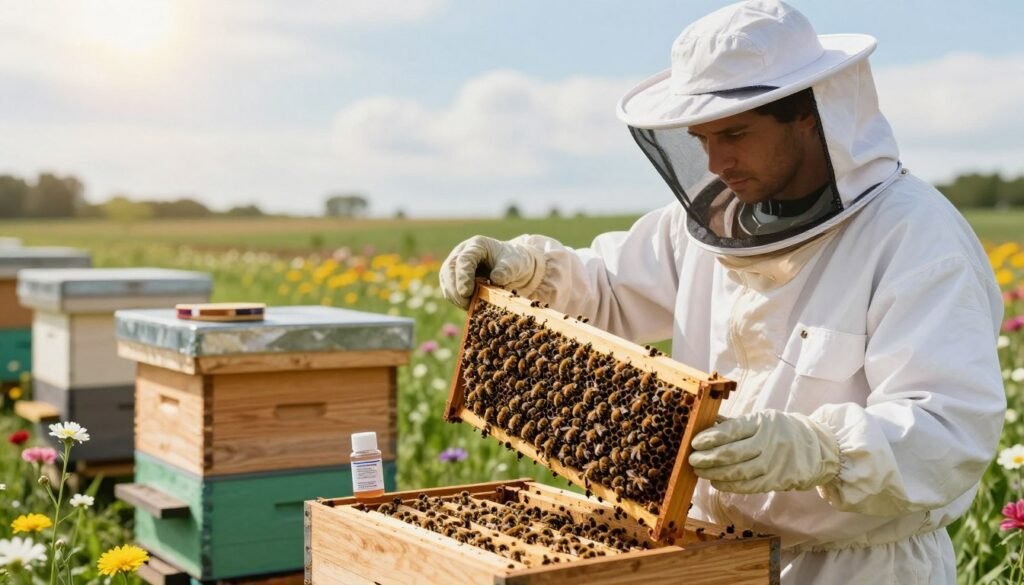
Focus on overall colony strength. Healthy brood patterns, a vigorous queen, and adequate forage give honey bees the resilience to withstand exposure and seasonal spikes.
Monitor regularly and adjust for each hive. Use resources like how to monitor properly and compare control options such as formic vs oxalic approaches.
“Proactive, low-impact management keeps colonies healthy and cuts the need for emergency treatment.”
Conclusion
A steady monitoring routine gives you the confidence to make timely control choices. Use the sugar shake method with a prepared jar and snug lid, a half‑cup measuring cup, and pure icing sugar or powdered sugar to sample about 300 bees.
Record your results on paper and compare counts over the season. Clean gear with fresh water between uses and keep samples consistent so the data guides your beekeeping decisions.
When you need method comparison, see details on a standard 300-bee sample. These steps help keep honey bee colonies productive, keep most insects alive, and reduce the need to kill bees or use harsh chemicals.
FAQ
What is the sugar roll method and why use it?
The sugar roll is a non-lethal sampling technique that dislodges mites from worker honey bees using powdered sugar. It lets beekeepers count mites per roughly 300 adult bees, estimate infestation levels, and decide if treatment is needed while keeping the sample bees alive for return to the hive.
How many bees should I collect for an accurate count?
Collect about 300 forager or nurse bees from the brood area for a representative sample. This number gives consistent results for comparisons across hives and seasons and helps you calculate mites per 100 bees to compare against economic thresholds.
What equipment is essential for a non-lethal sugar shake?
Use a jar or commercial mite test kit with a fine mesh lid, a clean cup or scoop, and powdered sugar (icing sugar). A fitted cover or secondary mesh helps hold bees while shaking. Many beekeepers use mason jars with a screened lid or a professional sugar-roll kit for reliability.
How long should I shake the jar during the test?
Shake firmly for about one minute. This duration is usually enough to free most mites without harming the bees. After shaking, invert and tap the jar so the sugar and dislodged mites fall onto a white surface for counting.
Do temperature or humidity affect the sugar roll?
Yes. High humidity can cause the sugar to clump and stick to bees, reducing mite removal efficiency. Perform tests in dry conditions when possible or use a slightly longer shake and ensure sugar is dry to improve results.
How do I release the sampled bees back to the hive safely?
After counting, gently open the jar and place bees near the hive entrance or directly on comb frames inside a shaded hive. Keep them calm and return them quickly to avoid stress on the colony and ensure the queen remains safe.
How do I convert my mite count to an infestation rate?
Count mites collected and divide by the number of bees sampled, then multiply by 100 to get mites per 100 bees. For example, 6 mites from 300 bees equals 2 mites per 100 bees. Many extension services publish thresholds that guide treatment decisions.
What are common economic thresholds for action?
Thresholds vary by season, region, and colony strength, but a common guideline is 3 mites per 100 bees (3%) during summer for strong colonies. Consult local extension services and research from universities like Penn State or Washington State for region-specific thresholds.
Are there reliable alternatives to the sugar roll?
Yes. Alternatives include powdered sugar with different jars, the iced sugar method, and non-lethal visual checks on drone brood. Alcohol washes remain the most accurate but kill the sampled bees. Some beekeepers use sticky boards or professional monitoring trays for ongoing surveillance.
Can repeated monitoring reduce chemical treatments?
Regular, accurate monitoring lets you apply treatments only when thresholds are exceeded. Timely actions, plus integrated pest management (IPM) strategies like drone brood removal, screened bottom boards, and biotechnical controls, help keep mite levels down and reduce reliance on chemicals.
How often should I monitor colonies during the year?
Monitor at key times: early spring after winter build-up, mid-summer before honey flow, and late summer/fall before wintering. Increased checks during brood breaks or after treatment help assess effectiveness and guide follow-up actions.
Will the sugar roll harm the queen or reduce colony strength?
When done correctly, the sugar roll does not harm the queen or reduce colony strength. Sample bees are returned alive. Use gentle handling, collect bees away from the queen, and avoid prolonged exposure outside the hive to minimize stress.
Where can I find validated protocols and further reading?
University extension services (e.g., Cornell, University of Minnesota), USDA publications, and beekeeper organizations like the American Beekeeping Federation provide validated protocols and research papers on sampling methods, thresholds, and sustainable mite control practices.