
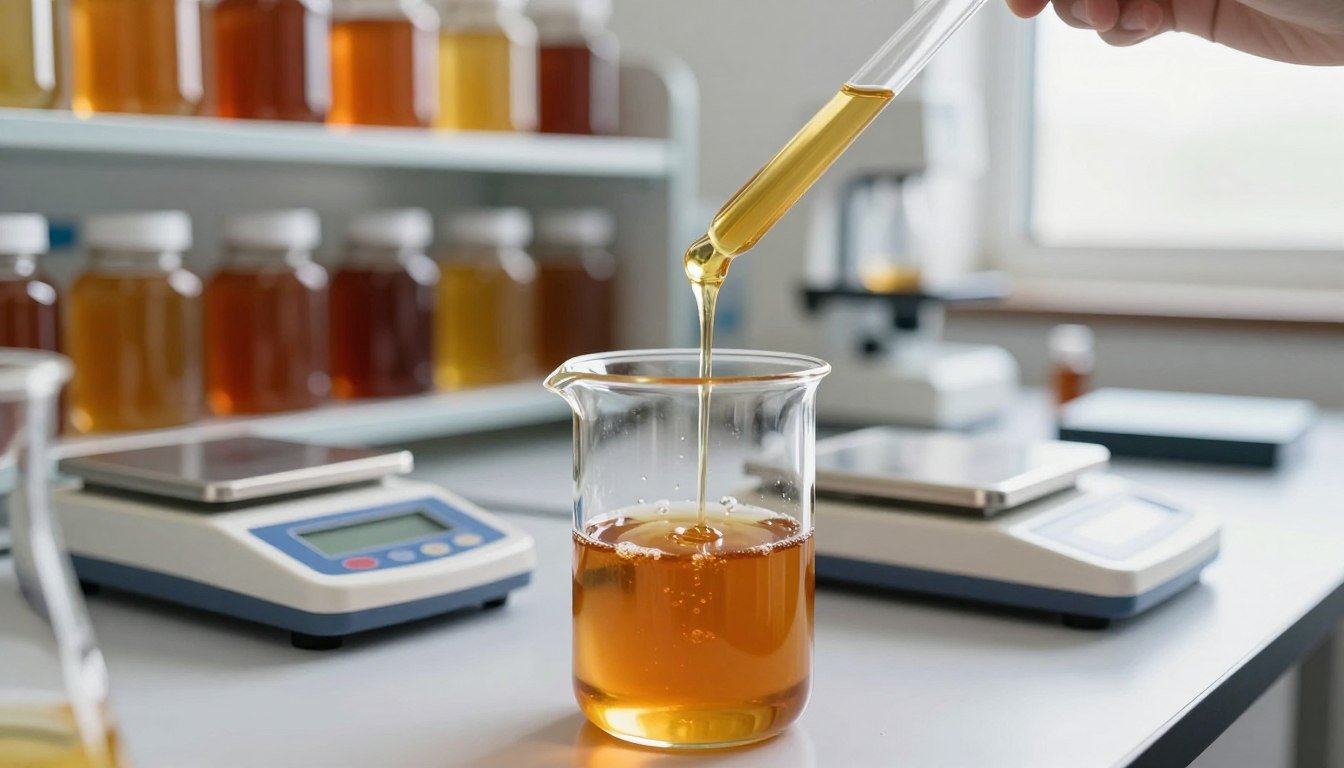
The diastase number is a vital lab metric used to judge the quality of natural sweeteners. It reflects enzyme activity that bees add during production and helps detect overheating or adulteration.
Standards such as Codex and EU regulation 2001/110/EC set reference limits. Most markets require a minimum of 8 DN on the Schade scale for acceptable products. That threshold helps protect food safety and origin claims.
Testing follows a controlled method. Labs keep samples at a steady 40°C water bath so the enzyme reaction proceeds reliably. Analysts measure absorbance at 660nm with a UV-Vis spectrophotometer to track starch hydrolysis and calculate values.
Practical takeaway: poor storage or excess heat lowers enzyme content and can reduce the result below the required number, risking rejection of samples.
For more detail on enzymes and testing protocols, see this overview on analyzing components of honey.
Key Takeaways
- Diastase number signals natural enzyme activity and product quality.
- Regulations often demand at least 8 DN on the Schade scale for market acceptance.
- Accurate testing needs a 40°C water bath and 660nm absorbance readings.
- Heat and poor storage degrade enzyme content and lower measured values.
- Proper methods help distinguish authentic products from altered samples.
Understanding the Diastase Number in Honey Explained
Alpha-amylase is the key enzyme bees add to nectar, and its activity reveals much about product quality.
What is Diastase
Diastase refers to the natural enzyme activity that remains after bees process nectar.
Laboratory assays measure how quickly starch breaks down to confirm authenticity and detect overheating.
The Role of Alpha-Amylase
Alpha-amylase drives starch hydrolysis. Higher activity usually signals minimal heat treatment and authentic origin.
The classic Schade method, set in 1958, still guides the determination of enzyme levels across many samples.
- Varietal differences: certain floral types may have lower baseline values and special lower limits apply for some products.
- Practical note: labs follow strict temperature and absorbance protocols to produce reliable results; see a procedural overview here.
- Home checks: simple purity tips are available for consumers at Beekeeper’s Realm.
Why Enzyme Activity Matters for Honey Quality
Enzyme activity serves as a biological fingerprint that links product quality to hive health and handling.
Low enzyme signals show thermal damage or dilution. Heat destroys delicate proteins and alters results for a sample.
The Codex Alimentarius sets global thresholds to preserve natural properties and protect food integrity.
“Consistent enzyme levels separate premium products from those degraded by processing or adulteration.”
Testing detects added sugars because foreign syrups lack native enzymes. Robust methods give absorbance data and clear analysis.
| Indicator | What It Shows | Interpretation |
|---|---|---|
| Enzyme activity | Protein integrity | High activity = minimal heat, better quality |
| Absorbance assay | Chemical reaction rate | Faster change = higher enzyme content |
| Sample analysis | Adulteration check | Lower enzyme levels suggest foreign sugars |
For background on natural enzymes, see a guide to living enzymes. For how floral source affects pH and quality, review floral source and pH.
Regulatory Standards and Legal Requirements
International law links laboratory procedures to set limits so consumers get authentic sweet products. Clear rules help regulators judge quality and protect trade.
Key global frameworks require labs to follow verified methods and produce comparable results across borders.
Global Compliance Standards
EU regulation 2001/110/EC mandates minimum enzyme activity as a legal quality metric. This rule helps ensure processed goods have not suffered harmful heat or tampering.
The USP/FCC 2021 identity standard names the Schade method as a primary compliance tool. Many importing markets also reference the Schade scale for official acceptance of imported honeys.
“Standardized assays are the backbone of fair trade and food safety.”
- Labs must follow protocols for water baths, absorbance readings, and sample handling.
- Consistent methods create defensible data used by regulators and courts.
- Producers who meet these requirements can prove product quality and avoid rejection.
Common Laboratory Testing Methods
Accurate enzyme measurement depends on standardized procedures and consistent reaction conditions. Labs use several complementary methods to assess activity and produce comparable data.
Schade Method
The Schade approach (DIN 10750‑1) is a traditional reference. It uses a potato starch solution to measure total amylase activity. Tests run in a 40°C water bath and rely on timed hydrolysis and absorbance readings.
Phadebas Method
The Phadebas procedure employs a cross‑linked, blue‑dyed starch polymer for selective alpha‑amylase detection. It is often preferred for specific alpha assays and faster determination. For manufacturer details see the Phadebas test for alimentary use.
Nitrophenol Method
Defined under DIN 10750‑2, the Nitrophenol method uses a tailored substrate and reports an expanded uncertainty near 8%. Labs still perform the reaction at 40°C and record absorbance at 660nm for consistent measurement.

Practical note: preparing a stable starch solution and following the same water bath and spectrophotometer settings is essential to get reliable results across samples.
Factors Influencing Diastase Activity Levels
Floral origin and colony health shape the enzyme profile found across different honeys.
Botanical source sets baseline enzyme content. Some unifloral varieties, such as Pine and Avocado, often show higher beta and gamma amylase levels. These natural differences change how labs interpret results.
Temperature control during storage is critical. Prolonged heat exposure rapidly reduces enzyme content and alters assay data.
Age matters too. Enzyme activity drops over time, even at room temperature, so older samples often give lower absorbance readings.
Adulteration with sugar syrups masks authentic profiles. Syrups lack native enzyme activity and can produce artificially low values that flag further analysis.
“Knowing origin, storage, and sample age helps labs distinguish genuine activity from signs of damage or tampering.”
| Factor | Effect on Activity | Lab Implication |
|---|---|---|
| Botanical origin | Varies by floral source | Adjust reference range |
| Storage temperature | Heat lowers enzyme content | Check handling history |
| Age of sample | Gradual decline over time | Compare harvest dates |
| Adulteration | Syrups reduce apparent activity | Flag for further chemical analysis |
For practical guidance on product handling and quality differences, read our raw vs processed comparison.
Detecting Adulteration and Foreign Amylases
Detecting added enzymes relies on comparing enzyme stability after strong heat and targeted assays.
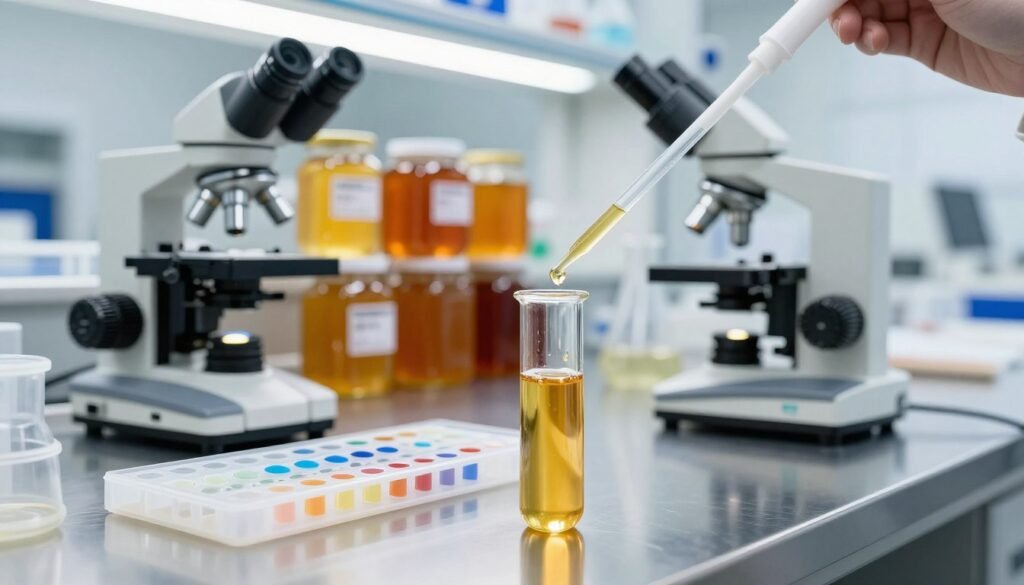
Foreign amylases may enter product by poor bee feeding or by adding starch syrups. Labs use focused procedures to spot these manipulations.
Identifying Artificial Manipulation
The Famyp method targets non‑native alpha‑amylases and helps reveal deliberate boosts to measured enzyme values.
Thermostable alpha‑amylases are a common fraud tool. Testing samples after strong heat distinguishes natural enzyme loss from thermostable additions.
“Cross‑method mismatches are a clear red flag for artificial manipulation.”
Analysts compare Schade, Phadebas, and Nitrophenol results. Discrepant data across these methods often points to adulteration. Labs also report beta and gamma activity; these should remain below 5 units/kg for most honeys, with noted botanical exceptions.
- Use advanced assays: Famyp finds foreign alpha‑amylases.
- Heat challenge: reveals thermostable enzymes.
- Multi‑method comparison: flags inconsistent results.
| Check | What it shows | Action |
|---|---|---|
| Famyp method | Non‑native alpha‑amylases | Confirm fraud; run follow‑up analysis |
| Heat stability test | Thermostable activity | Reject sample if suspicious |
| Method comparison | Cross‑method mismatch | Investigate botanical origin and additives |
For procedural guidance and case studies on adulteration detection, see the technical review at laboratory study and a practical overview of modern adulteration detection methods.
Best Practices for Sample Handling and Storage
Proper sample handling starts with consistent sampling and gentle mixing so lab results reflect the true batch. Stir each lot well and collect about 0.5kg for a representative sample. This reduces stratification and gives analysts uniform material for the assay.
Never apply heat during preparation, even if crystallization has occurred. Heating destroys native enzyme content and will invalidate the determination diastase activity measurement.
Store jars at stable room temperature until transport. Short-term refrigeration can change viscosity and complicate subsampling. Proper storage preserves enzyme activity and keeps results reliable.
During the test: keep the water bath strictly at 40°C. A constant temperature ensures reaction rates are comparable and absorbance data are valid across methods.
Prepare all reagents—acetate buffer, sodium chloride solution, and starch tablets—following verified laboratory protocols. Accurate reagent preparation is a core part of the procedure and prevents systematic error.
“Careful sampling, no heating, and strict temperature control are the cheapest quality insurance for any laboratory analysis.”
For the official procedure and technical details on determination diastase, consult the full protocol here: determination diastase.
Conclusion
Robust assays turn biological signals into actionable quality values for food oversight. The diastase number remains a key metric that links natural enzyme activity to product value and trust for honey and similar goods.
Following a consistent method yields reliable results across labs. Careful sample handling and steady temperature control keep data valid and prevent false low activity readings.
Detecting adulteration through cross‑method checks protects consumers and the market. Clear values let producers and regulators defend product quality and ensure authentic samples reach shelves.
FAQ
What is the diastase value and why is it important for honey quality?
The diastase value reflects enzyme activity—mainly alpha-amylase—that helps break down starch and indicates freshness and proper handling. High activity suggests minimal heat damage and correct storage, while low readings can signal overheating, long storage, or adulteration. This metric is commonly used by producers and regulators to assess product integrity and processing history.
Which enzyme does this test measure and what does it do?
The test targets alpha-amylase, an enzyme produced by bees and present in nectar. Alpha-amylase catalyzes the hydrolysis of starch into smaller sugars, and its activity level serves as a proxy for the biological and thermal history of the sample.
How do laboratory methods differ for measuring enzyme activity?
Common approaches include the Schade method, the Phadebas method, and nitrophenol-based assays. The Schade method measures starch breakdown with iodine, Phadebas uses a dyed starch substrate that releases color, and nitrophenol assays detect p-nitrophenol release. Each method varies in sensitivity, reagents, speed, and equipment needs.
What steps are involved in a typical enzyme activity assay?
A representative sample is dissolved and incubated with a specific substrate at controlled temperature. After a timed reaction, the product or residual substrate is quantified by absorbance or color change. Results are then converted to activity units and compared to reference values to determine compliance or quality.
How should samples be handled to preserve enzyme activity before testing?
Store samples at cool temperatures, avoid prolonged exposure to heat and sunlight, and analyze soon after collection. Use clean, sealed containers and limit freeze–thaw cycles. Proper handling minimizes loss of activity and improves reliability of results.
What factors can lower enzyme readings aside from adulteration?
Heat treatment during pasteurization, long-term storage at elevated temperatures, low pH, and moisture changes all reduce activity. Natural variation by floral source, season, and bee health also influences baseline levels.
Can foreign amylases or syrup additions affect test outcomes?
Yes. Adding external syrups or purified amylases can mask manipulation by raising or altering activity patterns. Specialized screening and complementary analyses—such as carbohydrate profiling or isotope ratio testing—help detect such adulteration.
What regulatory standards apply to enzyme activity measurements?
International and national standards define minimum acceptable activity for marketed products and outline validated methods. Laboratories follow protocols from organizations like the International Honey Commission and regional food safety authorities to ensure compliance and comparability.
How are results reported and interpreted by labs?
Results are expressed as enzyme activity units per gram or standardized units established by the chosen method. Laboratories provide raw data, method details, and reference thresholds to help producers and regulators determine product quality or conformity.
How often should producers test batches for enzyme activity?
Frequency depends on production scale, processing steps, and regulatory needs. Many commercial operations test each major batch or after thermal processing. Routine monitoring helps maintain quality control and document proper handling across the supply chain.


