Published March 31, 2026
Managing mite levels is a top priority for beekeepers during the active season. This introduction outlines how to fit thymol into a practical control plan while keeping hives strong through honey flow.
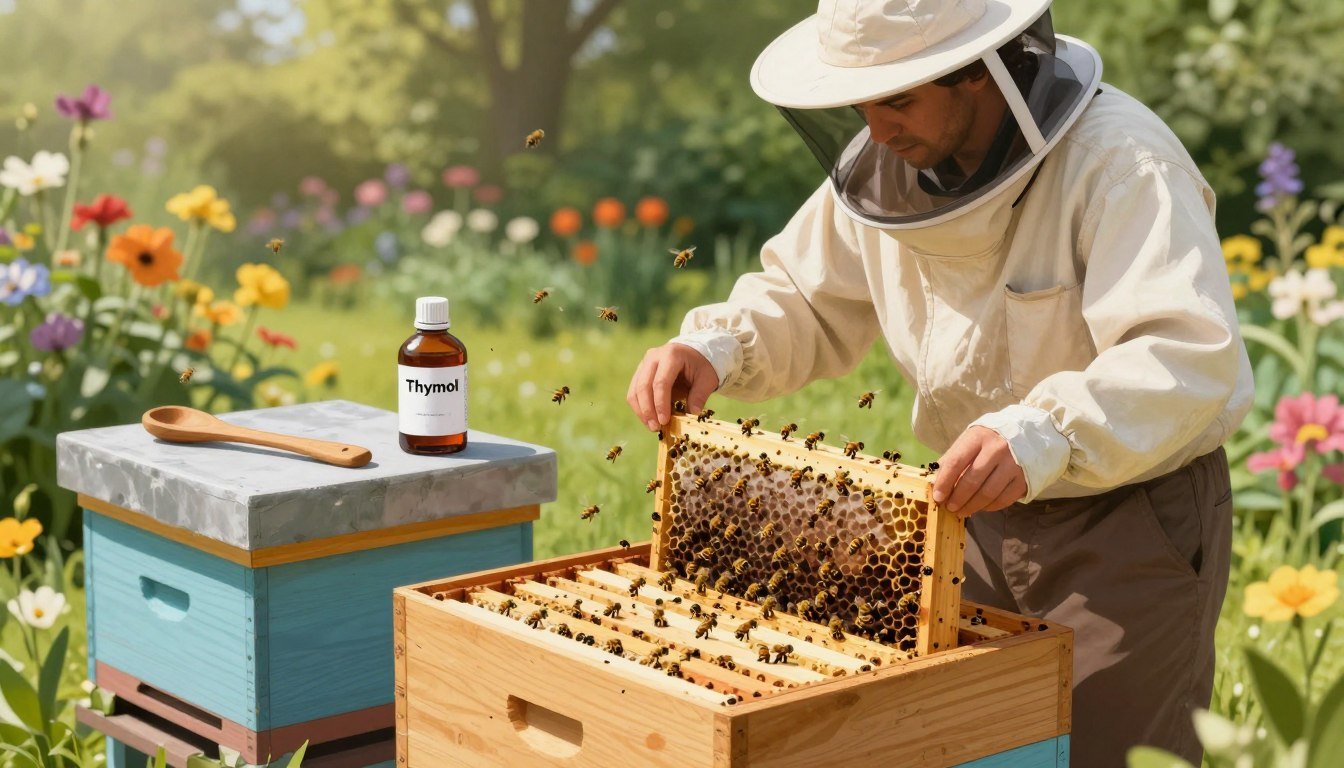
Randy Oliver of ScientificBeekeeping.com has led field research on application methods since 2017. His data show that thymol is a proven, natural miticide that bees generally tolerate well.
Apiguard remains the only registered thymol product in California, so it is crucial to follow the label instructions closely. Temperature and the specific month influence product effect and colony stress.
This brief guide will explain how to combine thymol with formic acid and oxalic acid in a multi-part strategy. You will learn how many applications may be needed per year and how to monitor mite counts monthly to protect hive health.
Key Takeaways
- Apply products at the recommended temperature window to reduce colony stress.
- Randy Oliver’s research supports thymol’s role in integrated pest management.
- Follow label instructions and track mite counts every month.
- Coordinate applications with honey flow to protect harvest quality.
- Use a rotation that includes formic and oxalic acid to maintain efficacy.
Understanding Varroa Mite Biology and Colony Impact
Understanding the life cycle of the mite is the first step in protecting colony health. Populations can double roughly every 4–6 weeks during active brood rearing. This makes regular monitoring essential.
Mite Reproduction Cycles
The reproduction cycle ties directly to the presence of brood. Mites enter cells, reproduce in capped brood, and emerge with new adults. Mites are most vulnerable when phoretic—riding on adult bees—so control measures target that phase.
Impact on Winter Bees
Bees reared in August and September become the winter workforce. High infestation shortens their lifespan and raises deformed wing virus risk. Keep fall mite levels below the 1% threshold to protect these cohorts.
- Brood management reduces hidden mite refuges inside capped cells.
- Temperature shifts can speed reproduction and affect efficacy of controls.
- Randy Oliver notes that thymol may temporarily suppress brood, a trade-off to weigh.
| Stage | Location | Vulnerability | Management note |
|---|---|---|---|
| Phoretic | On adult bees | High | Best target for chemical and non-chemical options |
| Reproductive | Inside capped brood | Low | Harder to reach; manage brood nest |
| Emerging | At cell exit | Moderate | Timing applications to emergence improves results |
For practical protocols and monthly monitoring guidance see managing mite counts.
Why Thymol Treatment Timing for Varroa is Critical
Successful control hinges on choosing the narrow window when vapors will move through the hive without stressing the colony.
Temperature matters: the product needs ambient air between 20–25°C (68–77°F) to volatilize and reach mites in the brood nest. If it is colder, little will evaporate and the effort fails.
High summer heat can also backfire. Excessive warmth may cause brood disruption, worker removal of brood, or queen stress. Manage dose and days of exposure carefully.
Randy Oliver’s field data underline that correct dose and consistent application method make the difference between success and harm.

Practical steps: monitor mite counts before and after any application period, follow label instructions exactly, and log product name and EPA number.
- Act quickly when counts cross 1% (fall) or 2% (spring).
- Use rotations with oxalic acid and formic acid to protect long‑term efficacy.
- See critical fall guidance: critical fall guidance.
Seasonal Thresholds for Effective Mite Management
Set seasonal action points that respond to hive health instead of a fixed calendar date. Clear thresholds help beekeepers decide when a treatment is needed and protect the honey flow.
Action Thresholds by Season
Spring and summer: act when counts reach 2% (about two mites per 100 bees). Rapid intervention protects brood and colony growth during the flow.
Late summer and pre-winter: lower the threshold to 1%. Bees raised in this period become the winter workforce; low mite levels are vital to survival.
- Monitor every 3–4 weeks during active months.
- If counts climb fast, check every 2 weeks and verify the efficacy of any treatments.
- In warm climates, plan multiple applications; data from California suggest at least four per season may be needed.
- Use formic acid while supers remain on hives and rotate products, including thymol gels, within recommended temperatures (59°F–80°F).
| Season | Action Point | Notes |
|---|---|---|
| Spring | 2% | Protect honey flow; act quickly |
| Summer | 2% | Use acids that can be applied with supers on |
| Late summer | 1% | Ensure winter bee cohort health |
Record mite counts and dates. Post-application counts confirm success and guide next steps. For natural alternatives and rotation ideas see natural remedies.
Temperature Requirements for Thymol Volatilization
Effective volatilization depends on steady ambient heat and good airflow through the brood nest.
Thymol is not highly volatile; its evaporation rate hinges on ambient temperature and hive ventilation. If air drops under 59°F, vapor output falls too low and mites remain largely unaffected.
Above about 80°F, the gel can evaporate too quickly. Rapid release often leads to bearding or strong colony stress. Check the 14-day forecast before any treatment period and avoid hot spells.
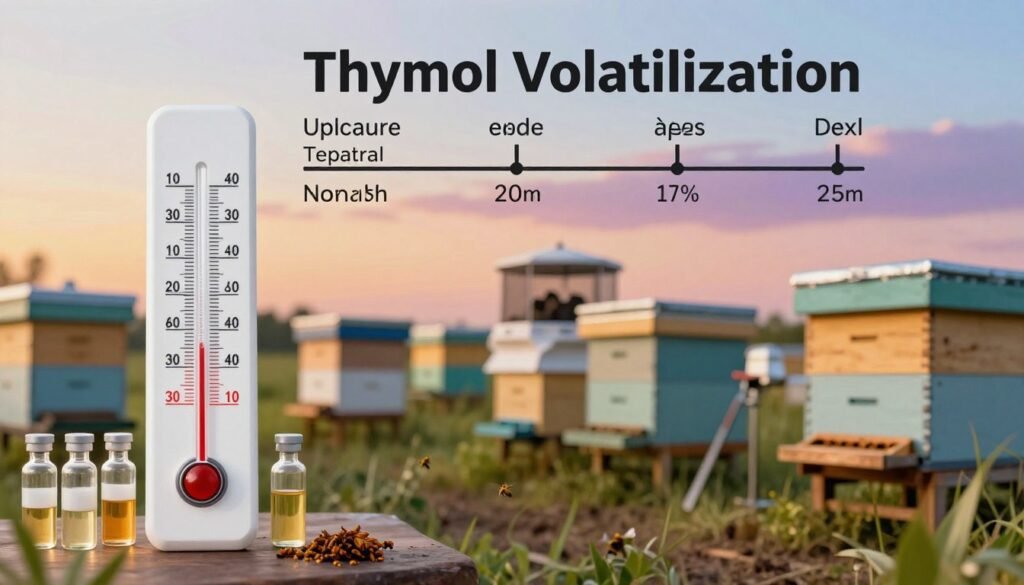
Apiguard uses a polyacrylate gel that slows release and requires bees to carry away gel particles through the brood. Use a spacer rim to give the product room above frames and follow label instructions exactly; deviation is unlawful.
- Keep ambient temperatures between 59°F and 80°F during the full application period.
- Monitor hive reaction daily and record dose, days, and hive response.
- Plan applications when honey flow is stable and colony stress is low.
Registered products remain the legal option for most commercial beekeeping. For scheduling and practical apiary workflows see time management for multi-hive apiaries.
Evaluating Registered Thymol Products
Selecting the right registered option starts with knowing how each formulation releases active vapors in the hive. Match the delivery system to your local climate and the strength of each colony. That lowers stress and improves control of mites.
Apiguard Gel Characteristics
Apiguard uses a water-based polyacrylate gel to suspend thymol crystals. The gel slows release, which gives a steadier dose over the full period and reduces sharp peaks that can upset bees.
ApiLife Var Composition
ApiLife Var combines thymol with eucalyptol, menthol, and camphor on a vermiculite wafer. This blend can work better at lower temperatures but may be more irritating to the brood and workers.
- Choose a product based on average summer temperature and colony strength.
- Record product name and EPA number and note the number of applications and days used.
- Follow label instructions exactly; these are registered pesticides and legal compliance matters.
| Product | Delivery | Notes |
|---|---|---|
| Apiguard | Polyacrylate gel | Controlled release; spacer rim recommended |
| ApiLife Var | Vermiculite wafer | Blend may work at lower temps; more irritating |
| Beekeeper choice | Based on apiary | Balance efficacy, colony comfort, and application time |
The Role of Brood Cycles in Treatment Success
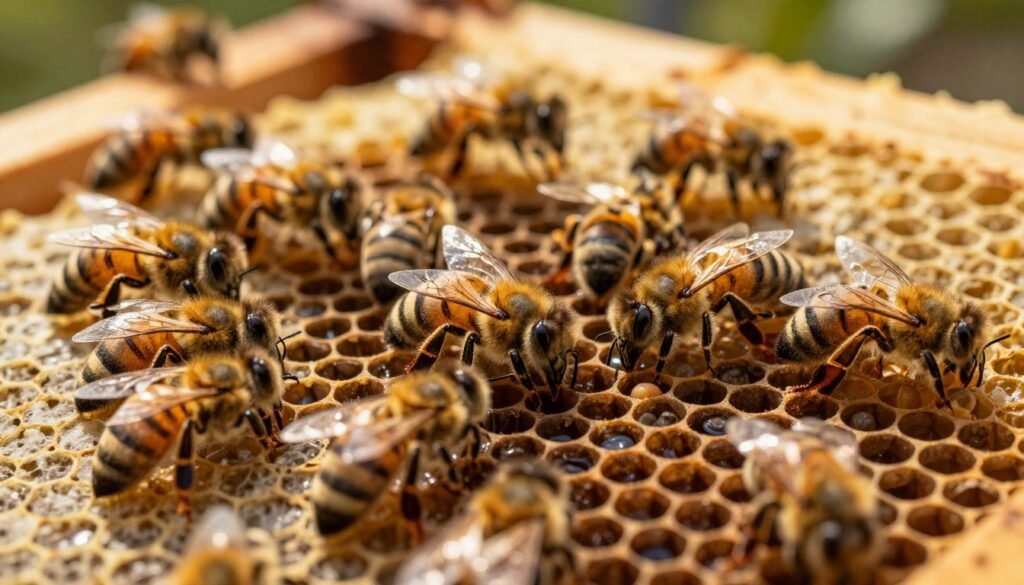
The presence of brood is the main reason mites hide from control efforts. Mites reproduce inside capped cells, where vapors have limited ability to reach them. That makes a single short application unlikely to catch all emerging mites.
Thymol often causes a brief suppression of brood rearing. Colonies may re-establish a divided brood nest after initial shock. This shift can help expose phoretic mites, but it also means the product must remain active across a full brood cycle to work well.
- Extend the application period long enough to cover one brood cycle so emerging mites are exposed.
- When colonies are broodless (natural break or winter), other options often show higher efficacy.
- Watch the brood nest for signs of deformed wing virus as an indicator of heavy mite impact.
| Factor | Effect | Practical note |
|---|---|---|
| Active brood | Mites protected | Extend application across brood cycle |
| Brood suppression | Short-term reduction in rearing | Monitor colony stress and queen activity |
| Broodless period | Mites exposed on adults | Use oxalic-based approaches when legal and appropriate |
Always perform a post-application mite count. That confirms efficacy and guides the next steps to protect the winter workforce and the upcoming honey flow.
Preparing Your Hives for Thymol Application
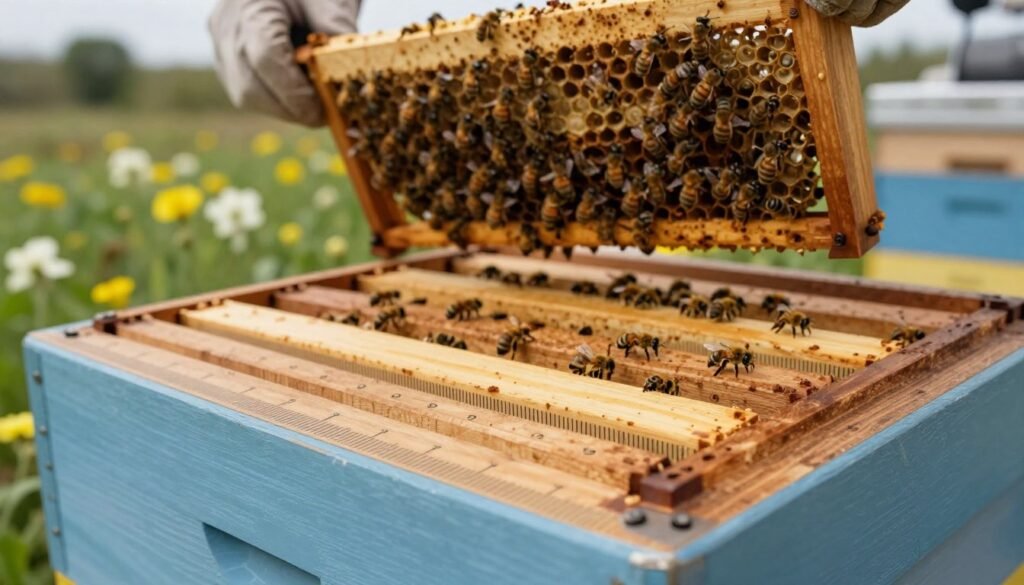
Small changes to hive setup improve vapor flow and reduce colony stress during an application period. Inspect each hive a day or two before starting. Confirm frames sit evenly and the top bars are clear so the product can rest above the brood.
Spacer Rim Requirements
Use a spacer rim as directed on the label. Many registered products require a rim placed between the brood box and the cover. This gap lets vapors circulate over the brood nest without being trapped.
- Remove honey supers before any application to protect the harvest.
- Ensure the entrance is open so bees can fan and ventilate the hive.
- Check colony strength; weak colonies may not tolerate odors or brief brood disruption.
- Watch for propolizing: bees may wall off an irritating matrix and change release rate (Randy Oliver observed this behavior).
- Follow the label for dose and period; homemade matrices can alter release and reduce efficacy.
Monitor post-application to confirm mites decline and the colony recovers. Proper prep raises the chance that the product works and that colonies stay healthy.
Avoiding Common Application Mistakes
Treat decisions should be driven by mite counts, not the calendar. Acting on a fixed date can cause under- or over-application and harm colony health.
One frequent error is applying thymol when ambient temperatures sit outside the recommended range. Low vapor output reduces efficacy. High heat can stress brood and workers.
Do not leave honey supers on during a product period. Removing them protects honey and follows label law. Also place the product as directed; a missing spacer rim can block vapor flow to the cluster.
Record keeping matters. Log counts, dose, dates, and hive responses. Without pre- and post-counts you cannot verify success or spot resistance.
- Follow the full duration on the label; premature removal lowers control.
- Avoid overdosing: high doses can provoke absconding or major brood loss, a risk noted by Randy Oliver.
- Treat based on mite thresholds rather than a schedule; pressure varies across apiaries.
If you need a refresher on integrated options, see this practical guide at six control methods. Small steps now protect honey and long‑term efficacy.
Monitoring Mite Levels Before and After Treatment
Start every control period by logging a reliable pre-count; sound data guide every follow-up step. Monitoring mite levels is the foundation of any successful varroa management program. Keep records in one central place so trends are easy to spot.
Calculating Treatment Efficacy
Perform a pre-count and a post-count to measure progress. Use this formula: ((Pre-count – Post-count) / Pre-count) x 100. That gives you a clear efficacy percentage to compare across colonies.
Randy Oliver recommends aiming for at least a 90% reduction. If efficacy is low, suspect resistance or a flawed application and rotate to a different mode of action immediately.
Using Stickyboards
Stickyboards show daily mite drop and help spot sudden spikes. They work best when paired with an alcohol wash to estimate infestation percentage accurately.
- Do a count before any thymol application and repeat at the end of the labeled period.
- Log counts, dates, product, ambient temperature, and hive response.
- Compare pre- and post-counts to decide next steps and protect bees and brood.
Managing Reinfestation Risks in Your Apiary
Beekeepers must treat reinfestation as an ongoing landscape problem, not a single-event fix.
Why it matters: mites move by drifting and robbing. Untreated colonies within about 2 miles can seed your hive. A colony that tests clean can return to action thresholds within 4–6 weeks when pressure is high.
Practical steps: coordinate control schedules with nearby beekeepers and increase monitoring in late summer. If post-application counts climb fast, reinfestation is the likely cause.
- Keep detailed records of counts, dates, product, ambient temperature, and colony response to verify efficacy.
- In high-density or migratory operations, plan more frequent applications and tighter monitoring.
- Share information with neighbors; Randy Oliver recommends awareness of nearby mite status to assess risk accurately.
Final check: always run a post‑application count. That confirms whether the application worked or if reinfestation requires a follow-up action to protect brood and long‑term colony health.
Comparing Thymol with Other Organic Acids
Building an annual plan that swaps active chemistries limits selection pressure on mite populations. Match product choice to colony status and season to keep controls effective.
Rotation Strategies
Oxalic acid works best when colonies are broodless. It targets mites on adult bees and gives high efficacy during winter or after a brood break.
Formic acid can penetrate capped cells, so it is useful when brood is present and honey supers remain on. It needs careful dose control and adherence to label temperature windows.
- Rotate modes of action across the season to slow resistance.
- Record product, dates, and observed efficacy after each application.
- If a control loses efficacy, switch chemistry immediately.
| Product | Best window | Strength | Limit |
|---|---|---|---|
| Thymol gel | Warm months | Organic-friendly; gentle on adults | Needs steady warm days; may irritate brood |
| Formic acid | Brood present | Reaches mites in capped cells | Temperature sensitive; can stress queens |
| Oxalic acid | Broodless | High efficacy on phoretic mites | Ineffective with heavy brood |
Record Keeping for State Compliance
Good records turn legal obligations into a practical tool for stronger hive management. State apiarists typically require a log of every pesticide and gel used, including product name, EPA registration number, and dates.
Record each application by hive ID and note the dose and duration. Track ambient temperature during the period and any observed colony behavior such as changes in brood or worker activity.
Include pre- and post-counts of mites and the numeric result of any sampling method used. Randy Oliver stresses that detailed data on mite counts and outcomes supports both scientific study and practical apiary decisions.
- Write the product name, EPA number, and exact dates.
- Log the dose, duration, and which hive(s) received the application.
- Record mite and mite count methods and results.
Tip: Use digital apps to store records securely and export reports if a state inspector asks. Consistent logs protect your operation, help evaluate the efficacy of a given treatment, and show diligence in caring for your bees.
Conclusion
Smart beekeeping treats mite control as an ongoing checklist, not a one‑time event.
Keep monitoring regularly and act when seasonal thresholds indicate risk. Use recorded pre‑ and post‑counts to verify success and to guide the next step.
Use thymol products within the recommended temperature window and follow label directions exactly. Rotate chemistries with organic acids to slow resistance and protect brood health.
Log every action: product, dates, counts, and observed hive response. Good records help meet state rules and improve decisions across the apiary.
By staying proactive and consistent you reduce winter losses and keep your bees healthy and productive year round.
FAQ
What is the best window to apply thymol-based products in relation to brood cycles?
Aim to apply during a period when brood is reduced so more mites are on adult bees. Treating shortly after the main summer nectar flow and before major brood expansion in late summer improves impact. Avoid application during peak egg-laying in spring or heavy brood breaks unless you combine with a brood interruption method like queen caging or creating a nucleus. Monitor brood pattern and local nectar flows to choose the optimal weeks.
How do temperature ranges affect volatilization and efficacy of thymol gels and pads?
Most gels and pads release active vapors best when daytime temperatures stay between roughly 59°F and 86°F (15°C–30°C). Too low and the product won’t vaporize enough; too high and it may stress bees or taint honey. Check the product label: Apiguard and similar formulations list recommended ambient ranges and may advise placing treatments when forecasts are stable within that band.
How many applications per year are safe and effective?
Many beekeepers use one to two thymol applications per active season, spaced according to label directions—often two applications separated by 7–14 days. Use mite counts to decide need; don’t exceed label limits. Combine with non-chemical controls and rotate actives across years to reduce resistance risk.
How should I prepare hive spacing and rim spacers before placing thymol trays or gels?
Provide a small airspace above brood frames, usually by fitting a 3/8″–1/2″ spacer or using the spacer included with the product. This promotes even vapor distribution. Ensure trays sit flat and avoid direct contact with comb or bees. Follow the manufacturer’s placement diagram to prevent hot spots and bee contact.
Can thymol products be used during a honey flow without contaminating honey supers?
Most labels prohibit treatment with honey supers in place. Remove supers or avoid treating during active nectar flows. If treatment is necessary, follow product guidance on how long before placing or extracting supers. When in doubt, delay treatment until after the main flow or use non-residual methods and extract only after the recommended withdrawal period.
How do I measure treatment success and calculate efficacy?
Use pre- and post-treatment mite counts from alcohol washes, powdered sugar rolls, or sticky boards. Calculate efficacy by comparing mite numbers: [(pre-treatment mites − post-treatment mites) ÷ pre-treatment mites] × 100. Aim for efficacy above 80% for a successful control; if lower, investigate application errors, temperature issues, or reinfestation.
How long should I leave Apiguard or similar gel in the hive?
Follow the product label for exact timing—commonly a two-stage regimen with a first tray left for 7–14 days then replaced for another 7–14 days. Adjust timing only per label and local conditions; premature removal reduces efficacy and may increase mite survival.
What common application mistakes reduce effectiveness?
Frequent mistakes include applying during inappropriate temperatures, placing product directly on comb, failing to provide correct spacers, treating with full honey supers on, and using an incomplete application schedule. Also, treating infested weak colonies without supportive management can produce poor results.
How can I reduce reinfestation from nearby untreated colonies?
Coordinate treatments with neighboring beekeepers when possible. Strengthen your colonies before treatment, combine chemical control with drone comb removal or brood breaks, and monitor mite immigration with sticky boards. Healthy, populous colonies resist reinfestation better than weak hives.
How do thymol products compare with formic or oxalic acid options?
Thymol-based products act via vapor and are effective under warm conditions and against phoretic mites. Formic acid penetrates brood cappings and can reduce mites within brood; oxalic acid works best during broodless periods. Each has specific temperature windows, brood considerations, and label restrictions—rotate actives and use an integrated approach for best long-term control.
When should I perform mite counts during the season to guide decisions?
Perform baseline counts in spring after the first strong brood expansion, again in mid-summer before treatment decisions, and post-treatment to confirm efficacy. Additional counts in fall help decide overwintering treatments. Use consistent methods and record results for trend analysis.
Are there special considerations for weak or newly established colonies?
Weak colonies may suffer stress from high vapor concentrations; follow label guidance and consider splitting treatment doses or using alternative methods. Newly established hives often have higher mite growth rates—monitor frequently and treat early if thresholds are exceeded to prevent rapid population buildup.
What record keeping is recommended to meet state compliance and track effectiveness?
Log dates of application, product name and batch, colony IDs, ambient temperatures during treatment, pre- and post-treatment mite counts, and any adverse reactions. Maintain copies of labels and MSDS sheets. Clear records help with regulatory inspections and guide future management decisions.
How should sticky boards be used to estimate mite drop and ongoing pressure?
Place a sticky board under the hive for 24–72 hours to count natural mite drop. Use counts to estimate infestation pressure; combine with alcohol or sugar rolls for more direct measures of mites per 100 bees. Repeat after treatment to assess control and detect reinfestation.
Can I combine thymol gels with other methods during a single season?
Yes. Integrate gels with mechanical controls like drone comb removal, screened bottom boards, brood interruption, or timed oxalic treatments during broodless windows. Avoid simultaneous chemical pairings unless labeled; rotation and integration reduce resistance risk and improve overall control.