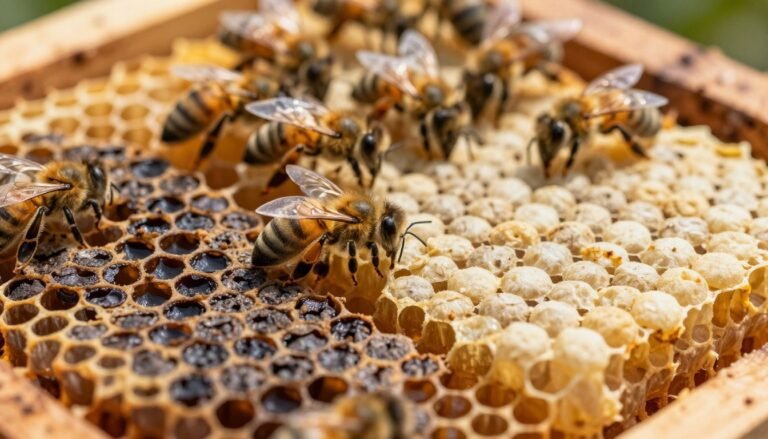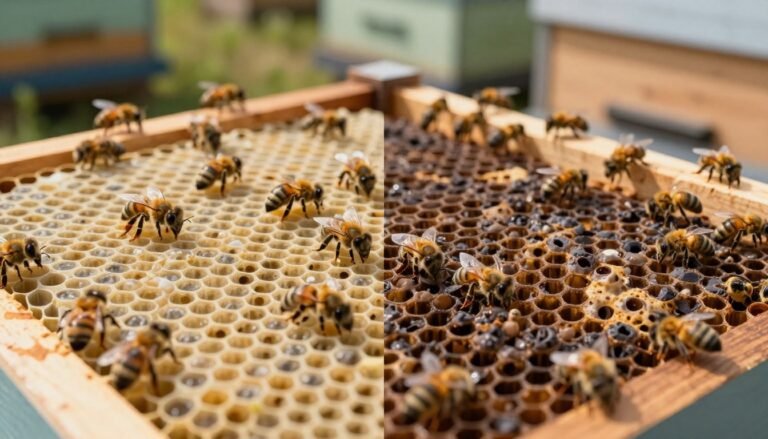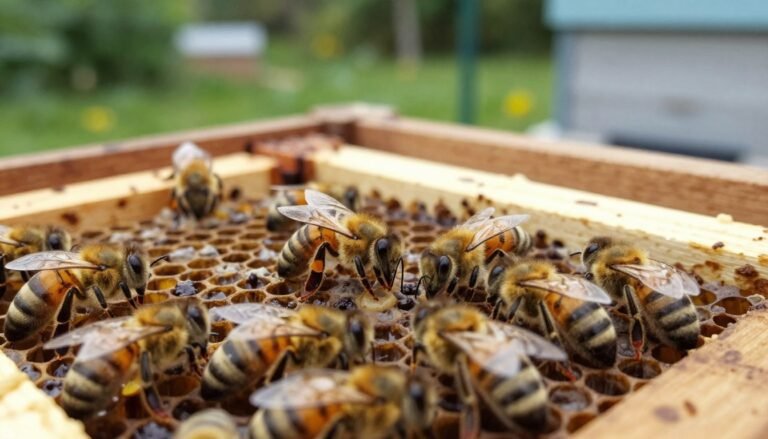
Knowing the level of nosema in a hive gives beekeepers a clear path for action instead of guesswork. Monitoring adult bees, especially older foragers, reveals whether a colony carries a heavy load of spores or only a few affected individuals.
Microscopic examination is the only reliable diagnosis. Field signs like dysentery or k-wing can mislead, since other issues often cause similar symptoms.
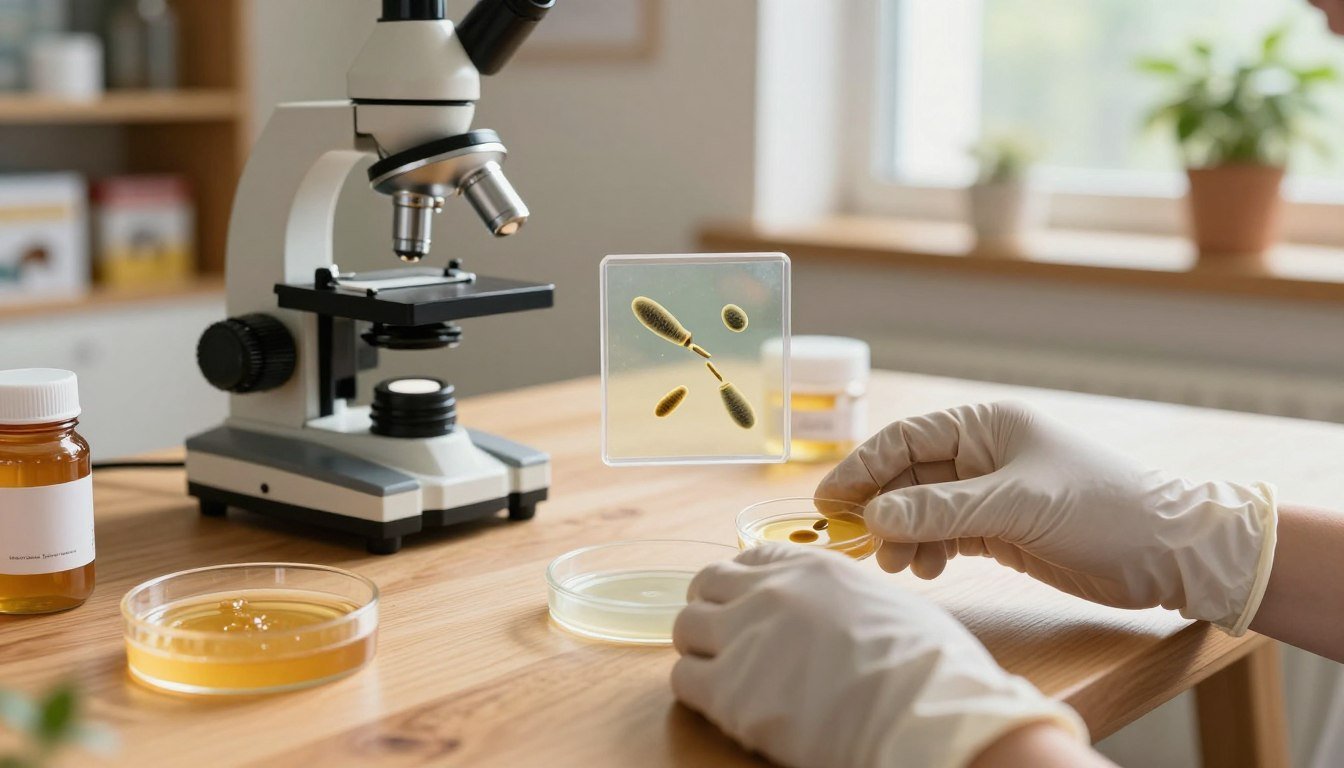
A modest investment in a good microscope pays off quickly. With simple sampling methods and basic equipment, you can grind a small sample, place a drop on a slide, and view spores at 400x. Practical guides, such as Randy Oliver’s microscopy notes, explain sampling and interpretation in clear steps: simple microscopy of nosema.
Key Takeaways
- Microscopy is the only definitive way to confirm infection.
- Sample older bees from under the cover or an outer frame for best results.
- A quality microscope and basic methods can prevent unnecessary treatment.
- Dysentery at the hive is not a reliable field diagnosis by itself.
- Use simple dilution and slide prep steps to triage infection levels.
Essential Equipment for Nosema Testing
Good optics are the backbone of accurate hive diagnostics. Proper gear makes microscopic checks fast and reliable for beekeepers who want measured results rather than guesses.
Microscope Requirements
A compound microscope capable of 400x magnification is required to identify tiny pathogens. Binocular scopes ease long sessions, and a mechanical stage helps scan a hemacytometer grid smoothly.
Many pros praise the Omano OM36L for field use because its optics and battery power suit on-site work. For more detailed guidance, see this microscopy guidance.
Necessary Lab Supplies
Essential supplies include a hemacytometer for precise counts, a 60ml syringe to measure dilution water, clean cover slips, and disposable pestles for homogenizing samples.
| Item | Purpose | Recommendation |
|---|---|---|
| Compound microscope (400x) | Visual identification of infection | Binocular with mechanical stage; Omano OM36L preferred |
| Hemacytometer | Quantify number per bee | Standard counting chamber |
| 60ml syringe | Measure dilution water | Graduated, reusable |
| Cover slips & slides | Protect lens and stabilize sample | Glass, dust-free |
Accurate equipment yields better treatment decisions. Reliable counts help protect the colony, preserve honey quality, and keep honey bees healthy.
How to Test for Nosema Spores at Home
Accurate spore counts begin with a representative bee sample and a clear, repeatable method. Collect at least 50 workers from under the inner cover or an outer frame. This reduces errors from a single highly infected individual.
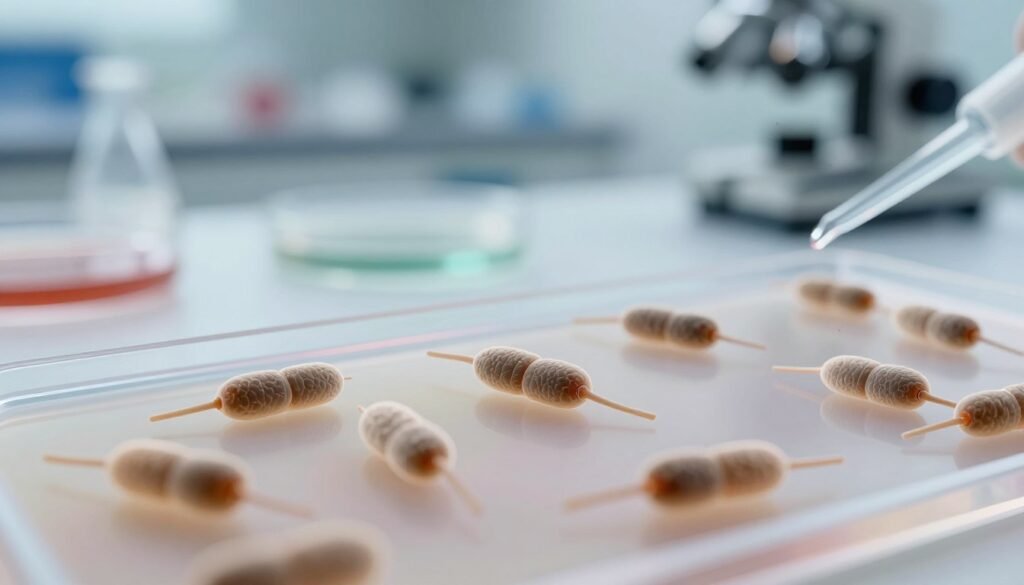
Many beekeepers use the ziplock method: crush the bees in a sealed bag, add measured water, and mix to create a uniform suspension. Use 1 mL of water per bee when possible; that dilution lets you estimate the number per bee by dividing counts in a field of view by five.
Preserve samples with rubbing alcohol before processing. A single drop of the homogenized liquid on a slide reveals whether infection is present and whether it is likely Nosema ceranae or Nosema apis under the microscope.
- Sample size: 50+ bees for reliable counts.
- Processing: ziplock bag plus 1 mL water per bee.
- Count: one drop on a slide, apply dilution factor to get spores per bee.
| Step | Key Detail | Reason |
|---|---|---|
| Collect sample | 50+ worker bees from under cover | Reduces skew from single heavy infections |
| Prepare suspension | Ziplock crush, 1 mL water per bee | Quick, clean, yields measurable dilution |
| Slide exam | One drop on a slide at 400x | Determines presence and approximate spore count |
For practical treatment guidance and diagnosis tips, see this diagnosing and treating nosema in honey.
Collecting and Preparing Bee Samples
Start sampling with a clear plan: pick bees that best represent colony health. Choose older workers from under the inner cover or an outer frame rather than from the entrance. Randy Oliver recommends this because entrance catches often overrepresent heavy infections.
Selecting the Right Bees
Count and record the number of bees before you add liquid. A standard sample uses 50 bees for a consistent water per bee ratio.
Collect quickly and work in the shade so the honey bee sample does not overheat or defecate. If you need guidance on diagnosis and treatment, see this diagnosing and treating nosema.
Homogenizing the Sample
Place the counted bees in a heavy ziplock bag. Use a rolling pin or wine bottle to crush them until gut contents are released.
Add 1 mL of water per bee for the standard dilution. As an alternative, some use 10 bees with 3 mL water when a concentrated suspension is preferred.
Knead the bag thoroughly so the material mixes evenly. Take a fresh drop for each slide; stray bee parts can lift the cover slip and skew the spore count.
- Tip: Preserve extra material in alcohol if you need to repeat the examination.
- Note: Record your final count and dilution; this lets you calculate number spores per bee accurately.
For related lab techniques and follow-up monitoring, consider resources on post-treatment mite counts as part of a full hive health plan.
Microscopic Examination Techniques
Begin every examination with a low-power sweep of the slide; this saves time and prevents lens damage. Start at 40x or 4x to locate debris and the hemacytometer squares before increasing magnification.
After locating the field, move to 100x, then 400x. Use the fine focus knob gently at 400x; tiny turns reveal the faint glow that confirms nosema ceranae or nosema apis. Adjust the condenser and diaphragm to create a darker background so the spores stand out against debris.
Wait at least 60 seconds after placing the drop so particles settle. Remember that the microscope inverts movement—slide left, image moves right—so track your hemacytometer counts carefully.
- Begin low, finish high: 4x → 100x → 400x.
- Use fine focus slowly to avoid breaking the cover slip.
- Count in hemacytometer squares to calculate spores per bee and overall infection level.
- If you preserved samples in alcohol, prepare the drop so debris does not obscure the view.
“Start at low power, then step up slowly; the glow at high power is the key.”

For a step-by-step demo, watch this nosema analysis video.
Identifying Nosema Spores Under the Lens
Under the lens, true identification rests on shape, movement, and that bright central flash.
Look first for elongated, capsule-like bodies with a smooth dark outline. These often show Brownian motion as water molecules jostle them. Wait about 60 seconds so particles settle; real spores will come into focus at one level.
Distinguishing spore characteristics
Nosema spores have a glowing center when you fine-focus. The outline stays dark and elliptical. If the center and rim alternate in sharpness, you are likely seeing a true spore.
Nosema ceranae can vary in shape and sometimes looks pointed or curved. Nosema apis is usually blunter and broader. Experienced examiners can tell the difference with practice and repeated counts.
| Feature | Spore | Common lookalike |
|---|---|---|
| Shape | Elongated ellipse or capsule | Oval debris or pollen grain |
| Motion | Brownian movement in water | Static particles |
| Focus | Bright center, dark rim at same level | May glow but lacks both features |
- Keep the cover slip clean; debris hides the glow.
- Count in hemacytometer squares for a reliable spore count.
- For detailed species differences, see this nosema ceranae vs nosema apis differences.
Interpreting Spore Counts and Colony Health
The number you record is only part of the picture. A mean count near one million spores per bee often signals that management action is needed, especially for Nosema apis. Use that threshold as a guideline, not an absolute rule.
Season and bee age change counts. Nosema ceranae often rises in winter and spring pollen flows, then may drop by late summer in many hives. If more than half of the house bees are infected, treat the colony as having a significant problem.

- Compare sequential samples to spot trends rather than relying on one reading.
- Assess brood, food stores, and adult bee activity along with the count.
- High counts across samples suggest the need for treatment or management changes.
- Low counts are encouraging but do not guarantee colony resilience.
“Track counts over time; trends guide smarter decisions than single measurements.”
For a refined sampling approach that improves interpretation, see the improved sampling method.
Conclusion
Regular screening gives beekeepers clear, data-driven insight into colony health.
Monitoring your colony for nosema spores is straightforward and empowers smarter hive care. By tracking the number per bee in each sample, you detect rising disease levels before they affect brood and honey stores.
Consistent methods and the right equipment make counts comparable over time. Trends matter more than single readings—record squares and dilution details so results stay useful.
Research shows hygienic selection and routine monitoring can cut spore loads over seasons; read the study on hygienic breeding for details.
With practice, counting gives you control and helps your bees thrive.
FAQ
What gear is essential for a basic spore count?
A clear light microscope (400–1000x capable), glass slides, cover slips, a fine tweezer or probe, a mortar and pestle or micro-homogenizer, distilled water, a clean tube or vial, and an eye dropper are the core items. A notebook and marker help label samples. Consider a portable LED microscope from brands like AmScope for good value.
What microscope specs matter most?
Look for magnification up to 400x at minimum; 1000x oil immersion improves accuracy. Bright, adjustable illumination and a clear mechanical stage make counts easier. A camera port helps document findings for records or consultation with labs such as Penn State’s extension service.
Which lab supplies will I need?
Use clean glass slides and 22×22 mm cover slips, distilled water, microcentrifuge or mixing tube, alcohol wipes, and small vials. A cheap hemocytometer can help standardize counts. Gloves and a disinfectant like bleach are important for preventing cross-contamination.
How should I collect adult bees for sampling?
Sample 30–50 foragers or nurse bees from the brood area depending on season. Use an empty vial chilled briefly on ice or in a cooler to calm bees before handling. Label each sample with date, colony ID, and location.
What is the correct way to prepare a bee sample?
Remove legs and freeze or euthanize ethically. Homogenize a known number of bees (commonly 10 or 30) in a measured volume of distilled water or 70% alcohol. Strain large debris, then mix thoroughly for even distribution before placing a drop on a slide.
How do I homogenize samples evenly?
Use a mortar and pestle, a disposable pestle in a microtube, or a small vortex with glass beads. Keep volume consistent—e.g., 1 bee per 1 ml of water for a simple ratio—so counts convert easily to spores per bee or million spores per bee.
What microscopic method gives reliable counts?
The direct smear method is fast: place a drop of homogenate on a slide, add a cover slip, then scan at 400x. For quantitative counts, use a hemocytometer and follow its grid protocol to calculate spores per microliter, then convert to spores per bee.
How can I tell Nosema spores from other particles?
Nosema spores are oval, refractile, and measure about 4–7 µm for Nosema apis and 4–6 µm for Nosema ceranae. They often appear as tiny, bright oval bodies under phase contrast or bright-field with oil immersion. Experience and reference photos from extension services help reduce misidentification.
Can I distinguish N. apis from N. ceranae by light microscopy?
No—morphology overlaps significantly. Molecular methods like PCR are needed for reliable species identification. If species matters for treatment decisions, send samples to a diagnostic lab such as a university extension.
What thresholds indicate a problematic infection?
Thresholds vary by season and region. Common guidance: below 1 million spores per bee is low; 1–10 million is moderate; above 10 million is high and can justify treatment or management changes. Use trends across colonies, not a single sample, for decisions.
How do I calculate spores per bee from my slide count?
Count spores in several fields or use a hemocytometer to get spores per microliter. Multiply by the dilution factor and divide by the number of bees in the homogenate. Clear recordkeeping of volumes and bee numbers is essential for accurate conversion.
Are there quick screening alternatives to microscopy?
Yes. Some beekeepers use rapid field kits or send crushed bee samples to labs for qPCR. Microscope screening remains cost-effective for routine checks, while qPCR provides species-level detail and greater sensitivity.
How often should colonies be screened?
Screen seasonally—spring and fall are common—or when colonies show symptoms such as dysentery, reduced brood, or slow spring buildup. More frequent checks help spot trends and guide treatments like fumagillin where permitted.
Is alcohol or water better for making homogenates?
Distilled water keeps spores intact and is fine for microscopy. Alcohol (70%) can preserve samples and help with field storage, but it may alter clarity. Use water for immediate slides and alcohol if you’ll delay analysis or send samples by mail.
When should I send samples to a diagnostic lab?
Send samples if you need species ID, confirm severe infections, or when microscopy results are ambiguous. University extension labs and private diagnostics offer PCR and standardized spore counts with professional interpretation.
Can treatment reduce spore counts quickly?
Treatments like fumagillin (where legal) can reduce Nosema apis levels, but efficacy against Nosema ceranae varies. Management practices—good nutrition, hive hygiene, and reducing stressors—support recovery. Retest after treatment to track effectiveness.