Last Updated August 26, 2026
This review examines recent research on how common agricultural chemicals alter the honey bee intestinal community. A December 2023 summary in Nature Reviews Microbiology, highlighted by Beyond Pesticides, links chemical exposure to shifts in the microbiome that affect immunity, metabolism, behavior, and development in Apis mellifera.
The paper outlines two main pathways: direct microbial toxicity and indirect, host-mediated effects. Studies report consistent declines in Bifidobacteriales and Lactobacillales after exposure. Duration of exposure often predicts outcomes more than dose.
We frame why Apis mellifera is a model for pollination and honey production in the United States, and we preview evidence on chemicals such as glyphosate, chlorothalonil, coumaphos, and tau-fluvalinate. This introduction sets expectations for a structured review of agricultural stakes, exposure routes, core microbiome composition, field evidence, and regulatory implications.
Key Takeaways
- Recent high-impact research links chemical exposure to measurable changes in the honey bee microbiome and health.
- Two disruption routes—direct microbial toxicity and indirect host effects—drive cascading impacts.
- Longer, low-level exposure often matters more than single high doses.
- Losses of key microbial groups can harm nutrition and disease defense.
- Findings have clear implications for honey production, pollination services, and regulatory review.
Why bee gut microbiota matter to pollinator health and U.S. agriculture
Declines in pollinators carry clear economic and ecological consequences for farmers and landscapes. Beyond Pesticides (Dec 12, 2023) notes that three of four food crops rely on animal pollination, and honey bees deliver key services for many U.S. specialty crops.
Pollinator declines, ecosystem services, and economic stakes
Pollinators support food security and native plant reproduction. Losses among insects and managed colonies reduce yields, lower honey production, and raise costs for growers who depend on managed hives.
The bee gut as a regulator of nutrition, immunity, and development
Gut microbiota form a compact community that aids digestion, defends against pathogens, and helps immature workers develop properly. Reduced microbial abundance and diversity link to altered gene expression and weakened immune responses in apis mellifera, which harms honey bee health.
- Chemical-driven agriculture adds residues to food and water, increasing chronic exposure across the environment.
- Microbial shifts in the bee gut can cascade into colony stress and lower pollination service.
| Stakes | Role of Microbiome | Agricultural Link |
|---|---|---|
| Food security | Nutrition and digestion | Managed hives for crops |
| Economic value | Immune competence | Residues from crop treatments |
| Ecological resilience | Development and behavior | Regional exposure patterns |
How pesticides disrupt bee gut bacteria
Research separates two clear routes linking chemical use to microbial shifts: direct toxicity to microbial cells and indirect, host-mediated changes in the internal environment. Both routes produce measurable effects on gut microbiota and colony health.
Direct toxicity versus host-mediated effects
Direct toxicity occurs when a pesticide impairs growth or viability of gut microbes. For example, glyphosate inhibits certain strains and reduces key taxa in honey bees. In contrast, indirect effects alter immune signaling, pH, or nutrient profiles, making the niche less hospitable for beneficial microbes.
Exposure duration versus dose
Multiple studies show that exposure duration often predicts the magnitude of change more than a single high dose. Prolonged pesticide exposure produces larger, more persistent shifts in community composition and host responses.
Shifts in core taxa and functional outcomes
Reviews consistently report declines in Bifidobacteriales and Lactobacillales. These losses reduce digestive efficiency, weaken colonization resistance, and raise infection risk in the bee gut microbiome. Interactions among chemical mixtures and adjuvants can compound these effects, so experiments that vary duration are essential to untangle time-dependent outcomes.
Core bee gut microbiome: composition, stability, and variability
Field surveys and sequencing studies consistently identify a compact suite of microbes that define a stable core across colonies.
The Virginia Tech study found the honey bee bacteriome dominated by Proteobacteria (49.2%), Firmicutes (34.4%), and Actinobacteria (13.0%). Prominent families included Lactobacillaceae and Bifidobacteriaceae, alongside orders such as Pasteurellales and Enterobacteriales.
These taxa support carbohydrate metabolism, fermentation, and competitive exclusion of pathogens. Controls show a relatively stable community, which makes it easier to detect treatment-driven shifts in abundance and composition.
Variation arises with age (forager versus brood), diet, season, and hive conditions. Orders like Pseudomonadales and Enterobacteriales include both commensals and opportunists that respond to host stressors.
- Baseline: a consistent core used as a reference for change.
- Function: abundance patterns link to nutrient processing and host interactions.
- Resilience: stability is not immutability—sustained stressors can cause measurable changes.
| Feature | Dominant Groups | Functional implication |
|---|---|---|
| Core composition | Proteobacteria, Firmicutes, Actinobacteria | Primary nutrient processing and niche stabilization |
| Key families | Lactobacillaceae, Bifidobacteriaceae | Fermentation, pathogen exclusion |
| Variable members | Enterobacteriales, Pseudomonadales | Opportunistic roles under stress |
Using this compositional baseline helps interpret the direction and magnitude of changes observed in field and lab work. For further context on microbial baselines and experimental design, see the linked review in PubMed Central: microbiome review.
Evidence from field-scale and laboratory studies
Field and lab work now link common hive treatments and agricultural sprays to measurable changes in microbial communities.
Field experiment design. A Virginia Tech multi-site study ran six-week treatments with control hives and three real-world exposures: in-hive tau-fluvalinate and coumaphos strips, and chlorothalonil delivered at 10 μg/L in 30% sucrose. Both forager and brood samples were included to capture age-related differences.

Analytical pipeline and core findings
Researchers used 16S rRNA sequencing with QIIME and Greengenes, OTU clustering at 97%, and weighted UniFrac for beta-diversity. Statistical tests included ANOSIM and PERMANOVA, with functional inference via PICRUSt and KEGG.
Chlorothalonil produced the strongest change in bacterial community structure versus control. Lactobacillales declined significantly under chlorothalonil, while other orders shifted in treatment-specific ways. ITS-based fungal profiles clustered by site more than by treatment, showing strong environmental signals.
- Glyphosate is reported in reviews to directly inhibit target gut microbes and link to performance declines when the gut microbiome shifts.
- Beekeeper-applied miticides and grower-applied fungicides and herbicides create distinct exposure profiles and pesticide residues in hive matrices.
Overall, the combination of sequencing-based profiling and functional inference strengthens causal links between exposure duration and health-relevant outcomes in honey-producing colonies.
Methodological foundations in current research
Modern sequencing and analysis pipelines define the technical backbone for microbiome work in managed hives. Clear methods turn raw reads into interpretable signals about the honey intestinal system.
16S, ITS and OTU-based profiling
16S rRNA and ITS amplicons provide complementary views of bacterial and fungal microbiota. The field study used barcoded 16S V2–V3 and ITS amplicons on Roche 454 with QIIME 1.8 for trimming and quality thresholds.
OTU clustering at 97% (Greengenes for bacteria, UNITE for fungi) standardizes taxonomic units across treatments and controls. Rarefaction and fixed sampling depths (e.g., 1,000 reads per sample) keep comparisons fair.
Community metrics and statistical tests
Weighted UniFrac captures phylogenetic distances for bacteria while Bray–Curtis serves fungi. PCoA visualizes clustering and helps spot treatment versus site effects.
Significance testing used PERMANOVA and ANOSIM. Studies applied Welch’s t-test with Benjamini–Hochberg correction in STAMP to limit false positives.
Functional inference and limitations
PICRUSt predicted enzyme profiles mapped to KEGG pathways to estimate metabolic function changes from 16S profiles. This adds a functional layer but remains an inference.
Metagenomics and metatranscriptomics offer direct functional readouts in future work. Robust experimental control, replication, and transparent QC steps remain essential for apis mellifera research and reliable inference.
For broader methodological context see the linked review: microbiome methods review.
Bacterial communities: consistent patterns and notable disruptions
Patterns in treated hives point to repeatable losses among beneficial fermenters and gains in opportunists.
Taxonomic shifts and functional signals
Virginia Tech results showed significant reductions in Lactobacillales under chlorothalonil treatment. These declines correlate with lower carbohydrate processing and weakened barrier function in the host.
Order-level reorganization
Enterobacteriales and Burkholderiales shifted in treatment-specific ways. Some runs saw increases consistent with opportunistic expansion. Others showed declines reflecting broad community reordering.
- Reduced Lactobacillales signal altered nutrient fermentation and colonization resistance.
- Shifts in Enterobacteriales often mark conditional opportunism when the niche changes.
- Multiple orders changing together indicate community-level effects, not isolated responses.
| Group | Control pattern | Chlorothalonil effect |
|---|---|---|
| Lactobacillales | High abundance; stable | Significant decline; reduced fermentation |
| Enterobacteriales | Low-moderate; conditional | Variable; sometimes increased opportunists |
| Burkholderiales | Site-dependent | Treatment-specific increases or decreases |
Reviews compiled by Beyond Pesticides mirror these findings, reporting declines in Lactobacillus and Bifidobacteriales across exposure scenarios. Site and colony context modulate the magnitude of effects, so longitudinal sampling is essential to track recovery or persistence.
Fungal communities: when site trumps pesticide effects
Site-specific factors dominated the fungal signatures recovered from honey-producing colonies in this field study.
ITS data showed that fungal composition clustered by location. Bray–Curtis distances and PCoA plots displayed clear site grouping, with ANOSIM and MRPP supporting strong site and site × treatment interactions.
No single treatment produced a significant shift in fungal structure across sites. Classes such as Dothideomycetes, Saccharomycetes (Ascomycota), and Tremellomycetes (Basidiomycota) varied widely, but variation tracked environment and local floral inputs more than the applied chemicals.
Possible reasons include environmental inocula from forage, microclimate differences, and hive management. These factors seed and shape the fungal community and can mask treatment-only effects in short-term field trials.
- Interpretation: fungi reflect local context; bacteria may respond faster to chemical exposure.
- Implication: integrating fungal data strengthens microbiome research and improves ecological inference.
- Recommendation: standardize or record site metadata to separate environment and treatment effects in future studies.
Pesticide classes and pathways of impact on the bee gut microbiome
Miticides, fungicides, and herbicides each leave unique fingerprints on colony health and the internal microbial community. Class, formulation, and route of entry set residue profiles and shape downstream effects on host physiology and microbial abundance.
In-hive miticides: coumaphos and tau-fluvalinate
Coumaphos (organophosphate) and tau-fluvalinate (pyrethroid) control mites but can lower immune competence in honey bees and shift gut microbiota. Reduced immunity feeds back to change community structure and abundance, lowering resilience to pathogens.
Agricultural fungicides: chlorothalonil
Field data from Virginia Tech show chlorothalonil produced the largest structural change in bacterial communities. Lactobacillales abundance fell significantly under chlorothalonil, a clear signal linking fungicide exposure to community reorganization.
Herbicides: glyphosate and targeted inhibition
Glyphosate can directly inhibit select gut microbes, altering the gut environment and host–microbe interactions. Real-world mixtures and adjuvants may create additive or synergistic effects, so residue persistence and exposure duration determine final impacts on apis mellifera.
“Class-specific residue profiles map onto distinct mechanisms—direct microbial inhibition versus immune-mediated shifts.”
- Class-aware studies help target mitigation and regulatory review.
- Abundance changes across taxa point to community-level reconfiguration, not single-species loss.
Functional consequences: immunity, metabolism, navigation, and disease risk
Shifts in symbiotic microbes translate into measurable losses in nutrition, defense, and behavior.
Immune gene expression, pathogen susceptibility, and microbiome dysbiosis
Dysbiosis alters host immune signaling and lowers expression of key antimicrobial genes. Reviews summarized by Beyond Pesticides link these molecular changes to higher pathogen loads and elevated disease risk in honey-producing colonies.
Losses of Lactobacillus and Bifidobacteriales reduce colonization resistance and weaken barrier function. This makes the colony more likely to experience outbreaks and chronic infections.
Behavioral outcomes: navigation and foraging success under sublethal exposure
Sublethal exposures show clear behavioral effects. A 2015 study reported impaired navigation and worse foraging returns after low-level chemical contact. A 2018 study connected glyphosate-linked microbiome changes to reduced performance.
“Performance-linked outcomes strengthen causal inference between microbiome changes and honey bee health.”
- Metabolic impact: lost microbial functions impair carbohydrate breakdown and nutrient uptake, lowering energy and slowing development.
- Colony cascade: altered immune response and higher disease lead to stress, reduced pollination services, and lower honey yields.
- Duration matters: longer exposure predicts greater persistence and severity of functional deficits.
Recommendation: integrate functional assays with microbiome profiling to link compositional shifts to real-world response and to use the bee microbiome as an early biomarker of sublethal effects on bee health.
Environmental interfaces: soil microbiota, residues, and exposure pathways
Belowground communities determine nutrient cycling, plant resilience, and the contaminant load in foraged resources.
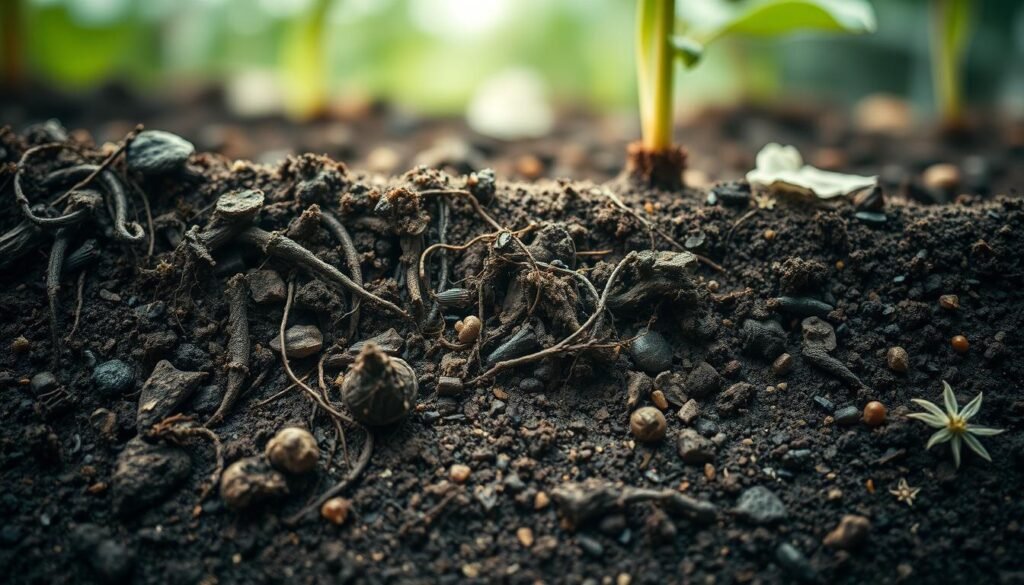
Soil microbial imbalance shifts diversity toward bacterial dominance and reduces beneficial fungi. This lowers functional resilience and short-circuits nutrient cycling in agricultural fields.
Plants grown in impaired soil often show weaker defenses and altered chemistry. That change can affect nectar and pollen quality, raising the chance that honey-producing colonies collect contaminated or nutritionally poor resources.
Soil to hive: pathways and monitoring
Persistent residues accumulate in soil and enter water, creating continuous exposure routes. Foraging honey bees meet those residues through contaminated nectar, pollen, and water sources.
- Residue persistence: leftover compounds in soil prolong low-level exposure for colonies.
- Plant-mediated effects: altered plant chemistry can reduce food quality and increase pathogen susceptibility.
- System linkages: microbe-driven nutrient cycling influences plant–pollinator interactions and thus gut composition in foragers.
Recommendation: integrate soil and water monitoring with plant and hive sampling. Coupling belowground and bee gut analyses will map real-world exposure pathways and identify leverage points to reduce residues and protect pollinator health.
Regulatory and risk assessment implications in the United States
Regulatory review processes in the United States lag behind emerging science that links chemical residues to internal microbial health in pollinators.
Current gaps at EPA: Beyond Pesticides (Feb 16, 2022) notes that the U.S. EPA does not require assessment of pesticide impacts on the gut microbiome of honey bees. This omission leaves a clear blind spot for sublethal effects that affect colony resilience and honey production.
Current gaps at EPA: microbiome impacts not routinely assessed
Field-scale research and controlled studies show structural shifts under realistic treatments and mixture exposure. Risk assessments should include community and functional microbiome metrics alongside mortality endpoints.
Toward environmentally relevant exposure durations and mixture effects
Recommendation: update guidance to require studies with chronic, low-dose exposure scenarios and common adjuvant mixtures. Standardized designs, robust controls, and replication will improve comparability and support policy decisions.
- Integrate system-level outcomes — immune, metabolic, and behavioral measures provide context for microbiome change.
- Incentivize targeted research to close data gaps on chronic exposure, mixtures, and sublethal effects.
- Promote cross-agency collaboration to modernize pollinator risk assessment and better protect managed hives and wild pollinators.
Mitigation, management, and research priorities
Local land use and beekeeper choices shape residue loads and the recovery potential of colonies. Practical steps can reduce pesticide residues in the environment and support long‑term bee health, while targeted research ties microbial change to real performance outcomes.
Reducing residues through organic and regenerative practice
Adopt organic and regenerative practices that minimize or eliminate toxic inputs across farms and yards. Pollinator‑friendly plantings and untreated seed choices lower exposure for honey bees and other pollinators.
Management controls such as better application timing, drift reduction, and avoiding risky tank mixes further cut residues and protect forage.
Standardized protocols and linking microbiome shifts to performance
Develop common study protocols that measure community composition and function in the gut and connect those shifts to foraging, overwintering, and honey production.
- Promote collaborative monitoring of residues, environment, and microbiome indicators.
- Integrate functional assays into routine colony checks to reveal hidden declines.
- Provide education and practical tools for applicators, growers, and beekeepers to translate data into on‑farm action.
Conclusion
Evidence shows class-specific chemical use reshapes the intestinal microbiome and harms colony performance.
These studies indicate two complementary mechanisms: direct microbial toxicity and host-mediated responses that change community abundance and function in apis mellifera. Field work highlights that chlorothalonil strongly alters bacterial structure, while glyphosate can inhibit select gut microbes and lower foraging performance.
Chronic exposure from soil, water, and contaminated forage sustains microbiome change and raises disease and immunity risks. Regulators should add microbiome-sensitive endpoints and realistic exposure scenarios to reviews.
Practical steps—organic or regenerative practices and better application timing—can reduce residue loads and support honey bee health. Using the bee gut microbiome as a system-level marker will guide targeted, evidence-based actions to protect pollinators and U.S. honey production.
FAQ
What is the relationship between the honey bee gut microbiome and pollinator health?
The gut microbial community supports nutrition, immune function, and development in Apis mellifera. Stable communities help digest pollen and nectar, synthesize vitamins, and limit opportunistic pathogens. Disruption of that balance can reduce colony performance and increase disease risk, with consequences for crop pollination and U.S. agriculture.
Which core microbial groups are most important in the honey bee gut?
Key taxa include Proteobacteria, Firmicutes (notably Lactobacillales), and Actinobacteria such as Bifidobacteriales. These groups form a relatively stable core across healthy foragers and nurse bees, contributing to nutrient breakdown, pathogen resistance, and gut barrier integrity.
What kinds of chemicals commonly encountered in hives and fields alter the microbiome?
In-hive miticides like coumaphos and tau-fluvalinate, agricultural fungicides such as chlorothalonil, and herbicides including glyphosate have all been linked to community changes. Residues can reach bees via nectar, pollen, water, and hive materials, producing measurable shifts in community composition and abundance.
Do short exposures matter more than low doses, or vice versa?
Both exposure duration and concentration shape outcomes. Brief high-dose events can cause acute mortality or severe community collapse, while chronic low-level exposure often produces subtle but persistent shifts in taxa and function that accumulate over time and impair resilience.
How do chemicals affect microbes directly versus indirectly through the host?
Some compounds exert direct antimicrobial effects on gut residents, inhibiting growth of sensitive strains. Others act indirectly by altering host immunity, gut pH, or nutrient availability, which in turn favors opportunists and reduces beneficial taxa. Studies show both modes occur depending on the compound class.
Which microbial shifts are most consistently reported after exposure?
Multiple studies report declines in Lactobacillales and Bifidobacteriales alongside increases in opportunistic Proteobacteria such as Enterobacteriales or Burkholderiales. These patterns signal loss of fermentation capacity and reduced colonization resistance to pathogens.
What research methods reveal these community changes?
Researchers use 16S rRNA gene sequencing, sometimes ITS for fungi, and analyze OTUs or ASVs with metrics like UniFrac and Bray-Curtis. Functional inference tools such as PICRUSt and KEGG pathway mapping help predict metabolic consequences of compositional shifts.
Are fungal communities in the gut affected the same way as bacteria?
Fungal assemblages show greater site- and season-driven variation, and several studies find pesticide signals weaker for fungi than bacteria. However, fungicide exposure can still reshape fungal members associated with the hive and forage, with potential indirect effects on bee nutrition.
What functional consequences link microbial change to bee performance?
Altered microbiomes correlate with changes in immune gene expression, higher pathogen susceptibility, impaired digestion, and behavioral deficits such as reduced navigation and foraging efficiency. These outcomes reduce colony fitness and resilience to stressors.
How do soil and environmental microbiota interact with hive exposures?
Soil, plant surfaces, and water act as reservoirs for microbes and chemical residues. Imbalances in soil communities or contaminated forage can change the microbes bees ingest and increase exposure to residues, creating feedbacks between landscape management and hive health.
What gaps exist in U.S. regulatory assessments regarding microbiome impacts?
Current frameworks at EPA rarely require microbiome endpoints. Assessments often miss chronic, low-dose, and mixture effects that alter community structure and function. Improved protocols should include environmentally relevant exposures and link microbial shifts to organismal outcomes.
What management strategies reduce harmful residues and support microbial health?
Integrated pest management, reduced in-hive chemical use, and adoption of organic or regenerative practices lower residue loads. Standardizing monitoring, minimizing off-label applications, and timing treatments to avoid peak foraging also help protect microbial communities.
What future research priorities would improve understanding of microbiome effects?
Standardized exposure protocols, longitudinal field studies, mechanistic lab assays, and trials linking microbial metrics to colony-level performance are top priorities. Research should also examine mixture toxicity, recovery dynamics, and mitigation strategies such as probiotics or habitat diversification.