Reviewed by Thomas B. · Last Updated November 12, 2026 · How we review
Bee communication happens mainly through dances, scent and touch. A honey bee forager who finds good flowers performs a waggle dance on the comb: the angle of her run shows the direction of the food relative to the sun, and the length of the run shows the distance. Pheromones, vibrations and shared food carry the rest of the colony’s messages. To navigate and distinguish their hives, honey bees learn the landscape on short orientation flights, steer by the sun and familiar landmarks, and recognize home by its position, its look and the colony’s own scent, which guard bees check at the entrance.
Key Takeaways
- The waggle dance is a map in miniature. “Straight up” on the vertical comb stands for the sun, so a run 30 degrees right of vertical means “fly 30 degrees right of the sun.”
- Distance is coded in the waggle run: the longer the run lasts, the farther the food. Close to the hive, Italian honey bees use a round dance instead.
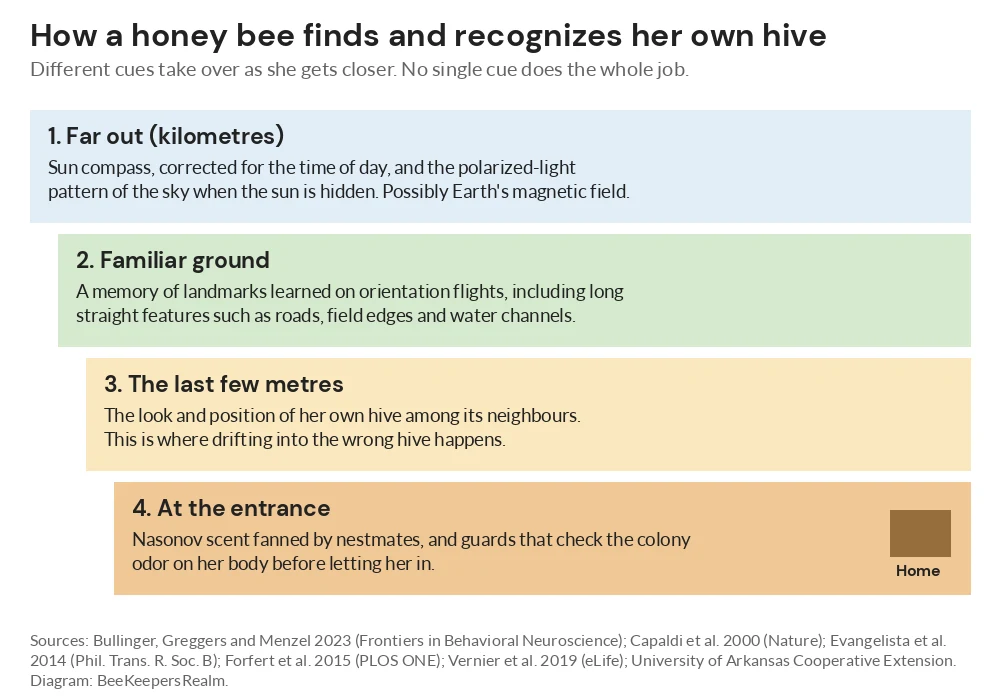
- Bees find their own hive with a chain of cues: sun compass and polarized light far out, remembered landmarks closer in, the hive’s look and position in the last few metres, and colony odor at the entrance.
- Bees do get lost. In one German study of hives set in a line, about 17 percent of workers sampled per colony had drifted in from another colony.
- Honey bees see ultraviolet, blue and green but are poor at telling reds apart, and many flowers carry ultraviolet “nectar guides” that people cannot see.
- Pheromones, the tremble dance, queen “toots” and “quacks,” and food sharing mouth to mouth carry messages that a dance cannot.
Table of Contents
- How Do Bees Communicate With Each Other?
- The Waggle Dance: Direction, Distance and Purpose
- How Honey Bees Navigate and Distinguish Their Hives
- How Do Bees Visually Communicate?
- Pheromones: The Chemical Channel
- Vibration, Sound and Touch
- Bee Antennae: Where Smell, Touch and Sound Meet
- How to Watch Bee Communication at Your Own Hive
- Frequently Asked Questions
- The Bottom Line
How Do Bees Communicate With Each Other?
A honey bee colony is tens of thousands of insects working in a dark, crowded nest, so its messages travel by touch, smell and vibration far more than by sight. Most of what is known comes from the western honey bee, Apis mellifera, so this page focuses on it. Our guide to worker bee roles explains who does what in the colony.
The messages fall into a handful of channels:
| Channel | Example | What it tells other bees |
|---|---|---|
| Dance | Waggle dance, round dance | Direction and distance to food, water or a new nest site |
| Scent (pheromones) | Nasonov scent, queen pheromone, alarm pheromone | “Home is here,” “the queen is present,” “danger” |
| Colony odor | Body-surface chemicals shared by nestmates | “I belong to this colony,” checked by guards |
| Vibration and sound | Tremble dance, queen tooting and quacking | “We need more nectar receivers,” queen status before swarming |
| Touch and food sharing | Antennal contact, trophallaxis | Food quality, the colony’s need for water, the queen’s condition |
| Vision | Flower colors, ultraviolet nectar guides, landmarks | Mostly flowers and the landscape talking to the bee, not bee to bee |
Note the last row: bees rarely signal to each other by sight, because the nest is dark. Vision is how they read flowers and find their way.
The Waggle Dance: Direction, Distance and Purpose
A forager back from a rich patch of flowers runs a small figure-eight on the comb: a straight “waggle run,” in which she shakes her abdomen from side to side, then a loop back to the start on one side, another waggle run, then a loop on the other side. Wikipedia’s summary of the research describes a single dance as anything from one to more than 100 of these circuits. Nestmates follow her moves, then fly out to search. Bees dance for nectar, pollen and water, and scouts dance for possible nest sites when a swarm is house-hunting, a story told in our piece on Thomas Seeley’s swarm research.
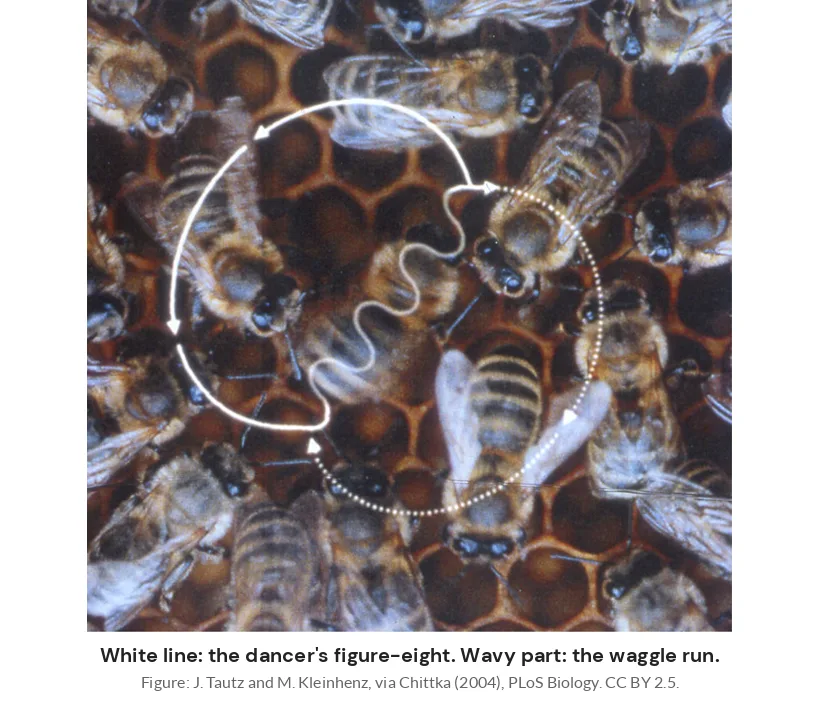
Austrian biologist Karl von Frisch decoded the dance and shared the 1973 Nobel Prize for the work. Arizona State University’s Ask A Biologist notes that he saw dancers shift their angle at the same rate as the sun moved across the sky. Our history of how von Frisch discovered the waggle dance covers the experiments, and the Wenner versus von Frisch controversy explains why some scientists once doubted it.
Direction: the angle to the sun
Inside the hive the comb hangs vertically and it is dark, so the dancer uses gravity. Straight up on the comb stands for the direction of the sun. The angle between her waggle run and straight up equals the angle between the sun and the food outside. A University of Arkansas Cooperative Extension guide gives the classic example: a run 30 degrees to the right of vertical tells her sisters to leave the hive, face the sun, turn 30 degrees to the right and fly straight. A run straight down means “fly away from the sun.”
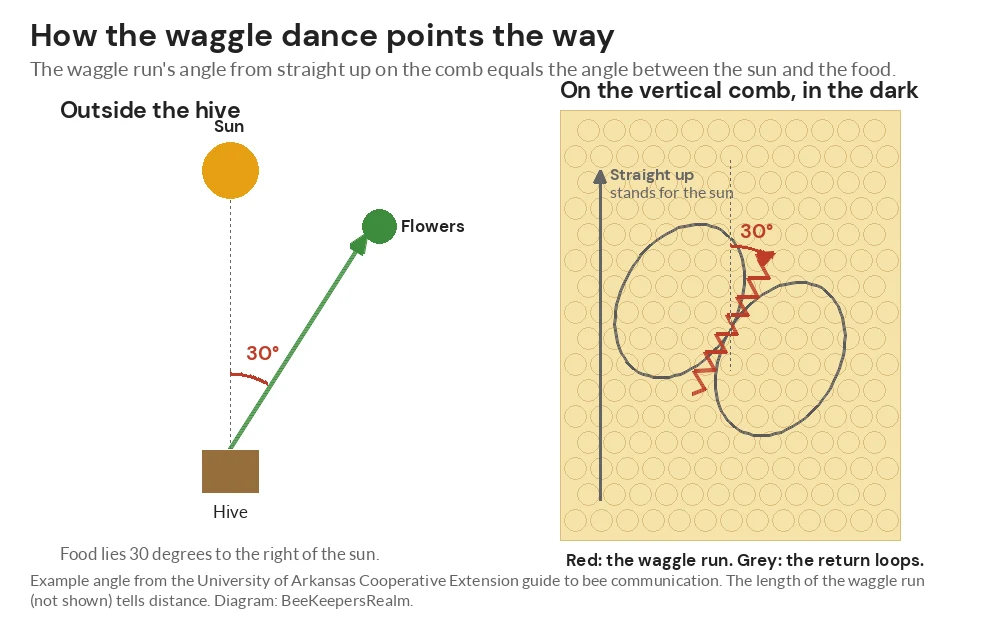
Because the sun moves, the code has to move too. Dancers adjust their angle through the day, which is the shift von Frisch spotted. When clouds hide the sun, bees can still read its position from the pattern of polarized light in patches of blue sky, and in a 2014 paper Evangelista and colleagues showed that bees which flew under polarized light alone passed that compass information on in their dances. The study appeared in Philosophical Transactions of the Royal Society B.
Distance: the length of the waggle run
The longer the waggle run lasts, the farther away the food is. The Arkansas guide puts it at roughly 1,000 yards of flight for each second of waggling. Treat that as a rule of thumb, not a constant. The exact scale differs between honey bee species and races, which is the basis of the waggle dance “dialects” that researchers have measured.
Followers pick up more than a bearing. The Arkansas guide notes that dances carry the quality of a find as well as its direction and distance. Most researchers also agree that the scent of the flowers on the dancer helps recruits, though how much it matters compared with the dance itself was the heart of the Wenner debate.
Round dance vs waggle dance
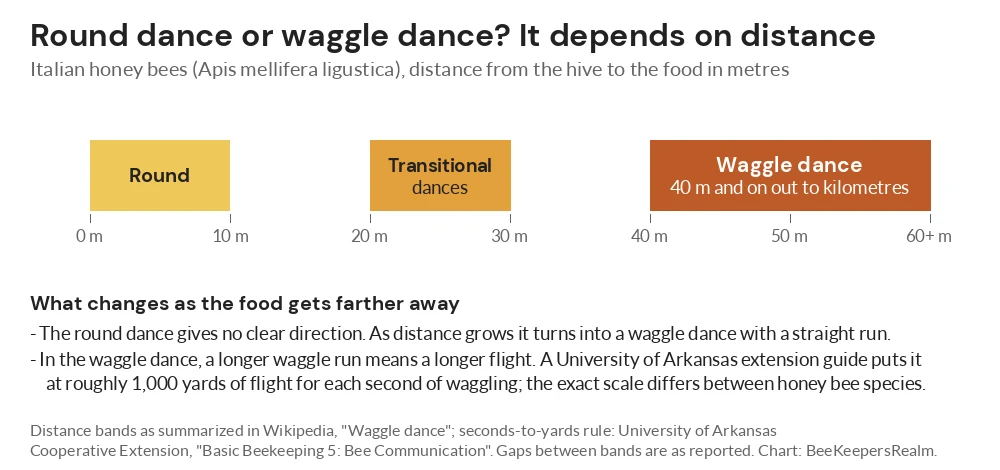
For food close to the hive, a forager runs in small circles, switching direction, with little or no waggle run. This round dance says “food is near, go and search,” but gives no clear bearing. According to the research summarized on Wikipedia’s waggle dance page, Italian honey bees (Apis mellifera ligustica) use the round dance for food up to about 10 metres away, transitional dances at about 20 to 30 metres, and the full waggle dance beyond about 40 metres. The forms blend into one another, which is why some researchers now call them all waggle dances.
Purpose and benefits of the waggle dance
The purpose of the waggle dance is recruitment: it sends more foragers to the best food the colony knows about, right now. The Arkansas guide notes that when scouts dance for possible nest sites, the most enthusiastic dancers recruit the most followers, and the same logic steers foragers toward the better patches. The University of Mainz noted in 2019 that some waggle dances last only a few seconds while others go on for up to five minutes. The dance also saves time. A new forager who follows a dance does not have to search the whole landscape herself.
The benefit depends on the landscape, though. A team from the Universities of Lausanne and Mainz disrupted the dance by keeping light off the combs and laying them horizontal, so dancers could no longer point the way, and then compared how much food the colonies brought home.
“To our surprise, we found that bee colonies are more successful at collecting food if they are deprived of their dance language,”
That result came from farmland where food was spread out and uniform. The Wikipedia summary of later work says bees use dance information more in complex, patchy landscapes, such as towns full of gardens, than in plain arable country. So the dance is a tool the colony uses when it pays, not a fixed rule.
How Honey Bees Navigate and Distinguish Their Hives
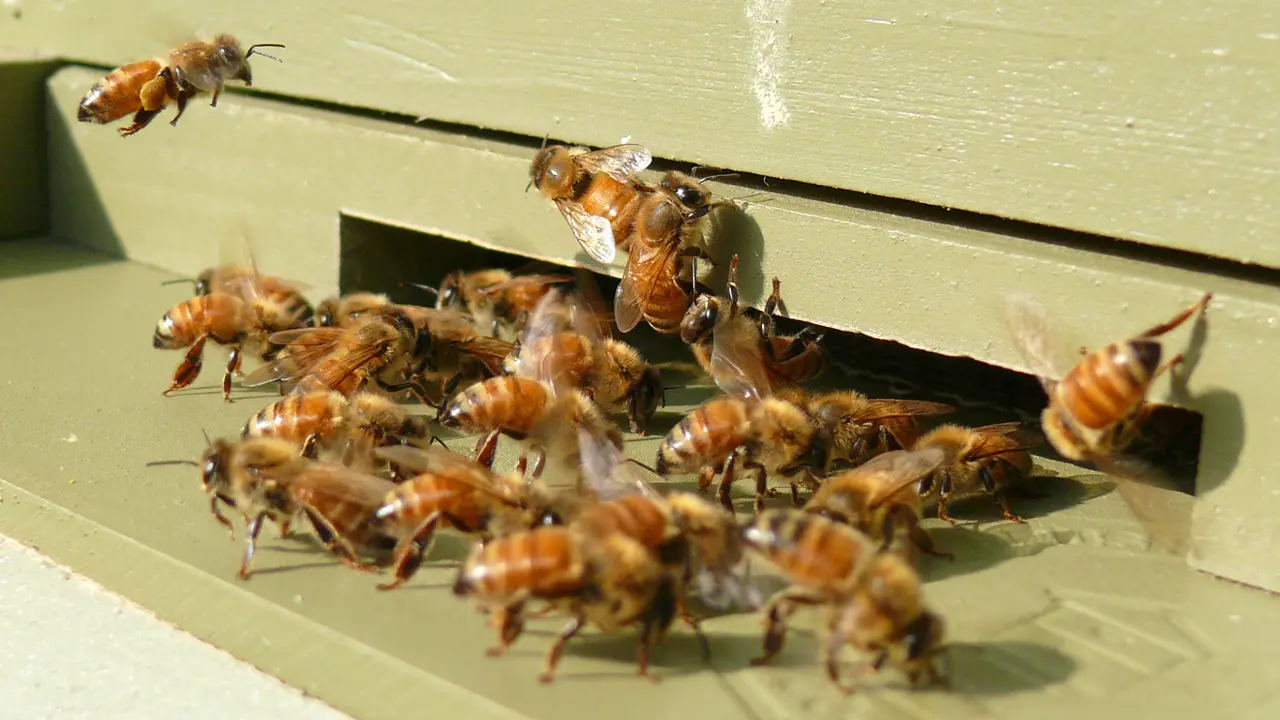
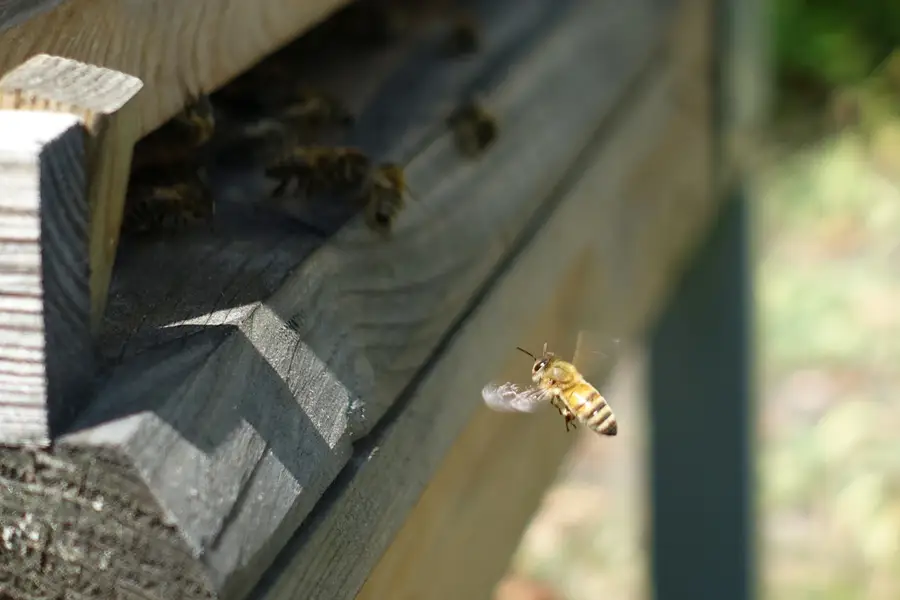
To navigate and distinguish their hives, honey bees combine several cues in sequence: a sun compass and polarized skylight far from home, remembered landmarks over familiar ground, the look and position of their own hive in the last few metres, and scent at the entrance, where nestmates fan the Nasonov “home” scent and guards check each arrival’s colony odor.
Orientation flights: learning the way home
A young worker does not fly off to forage on her first trip out. After weeks of work inside the nest, and before she becomes a forager at about three weeks old, she takes short “orientation flights,” hovering in front of the hive, facing it, then circling out farther each time. In a study published in Nature in 2000, a team led by E. A. Capaldi tracked these flights with harmonic radar. Experienced bees kept their flights about the same length in time but flew faster, so later flights covered more ground, and each flight usually stayed within a narrow sector around the hive.
“Orientation flights provide honeybees with repeated opportunities to view the hive and landscape features from different viewpoints, suggesting that bees learn the local landscape in a progressive fashion.”
Because foragers learn where home is this way, it pays to choose a hive site with care; our beehive placement guide covers what to look for.
Sun compass and polarized light
Out in the open, a forager holds a course relative to the sun, allowing for its movement through the day, and falls back on polarized skylight when the sun is hidden. It is the same compass the dance uses, which is why a dance can be turned into a flight.
Landmarks and a mental map
Closer in, bees use what they learned on orientation flights. A Frontiers news release on a 2023 study by Randolf Menzel’s group at the Free University of Berlin lists the cues bees are known to use: smell, the sun, polarized skylight, vertical landmarks that stand out from the panorama, and possibly Earth’s magnetic field. In the study, 50 experienced foragers carried tiny radar transponders and were released in an unfamiliar area. Their search flights followed long straight features in the landscape, such as irrigation channels.
“Here we show that honeybees use a ‘navigation memory’, a kind of mental map of the area that they know, to guide their search flights when they look for their hive starting in a new, unexplored area.”
The full paper is Bullinger, Greggers and Menzel, “Generalization of navigation memory in honeybees,” in Frontiers in Behavioral Neuroscience. The magnetic sense is still the least settled cue on the list; our article on how bees detect electromagnetic fields looks at that evidence.
Colony odor, Nasonov scent and guard bees
The final check is chemical. Workers at the entrance raise their abdomens, expose the Nasonov gland near the tip and fan their wings to blow its scent out of the hive. The Arkansas guide describes the scent as smelling like lemongrass oil. It draws returning bees and lost bees home, and it pulls a swarm together at a new site, which is why beekeepers use synthetic versions in swarm lures.
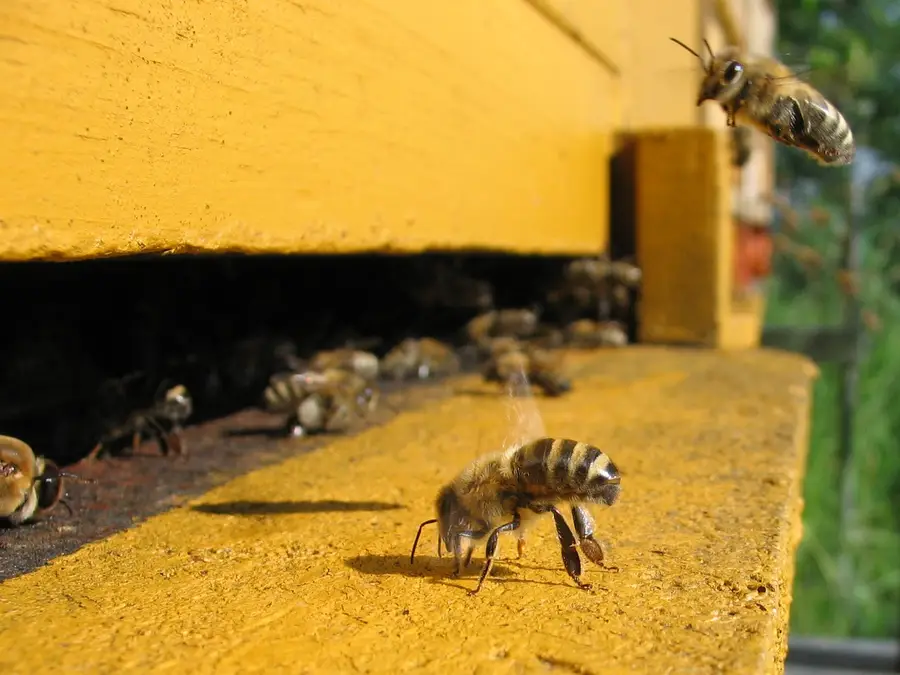
Guard bees stand at the entrance and touch arriving bees with their antennae. What they are checking is colony odor, a blend of waxy chemicals on the body surface. A 2019 study in eLife by Vernier and colleagues found that individual bees make their own blends rather than swapping chemicals with nestmates. The blend changes as a bee ages, and by the time she starts foraging it is specific to her colony, shaped by the hive environment. The eLife summary concludes that guards can only identify foreign foragers as intruders, not every stranger that turns up. Guards that spot an intruder bite or sting it and release alarm pheromone, calling more defenders. Our article on how bees detect hive intruders covers the defence side.
When bees get it wrong: drifting
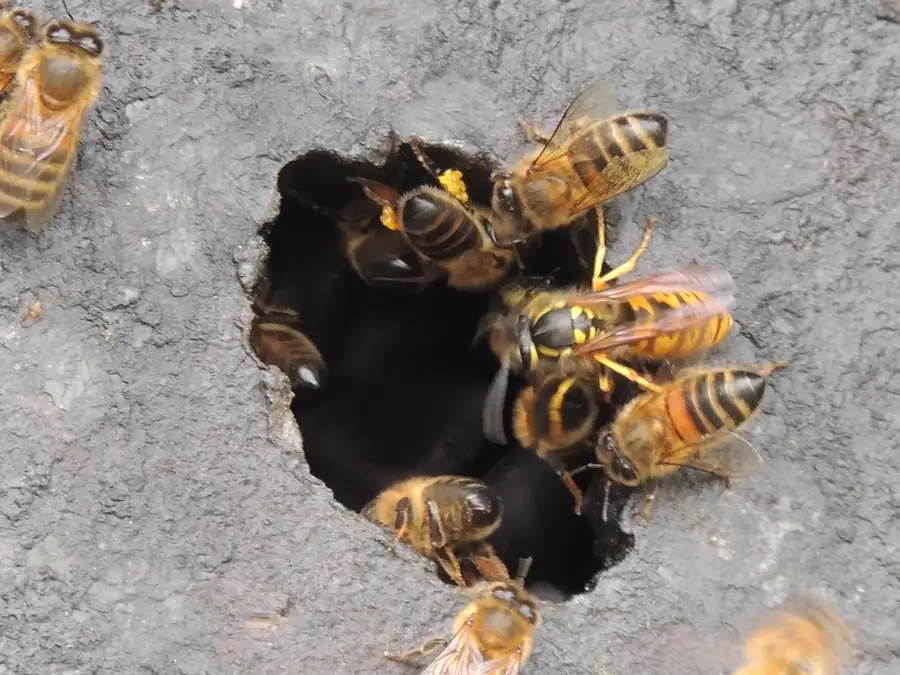
Navigation fails more often than people expect. In a 2015 study in PLOS ONE, Forfert and colleagues set colonies in a line of matching hives with entrances facing the same way, to make drifting likely. Genetic tests on 328 returning workers identified 75 drifters, an average of 17 ± 4 percent per colony, and the distance between colonies explained 79 percent of the drifting.
Drones drift too. When Thomas Seeley and Michael Smith compared two groups of 12 colonies, one crowded and one spread out, they reported in Apidologie that drones “made many homing errors in the crowded group, but not in the dispersed group.” Drifting matters because bees that enter the wrong hive can carry mites and disease with them. The fixes are the ones the PLOS ONE authors list: space hives apart and give entrances different colors or markings. Our guide to apiary entrance spacing for biosecurity has layouts.
How Do Bees Visually Communicate?
Bees do not flash signals at each other in the dark nest. Their vision works outdoors, on flowers and landmarks, so the useful question is “what do bees see?”
What colors honey bees see
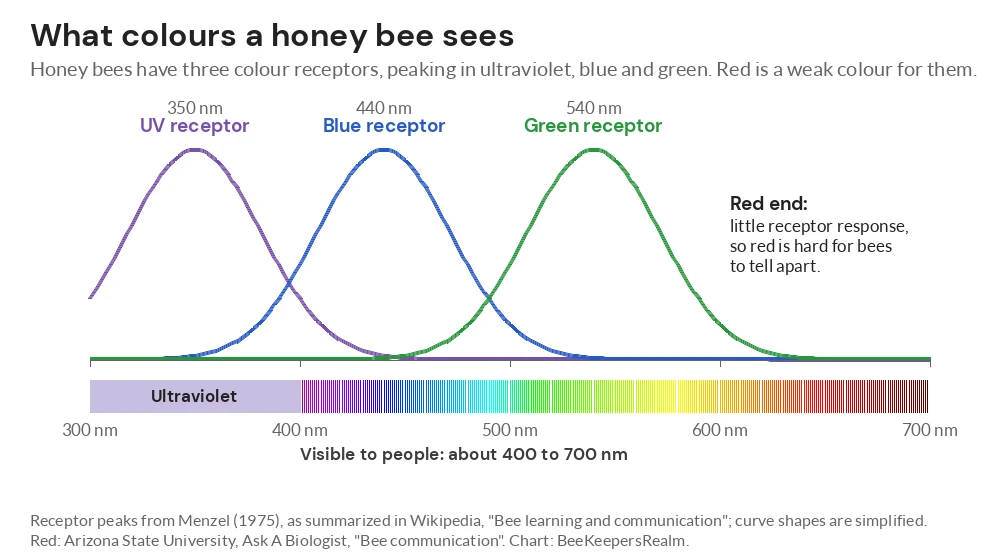
Honey bees have three kinds of color receptor. In work summarized on Wikipedia’s bee learning page, Randolf Menzel found that they respond most strongly at about 350 nanometres (ultraviolet), 440 nm (blue) and 540 nm (green). People see roughly 400 to 700 nm, so bees see into the ultraviolet, which we cannot, and lose much of the red end. Arizona State University’s Ask A Biologist puts it simply: honey bees cannot tell reds apart very well, but they see ultraviolet. Red flowers are not invisible to them, but red is a weak color for a bee.
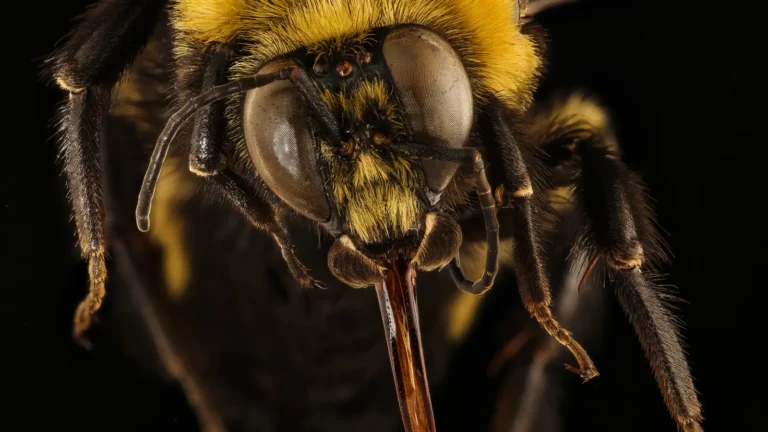
The rest of the bee’s eye kit, including the compound eyes and the three small ocelli on top of the head, is covered in our article on honeybee sensory organs.
Flowers talk to bees: nectar guides
The real visual conversation is between flowers and bees. The US Forest Service describes typical “bee flowers” as bright white, yellow, blue or ultraviolet, often with nectar guides, patterns that lead the bee to the reward. Many of those guides show up only in ultraviolet light.
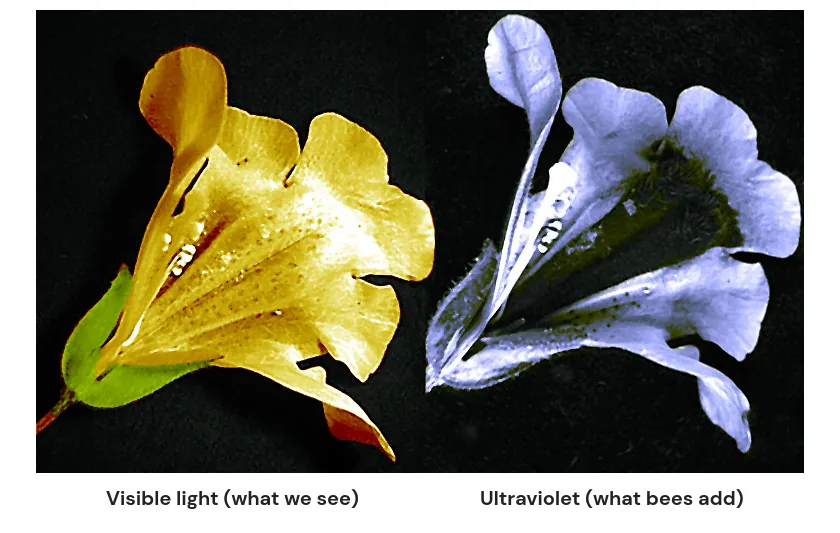
Our explainer on pollination syndromes shows how flower color, shape and scent line up with the animals that visit them.
Dances are felt, not watched
Western honey bees dance in darkness, so followers read the dance by touch, by the air currents and sound it makes, and by its electric field, not by sight. The exception proves the point. The dwarf honey bees of Asia, Apis florea and Apis andreniformis, dance on the flat, exposed top of their open-air nest. Their waggle runs point straight at the food, with no translation from gravity needed.
Pheromones: The Chemical Channel
Pheromones are the colony’s long-running background messages. The queen’s pheromones, spread through the nest as workers touch her and pass food to each other, tell the colony she is alive and laying. When they fade, workers start rearing a new queen; our queen bee guide explains her role. Brood pheromones tell nurse bees what the larvae need, as covered in our article on brood pheromone functions. Alarm pheromone, released when a bee stings, marks the target and rallies defenders; see our piece on alarm signals in bees.
For the full list of honey bee pheromones and what each does, read our guide to bee pheromone communication.
Vibration, Sound and Touch
Bees have no ears like ours, but they are very sensitive to vibration through the comb and to air movement close to the body.
The tremble dance
A forager who comes home with nectar and has to wait a long time for a receiver bee to unload her performs a tremble dance, shaking, spinning and walking across the comb, sometimes for as long as half an hour. Research summarized on Wikipedia’s tremble dance page links it to long unloading delays and a shortage of receivers, and it shifts workers from foraging toward receiving. In effect it says “stop recruiting more collectors, we need more hands inside.”
Queen tooting and quacking
Virgin queens make sounds of their own. Researchers at Nottingham Trent University, who used vibration detectors on hives, told CBC Radio in June 2020 that a queen still sealed in her cell “quacks,” while a queen that has emerged “toots,” and that the signals help workers decide when to release the other queens during swarming. A colony that has lost its queen makes a different, louder sound; our article on the queenless roar describes it.
Food sharing (trophallaxis)
Bees pass liquid food mouth to mouth constantly. That exchange carries information as well as calories. The Wikipedia summary of the research says it can signal the quality of a food source, temperature, a need for water and the condition of the queen.
Bee Antennae: Where Smell, Touch and Sound Meet
A bee’s antennae do much of her “listening.” They carry her smell receptors, so they detect pheromones, flower scents and colony odor. They are also touch organs, used when guards inspect arrivals and when followers keep contact with a dancer. At the base of each antenna sits the Johnston’s organ, which senses movements of the antenna. Dancing bees produce near-field sound, rhythmic pulses of air, and the Johnston’s organ picks it up. Experiments summarized on Wikipedia show it also responds to the electric fields that bees carry, and bees stopped responding to those fields when their antennae could not move at that joint.
Our article on sensory receptors in bee antennae goes through them one by one.
How to Watch Bee Communication at Your Own Hive
You do not need a lab to see most of this:
- Watch the entrance on a warm afternoon. Bees hovering and facing the hive are on orientation flights. Bees standing still with abdomens raised and wings fanning are spreading Nasonov scent.
- Look for guards. Bees touching each arrival with their antennae are checking colony odor.
- Find a dance. During an inspection, hold a frame from the brood nest vertically and look for a bee running a figure-eight with a knot of followers. Compare the angle of her waggle run from vertical with the sun’s direction outside.
- Listen. A steady hum is normal. A sharp rise in pitch and bees flying at you is a cue to close up slowly.
- Help bees get home. Space hives apart, paint entrances different colors and avoid long straight rows of identical boxes.
Frequently Asked Questions
How does a bee communicate?
Mostly by dancing, by scent and by touch. A honey bee forager dances to show direction and distance to food, pheromones broadcast the queen’s presence or alarm, and bees share food mouth to mouth, which passes on information about food and colony needs.
What is the purpose of the waggle dance?
To recruit nestmates to a good resource. The angle of the waggle run shows the direction relative to the sun, and the length of the run shows distance. Dances also carry the quality of the find, so the best patches draw the most recruits.
How do bees know which hive is theirs?
They learn its position and appearance on orientation flights, steer home by the sun and landmarks, and are recognized at the entrance by their colony odor. Look-alike hives in a row still confuse them, so some bees drift into neighbouring hives.
Do bees communicate by buzzing?
Partly. Bees sense vibration and near-field sound rather than hearing as we do. Dancers produce air pulses that followers detect with their antennae, queens toot and quack, and workers vibrate in the tremble dance.
How do bees communicate with humans?
They do not send messages to people on purpose, but beekeepers can read them. A calm hum, guards at the entrance and fanning bees signal a settled colony, while rising pitch and bees bumping into you signal alarm. Whether bees can learn individual people is explored in do bees recognize their beekeeper?
How long will a bee remember you?
There is no good evidence on how long a bee remembers a particular person. What is documented is memory for places: foragers can recall a rich feeding spot for several days, according to the 2019 Mainz study of dancing bees.
The Bottom Line
Bee communication works because each signal has a job. The waggle dance turns a flight into a few seconds of movement on the comb. Scent and touch hold the colony together. A string of cues, from the sun down to a guard’s antennae, brings each forager back to the right hive. If you keep bees, a quiet ten minutes at the entrance will show you most of it.
Image credits: Featured photo: Italian honey bees fanning and guarding a hive entrance, Ken Thomas, Wikimedia Commons, public domain, cropped. Other photos are credited in their captions. Diagrams and charts by BeeKeepersRealm from the sources named in each image.