In 1712, a French-Italian astronomer measured the angle of a honeycomb cell’s rhombic base with an instrument built for tracking stars, and got a number that would take three more mathematicians and thirty-one years to fully explain — and that, remarkably, turned out to be more accurate than the calculus-based answer that came after it. The story of how Giacomo Maraldi, René Réaumur, Samuel König, and Colin Maclaurin chased the honeycomb’s “perfect angle” is one of the more genuinely surprising episodes in the history of mathematics, and almost none of it involves a beekeeper.
Key Takeaways
- In 1712, astronomer Giacomo Filippo Maraldi measured honeycomb cell angles and calculated the rhombic base’s acute angle as 70°32′, assuming (correctly, as it turned out) that the rhombus and trapezoid angles were equal.
- Naturalist René Réaumur later asked mathematician Samuel König to calculate, from first principles, the angle that would minimize the wax needed to build a cell — König’s calculus answer was 70°34′, just 2 arcminutes off from Maraldi’s empirical figure.
- In 1743, Colin Maclaurin recalculated the problem independently and got 70°32′ — exactly matching Maraldi’s original 1712 measurement, and revealing that König’s calculation contained a small error traced to an imprecise logarithm table.
- The punchline: the empirical measurement came first and was actually more accurate than the initial “proven” mathematical answer, a genuinely unusual sequence in the history of science.
- This specific mathematical history is distinct from — and complements — general explanations of why honeycomb cells are hexagonal in the first place, which is a separate optimization question about cell cross-section rather than the base angle.
Table of Contents
- Maraldi’s 1712 Measurement
- Réaumur’s Question to a Mathematician
- König’s Calculus and a Small Error
- Maclaurin’s 1743 Correction
- The Angles Compared
- An Even Older Precedent: Pappus of Alexandria
- Why This Story Still Matters
- Why Engineers Still Care About This Angle
- Frequently Asked Questions
Maraldi’s 1712 Measurement
Giacomo Filippo Maraldi was an Italian-French astronomer working at the Paris Observatory — not a naturalist or beekeeper by trade, but someone with precision measuring instruments and the training to use them carefully. In 1712, he took on the honeycomb as a side project, measuring the angles of the trapezoidal side walls and rhombic base cells across many samples. He found the angles were remarkably consistent from cell to cell, and by assuming the rhombus’s acute angle equaled the trapezoid’s corresponding angle, he calculated a precise figure: 70 degrees, 32 arcminutes. It was a purely empirical result — a careful measurement, not a derivation from any physical or mathematical principle about why that angle should be optimal.
Réaumur’s Question to a Mathematician
Several years later, French naturalist René Antoine Ferchault de Réaumur picked up the problem from a different angle entirely — literally and figuratively. Réaumur suspected the honeycomb’s geometry wasn’t arbitrary but reflected a genuine material-efficiency optimization: given a fixed volume, what rhombic angle would require the least total wax to construct? Rather than attempt the calculus himself, Réaumur posed the question directly to his mathematically trained contemporary, the Swiss mathematician Johann Samuel König, effectively outsourcing the proof to someone equipped to actually solve the optimization problem.
König’s Calculus and a Small Error
König took up Réaumur’s challenge and worked through the calculus of the wax-minimization problem, arriving at an answer of 70 degrees, 34 arcminutes — tantalizingly close to Maraldi’s empirical figure, but not identical. At the time, the two-arcminute gap read as a reasonable margin between real-world measurement imprecision and a clean theoretical derivation; nobody involved suspected the theoretical answer itself might be the one with the error.
Maclaurin’s 1743 Correction
Maclaurin’s 1743 recalculation found the ideal acute angle to be 70°32′ — a result that “matched Maraldi’s empirical measurement exactly,” resolving the discrepancy in favor of the original 1712 observation rather than König’s calculus-based figure.
Scottish mathematician Colin Maclaurin revisited the problem independently in 1743, working through the same optimization calculus König had attempted three decades earlier. Maclaurin’s result came out to 70°32′ — precisely matching Maraldi’s original empirical measurement, not König’s calculated figure. Tracing the discrepancy back, later analysis found König’s original 1730s calculation had relied on an imprecise logarithm table, introducing the small error that produced his slightly-off 70°34′ result. The mathematics itself was sound; the arithmetic tool available to König at the time simply wasn’t precise enough to catch a two-arcminute error.
The Angles Compared
| Figure | Year | Method | Calculated Acute Angle |
|---|---|---|---|
| Giacomo Maraldi | 1712 | Direct physical measurement of real honeycomb | 70°32′ |
| Samuel König | ~1730s (per Réaumur’s request) | Calculus-based wax-minimization proof | 70°34′ (later found to contain a small logarithm-table error) |
| Colin Maclaurin | 1743 | Independent calculus-based re-derivation | 70°32′ (matched Maraldi exactly) |
The sequence is genuinely unusual as a piece of scientific history: an empirical measurement, made with the tools available to an astronomer rather than a mathematician, turned out to be more accurate than the first rigorous theoretical derivation attempting to explain it. It took a second, independent mathematical pass thirty-one years later to catch the error and vindicate Maraldi’s original number.
An Even Older Precedent: Pappus of Alexandria
The eighteenth-century mathematicians weren’t the first to notice something mathematically special about honeycomb geometry. The Greek mathematician Pappus of Alexandria, writing more than a thousand years earlier, had already observed that of the regular polygons capable of tiling a flat plane without gaps — triangles, squares, and hexagons — the hexagon encloses the most area for the least perimeter, making it the most material-efficient shape for the job. Pappus’s observation concerned the two-dimensional tiling question (why a hexagonal grid rather than a triangular or square one), a genuinely separate problem from the specific three-dimensional rhombic base angle Maraldi later measured, but the two threads are historically connected: both are pieces of the same underlying mathematical puzzle about what makes the honeycomb’s geometry so consistently efficient across multiple, independently discoverable dimensions of the same structure.
Why This Story Still Matters
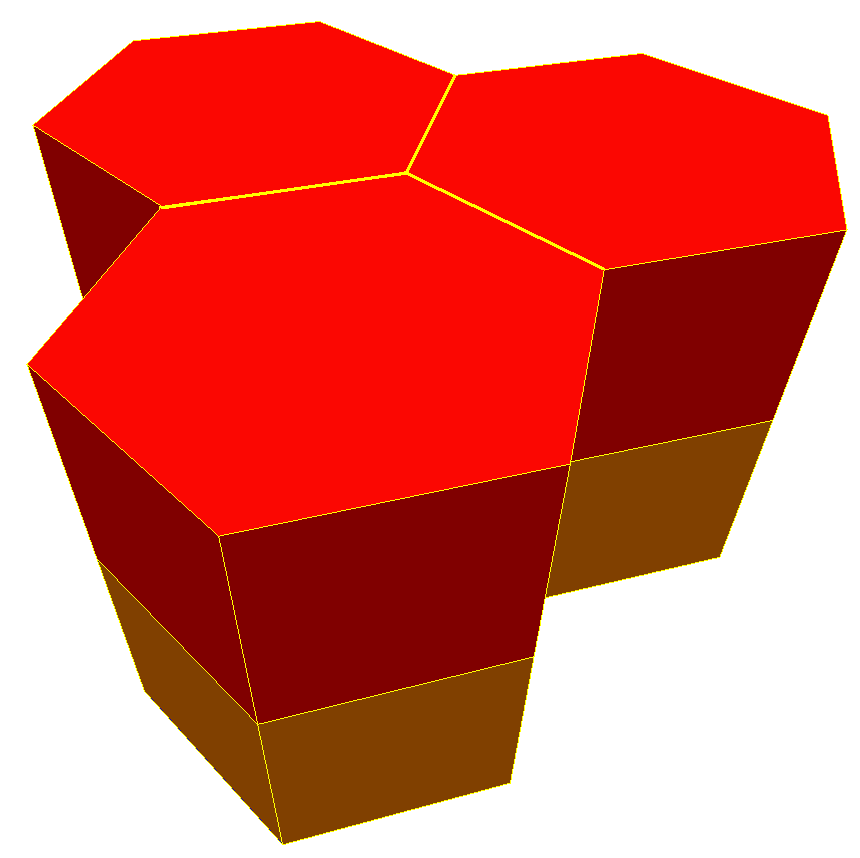
This specific angle-optimization history is a different question from the broader, more commonly told story of why honeycomb cells are hexagonal at all — that’s a separate optimization problem about which cross-sectional shape tiles a plane most efficiently, one covered in our general explainer on why honeycomb cells are hexagonal. The Maraldi-Réaumur-König-Maclaurin sequence is specifically about the three-dimensional rhombic base angle where three cells meet at the back of each hexagonal tube — a subtler, less commonly told piece of the honeycomb-geometry story, but arguably the more interesting one from a history-of-science perspective precisely because it shows real scientists getting the theory wrong before an independent check got it right. It’s also a genuinely early example of what’s now called the honeycomb conjecture — the broader claim, building on Pappus’s ancient observation, that hexagonal tiling is the most material-efficient way to partition a plane into equal-area cells — which mathematician Thomas Hales wouldn’t formally prove with full mathematical rigor until 1999, more than 250 years after Maclaurin’s work settled the narrower angle question — a history Dadant & Sons’ own beekeeping education center covers in more general form. Charles Darwin later picked up this same efficiency question from an entirely different angle, arguing it as evidence for natural selection rather than mathematical design; our article on Darwin’s bees covers that nineteenth-century evolutionary-biology thread in full.
Why Engineers Still Care About This Angle
The honeycomb’s efficient geometry didn’t stay a purely academic curiosity. Modern honeycomb sandwich panels — lightweight structural material built from a hexagonal-celled core between two flat face sheets — are used extensively in aerospace, automotive, and architectural engineering specifically because the same material-to-strength efficiency Maraldi, König, and Maclaurin worked out mathematically for wax also holds for aluminum, aramid fiber, and other engineered materials. An aircraft interior panel or a satellite structural component built on a hexagonal honeycomb core achieves a strength-to-weight ratio that a solid panel of the same material simply can’t match, for exactly the same underlying geometric reason bees evolved to build hexagonal cells rather than any other shape in the first place: it’s the most efficient way to enclose maximum volume using minimum material.
Frequently Asked Questions
What angle did Maraldi measure in honeycomb cells?
He measured the rhombic base’s acute angle as 70 degrees, 32 arcminutes, based on careful physical measurement of real comb samples in 1712.
Who first tried to mathematically prove the honeycomb angle was optimal?
Réaumur posed the question to mathematician Samuel König, whose calculus-based answer of 70°34′ was close to but not identical to Maraldi’s measurement.
Why didn’t König’s calculation exactly match Maraldi’s measurement?
König’s original calculation relied on an imprecise logarithm table available at the time, introducing a small error that Colin Maclaurin’s independent 1743 recalculation later caught and corrected.
Is this the same question as why honeycomb cells are hexagonal?
No — that’s a related but separate optimization question about the hexagonal cross-section itself. This history concerns the angle of the rhombic base where three cells meet at the back of each cell, a more specific geometric detail.
Was the honeycomb angle question ever fully mathematically resolved?
The base-angle optimization was settled by Maclaurin in 1743. The broader, related honeycomb conjecture — that hexagonal tiling is the most material-efficient way to divide a plane into equal areas — wasn’t formally proven until mathematician Thomas Hales’s 1999 proof.
Did bees actually evolve to build this mathematically optimal angle?
Bees build cells through simple, repeated physical actions rather than by calculating geometry, and natural selection favoring wax efficiency over many generations is the generally accepted explanation for why the resulting structure converges on a near-optimal angle.