Published August 27, 2026
Table of Contents
- What the Taranov Method Is
- Why This Sorting Actually Works
- Where the Method Comes From
- Equipment Needed
- Step-by-Step Process
- What Happens to the Parent Colony
- Hiving the Sorted Swarm
- Taranov vs. Pagden vs. Demaree
- Timing and Weather Considerations
- Who This Suits Best
- Signs the Sort Went Well
- Varroa and Disease Considerations
- Building or Sourcing a Taranov Board
- Common Mistakes
- FAQ
What the Taranov Method Is
The Taranov method is a swarm-control technique that uses a sloped board and sheet, placed in front of the hive entrance, to physically sort a shaken colony into two distinct groups: older flying foragers, which take off and return to the original hive location, and younger bees (along with the queen), which walk up the board and form a cluster you can then hive as a new, separate colony. Unlike the Pagden method’s hive-repositioning approach or the Demaree method’s excluder-based separation, Taranov achieves the queen/forager split through the bees’ own flight behavior and age-related physiology, sorted out on a single physical board in one session rather than over several days.
Why This Sorting Actually Works
The method exploits a real, well-documented biological fact about natural swarms: a swarm cluster is composed mostly of younger bees that haven’t yet reached full flying/foraging maturity, alongside the queen, while a colony’s oldest, most flight-capable bees are the ones actively out foraging or ready to immediately take wing. When a frame of mixed-age bees is shaken onto a sloped board, the bees that are physiologically ready to fly do exactly that — they take off and, having already oriented to the original hive location, return directly to it. The younger bees that aren’t yet flying are the ones who instead crawl upward along the board’s slope and cluster together near the top, alongside the queen (who, as an established, non-flying-for-foraging individual in this context, ends up sorted with the younger group). The result mimics the natural age composition of a real swarm cluster without needing to wait for the colony to actually swarm on its own.
Where the Method Comes From
The technique is named after G.F. Taranov, a Russian beekeeper and researcher who developed and documented the method, built directly on his observations of natural swarm composition. It remains a well-documented, if less commonly taught, swarm-control option compared to Pagden’s artificial swarming or the Demaree method — more common among experienced beekeepers looking for a fast, single-session alternative to techniques that require staged visits over several days or weeks.
Equipment Needed
- A Taranov board (a ramp roughly the width of the hive entrance, sloped at about 45 degrees from the ground up to entrance height) — purpose-built or improvised from a plank and support
- A white sheet to cover the lower portion of the board, hanging down on the sides to create a shaded space underneath
- A strip of rough wood, felt, or carpet attached under the board, roughly 10cm from the entrance-side edge, giving bees walking underneath something to grip and cluster on
- A new hive box to receive the sorted swarm once clustering is complete
Step-by-Step Process
- Set up the sloped board directly in front of the hive entrance, sheet draped over the lower section to create shade underneath.
- Remove frames from the hive one at a time and shake the bees evenly across the surface of the board.
- Let the bees sort themselves. Flight-ready bees take off and return to the original entrance location within minutes; younger bees walk upward along the slope.
- Watch for the queen and young bees to cluster under the lip near the top of the board, often gathering in the shaded space created by the sheet.
- Once sorting is complete (typically within 20-30 minutes as flying bees clear out), the clustered group — queen included — is ready to be collected and hived.
What Happens to the Parent Colony
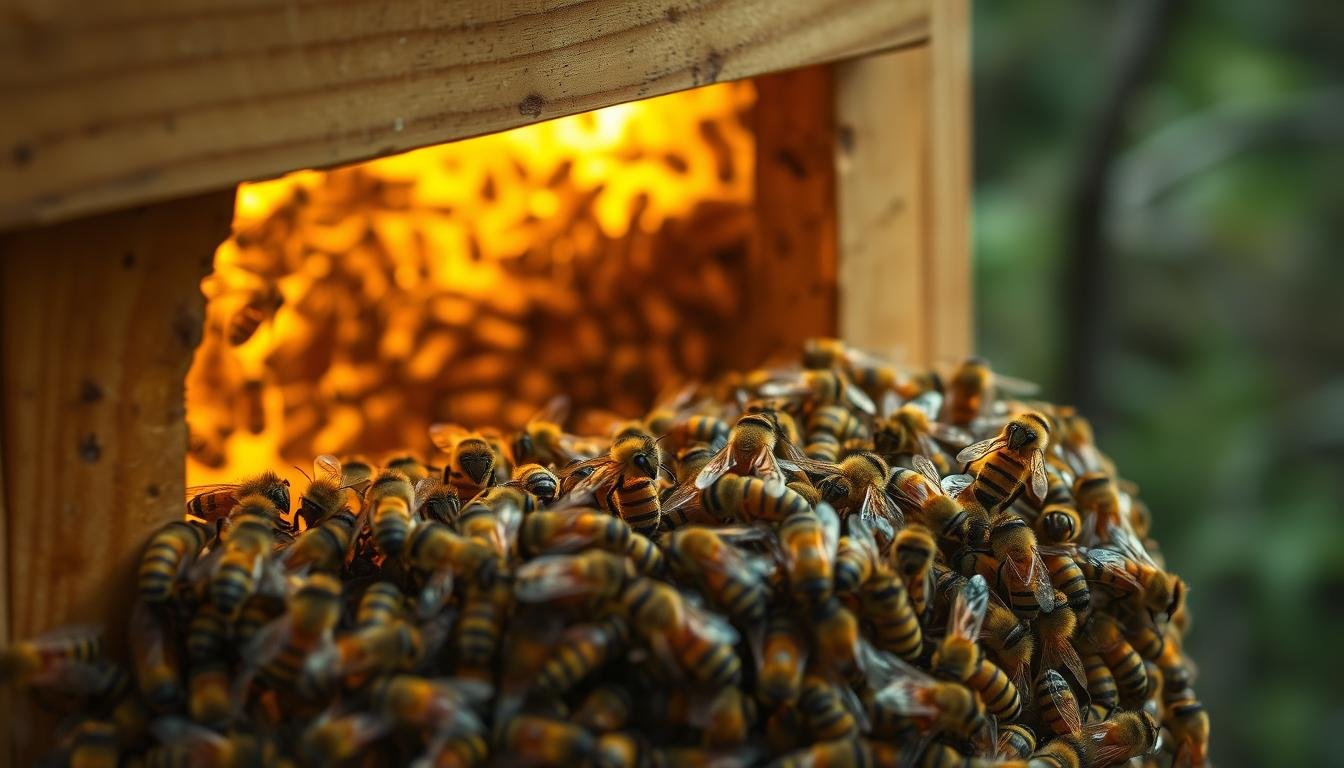
The original hive box, still at its original location, receives back all the flight-capable bees that returned there directly. As with the Pagden and Demaree methods, the parent colony is typically left with a frame of brood carrying an existing queen cell (or one is left deliberately during setup) so it can raise a replacement queen and continue as an independent colony in its own right, rather than being left permanently queenless.
Hiving the Sorted Swarm
The clustered group of young bees and the queen is handled the same way you’d hive any captured swarm — gently transferred into a prepared hive box, ideally positioned some distance from the parent colony so the two don’t experience ongoing forager drift back and forth between them. Because this group skews young, it behaves much like a natural swarm in terms of comb-building enthusiasm: young bees in a freshly hived swarm are typically vigorous, motivated wax producers, which is part of why this method has a reputation for establishing a strong, fast-building new colony rather than a weak one. Feeding the newly hived swarm 1:1 sugar syrup for the first week or two, similar to the feeding approach used after a shook swarm, supports this rapid comb-building while the colony establishes itself on entirely new foundation.
Taranov vs. Pagden vs. Demaree
| Method | Sorting mechanism | Time to complete | Physical effort |
|---|---|---|---|
| Taranov | Bee flight behavior/age, sorted on a board | Single session, ~30-60 minutes | Shaking every frame by hand |
| Pagden method | Hive repositioning, foragers return to original spot | About a week, two visits | Moving full hive boxes twice |
| Demaree method | Queen excluder physically blocking movement | Ongoing, weekly checks | Repeated full inspections |
Taranov’s main practical advantage is speed — the entire sorting happens in one visit rather than being staged across days or weeks, which appeals to beekeepers who want a same-day result. Its tradeoff is the physical effort of shaking every frame individually and the need for a specific piece of equipment (the board itself) that the other methods don’t require.
Timing and Weather Considerations
Taranov works best on a calm, mild day with decent flying conditions, since the whole sorting mechanism depends on flight-ready bees actually being willing and able to take off promptly — cold, wet, or very windy conditions can slow or disrupt the sorting process, leaving the two groups less cleanly separated than intended. Late morning through early afternoon, once the day has warmed enough for normal flight activity but bees haven’t already dispersed far on forage runs, tends to work better than very early morning or evening attempts.
Who This Suits Best
Taranov tends to appeal to beekeepers who want a fast, single-session swarm-control option and don’t mind the physical work of shaking down an entire colony’s frames, as opposed to beekeepers who prefer the lower single-visit effort (but multi-week timeline) of checkerboarding or OSBN, or the intuitive but multi-visit process of the Pagden method. It’s also a genuinely useful technique to know as a general skill even outside planned swarm prevention, since the same board-and-sheet setup can be used to sort and hive a swarm that’s already clustered somewhere inconvenient.
Signs the Sort Went Well
A clean Taranov sort produces a fairly distinct, sizable cluster of young bees and the queen near the top of the board, with the majority of the shaken population having flown off back to the entrance within the first half hour. If the cluster forming on the board looks thin or scattered rather than forming a cohesive group, that can indicate the day’s flying conditions weren’t ideal (bees are reluctant to take off in cool or overcast weather, muddying the sort), or that the colony being shaken was smaller or younger-skewed than typical, producing a less clean separation between the two groups. A queen that’s difficult to spot in the cluster isn’t necessarily a bad sign on its own — she’s often tucked well into the middle of the young-bee cluster rather than sitting visibly on the surface — but if no coherent cluster forms at all after 30-45 minutes, it’s worth checking that the board’s slope and shaded area are set up correctly rather than assuming the attempt simply failed.
Varroa and Disease Considerations
Because the Taranov method physically separates a colony’s bees by age rather than by treating or removing anything, it doesn’t reduce total mite load any more than a Pagden split or walk-away split does — the mites present on shaken bees end up wherever those specific bees end up, split roughly in proportion to how the bees themselves sorted. As with any method that produces two colonies from one, both the parent hive and the newly hived swarm deserve independent mite monitoring afterward rather than assuming the split itself provided any disease-management benefit on its own. A baseline mite count on both resulting groups within the first couple of weeks gives you an actual starting point to work from, rather than guessing at how the mite population divided between them. The newly hived young-bee swarm, being freshly established on new comb, is in a similar broodless-transition window to a shook swarm in this regard — see the shook swarm method for more on why that kind of transition period can be a useful window for certain mite treatments.
Common Mistakes
| Mistake | Why it matters |
|---|---|
| Attempting it in cold, wet, or very windy weather | Poor flying conditions disrupt the sorting mechanism the whole method depends on |
| Not creating enough shade under the board | The shaded area is where young bees and the queen naturally prefer to cluster — insufficient shade can lead to a more scattered result |
| Rushing the process before sorting is complete | Collecting the cluster too early can mix in bees that hadn’t finished sorting, undermining the age-based separation |
| Forgetting to leave a queen cell (or means to raise one) in the parent colony | Without this, the parent hive is left permanently queenless after losing its queen to the sorted swarm |
| Hiving the sorted swarm too close to the parent colony | Encourages forager drift back and forth between the two, undermining the clean separation just achieved |
Building or Sourcing a Taranov Board
Taranov boards are less commonly stocked as a ready-made product than more mainstream equipment like queen excluders or entrance reducers, so many beekeepers build their own from a plain wooden board or plywood sheet, roughly matched to the hive entrance width, with simple leg or block supports to hold the roughly 45-degree slope. The sheet draped over the lower section can be any plain white cloth large enough to create genuine shade underneath rather than just a token covering, and the rough-textured strip near the entrance-side edge can be as simple as a piece of scrap carpet, felt, or burlap stapled or tacked in place. None of this requires precision woodworking — the mechanism depends on the slope, the shade, and something for bees to grip, not tight tolerances or specialized materials.
Sources
Method mechanics, board construction, and the underlying age-composition biology reflect G.F. Taranov’s original documented technique as preserved and taught through established beekeeping reference resources and beekeeping association guidance on the Taranov board.
FAQ
What is a Taranov board used for?
Sorting a shaken colony into flying foragers (which return to the original hive) and younger bees plus the queen (which cluster on the board), used to create a fast, single-session artificial swarm for colony increase or swarm control.
How long does the Taranov method take?
Sorting typically completes within about 20-30 minutes once bees are shaken onto the board, with the whole process, including hiving the sorted swarm, generally done in a single session of an hour or so.
Does the Taranov method require special equipment?
Yes — a sloped board (roughly hive-entrance width, about a 45-degree angle) and a sheet to create shade, either purpose-built or improvised, plus a new hive box to receive the sorted swarm.
What happens to the original hive after a Taranov split?
It keeps all the flight-capable bees that returned to the original location and, provided with a queen cell or the means to raise one, continues as an independent colony developing a new queen.