Preparing to sell honey means more than filling jars. You must follow a clear process to meet both state and federal requirements. This short guide explains why a strict checklist matters and what to review first.
Extension Publication 3953 offers detailed guidance on inspection and label requirements for retail markets in Mississippi. Use it to confirm specific local rules and avoid costly penalties.
Accurate labeling gives consumers essential information and protects your brand. Establishing a consistent workflow helps every batch comply with legal standards and makes your product stand out on shelves.
For broader packaging and label design tips, consult this resource on proper labelling and packaging practices: honey labelling and packaging guidance.
Key Takeaways
- Follow Extension Publication 3953 to meet Mississippi label requirements.
- Use clear, accurate information to protect your business and consumers.
- Set a repeatable workflow to ensure each jar meets legal requirements.
- Confirm nutritional and address details match regulatory demands.
- Review labels regularly to stay compliant with federal rules.
Understanding the Importance of Your Honey Label
A clear label is your product’s first handshake with shoppers at farmers’ markets and stores.
Legible labels tell customers what to expect and make jars easier to compare on busy shelves.
Good food labeling builds trust with consumers who seek safe, authentic products. It also helps you meet state and federal rules.
Professional, informative copy should show origin, net weight, and contact details in plain text. That makes decisions quicker and reduces questions at the point of purchase.
Think of each label as a silent salesperson. A strong presentation signals care about safety and consistency and can turn first-time buyers into repeat clients.
- Keep text large and simple.
- Prioritize key facts near the front.
- Use trusted resources like honey labelling and packaging guidance and how to read and understand honey.
For grading context, review honey grading standards to match consumer expectations and reduce misbranding risks.
Essential Honey Quality Checklist Before Labeling for Sale
A precise front label helps shoppers identify the product and trust its origin at a glance.
Common name requirements
You must make sure the common name, such as Wildflower, appears clearly on the jar front. This helps producers and farmers markets staff and avoids confusion on busy shelves.
Net weight accuracy
The net weight (product only) must sit in the lower 30% of the label. List ounces and grams. One pound equals 16 ounces or 453.5 grams; one ounce equals 28.35 grams.
Manufacturer and distributor contact information
Include the manufacturer or distributor name and address so consumers can reach producers if issues arise. State departments, including the Department of Agriculture, often require this data.
- Ingredient statements are required if flavors are added; list ingredients in descending order by weight.
- Recommend adding nutrition facts to meet modern food expectations.
- Display floral source (clover, cranberry, etc.) on the jar to identify the origin.
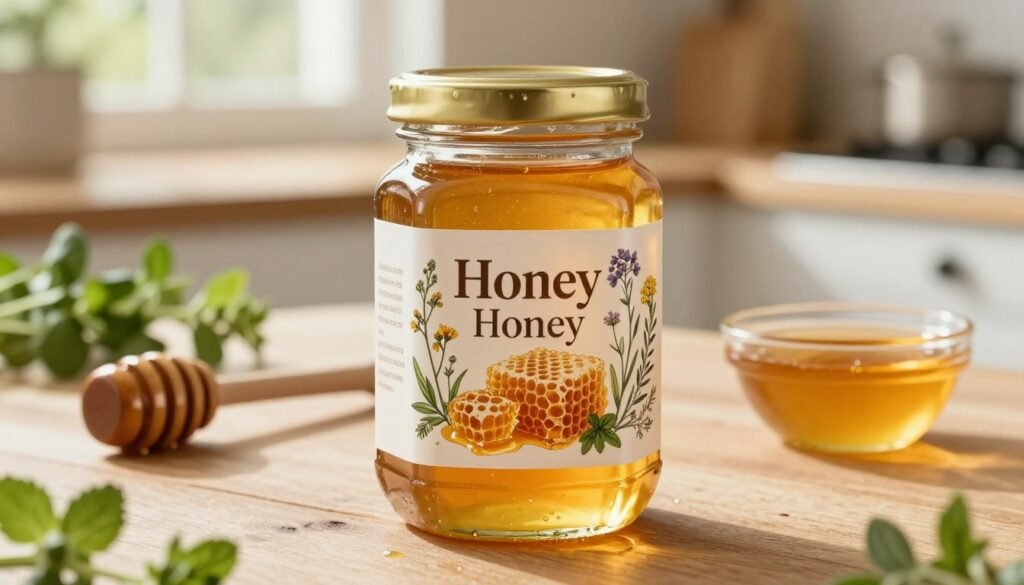
For practical label tips and packaging methods, review label tips and this guide on how to package and label honey.
Recommended Additions for Consumer Safety and Brand Identity
Adding a few targeted warnings and producer details turns a label into a safety tool.
Infant Safety Warning
The state of Mississippi requires the exact phrase: “Warning: Do not feed to infants under one year of age”. Include this text prominently to protect infants and reduce legal risk.
“Label warnings are simple steps that prevent serious illness and build trust with customers.”
Practical label elements
- Add your physical address as producer contact to meet state rules and show transparency.
- Include a clear manufacturer or distributor statement so buyers can reach you with questions.
- Consider listing the harvest year and the floral source to highlight provenance.
- Nutrition facts are optional but helpful for shoppers comparing food items.
| Element | Why it matters | Example |
|---|---|---|
| Infant warning | Prevents botulin-related illness | “Warning: Do not feed to infants under one year of age” |
| Producer address | Ensures traceability and compliance | 123 Apiary Rd., Jackson, MS |
| Year & source | Communicates seasonality and origin | Harvest 2025 — Wildflower |
For detailed guidance on reading labels and meeting U.S. requirements, see this how to read and understand honey and review federal rules at U.S. labeling requirements.
Selecting Materials and Design Elements for Professional Packaging
Select label materials that withstand humidity and handling to keep your jars readable on store shelves.
Choosing Durable Label Materials
Use waterproof film or laminated paper so print stays clear when stored in humid areas. Flexible stocks work well on round jars and squeeze bottles.
Ensure the weight in grams is exact on every label; accuracy helps meet state and federal requirements and builds trust at point of purchase.
- Pick materials that resist creasing and peeling when applied to curved surfaces.
- Order custom-shaped labels to highlight color and clarity of your product.
- If unsure, contact Avery Customer Care at (800) 462-8379 for material and template help.

Tips for Effective Visual Design
Keep type readable and use contrast so the product name and weight stand out. Limit fonts and colors to create a cohesive shelf presence.
Use templates to speed production and keep every jar consistent. Consistency reduces errors and improves brand recognition.
“Durable materials and clear design protect both the printed facts and your reputation.”
| Feature | Benefit | Example |
|---|---|---|
| Waterproof film | Maintains legibility in humidity | Clear laminate over printed label |
| Flexible stock | Fits bottles without peeling | Polypropylene for squeeze bottles |
| Custom shape | Highlights color and clarity | Die-cut oval to match jar profile |
For design examples and templates, review a practical guide on label design for small producers or read how to get started selling your product legally via this seller’s guide.
Conclusion: Finalizing Your Honey Product for Market
Final review, C: A final compliance sweep helps your product reach shelves without regulatory surprises.
Confirm that each jar meets state and federal requirements and that the label lists net weight, producer contact, and any required safety warnings. Use the USDA honey labels guide and your local Department of Agriculture as references.
Check packaging and food handling, then verify the year and any floral source or color notes that inform customers. For farmers markets, consult a practical guide on selling honey at farmers markets.
Consistent attention to these details protects consumers, supports producers, and helps your product stand out on store shelves.