This guide explains how to create compliant, clear labels for honey sold in the United States. It ties federal law—rooted in 21 U.S.C. 342 and 343—to practical steps you can use on pack. The focus is on the essentials: common name, net weight placement on the principal display panel, and manufacturer or distributor identification.
You’ll also learn when to add ingredient lists for blends or flavored products, how Nutrition Facts should show added sugars, and when a recommended infant warning matters. Optional quality cues like USDA grade statements and Pfund color terms can help buyers, but must avoid misbranding the food.
Operational tips cover material choices and application—use BOPP or vinyl for flexible containers, allow overrun space on glass, and set up print‑and‑apply date coding for pails and bulk. With clear panels, legible type, and accurate information, your product gains trust and avoids enforcement risks.
Key Takeaways
- Federal statutes (21 U.S.C. 342, 343) set core rules for product identity and panel placement.
- Place net weight in the bottom 30% of the PDP in customary and metric units.
- Include ingredients and Nutrition Facts when applicable; show added sugars clearly.
- Use USDA grades and Pfund color terms carefully to inform without misbranding.
- Choose appropriate label materials and allow jar overrun to prevent flagging.
- Know state “local” claim variations and small‑producer exemptions to stay compliant.
What today’s U.S. honey sellers need to know before designing a label
Start by locking in the basics: the common product name, the net weight by weight, and the full contact line for the responsible business. These three items are non‑negotiable and must be clear on the principal display panel.
Use the simple name Honey when the jar contains only that product. If you offer flavored or blended jars, the name must reflect that change and an ingredients list must appear in descending order by weight.
Plan the panel layout so the net weight sits in the bottom 30% of the PDP in both customary and metric units. Make sure the type is legible—small packages need a minimum type height (around 1/16 inch).
“Design early with compliance in mind to avoid costly reprints and to help customers find key facts at a glance.”
Pro tip: verify state variations before printing. Some states add metric or local‑claim rules that affect what you print. For a practical rulebook, see the label regulations that many sellers use as a starting checklist.
| Element | Placement | Why it matters |
|---|---|---|
| Common name | Principal display panel | Identifies the product for customers and regulators |
| Net weight (by weight) | Bottom 30% of PDP; customary & metric | Prevents misrepresentation and aids purchase decisions |
| Manufacturer/packer/distributor | Info panel; legible address | Allows customers to contact your business |
32. U.S. honey labeling requirements: the how-to steps to stay compliant
This section walks you through practical steps to make labels that meet federal and market expectations. Follow each item to keep the principal display panel clear and compliant.
Use the correct common name on the principal display panel
UseHoneyfor pure product. If the jar contains blends or flavor additions, state that in the name (for example, “A Blend of Honey and Corn Syrup” or “Strawberry‑flavored Honey”). Clear names prevent misbranding.
Declare net weight in customary and metric units in the bottom 30% of the PDP
Place net weight on the lower 30% of the panel and show both ounces and grams so interstate sales stay simple.
Include manufacturer, packer, or distributor name and address
List the responsible party with a legible address for traceability and consumer contact. This must be on the information panel.
When and how to list ingredients
Pure jars omit an ingredient line. Blends and flavored products must list ingredients in descending order by weight. Use plain type and common names.
Nutrition Facts, added sugars, infant safety, and origin
Follow standard nutrition formats and include the added sugars footnote (one serving adds 17 g and 34% DV). Small producers under $500,000 may qualify for an exemption; verify eligibility before removing a panel. Add the recommended infant warning:WARNING: Do Not Feed Honey to Infants Under One Year Old.For imports, disclose country of origin even if packaging occurs domestically.
Optional quality cues
You may show USDA grades and Pfund color descriptors to describe quality and color. For grading details, see thelabel guideand a detailed analysis ofgrading standards.
Navigating state and local nuances without misbranding your product
Selling across state lines means adapting packaging to meet local expectations and program rules. Many states add unit, claim, or disclosure rules that go beyond federal law. Plan early so you avoid relabeling and market disruptions.
Metric weight and “local” claims often cause the most confusion. New York, for example, requires metric units alongside imperial. Several New England states — Connecticut, Maine, New Jersey, New Hampshire, and Vermont — define “local” by in‑state origin or a set radius.
To reduce risk, make these checks part of your pre‑print review:
- Verify each state where you sell to make sure your label shows required units.
- Confirm geographic sourcing before you use any “local” claim on jars or marketing.
- Keep documentation to back floral or locality statements for regulators and consumers.
Standardize where possible. Adopt the strictest practical approach — for example, always include metric weight — so products work across multiple markets. This saves time and reduces printing errors.
“Meeting state add‑ons can unlock programs like school or state promotional opportunities.”
Before any print run, run a compliance check and version control step. For more on production and label craft, see our production and labeling guide.
From jar to shelf: materials, label design, and application that pass the real-world test
Select packaging and labels to match how a container behaves. For squeezable plastic, choose BOPP or vinyl face stocks; they flex without wrinkling and, with fine adhesive carriers, reduce outgassing bubbles. For jars that meet spills or moisture, use waterproof films. Reserve kraft paper for dry, controlled environments when a rustic look matters.
Design for legibility and brand impact. Prioritize size, contrast, and clear space so required information reads at a glance. Keep the net weight and common name on the principal display panel with room for mandatory lines.
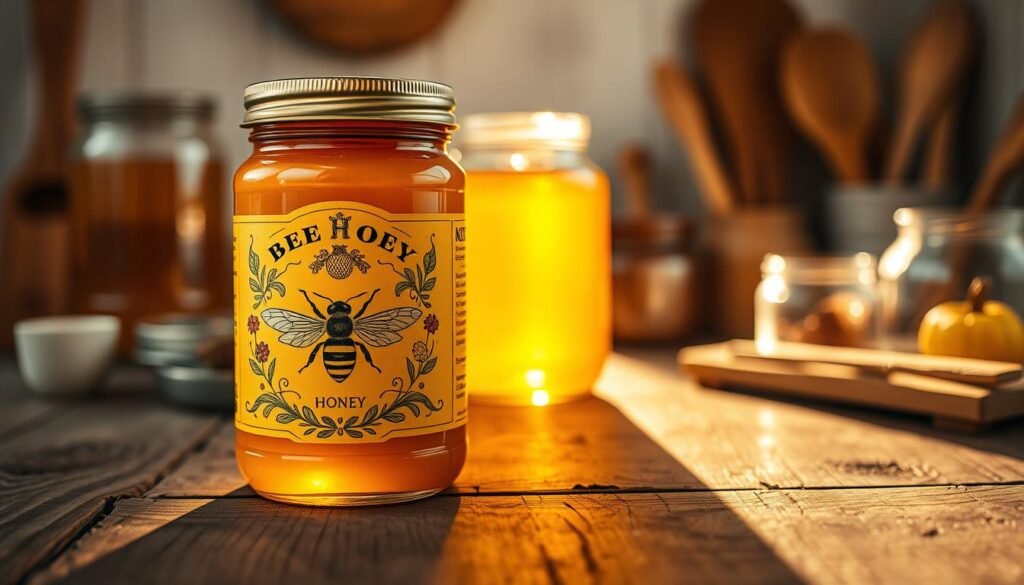
Apply labels the right way. On glass, avoid compound curves and add 1/8–1/4 inch overrun to prevent flagging. Test filled containers for edge lift and scuffing after storage and transit simulations.
- Use print-and-apply systems to add production or best-by dates; they can accept local input or PLC feeds.
- Plan for pail labeling if you sell bulk product; systems that handle 5-gallon pails speed compliance for foodservice and industrial channels.
- Choose DIY templates for small runs and fast changes; opt for professional custom runs for high volume and tight color control.
“Validate labels on the filled product — that real-world check saves reprints and lost shelf time.”
For seasonal production and line planning, see our guide on seasonal tasks and workflow to align packaging cycles with harvest and sales windows.
Putting it all together: a step-by-step labeling checklist for U.S. honey
A focused checklist helps you move from artwork to shelf without surprises. Use this ordered list during pre-press, production, and quality checks.
- Confirm the common name: use “Honey” for pure product. For blends or flavored jars, state a clear product name that matches the jar contents.
- Place net weight correctly: show customary and metric units in the bottom 30% of the PDP at a readable size.
- List contact info: include manufacturer, packer, or distributor name and address on the information panel.
- Declare ingredients and order: for non-pure jars, list ingredients in descending order and keep production records to verify the order.
- Decide on nutrition: determine if a Nutrition Facts panel is required or if you qualify for an exemption; include the added sugars footnote when needed.
- Note safety and origin: add the recommended infant warning and verify any country-of-origin or source claims for imported product.
- Substantiate quality cues: if you use USDA grades or Pfund color, keep supporting documentation and apply descriptors consistently.
- Validate materials & application: pick durable face stocks (BOPP/vinyl or waterproof film), set proper overrun for glass, and use print-and-apply systems for date and year coding.
- Standardize and archive: keep artwork, approvals, and proofs on file. Standardize size, layout, and packaging specs so customers and auditors see consistent information.
Quick tip: run a final compliance review and a filled-product mockup before any full run. This saves time and prevents costly reprints.
“Keep a single master file for each SKU — it makes updates, audits, and reprints far easier.”
Conclusion
, A concise compliance plan ensures each jar hits shelves with the right information and consistent design. Confirm the common name, dual-unit net weight, and the distributor contact before approving print.
Layer ingredient lines, Nutrition Facts notes for added sugars, and the recommended infant warning where applicable. Choose durable materials like BOPP or vinyl, or waterproof film, so printed text survives transit and handling.
Keep a controlled archive by year and lot so changes to recipes or sourcing update labels promptly. Coordinate procurement, production, and quality so products and artwork match on every SKU and shelf.
Bottom line: disciplined design and routine checks make reliable honey labels that protect consumers, reduce risk, and support growth.
FAQ
What is the required product name to use on the principal display panel?
Use a clear common name that accurately describes the product on the principal display panel. If the product is pure honey, use “Honey.” For blends or flavored products, use a descriptive name such as “Honey Blend with Cinnamon” or “Orange‑Flavored Honey.” Avoid vague or misleading terms that could cause misbranding.
How should net weight be displayed?
Declare net weight in both customary (oz, lb) and metric (g, kg) units on the bottom 30% of the principal display panel. Display the information in a readable font size and group to meet FDA visibility expectations. Use accurate rounding rules and ensure the declared weight matches the filled package.
Where do I list the name and address of the business?
Include the packer, manufacturer, or distributor name and a domestic street address, city, and state, or a city and state plus a registered agent. If the business is outside the U.S., provide a U.S. contact. This information should appear on the information panel near other required statements.
When must ingredients be listed and how for blends or flavored products?
List ingredients in descending order of predominance by weight when your product contains added flavors, sweeteners, or other ingredients. For single-ingredient pure honey, an ingredient list is not required. For blends, identify any allergens if present, and use clear names for added flavors or syrups.
Do I need a Nutrition Facts panel and added sugars disclosure?
Most honey products sold at retail require a Nutrition Facts panel. Declare calories, total sugars, and added sugars if sweeteners beyond the honey are added. Small-producer exemptions may apply for very small operations; verify current FDA thresholds to confirm eligibility.
Are there special warnings for infants or vulnerable groups?
Labels should include an infant safety statement when applicable. For raw or unpasteurized products, recommend that infants under 12 months not consume the product due to botulism risk. Consider additional consumer safety guidance where appropriate.
How do I show country of origin for imported honey?
Imported products must state the country of origin on the label. The statement should be clear and conspicuous, for example, “Product of Brazil” or “Imported from Canada.” Country-of-origin rules apply to whole and blended imports and may affect marketing claims.
Can I use optional quality cues like USDA grades or Pfund colors?
Yes. You may include USDA grades or Pfund color descriptions as optional quality indicators, but only if the product actually meets those standards and you can substantiate the claim. Avoid unverified quality claims that could be considered misleading.
What label claims are allowed when advertising "local" or single-state origin?
You may claim “local” honey if the product is sourced and packed within a defined local area and you can substantiate that claim. When referencing a specific state, be sure your sourcing and packing practices meet the representation to avoid deceptive marketing under state or FTC rules.
Do state and local rules add requirements beyond federal labeling?
Yes. Some states require additional disclosures, registration, or grading for retail honey. Check state agriculture department rules for labeling, weight rounding, and market-specific claims to avoid misbranding at the state level.
What label materials perform best for jars and squeezable bottles?
Choose materials compatible with your container and storage conditions. BOPP and waterproof films work well for squeezable plastic bottles, while vinyl and kraft paper are suitable for glass jars when protected. Consider adhesives that resist outgassing and humidity.
How should labels be designed for readability and compliance?
Use high contrast, legible typefaces, and allocate space for required elements like net weight and contact information. Keep the principal display panel uncluttered and ensure mandatory text meets minimum size guidelines for easy consumer reading.
What are best practices for applying labels to curved or heated containers?
Allow for overrun space and use conformable films and pressure‑sensitive adhesives for curved surfaces. For heat‑treated containers, select heat‑resistant adhesives and test application to avoid wrinkling or lifting during processing.
How should date coding and batch information be handled for retail jars?
Include lot codes or production dates for traceability. Use clear, durable printing near the cap or base. For scaling up, consider print‑and‑apply systems or preprinted pressure‑sensitive labels sized to integrate batch codes without obscuring required label information.
When is it acceptable to use DIY printing versus professional runs?
DIY printing is suitable for very small batches or farmers’ market sales, provided the labels meet legal requirements. For larger retail distribution, invest in professional printing to ensure consistency, durability, and compliance with font and placement rules.
Is there a concise step-by-step checklist to prepare a compliant label?
Yes. Verify product common name, declare net weight in both unit systems, add manufacturer contact details, list ingredients if needed, include a Nutrition Facts panel when required, add infant safety or country‑of‑origin statements where applicable, and test label materials and adhesion. Confirm state rules before finalizing.