Family-run, no-kill specialists offer fast, humane bee removal with more than 50 years of combined experience and 180+ five-star Google reviews.
We focus on live removal, not extermination. Our licensed, insured team works across multiple regions and follows legal guidelines for safe, compliant work.
Typical timelines range from one to six hours depending on hive size and access. Many customers get transparent quotes the same day.
We handle homes and businesses, complete honeycomb cleanup, sealing, and repairs to prevent re-infestation. Safety and proper identification guide every job to protect families, pets, and neighbors.
Contact a real team member quickly for a same-day inspection and clear plan. Call (954) 274-6425 or 877-DEAD-BUG to restore comfort and safety to your property today.
Key Takeaways
- Humane, live bee removal backed by decades of experience.
- Licensed, insured service with hundreds of five-star reviews.
- Same-day inspections, transparent quotes, and tailored removal plans.
- Complete cleanup, sealing, and repairs to stop reinfestation.
- Fast response and clear communication to protect your household or business.
Beehive Relocation and Transport USA: Humane, Licensed, and Reliable
State-registered, fully insured beekeepers lead every job. Our family-run crew uses non-toxic methods so colonies remain healthy while people stay safe.
Live bee removal and apiary relocation across the United States
We perform no-kill bee removal and move colonies to licensed apiaries or local farms for monitored care. This helps honey bees keep pollinating local gardens while preventing property damage.
Trusted by homeowners and businesses for safe, no-kill solutions
Available 24/7 in South Florida and usually within 24–48 hours across KY, IN, and TN, our response minimizes disruption. Years of field experience and strict safety protocols reduce risks during extraction and transport.
- Humane standard: beekeeper-led removals without pesticides.
- Scalable services: from small swarms to large structural cut-outs.
- Community trust: 180+ five-star reviews and repeated neighborhood awards.
Contact our team to schedule live bee removal and certified colony rehoming with direct, courteous communication from inspection through follow-up.
Why choose live bee relocation over extermination
Opting for live removal helps maintain pollination services and avoids hidden structural damage. Honey bees pollinate roughly one in every three bites of food, so saving colonies protects gardens and local agriculture. Florida encourages live methods, which aligns environmental responsibility with practical results.

Protect pollinators and local ecosystems
Relocating a colony preserves vital bee populations that support native plants and crops. Keeping honey bees alive helps stabilize pollination cycles and local biodiversity.
Prevent property damage and recurring infestations
Professional removal extracts comb and residues so pheromones do not lure new swarms. Leftbehind honey and wax can stain wood, cause odors, and attract ants, roaches, and rodents — harming property value over time.
Safer for families, pets, and neighbors
Skilled teams use non-toxic methods that reduce risk in a home or business setting. Early, humane intervention limits exposure to stings — important since about 5–7.5% of people may have severe allergic reactions.
- Long-term benefits: thorough cleanup reduces callbacks and future structural issues.
- Scale matters: large colonies can grow toward ~70,000 bees, so prompt action limits disruption and cost.
- Correct ID: distinguishing honey bees from more aggressive insects ensures safe, appropriate work.
For expert, humane service that protects people and pollinators, learn more about our bee relocation services.
Our proven removal-to-relocation process
Our team follows a clear, step-by-step method that moves a colony from inspection to monitored rehoming without damaging the structure.
Inspection and identification begin with species checks to tell honey bees from wasps or hornets. We inspect attics, roofs, walls, soffits, trees, decks, grills, water meters, and utility boxes for entry points.
Safe extraction and access planning
We develop an access plan for walls, roofs, or trees that limits disturbance. Protective suits, smoke, hive boxes, and a bee vac are used when appropriate to gather the queen-focused cluster.
Hive removal, cleanup, and repairs
Teams remove all comb, wax, and honey. Cleanup and sanitation eliminate pheromones that attract new swarms. We seal gaps, perform light repairs to siding, soffits, or drywall, and protect interiors with drop cloths during work.
- Precise ID to apply correct removal technique.
- Thorough cavity checks and access mapping.
- Non-destructive cut-outs and careful hive extraction.
- Sanitation, sealing, and small repairs to prevent re-entry.
- Clear time estimates and post-service monitoring tips.
Final step: collected bees are taken to a licensed apiary for monitored rehoming. For related best practices, see our beekeeping expansion guide.
Safety, licensing, and legal compliance
Every job begins with verifying licenses, insurance, and local rules before any entry into walls or attics. This upfront check protects homeowners and clarifies liability when structural cut-outs are required.
Fully licensed and insured teams handle every removal. Our certified beekeeper technicians receive training for structural access, humane handling, and documented safety procedures.
Adherence to local, state, and national regulations
We follow laws across Southern Indiana, Louisville, Evansville, Lexington, Northern KY, and Nashville. Florida policy also favors live methods, so our approach aligns with regional expectations.
Non-toxic methods and controlled work zones
Non-toxic practices are used for honey bee colonies. Technicians set up clear work zones to keep people and pets safe and to limit bee movement during the job.
“Proper permits and clear documentation reduce risk and protect both property and pollinators.”
- Work by licensed, insured pros trained for structural access.
- Coordination with 20+ local apiaries to ensure colony health after removal.
- Clear documentation and staged steps for cut-outs and cleanup.
- Special handling protocols when wasps or hornets are identified.
Transparency matters: reputable companies provide proof of insurance, a written scope of work, and a post-service report. For technical guidance on best practices, review our removal best practices.
Years of field-tested process refinement reduce risk, speed work, and improve outcomes for both property owners and pollinators.
Common hive locations we service at homes and businesses
Common nesting spots often hide in plain sight around a property, where sheltered voids give colonies safe, dry space to grow.
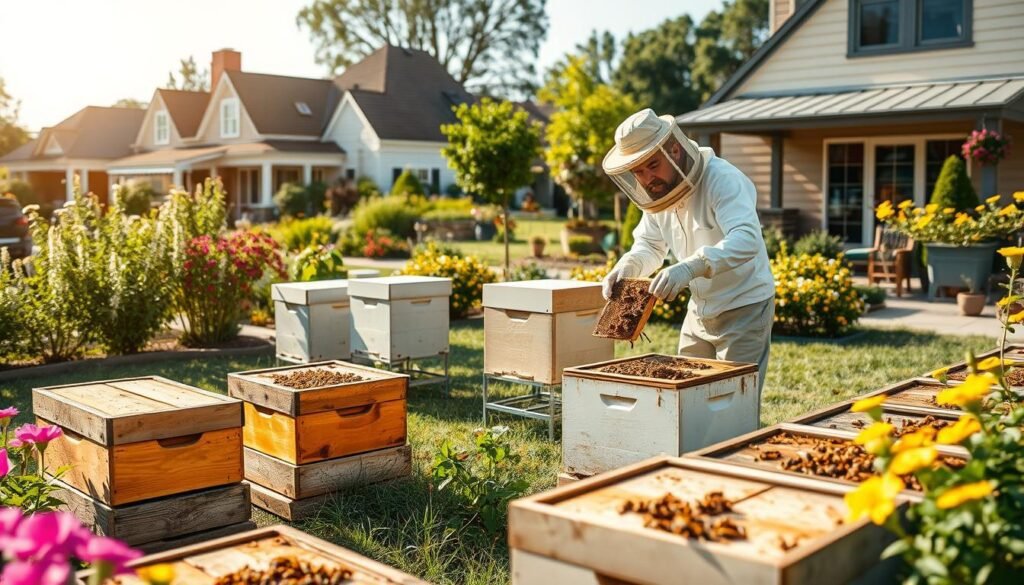
We inspect typical areas on both homes and commercial sites to find active bees before comb expands. Early checks limit damage and reduce the need for major cut-outs.
Roofs, soffits, fascia, and attic voids
Roof edges, soffits, and attic cavities offer dry, warm shelter. Small gaps at fascia or vents often show steady bee traffic that signals a developing hive.
Inside walls, decks, and fences
Wall voids, deck posts, and hollow fence boards provide protected chambers. Buzzing from inside a wall or honey stains near wood are clear signs to call for service.
Trees, stumps, outdoor furniture, and grills
Hollow trees, old stumps, chairs, and grills hide colonies until activity becomes obvious. These spots are easy to miss during yard work.
Water meters, utility and cable boxes
Compact, dark utility boxes and water meter cavities attract bees. Technicians can safely access these small spaces to remove bees with minimal disruption.
- Assessment first: we plan to protect finishes and limit invasive access.
- Signs to watch: steady traffic through a small gap, buzzing from a wall, or honey drips.
- Proper ID: wasps may use similar spots, so correct identification ensures the right method.
| Location | Common sign | Access difficulty |
|---|---|---|
| Roof/Attic | Traffic at soffit vents | Medium |
| Wall voids | Buzzing inside wall | High |
| Trees & Stumps | Cluster near cavity | Low |
| Utility boxes | Bees entering small gap | Low |
Contact us early to remove bees before comb growth complicates work. For more reading on hive care and resources, see our beekeeping resources guide.
Nationwide coverage with local expertise
A nationwide footprint backed by nearby specialists lets us tailor removal plans to each property’s design and season.
South Florida: We serve Broward and Palm Beach counties, including major ZIPs across both areas. Rapid arrival windows and 24/7 phone support at (954) 274-6425 help homeowners and businesses book timely inspections.
Kentucky, Indiana, and Tennessee service corridors
In Southern Indiana, Louisville, Evansville, Lexington, Northern KY, and Nashville our staff schedules most jobs within 24–48 hours via 877-DEAD-BUG. Coordinated crews ensure compliant removal and humane handling while working with local apiaries.
Midwest markets including Milwaukee
Milwaukee and surrounding suburbs face dense, varied structures. Our Milwaukee team offers same-day inspections and adapts tools and access strategies for urban row homes and larger commercial sites.
- Local experts: crews who know regional building styles, climate, and seasonal behavior.
- Consistent standards: one professional process applies across every area, supported by local bee partners.
- Clear communication: we provide arrival windows and minimize disruption at homes and business locations.
Even remote or unique properties are reachable with planning, logistics, and coordination with property managers. Call for the nearest scheduling window and a clear plan from a knowledgeable local bee professional.
Timelines, availability, and pricing
Rapid response windows help stop swarms from settling and limit damage to structures. We offer same-day inspections in South Florida and many Milwaukee cases, with most KY/IN/TN jobs scheduled within 24–48 hours.
Same-day and 24/7 emergency response
Emergency calls are prioritized. Our team fields 24/7 requests for active swarms so we can contain bees quickly and reduce disruption to homes and businesses.
Typical job durations and what affects the timeline
Most removals take 2–4 hours. Small swarms often finish in about an hour. Large wall infestations or complex roof access can extend work to around 6 hours.
| Job type | Typical time on site | Why it varies |
|---|---|---|
| Small swarm | ~1 hour | Easy access, minimal cleanup |
| Standard removal | 2–4 hours | Moderate access, comb removal, sealing |
| Large wall/structural | Up to 6 hours | Cut-outs, deep comb, multiple entry points |
Transparent estimates and pricing
Typical cost ranges from $150–$800+, based on hive size, access difficulty, and repair needs. Quotes factor in structure type, cleanup scope, and any required containment.
- Free inspections and fast estimates are available to clarify scope.
- Formal quotes list timeframe, contingencies, and post-removal guidance.
- Years of field experience speed setup, containment, and precise cut-outs.
Call today to request the next available slot and to learn if a same-day response is possible in your area. Our teams aim to finish within the projected window and will communicate promptly if onsite conditions extend the time.
Solutions for homeowners, property managers, and businesses
Proper removal focuses on cleaning every trace of comb so a property stays odor-free and pest-free.
Preventing honey stains, pests, and structural issues
Complete hive removal and cleanup stop honey stains and lingering odors that attract ants, roaches, and rodents.
Technicians remove comb, sanitize cavities, and make light repairs to prevent future infestation.
Coordinated cut-outs for walls and roofs with minimal disruption
We coordinate access with property managers and on-site teams to limit downtime for a home or business.
During structural cut-outs we use dust containment, clear signage, and step-by-step communication so the job stays tidy.
“A professional job addresses every hive component and seals entries so a bee colony won’t return.”
- Process: access, safety setup, remove bees humanely, cleanup, seal, and light repairs.
- We provide free estimates that list scope, timelines, and any larger structure repairs needed.
- Insured crews and documented procedures help companies meet building rules and scheduling limits.
Conclusion
Choosing humane removal preserves vital pollinators while protecting your property from further damage.
Our licensed, insured beekeeper teams perform live bee removal with careful ID, speedy response, and clear quotes based on hive size, access, and cleanup needs. Teams move every colony to a monitored apiary or trusted local bee partner to ensure a humane outcome for honey bee populations.
Thorough removal and light repairs reduce future infestation risk and limit structural damage. We also handle wasps when found, using the correct method for safety and compliance.
Contact us today for prompt, professional bee removal services that protect homes, support pollinators, and finish the job without surprises.
FAQ
What areas do you service for live bee removal and rehoming?
We provide nationwide coverage with local expertise, serving communities from South Florida (including Broward and Palm Beach) to Midwest markets such as Milwaukee, and service corridors in Kentucky, Indiana, and Tennessee. Local teams handle inspections, extractions, and transport to licensed apiaries.
Do you remove honey bees without killing them?
Yes. Our team specializes in humane, no-kill honey bee removal and relocation. We practice live bee removal, extract the colony intact when possible, and transport bees to monitored apiaries for rehoming with licensed beekeepers.
How do you tell honey bees apart from wasps or hornets?
Technicians perform an on-site inspection to identify the species and colony behavior. Honey bees form clustered combs and have characteristic slow movement; wasps and hornets show different nest shapes and aggressiveness. Proper ID guides the safe removal method.
What does the removal-to-relocation process involve?
The process includes inspection and identification, access planning for walls, roofs, trees or utility boxes, safe extraction of the colony and comb, cleanup to eliminate pheromones, sealing entry points, and transport to a licensed apiary for monitored rehoming.
Can you remove a colony from inside walls or attics without major damage?
We aim to minimize structural damage. Our teams use targeted cut-outs and careful extraction techniques to preserve framing, insulation, and finishes. After removal we seal entry points and offer light repairs to restore the area.
Are your technicians licensed and insured?
Yes. Our beekeepers and technicians are fully licensed and insured. We follow local, state, and national regulations, use non-toxic methods, and establish controlled work zones to protect people and pets.
How quickly can you respond to a swarm or infestation?
We offer rapid response options, including same-day and emergency service when swarms appear. Response time depends on location and schedule, but we prioritize safety and swift containment to reduce risk.
What factors affect the cost of removal and relocation?
Estimates depend on hive size, colony location, access difficulty (walls, roofs, trees, utility boxes), required repairs, and travel distance to a licensed apiary. We provide transparent quotes after an inspection.
Will you clean up honey and pheromones to prevent re-infestation?
Yes. We remove remaining comb and honey, clean the area to reduce attractive pheromones, and recommend or perform sealing and repairs. This lowers the chance of future colonization and pest attraction.
Do you handle hive removals from commercial properties and rental units?
Absolutely. We work with homeowners, property managers, and businesses to prevent honey stains, secondary pests, and structural issues. Our team coordinates cut-outs and repairs to minimize business disruption.
Are your relocation hives monitored after transport?
Yes. Transported colonies go to licensed apiaries where beekeepers monitor health, queen status, and integration. This ensures bees remain productive members of local pollinator populations.
What safety measures do you take during removal near families and pets?
We set up controlled work zones, use protective equipment, and apply non-toxic methods to reduce agitation. Technicians advise on temporary safety steps for residents and pets during the job.
Can you remove bees from utility and cable boxes or water meter enclosures?
Yes. Our teams are experienced accessing and extracting colonies from challenging locations like utility boxes, water meter enclosures, grills, and outdoor furniture while protecting infrastructure and ensuring safe disconnection if needed.
How long does a typical removal job take?
Job durations vary based on hive size, location, and access. Small hive extractions can take a couple of hours; complex wall or roof removals may require more time. We provide a time estimate during the inspection.