Charles Darwin knew that if he couldn’t explain the honeybee’s hexagonal comb without invoking a designer, his entire theory of natural selection was vulnerable at exactly the point critics would attack it hardest. Natural theologians had long pointed to the honeycomb’s precise geometry as living proof of divine design — a problem so mathematically elegant that trained human geometers struggled to improve on it, apparently solved effortlessly by an insect with no capacity for calculation. Darwin’s answer, built on his own hands-on experiments and, separately, on his observations of bumblebees pollinating red clover, became two of the more quietly important pieces of evidence in On the Origin of Species.
Key Takeaways
- Darwin treated the honeybee’s comb-building instinct as a genuine test case for natural selection, since natural theologians cited the hexagon’s mathematical efficiency as evidence of deliberate divine design.
- In the 1850s, Darwin ran his own hands-on experiments at Down House, using wax blocks placed in active hives to observe how bees actually built cells, rather than theorizing about bee behavior from a distance.
- His conclusion: bees don’t possess innate geometric knowledge. Simple instinctive actions — excavating hemispherical space and stopping when walls from adjacent excavations meet — produce hexagonal cells as a physical byproduct, not through deliberate design.
- Separately, Darwin’s observations of bumblebees pollinating red clover (Trifolium pratense), whose flowers only bumblebees’ longer tongues could effectively reach, became a specific, cited example in Origin of Species of ecological interdependence shaped by natural selection.
- This evolutionary-biology use of bees as evidence is a distinct historical topic from the separate eighteenth-century mathematical debate over the honeycomb’s precise cell angle, though the two threads intersect at the same underlying structure.
Table of Contents
- The Design Problem Darwin Had to Solve
- Darwin’s Own Experiments at Down House
- The Melipona Argument
- Bumblebees, Red Clover, and Long Tongues
- Where This Fits in the Structure of Origin of Species
- Darwin’s Correspondence With a Real Bee Expert
- How This Evidence Held Up
- Frequently Asked Questions
The Design Problem Darwin Had to Solve
By the time Darwin was preparing On the Origin of Species for publication in 1859, the honeybee’s hexagonal comb was already a well-known talking point in natural theology — the argument that the intricate, apparently optimal design found throughout nature was evidence of a deliberate creator. The honeycomb was a particularly potent example because its efficiency wasn’t just aesthetically impressive; it reflected a genuine, non-obvious mathematical optimization (later formalized as the honeycomb conjecture) that human mathematicians of the era found genuinely difficult to improve upon. If an insect with no capacity for geometric reasoning could apparently out-engineer trained mathematicians, that was a real rhetorical problem for a theory built on unguided, gradual, undirected variation and selection. Darwin understood exactly how much rode on giving that problem a real, mechanistic answer rather than waving it away.
Darwin’s Own Experiments at Down House
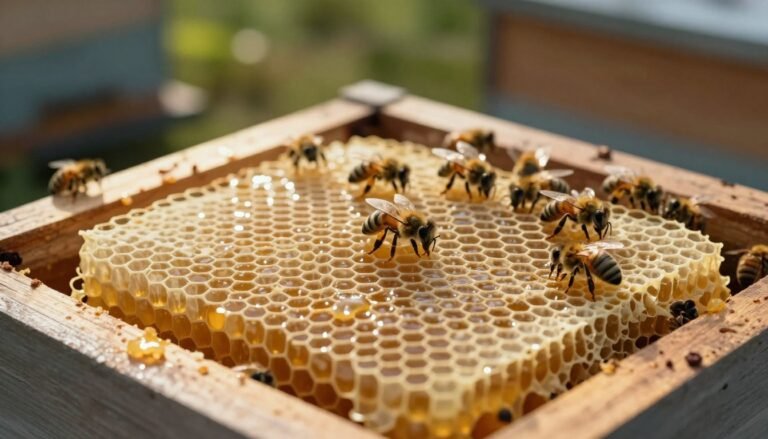
Rather than theorize from his armchair, Darwin ran his own direct experiments at his home, Down House in Kent, during the 1850s — a detail that matters because it shows Darwin treating this as an empirical question requiring real data, not merely a rhetorical point to argue around. He placed wax blocks and structures of varying shapes inside active hives and observed how bees responded, tracking exactly how cell walls formed as bees excavated and built. What he found was that bees don’t appear to work from any innate blueprint of a hexagon at all. Instead, individual bees excavate roughly hemispherical depressions in wax, working from simple, repeated instinctive actions and immediate sensory feedback — essentially, digging until they sense they’re getting close to a neighboring bee’s excavation from the other side. When two or more hemispherical excavations intersect, the shared walls between them flatten out geometrically as a physical consequence of the intersecting curves, not because any bee “decided” to build a flat wall. Hexagons emerge as the byproduct of many simple excavations packed together, not from any individual bee executing a complex geometric plan.
As the Darwin Correspondence Project’s own analysis of this work puts it, the “unfailing regularity and precision of the bee cell was, when precise measurement was brought to bear, a myth” — Darwin’s experiments showed structural complexity emerging from elementary, repetitive behaviors constrained by physical space, not from mathematical sophistication on the bees’ part.
The Melipona Argument
Darwin strengthened his case with a comparative argument, pointing to Melipona, a genus of stingless bees that build cells intermediate in regularity between the crude, irregular cells of bumblebees and the precise hexagons of honeybees. His reasoning was explicitly gradualist: if Melipona represents something like a halfway point, then a plausible, unbroken sequence of small, individually advantageous steps could lead from bumblebee-level irregularity, through Melipona‘s intermediate regularity, to full honeybee hexagonal precision — exactly the kind of gradual, cumulative pathway natural selection requires, and exactly what special creation, positing the honeybee’s comb as designed complete and perfect from the start, didn’t need to explain at all. Darwin argued that if Melipona “put its cells together in a more regular fashion,” it would very plausibly begin approaching honeybee-style construction — treating the honeybee’s hexagon not as a uniquely engineered endpoint, but as one point along a real evolutionary continuum other living bee species still visibly occupy.
Bumblebees, Red Clover, and Long Tongues
Separately from the honeycomb argument, Darwin used a different bee-related observation to illustrate ecological interdependence shaped by natural selection: the specific relationship between bumblebees and red clover (Trifolium pratense). Red clover flowers have a nectar tube long enough that only insects with sufficiently long tongues — bumblebees, notably, but not honeybees — can reach the nectar effectively, making bumblebees functionally indispensable to the plant’s pollination in practice.
Darwin wrote in the first edition of On the Origin of Species: “From experiments which I have tried, I have found that the visits of bees, if not indispensable, are at least highly beneficial to the fertilisation of our clovers; but humble-bees alone visit the common red clover (Trifolium pratense), as other bees cannot reach the nectar.”
This wasn’t a throwaway aside. Darwin used the red-clover relationship as a concrete, testable illustration of how natural selection could produce tightly coupled dependencies between species — a flower’s morphology shaped over generations by which pollinators could actually access its nectar, and a pollinator’s foraging success in turn shaped by which flowers its own anatomy let it exploit. It’s a smaller-scale, more immediately verifiable example than the honeycomb argument, and Darwin used it partly for exactly that reason: it was evidence readers could go check for themselves in any clover field.
Where This Fits in the Structure of Origin of Species
Darwin’s bee arguments appear specifically in Chapter 7 of On the Origin of Species, titled “Instinct” — a chapter dedicated entirely to showing that complex, apparently purposeful animal behaviors could arise through the same gradual, unguided selective process as physical traits like beak shape or coat color. This placement matters: Darwin wasn’t treating the honeycomb as an isolated curiosity tucked into a miscellaneous chapter. He built an entire chapter’s argument around showing that instinct itself — including behaviors as sophisticated-looking as hexagonal comb construction — was as much a product of natural selection as any anatomical structure, using the bee material as his single most detailed and carefully worked example precisely because it was also natural theology’s strongest counterexample.
Darwin’s Correspondence With a Real Bee Expert
Darwin didn’t develop his bee arguments in isolation. His correspondence with William Bernhard Tegetmeier, a poultry and bee expert, is well documented in Darwin’s surviving letters and shows Darwin actively soliciting practical beekeeping knowledge and specific observational data to test and refine his own theoretical arguments — checking his reasoning against someone with genuine hands-on apicultural expertise rather than relying solely on his own experiments and armchair reasoning. This pattern, seeking out practitioners with real specialized knowledge to stress-test a theoretical claim, recurs throughout Darwin’s working method across many subjects, not just bees, and the bee correspondence is a well-documented example of it in action.
How This Evidence Held Up
Darwin’s mechanistic explanation for hexagonal comb-building — simple instinctive excavation producing geometric regularity as a physical byproduct, not a designed blueprint — has held up well against more than a century and a half of subsequent research, though later work has added considerable nuance about the precise physical and behavioral mechanisms involved beyond what Darwin could observe with 1850s tools. It’s worth being clear that this evolutionary-biology argument is a genuinely separate historical thread from the eighteenth-century mathematical debate over the honeycomb’s exact cell angle — the Maraldi-Réaumur-König-Maclaurin sequence we cover in a dedicated article on that mathematical history. That earlier debate settled a precise geometric question about optimal angles; Darwin’s later argument addressed an entirely different question — not what the optimal angle is, but how an insect with no capacity for geometric reasoning could arrive at it anyway through blind, cumulative selection.
Darwin’s explanation wasn’t the only one proposed by his contemporaries, either. British naturalist George Robert Waterhouse, a Darwin correspondent, offered a competing account suggesting bees work from two opposing instinctive drives — one prompting them to deposit and excavate wax, the other limiting how far that excavation goes — with hexagonal regularity emerging from bees initially attempting circular cells that flatten into hexagons under the geometric constraints of neighboring cells packed closely together. Darwin engaged directly with Waterhouse’s alternative in his own writing and correspondence, a useful reminder that Darwin’s honeycomb argument developed through real scientific debate with contemporaries proposing genuinely different mechanisms, not as a single unchallenged theory he simply announced.
Frequently Asked Questions
Why did Darwin need to explain honeycomb geometry specifically?
Natural theologians cited the honeycomb’s mathematically efficient hexagonal structure as evidence of deliberate divine design, since it appeared to require a level of engineering sophistication no insect should be capable of. Darwin needed a plausible, evidence-based mechanism showing how blind natural selection could produce the same result.
What did Darwin’s Down House experiments actually show?
That bees build hexagonal cells through simple, repeated instinctive excavation and immediate sensory feedback, not through any innate geometric blueprint — the hexagon emerges as a physical byproduct when multiple bees’ hemispherical excavations intersect and their shared walls flatten.
What is the Melipona argument?
Darwin’s observation that Melipona stingless bees build cells intermediate in regularity between crude bumblebee cells and precise honeybee hexagons, offered as evidence of a plausible gradual evolutionary pathway toward full hexagonal precision.
What did Darwin say about bumblebees and red clover?
He specifically noted that only bumblebees, with sufficiently long tongues, could effectively reach red clover’s nectar, using the relationship as a concrete example of ecological interdependence shaped by natural selection.
Is this the same topic as the honeycomb angle math history on this site?
No — that article covers the separate eighteenth-century mathematical debate (Maraldi, Réaumur, König, Maclaurin) over the honeycomb’s precise cell angle. This article covers Darwin’s later, distinct nineteenth-century use of bees as evolutionary-biology evidence.
Did Darwin work with any actual beekeeping experts?
Yes — his documented correspondence with bee and poultry expert William Bernhard Tegetmeier shows him actively seeking practical apicultural knowledge to test and refine his theoretical arguments.