The real off-grid beekeeping problem isn’t keeping the bees themselves — it’s every piece of equipment downstream of the hive that was designed assuming a wall outlet: the extractor motor, the uncapping knife, the honey warming cabinet, and the hive monitor that needs a charge or a cell signal. A manual crank extractor and a solar setup solve most of it, but knowing which pieces genuinely need power and which don’t is what separates a smooth off-grid honey harvest from an all-day hand-crank slog.
This site’s existing off-grid beekeeping guide already covers site selection, water without a tap line, hive types, and acquiring your first bees in detail — read that first if you’re starting from zero. This article picks up where it leaves off: the electricity question specifically, plus the two practical logistics problems that come with a remote or off-grid address — getting an apiary inspector out to you, and getting bees or queens delivered in the first place.
Key Takeaways
- A manual crank extractor needs no electricity at all and is genuinely the better choice, not just the fallback, for an operation under about 10 hives.
- Beyond the extractor, the equipment most likely to need power is the uncapping knife (if heated), a honey warming cabinet for winter-thick honey, freezer storage for wax moth control, and any Wi-Fi or cellular hive monitor.
- A small solar setup — panel, charge controller, and a deep-cycle battery — covers occasional-use equipment like a water pump or an electric fence energizer without needing a generator running during harvest.
- Most state apiary laws give inspectors a right of entry for disease inspection regardless of how remote the property is — the burden is on you to make the apiary findable and accessible, not on the inspector to skip it.
- Package bees and queens travel by USPS mail nationwide, including to rural addresses, so “off-grid” doesn’t mean you have to drive to pick up your first colony in person.
Table of Contents
- What Actually Needs Electricity (and What Doesn’t)
- Manual Extraction: The Real Off-Grid Default
- Sizing a Small Solar Setup for Occasional-Use Equipment
- Getting an Apiary Inspector to a Remote Property
- Getting Bees and Queens to an Off-Grid Address
What Actually Needs Electricity (and What Doesn’t)
It helps to sort a small honey operation’s equipment into three buckets before assuming you need a generator running all season. The first bucket — hive tools, frames, smokers, veils — needs nothing but fuel for the smoker. The second bucket is genuinely optional-powered: an uncapping knife can be a cold knife worked by hand instead of an electrically heated one, and a solar wax melter (already covered in this site’s solar wax melter brand comparison) does the rendering job a steam or electric melter would, using nothing but sun. The third bucket is where off-grid beekeepers actually need to solve a real power problem: a honey warming cabinet for liquefying crystallized honey before bottling in a cold climate, freezer storage to kill wax moth eggs in stored comb, and any digital hive-monitoring system that needs a charge or a data connection to report in.
The practical takeaway is that “off-grid” rarely means zero electricity needs — it means a short, specific list of loads that are worth solving individually rather than one blanket assumption that you need full-time grid-equivalent power at the honey house.
| Equipment | Needs power? | Off-grid solution |
|---|---|---|
| Honey extractor | No, if manual | Hand-crank extractor (see next section) |
| Uncapping knife | Optional | Cold (unheated) knife or uncapping fork |
| Wax melter | No | Solar wax melter |
| Honey warming cabinet | Yes | Small solar-battery setup or generator for short runs |
| Wax moth freezer storage | Yes | 12V DC chest freezer off a solar-battery bank, or seasonal ice |
| Digital hive monitor | Yes (charge/data) | Solar trickle-charge kit; check cellular coverage before buying |
| Electric fence (bear/predator) | Yes | Solar fence energizer, purpose-built for this exact use case |
Manual Extraction: The Real Off-Grid Default
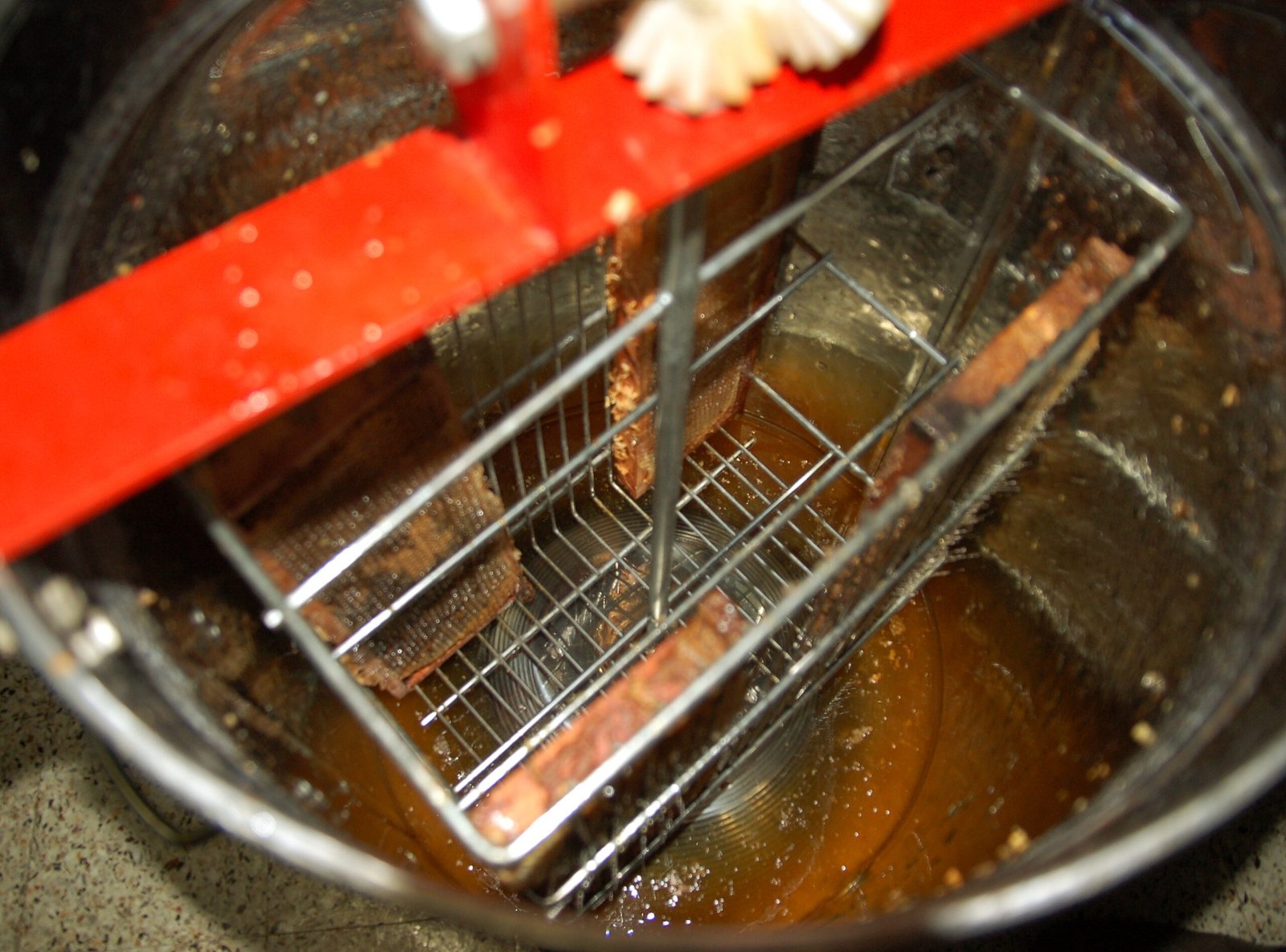
A hand-crank extractor uses centrifugal force generated entirely by turning a crank — no motor, no outlet, nothing to wire up. For an operation of roughly one to five hives, this isn’t a compromise; it’s genuinely the simpler machine, with fewer parts to service and nothing that fails when a fuse blows or a battery runs flat mid-harvest. The honest tradeoff shows up at scale: cranking every frame by hand gets tedious past about ten to fifteen hives, which is the point where most beekeepers — off-grid or not — start looking at a motorized extractor and, if they still want to stay off mains power, running that motor off an inverter and a solar-charged battery bank instead of a generator.
A manual extractor “requires no electricity” and remains “the ideal choice for remote apiaries or off-grid locations where electricity is unavailable” — precisely the scenario this article is written for, not a downgrade from a “real” motorized setup.
If you do outgrow manual cranking, a small inverter generator used only during the few hours of an extraction session is a realistic middle step before committing to a full solar-battery bank sized for continuous use — it keeps fuel and noise limited to a handful of days a year rather than running an off-grid property on generator power full time.
Sizing a Small Solar Setup for Occasional-Use Equipment
The pattern that shows up across remote and off-grid apiary setups is a solar panel paired with a charge controller and a deep-cycle battery, sized for occasional, not continuous, loads: running a small water pump to keep a bee-safe water source filled, powering an electric fence energizer against bears and other predators, or trickle-charging a hive monitor’s battery. None of these need a large system — a single 100–200 watt panel and one deep-cycle battery comfortably covers a fence energizer and a small water pump for one apiary, well below what you’d need to run a home.
Where people overspend is sizing a solar setup for the extractor and warming cabinet’s peak draw as if those ran constantly, rather than recognizing that extraction happens a handful of days per year and warming/decrystallizing happens in short batches. Size the everyday loads (fence, monitor, water pump) for full solar coverage, and treat the occasional heavy loads (extractor motor, warming cabinet) as a short-duration generator or grid-charged-battery job instead — it’s a fraction of the system cost.
Getting an Apiary Inspector to a Remote Property
Most state apiary laws grant the state’s apiary inspector or commissioner a right of entry onto any property where bees are kept, specifically to check for disease — remoteness doesn’t exempt a registered apiary from inspection, and it isn’t the inspector’s job to give up if your driveway is a mile of dirt road. Michigan’s Department of Agriculture and Rural Development (MDARD), for example, runs a standing apiary inspection program that explicitly covers registered hives statewide, rural or otherwise. What actually falls on you as the off-grid beekeeper is making the apiary findable and physically accessible: clear directions that don’t rely on a street address a GPS can’t resolve, a gate code or a call-ahead arrangement if the property is locked, and keeping your registration and location on file current with your state’s department of agriculture so an inspector isn’t trying to find an apiary that moved two seasons ago.
This is a case where checking your own state’s specific apiary registration and inspection rules matters more than anything general written here — contact your state’s department of agriculture directly for the current requirements rather than assuming another state’s process applies to you.
Getting Bees and Queens to an Off-Grid Address
The other logistics question unique to a remote property is simpler to solve than it sounds: package bees and mated queens are routinely shipped by USPS mail, including to rural addresses, so an off-grid location doesn’t mean driving hours to a supplier’s pickup day. What it does mean is planning around mail-carrier reality: a rural route carrier may not attempt same-day delivery of a buzzing package to an address with no clear mailbox or drive access, so calling ahead to your local post office when a shipment is inbound, and arranging to be there or to pick up directly from the post office, avoids the worst-case scenario of a box of bees sitting in a hot truck overnight.
Conclusion
Off-grid beekeeping’s electricity question has a narrower answer than it first appears: a manual extractor and a solar wax melter cover the two jobs people assume need a motor, a small solar-battery setup handles the genuinely occasional loads like a fence energizer or hive monitor, and the two logistics problems unique to a remote property — inspection access and bee delivery — are solved with planning rather than equipment. None of it requires the property to be connected to mains power to run a legitimate, disease-compliant, fully-equipped small apiary.
Frequently Asked Questions
Can you extract honey with absolutely no electricity?
Yes — a hand-crank manual extractor needs no power source at all and is a genuinely good choice, not just a fallback, for an operation of roughly one to five hives.
What beekeeping equipment actually requires power off-grid?
The short list is a honey warming cabinet for decrystallizing in cold climates, freezer storage for wax moth prevention, and any digital hive-monitoring system that needs charging or a data connection — everything else has a no-power alternative.
Do state apiary inspectors still check remote or off-grid apiaries?
Yes — most state apiary laws grant inspectors a right of entry to any registered apiary regardless of how remote it is, so keeping your registration and directions current matters more than the property’s distance from town.
Can you get package bees or a queen delivered to a rural or off-grid address?
Yes — package bees and mated queens are routinely shipped by USPS, including to rural routes, though calling your local post office ahead of an expected shipment helps avoid delivery delays to a hard-to-find address.
Is a generator or solar power better for an off-grid apiary?
Solar with a deep-cycle battery is the better fit for small, constant loads like a fence energizer or water pump, while a generator run only during the few hours of an actual extraction session is often the more practical choice for the occasional heavier load of a motorized extractor.