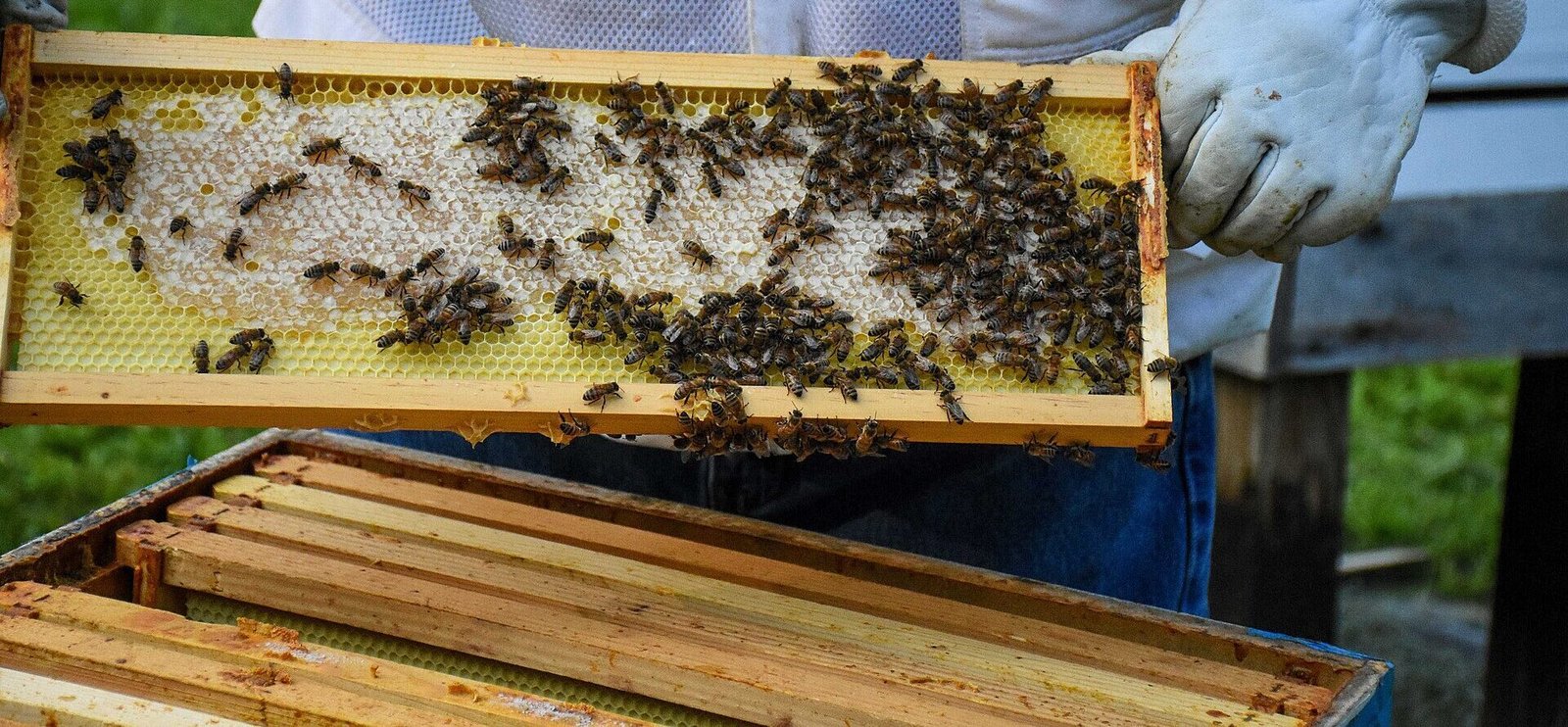
Getting a colony through one season is often a matter of good forage and a bit of luck. Keeping colonies healthy year after year takes a system: regular Varroa monitoring with clear action thresholds, reliable nutrition, planned comb and queen renewal, routine brood disease checks, records you can act on, and winter preparation that starts in late summer.
US beekeepers have strong public resources to build that system on, including the Honey Bee Health Coalition’s Varroa guide, land-grant university extension services, and state apiary inspection programs. This guide pulls those pieces together into a long-term plan.
Key Takeaways
- Monitor Varroa at least four times a year with an alcohol wash or sugar roll, and treat when counts pass the thresholds for the colony’s seasonal phase.
- Always re-test after a treatment to confirm it worked.
- Match colony numbers to local forage, and feed when stores run short going into winter.
- Date your frames and retire old brood comb on a rolling schedule.
- Replace queens that are past their prime, and check brood for foulbrood at every full inspection.
- Keep a simple per-colony record so trends are visible before they become losses.
Table of Contents
- 1. Treat Varroa as a Year-Round Program
- 2. Nutrition and Forage
- 3. Renew Brood Comb on a Schedule
- 4. Keep Young, Productive Queens
- 5. Inspect Brood for Disease and Use Your State Apiary Inspector
- 6. Keep Records You Can Act On
- 7. Winter Preparation Starts in Late Summer
- A Year-Round Health Calendar
- Conclusion
- FAQ
1. Treat Varroa as a Year-Round Program
Varroa mites and the viruses they spread are the main threat to long-term colony health in the United States. The Honey Bee Health Coalition’s Tools for Varroa Management guide describes monitoring as the basis of an integrated pest management (IPM) strategy and recommends sampling “at least four times during the year, beginning with the Population Increase phase,” with more frequent checks during the Population Decrease phase in late summer and autumn. It also advises that you “always repeat sampling after treatment” to confirm it worked.
How to sample
The guide recommends collecting about 300 adult bees (roughly half a cup) from one to three brood-nest combs, making sure the queen is not in the sample. An alcohol or soap wash is the more reliable method; a powdered sugar roll gives more variable counts but returns the bees to the hive alive. To get the infestation rate, divide the number of mites by the number of bees and multiply by 100. For example, 12 mites in a 300-bee sample is 4 mites per 100 bees, or 4%.
For apiaries with fewer than ten colonies, the guide recommends sampling every colony. For larger yards, sample at least eight randomly chosen colonies. A step-by-step comparison of methods is in How to Test for Varroa Mites: Alcohol Wash, Sugar Roll & Sticky Board Compared.
When to act
| Colony phase (HBHC) | Immediate control not needed | Promptly control |
|---|---|---|
| Dormant | Below 1% | Above 1% |
| Population Increase | Below 2% | Above 2–3% |
| Peak Population | Below 2% | Above 3% |
| Population Decrease | Below 2% | Above 2–3% |
Percentages are mites per 100 adult bees. The Coalition notes that thresholds are “an evolving science” and often regionally specific, and suggests checking with your local apiary inspector or extension service. Use treatments that fit the season and label restrictions, especially rules about honey supers, and rotate between products with different modes of action rather than relying on one product year after year.
2. Nutrition and Forage
Colonies need steady nectar and pollen to raise healthy brood, and poorly fed bees cope worse with mites and disease. Place apiaries where a variety of plants bloom through the season, avoid overstocking a site, and learn when your local dearths happen.
Winter stores are the clearest nutritional target. Mississippi State University Extension recommends “at least 60 to 65 pounds of honey or stored syrup positioned above the cluster of bees in late autumn,” and suggests finishing supplemental feeding of heavy sugar syrup by the end of October (Mississippi State University Extension). Those figures are for a southern climate; colonies in northern states with long winters generally need more, so ask your state extension service what is typical where you live. When pollen is scarce and you need brood rearing, a pollen substitute can bridge the gap, and a reliable water source close to the apiary matters in hot weather.
3. Renew Brood Comb on a Schedule
Brood comb darkens with every generation of bees as cocoons build up in the cells. Old comb can also hold residues from past treatments and agricultural chemicals, and spores or other disease organisms. A long-term plan should keep any one comb from staying in the brood nest indefinitely.
A practical approach is to write the year on each frame’s top bar when it goes into service, then move the oldest, darkest brood frames to the outside of the box in spring and replace a few of them each year once they are free of brood. How fast to rotate depends on your setup; How Often Should You Replace Old Brood Comb? covers the options.
4. Keep Young, Productive Queens
A strong queen is the foundation of a strong colony. Mississippi State University Extension advises that “queens that are more than 2 years old should be replaced” so that young, well-laying queens head colonies going into spring. Beyond age, watch for a spotty brood pattern that is not explained by disease, persistent defensiveness, and colonies whose mite counts climb faster than their neighbors’. When buying queens, ask breeders about selection for hygienic behavior and mite resistance.
5. Inspect Brood for Disease and Use Your State Apiary Inspector
American foulbrood (AFB) is the most serious bacterial brood disease because its spores last for decades. Penn State Extension lists the classic signs as a “spotty, irregular brood pattern” and “sunken, dark, greasy, perforated cappings.” In the rope test, a toothpick is pushed into the brown remains of a dead larva or pupa and slowly withdrawn; the test is positive when it ropes out “½ inch or more” (Penn State Extension).
Penn State notes that AFB spores “can be dormant in the colonies or used equipment for 70 or more years,” that antibiotics “do not kill Paenibacillus larvae spores,” and that burning the bees and equipment is the only sure way to be rid of the disease. If you suspect AFB, contact your state apiarist or apiary inspector before you do anything else; many states require AFB to be reported. European foulbrood (EFB) is caused by a different bacterium and behaves differently, so a correct diagnosis matters. See American vs. European Foulbrood: Key Differences Explained.
Also check whether your state requires apiary registration. Registered beekeepers are often the first to hear about disease outbreaks nearby, and inspectors can help diagnose problems you are unsure about.
6. Keep Records You Can Act On
Memory is a poor guide to a colony’s history. A simple per-colony log turns scattered observations into trends. At each visit, record the date, whether you saw eggs or the queen, the number of frames of brood and bees, stores, temperament, any signs of disease, and every mite count with the method used. Record treatments with the product, dose and dates, and note feeding. Two rising mite counts in a row, or a colony that has shrunk over three visits, are much easier to spot on paper. What Records Every Beekeeper Should Keep has a template.
7. Winter Preparation Starts in Late Summer
Colonies survive winter on the bees raised in late summer and autumn. Penn State Extension notes that “a healthy population of winter bees is essential to colony winter survival,” and that autumn mite monitoring is needed to confirm late-summer treatments worked (Penn State Extension). That makes August and September the key months for mite control in much of the country.
- Test for mites and treat early enough that the winter bees are raised in a low-mite colony.
- Check stores and feed heavy syrup while the weather is still warm enough for bees to take it down.
- Combine colonies that are too weak to overwinter, with one queen and a sheet of newspaper between boxes.
- Reduce entrances, fit mouse guards, and plan for ventilation so moisture does not drip onto the cluster.
A Year-Round Health Calendar
| Season | Main health tasks |
|---|---|
| Early spring | Check stores and queen status; first mite test once colonies are building; retire old brood comb |
| Late spring to early summer | Regular inspections for swarm prep and brood disease; mite test; add space |
| Late summer | Mite test and treat after honey removal; watch for robbing in the dearth; evaluate queens |
| Autumn | Re-test after treatment; feed to target weight; combine weak colonies; reduce entrances |
| Winter | Minimal disturbance; heft or weigh hives; emergency feeding if light; review records |
Conclusion
Long-term colony health in the US comes down to a handful of habits done consistently: test for mites and act on the numbers, keep colonies well fed, renew comb and queens before they fail, look at brood for disease every time you do a full inspection, and write down what you find. None of these steps is complicated, but together they give colonies a much better chance of surviving from one year to the next.
FAQ
How often should I test my colonies for Varroa mites?
The Honey Bee Health Coalition recommends testing at least four times a year, starting when colonies begin building up in spring, with more frequent tests in late summer and autumn. Always test again after a treatment to confirm it lowered the mite count.
What mite count means I should treat?
Using an alcohol wash or sugar roll of about 300 bees, the Coalition’s guide suggests prompt control when counts exceed roughly 2 to 3 mites per 100 bees during the active season, and above 1 per 100 during the dormant phase. Thresholds vary by region, so check with your state inspector or extension service.
How often should I replace my queen?
Mississippi State University Extension recommends replacing queens older than two years. Replace a queen sooner if her brood pattern is poor without a disease explanation, if the colony is persistently defensive, or if its mite levels rise faster than other colonies.
What should I do if I suspect American foulbrood?
Close the hive, keep equipment from that colony separate, and contact your state apiarist or apiary inspector. Do not move frames to other colonies. AFB spores survive for decades and antibiotics do not kill them, so an official diagnosis and the inspector’s guidance come first.
How much honey does a colony need for winter?
It depends on your climate. Mississippi State University Extension suggests at least 60 to 65 pounds of honey or stored syrup above the cluster in late autumn for its region. Colonies in colder northern states usually need more, so ask your local extension service for a figure that fits your area.