Beekeeping and Honey Production Associations Worth Joining

Local beekeeping clubs and national associations like ABF and AHPA solve different problems. Here is what each actually does and which one to join first.


Local beekeeping clubs and national associations like ABF and AHPA solve different problems. Here is what each actually does and which one to join first.

The Dartington Long Deep Hive is a British design built around a single engineering problem: how do you keep bees somewhere with no room for a ground-level apiary, without ever lifting more than about 16 pounds. Robin Dartington, a professional…
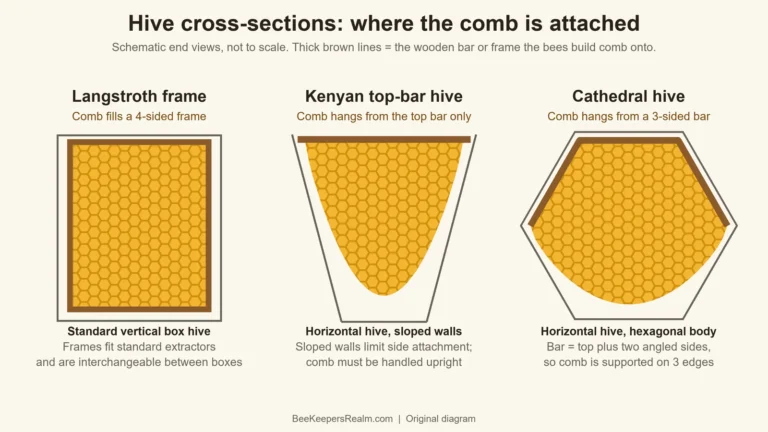
The Cathedral hive is a horizontal top-bar hive with a hexagonal body and 3-sided bars: how it works, the maker's specs and price, and how it compares.

A “Hex Hive” almost always means one specific product: the BEEcosystem, a wall-mountable observation hive built from magnetic hexagonal modules. It borrows its shape from the honeycomb cell itself, but the resemblance is cosmetic as much as functional — the…

A log hive is a hollowed tree trunk that gives bees a tree-cavity nest. This guide covers sizes, the research on insulation, honey harvest and US apiary law.

The Flow Hive replaces the last, messiest step of beekeeping — pulling frames, uncapping wax, and spinning an extractor — with a plastic frame that splits open at the turn of a key and lets honey drain straight into a…

The Warre hive is a low-intervention, vertical top-bar design built around minimal management. Here is how it actually works and what to expect running one.

A top-bar hive is a single-story, frameless hive in which comb hangs from removable wooden bars rather than milled frames, and the box itself lies on its side instead of stacking upward. The most common version in North America and…

A Kenyan top bar hive (KTBH) is a single-storey, horizontal beehive with sloping side walls, in which the bees build natural comb hanging down from a row of loose wooden bars laid across the open top, with no frames and…