The blue banded bee (Amegilla, mostly Amegilla cingulata along Australia’s east coast) is a solitary native bee that can do something no honeybee can: grab a flower and shiver its flight muscles roughly 350 times a second to blast pollen loose from the anther, a trick called buzz pollination. Found across most of Australia and instantly recognizable by the pale, iridescent bands across its abdomen, this fist-sized-colony-free bee has gone from a backyard curiosity to a serious candidate for commercial greenhouse pollination — because Apis mellifera, the workhorse Western honeybee used almost everywhere else, is physically incapable of the vibration frequency several major crops actually need.
Key Takeaways
- Blue banded bees are solitary, not colonial — each female digs and provisions her own nest burrow, usually in bare clay soil or soft mudbrick, with no queen or worker caste involved.
- Males and females are told apart by their bands: males have five pale bands across the abdomen, females have four.
- They perform buzz pollination (sonication) — vibrating their flight muscles against a flower at roughly 350 Hz to shake pollen loose — something the common Western honeybee cannot physically do.
- That single trait makes them valuable for tomatoes, blueberries, eggplant, chili, and kiwifruit, crops that release pollen best (or only) under sonication.
- University of Adelaide research led by Dr Katja Hogendoorn has shown blue banded bees can be bred year-round for commercial greenhouses and produced tomatoes 15–20% heavier than conventional vibration-wand pollination.
Table of Contents
- How to Identify a Blue Banded Bee
- Solitary Nesting: No Hive, No Queen
- The Buzz Pollination Trick Honeybees Can’t Do
- Real Research Into Farming Them for Greenhouses
- Frequently Asked Questions
How to Identify a Blue Banded Bee
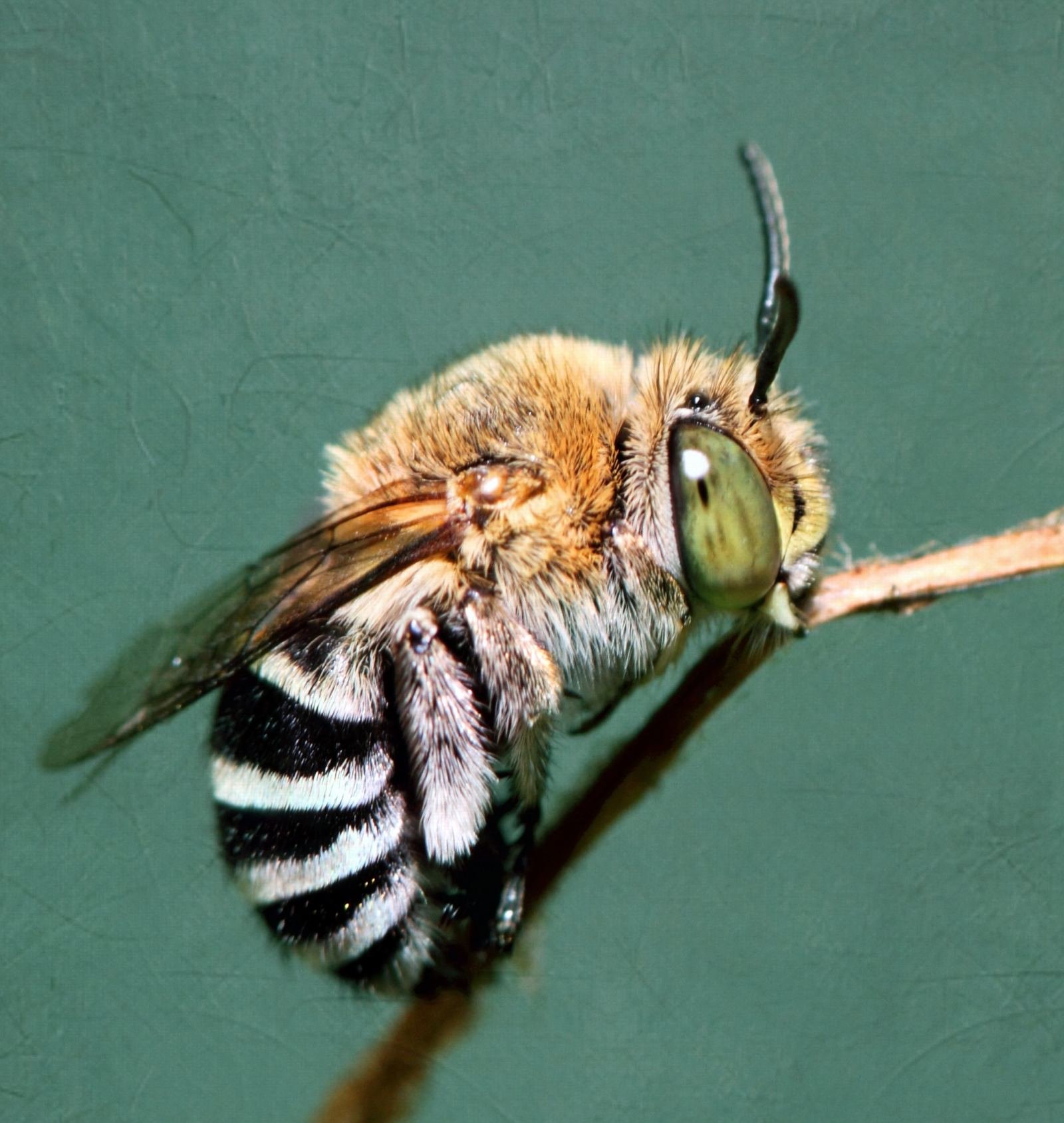
Blue banded bees are small to medium-sized native bees, roughly 8–14 mm long depending on species, with a stocky body covered in golden-and-white fluff, large green-tinted eyes, and — the field mark that gives them their name — a row of pale blue-white metallic bands running across an otherwise dark abdomen. There are eleven described blue banded bee species in Australia, split across two subgenera (Notomegilla and Zonamegilla), with Amegilla cingulata the most commonly encountered species along the east coast. The bands themselves double as a simple way to sex the bee: males carry five bands, females four — unusually easy to check in the field compared to most native bee sex differences, which usually require a closer look than a backyard observer can manage.
This short video from YouTube channel Bee Happy shows the blue banded bee’s distinctive banding and foraging behavior up close, a useful visual companion to the identification notes above.
Solitary Nesting: No Hive, No Queen
Unlike honeybees, blue banded bees have no colony, no queen, and no worker caste. Each female is fully independent — she mates, then excavates and provisions her own nest burrow entirely on her own, without help from other bees. According to the Australian Native Bee Research Centre (Aussie Bee), a long-established Australian native-bee research and education organisation:
“She builds her nest in a shallow burrow in clay soil or sometimes in mudbricks.”
Because many females often choose the same patch of exposed clay bank, mudbrick wall, or unmortared brickwork, nests frequently end up clustered into loose aggregations of dozens or even hundreds of individual burrows side by side — visually similar to a colony from a distance, but each burrow still belongs to, and is provisioned entirely by, one female working alone. This nesting habit is also why the species does well in built environments with old mudbrick or mortar-poor brick walls, not just untouched bushland.
The Buzz Pollination Trick Honeybees Can’t Do
Some flowers — including tomato, eggplant, blueberry, cranberry, kiwifruit, and chili — keep their pollen sealed inside narrow tube-like anthers that don’t release it through simple contact the way an open flower does. Those flowers need to be vibrated to shake the pollen loose, a technique called buzz pollination or sonication. A blue banded bee grips the flower and rapidly contracts its flight muscles without actually flapping its wings, generating a vibration researchers have measured at around 350 times per second, which dislodges the pollen through pores in the anther tip.
Apis mellifera — the Western honeybee used for the overwhelming majority of managed pollination worldwide, including on this site’s own coverage of how buzz pollination works and why honeybees can’t do it — simply cannot generate this specific vibration. That single physical limitation is the entire reason buzz-pollinated crops have historically depended on wind, hand-held vibrating wands, or bumblebees (which can sonicate, but are a restricted, non-native import in mainland Australia) rather than the bee species beekeepers already manage at scale.
Real Research Into Farming Them for Greenhouses
The idea of using blue banded bees commercially isn’t new: Aussie Bee documented some of the earliest glasshouse trials back in 2001, when Melissa Bell of the University of Western Sydney–Hawkesbury ran what the organisation described as Australia’s first-ever glasshouse pollination experiments with the species, rearing prepupae through to adulthood and releasing them into a tomato glasshouse room to test whether they would forage and pollinate under those conditions.
That early groundwork has since been built on by a University of Adelaide research program led by entomologist Dr Katja Hogendoorn, published in the peer-reviewed journal Apidologie, which worked out how to breed blue banded bees year-round in large enough numbers for commercial use. The findings are genuinely striking: foraging females made an average of about nine pollen-collecting flights per day, researchers estimated roughly 282 actively nesting females per hectare are needed for adequate greenhouse coverage, and — the number that matters most to a grower — tomatoes pollinated by the bees came out 15–20% heavier than those pollinated by the vibrating hand-wands most commercial glasshouses currently use. For an industry looking for an alternative to importing non-native bumblebees, a native bee that out-performs the current mechanical standard is a genuinely commercially relevant result, not just an ecological curiosity.
Frequently Asked Questions
Are blue banded bees native to Australia?
Yes. Amegilla species are native Australian bees found across the mainland, in every state and territory except Tasmania and the Northern Territory.
Do blue banded bees sting?
They can sting, but they’re solitary and non-aggressive, with no colony or brood to defend, so stings are rare and typically only happen if a bee is handled directly.
How is a blue banded bee different from a honeybee?
Blue banded bees are solitary (no hive, no queen, no workers) and can buzz-pollinate flowers by vibrating at roughly 350 Hz — something the colonial, hive-based Western honeybee physically cannot do.
What plants do blue banded bees pollinate best?
Crops and flowers that need sonication to release pollen, including tomatoes, eggplant, blueberries, cranberries, kiwifruit, and chili peppers, along with many native Australian wildflowers.
Can you keep blue banded bees like honeybees?
Not in a hive. Because they’re solitary, “keeping” them means providing nesting habitat — a bare clay bank or a soft mudbrick/mortar block — rather than housing a colony, though research programs have shown they can be reared in managed numbers for greenhouse pollination.
Why can’t honeybees buzz-pollinate?
Sonication requires a specific muscle-vibration frequency that honeybee flight muscles aren’t built to produce; bumblebees and many solitary bees, including blue banded bees, can generate it, but Apis mellifera cannot.