The bee orchid (Ophrys apifera) grows a flower shaped, colored, and scented to imitate a female solitary bee closely enough that male bees try to mate with it — a deception called pseudocopulation that gets the orchid pollinated while giving the bee nothing at all in return. It’s one of the most visually striking examples of floral mimicry in Europe, and, in a genuinely odd evolutionary twist, the exact bee species it evolved to fool has become so rare across much of its range that many bee orchid populations have quietly given up on the trick and now just pollinate themselves.
Key Takeaways
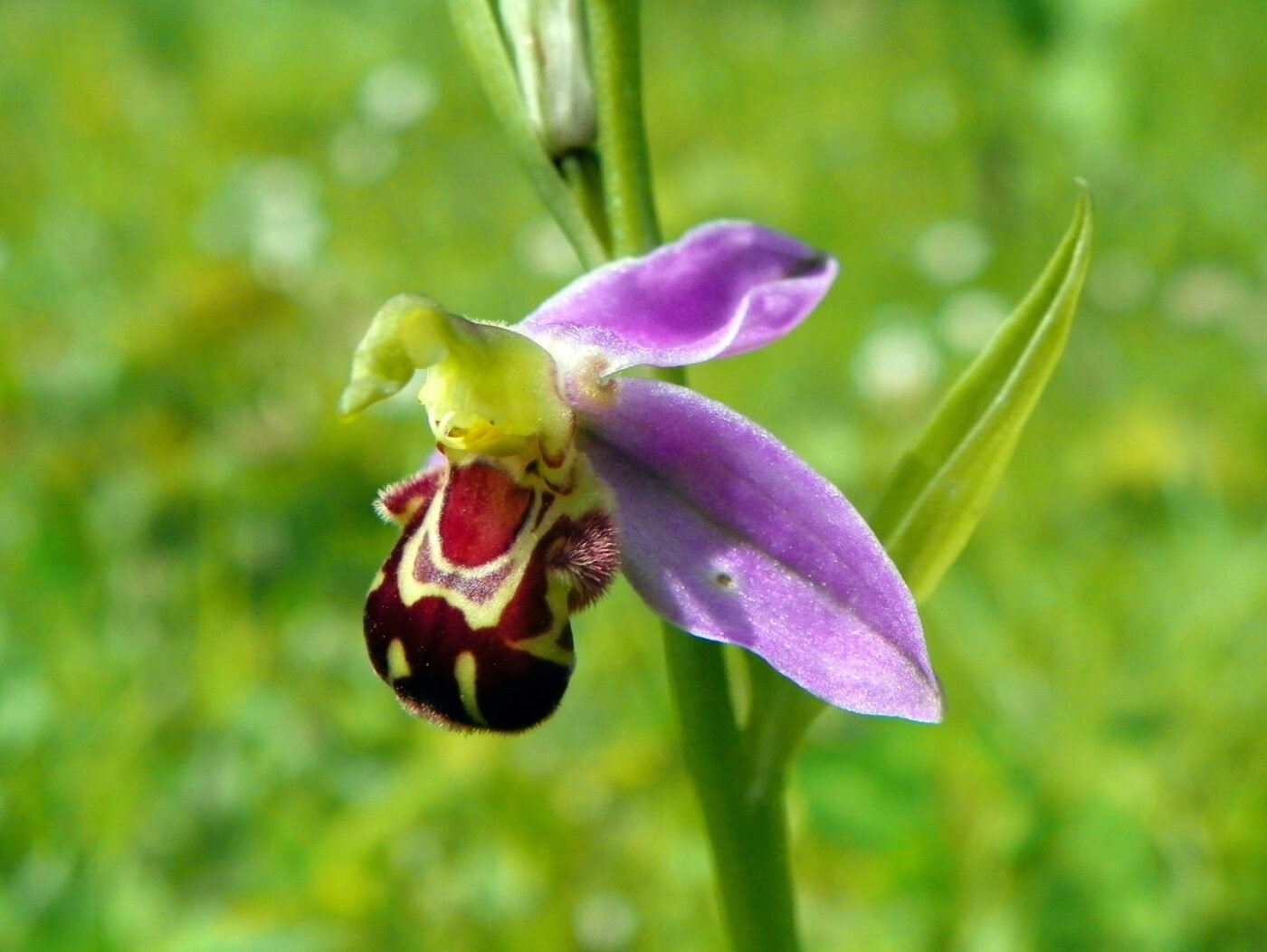
- The bee orchid’s lower petal (labellum) has evolved a furry texture, reddish-brown and yellow patterning, and a scent that closely mimics a female Eucera (long-horned) solitary bee.
- Male bees attempt to mate with the flower in a behavior called pseudocopulation; during the attempt, a pollen-carrying structure called a pollinium sticks to the male, which he then carries to the next orchid he’s fooled by.
- The bee gets no nectar or other reward — this is a pure deception strategy, one of several found across the genus Ophrys, all of which target a different specific bee or wasp species.
- In the United Kingdom specifically, the right Eucera pollinator is now uncommon enough that most British bee orchids self-pollinate instead, with the pollinia simply drooping down onto the flower’s own stigma.
- The strategy is powered mainly by chemical mimicry — the orchid produces compounds that closely resemble the female bee’s own sex pheromones — reinforced by visual and tactile cues that are secondary to scent.
Table of Contents
- A Flower Built to Look Like a Bee
- Pseudocopulation: How the Deception Actually Works
- Chemical Mimicry Does the Real Work
- When the Trick Stops Working: Self-Pollination as a Backup
- Frequently Asked Questions
A Flower Built to Look Like a Bee
Native across much of Europe, North Africa, and parts of the Middle East, Ophrys apifera gets its common and scientific names — “apifera” literally means “bee-bearing” — from the unmistakable resemblance of its labellum, the large lower petal at the center of the flower, to the rounded, furry body of a female bee. The labellum is a rich reddish-brown, patterned with pale yellow markings, and covered in fine hairs that mimic bee fuzz closely enough to fool a searching male at close range. Two smaller petals above it even curl forward in a way that has been compared to a pair of antennae, adding to the illusion. It’s a strategy shared, with regional variations in the specific target species, across the wider Ophrys genus of roughly 250 species, each one typically tuned to deceive one particular bee or wasp species in its home range.
Pseudocopulation: How the Deception Actually Works
The specific behavior this flower exploits is called pseudocopulation — a mating-like act directed at something that isn’t actually a mate. A male solitary bee, most commonly a species in the genus Eucera (long-horned bees) for Ophrys apifera, is drawn in by the flower’s resemblance to a receptive female and attempts to copulate with the labellum. During this attempt, a small, sticky mass of pollen called a pollinium attaches firmly to the bee’s body — typically the head or thorax, positioned so the bee can’t easily remove it. Frustrated or eventually satisfied that nothing further will happen, the male moves on and, sooner or later, attempts the same act on another bee orchid flower, depositing the pollinium onto that flower’s stigma and completing pollination. The bee receives no nectar, no pollen as food, and no actual mate — from a strict cost-benefit standpoint, it is purely used.
The Natural History Museum in London has documented this process on camera, following museum botanist Fred Rumsey as he searches out bee orchids and their close relative the late spider orchid (Ophrys fuciflora) to explain exactly how the deception plays out in the field:
Chemical Mimicry Does the Real Work
Vision and touch play a role in the deception, but researchers studying Ophrys pollination have found that scent is doing most of the heavy lifting. The orchid’s labellum produces a blend of chemical compounds that closely mirrors the actual sex pheromones released by a receptive female of the target bee species — a level of chemical precision specific enough that, in many Ophrys species, males will attempt pseudocopulation with the orchid even before landing close enough to see it clearly, drawn in purely by scent from a distance. This is also why the deception is so often species-specific: because the pheromone blend has to closely match one particular bee or wasp species’ own chemistry, a given Ophrys orchid typically only fools one, or a small handful, of pollinator species, rather than bees in general.
When the Trick Stops Working: Self-Pollination as a Backup
Because the whole strategy depends on the right pollinator actually being present and active nearby, it comes with an obvious vulnerability: if the target bee species declines or disappears from an area, the orchid’s reproduction should, in theory, collapse along with it. In the United Kingdom specifically, this is close to what has happened — the specific Eucera species the plant evolved to attract has become genuinely scarce across much of Britain, and field botanists have documented that most UK bee orchid populations now reproduce mainly through self-pollination rather than pseudocopulation. In these flowers, the pollinia simply soften and droop downward over time until they make direct contact with the flower’s own stigma, fertilizing it without any insect involvement at all — a genuine backup mechanism that keeps the population reproducing even where the deception strategy it evolved around no longer has anyone left to fool. It’s a useful reminder that even a spectacularly specialized adaptation, of the kind covered more generally in this site’s guide to pollination syndromes, isn’t necessarily the plant’s only option when conditions change.
Frequently Asked Questions
What does the bee orchid get out of tricking bees?
Pollination transfer — a male bee that attempts to mate with the flower picks up a pollen mass (pollinium) and unknowingly delivers it to the next bee orchid he’s fooled by, which is how the plant reproduces without offering any nectar reward.
What bee species does the bee orchid mimic?
Ophrys apifera primarily targets male bees in the genus Eucera (long-horned bees), matching both their visual appearance and their species-specific sex pheromone chemistry.
Why do UK bee orchids often self-pollinate instead?
The specific Eucera bee species the flower evolved to deceive has become uncommon across much of the UK, so many British bee orchid populations rely instead on the pollinia drooping down to self-fertilize the same flower.
Does the bee get hurt or gain anything from pseudocopulation?
No lasting harm comes to the bee, but it also gains nothing — no nectar, pollen, or actual mating occurs. The interaction purely benefits the orchid.
Are all Ophrys orchid species pollinated the same way?
The general pseudocopulation strategy is shared across the roughly 250 species in the genus, but each species typically targets a different specific bee or wasp species through its own tailored scent, color, and shape.