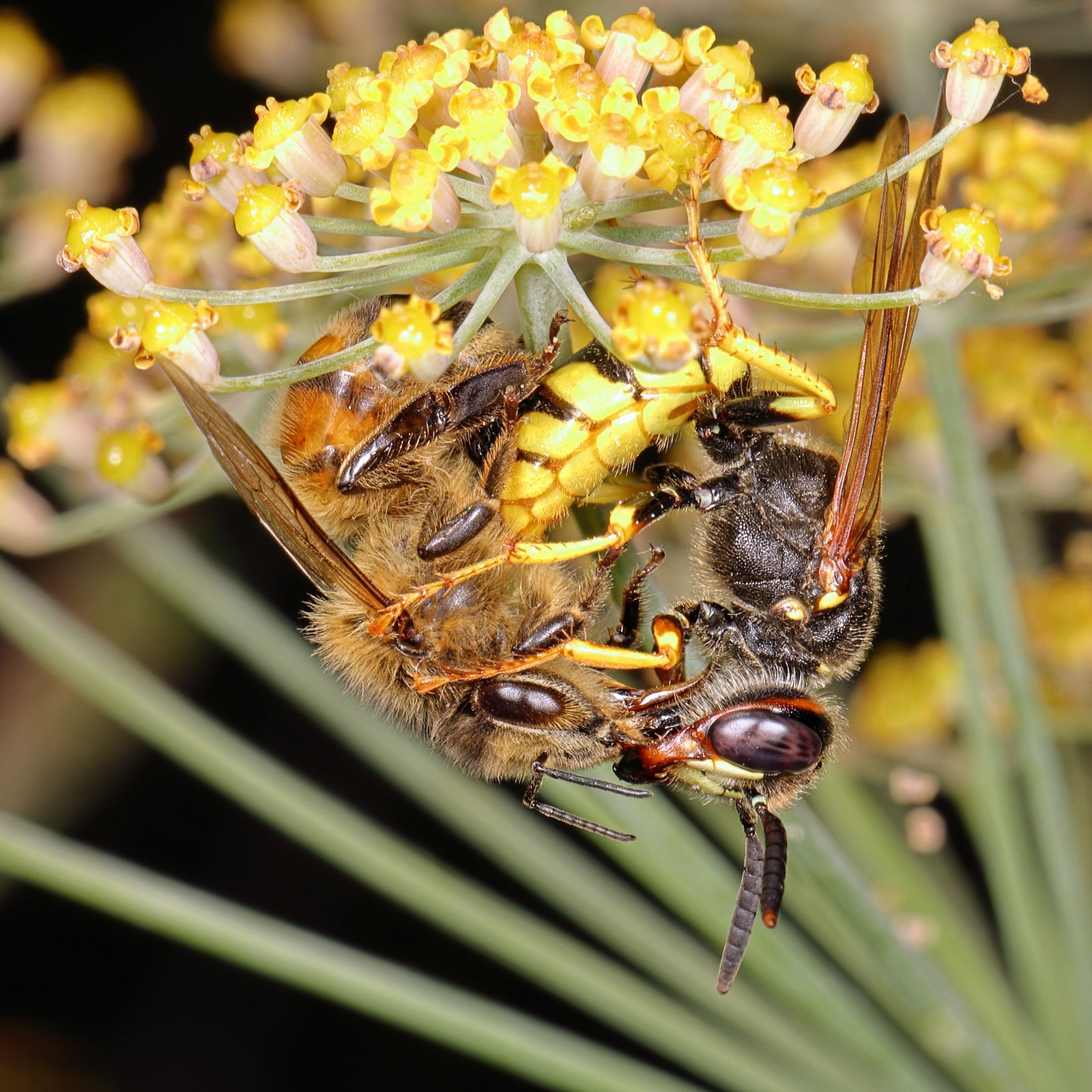
The European beewolf (Philanthus triangulum) is a solitary digger wasp whose females hunt honeybees for a living — stinging each one into permanent paralysis, hauling it back to an underground burrow, and sealing it alive in a chamber as fresh food for a single wasp larva. It’s the only member of its genus that specializes almost exclusively in honeybees, and despite the name, it isn’t a threat to a healthy colony the way mites or hive beetles are — it’s a solitary predator working one bee at a time, with a genuinely strange piece of biology backing up its hunting strategy.
Key Takeaways
- Only female beewolves hunt; males feed on nectar and pollen like most other wasps and take no part in provisioning the nest.
- A female beewolf paralyzes a foraging honeybee with a precisely placed sting, carries it back to her burrow — sometimes flying with prey nearly as heavy as she is — and packs several paralyzed bees into a single underground brood cell with one egg.
- Beewolves nest in large aggregations in sandy, sun-exposed soil, with individual burrow systems reaching up to a meter long and branching into as many as 30-plus separate brood cells.
- Female beewolves cultivate a specific Streptomyces bacterium in glands inside their own antennae and smear it into the brood cell — the bacteria produce antibiotics that protect the wasp’s egg and larva from mold in the humid underground chamber.
- Beewolves are a natural, long-standing part of the ecosystem in Europe and Africa; they take individual foragers, not entire colonies, and are not managed as a pest in beekeeping.
Table of Contents
- How a Beewolf Actually Hunts a Honeybee
- Inside the Burrow: Nesting and Brood Cells
- The Wasp That Farms Its Own Antibiotics
- Does It Actually Hurt Beekeeping?
- Frequently Asked Questions
How a Beewolf Actually Hunts a Honeybee
A female beewolf hunts by sight and scent, scanning flowers and foraging areas for worker honeybees rather than raiding hives directly. When she finds one, she grabs it in flight or on a flower and delivers a sting aimed squarely at the nerve tissue behind the bee’s head — not a killing blow, but a precise neurological strike that leaves the bee permanently paralyzed while keeping it alive. That distinction matters: a paralyzed-but-living bee stays fresh for days, giving the developing wasp larva a food supply that won’t rot before it’s needed.
Once a bee is subdued, the female beewolf carries it back to her nest clutched beneath her body — a genuinely demanding feat of flight, since the honeybee’s weight is close to her own. She may need to pause and rest during the trip. A single female will typically hunt and deliver several bees to provision each brood cell before laying an egg and sealing it shut.
Inside the Burrow: Nesting and Brood Cells
Beewolves dig their nests in loose, sandy, sun-warmed soil, often on open banks or exposed vertical faces, and they rarely nest alone. Aggregations of beewolf burrows can be dense — some documented nesting sites have held thousands of individual burrows in a relatively small area, even though each female excavates and provisions her own nest independently rather than cooperating with neighbors.
A single burrow can run close to a meter into the soil, branching at the end into a series of short side tunnels, each terminating in its own brood cell. A female may build anywhere from a handful up to several dozen of these cells over her nesting life, provisioning each one with multiple paralyzed honeybees before laying a single egg on top of the stockpile and sealing the chamber with soil.
The Wasp That Farms Its Own Antibiotics
The most unexpected part of beewolf biology has nothing to do with hunting at all. Sealed underground in a humid soil chamber stocked with dead-but-fresh insect prey, a beewolf egg and larva face a serious risk: mold and fungal infection, which could easily wipe out an entire brood cell before the larva finishes developing.
Female beewolves solve this with a genuine biological innovation. They cultivate a specific bacterium — Streptomyces philanthi — in dedicated glands inside their own antennae, then secrete it into the brood cell before sealing it. The larva picks up the bacteria and works them into the silk of its cocoon. Research led by entomologist Martin Kaltenpoth and colleagues has identified at least nine distinct antibiotic compounds produced by these bacteria directly on the cocoon surface, actively suppressing the fungi and other pathogens that would otherwise thrive in that damp, enclosed environment. It’s one of the best-documented examples anywhere in the insect world of an animal deliberately farming its own antibiotic-producing bacteria to protect its offspring — closely related streptomycete symbionts have since been confirmed across dozens of Philanthus species, suggesting the partnership is old and evolutionarily stable rather than a one-off fluke.
Does It Actually Hurt Beekeeping?
Not in any way that shows up in colony health or honey yield. A beewolf takes individual foraging workers one at a time, and even in areas with dense beewolf nesting aggregations, the losses are a rounding error next to a colony’s daily forager traffic — a strong hive can field tens of thousands of workers, and normal forager mortality from all causes (age, weather, predation, and simple attrition) already runs high. Beewolves aren’t tracked or treated as an apiary pest anywhere in their range, unlike genuine colony-level threats such as Varroa mites or small hive beetles.
Where beewolves and beekeeping do occasionally intersect is anecdotal: beekeepers in areas with large beewolf aggregations sometimes notice reduced forager return rates near the nesting site itself, but there’s no documented case of a beewolf population causing measurable harm to a managed apiary’s productivity or overwintering success.
Frequently Asked Questions
Do beewolves sting humans?
Females can sting, but they’re not aggressive toward people and reserve their sting for hunting prey; stings on humans are rare and generally only happen if a wasp is handled or trapped against skin.
Are beewolves the same as “murder hornets”?
No. Beewolves are solitary digger wasps that hunt individual bees for food; they don’t attack hives in groups and have no relationship to the Asian giant hornet, which raids colonies collectively to feed its own brood on bee larvae.
Where are beewolves found?
Philanthus triangulum occurs across the Western Palearctic (Europe, North Africa, and parts of the Middle East and Central Asia) and sub-Saharan Africa, favoring warm, sandy, open habitats.
Can a beekeeper get rid of a beewolf nesting site?
Since beewolves aren’t classified as an apiary pest and cause no meaningful colony-level damage, no targeted control method is generally recommended; keeping ground cover or turf over bare sandy soil near an apiary makes the area less attractive for nesting in the first place.