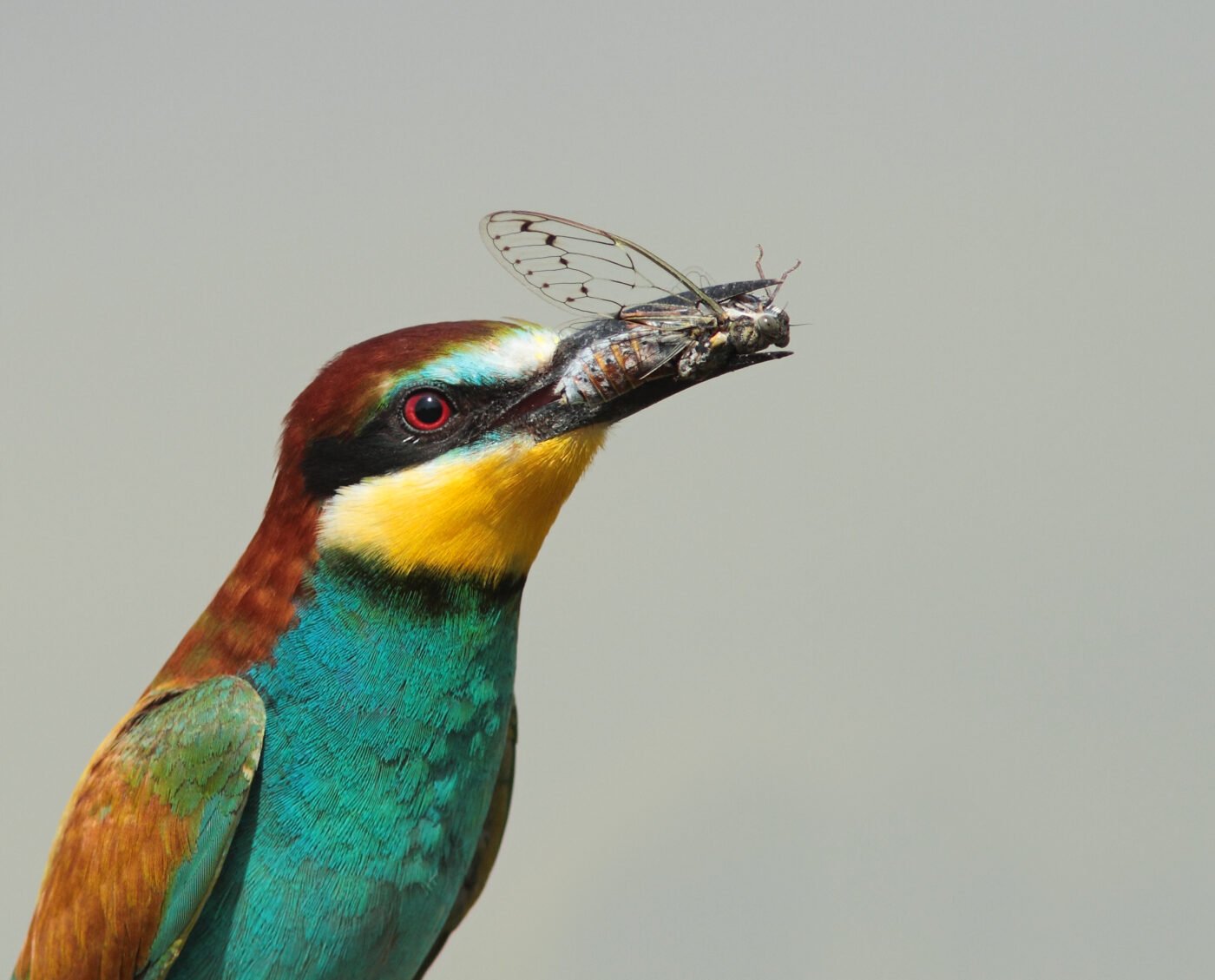
The European bee-eater (Merops apiaster) is exactly what its name promises: a strikingly colorful bird that specializes in catching flying insects on the wing, and in parts of its range honeybees make up close to half the diet fed to its chicks. For beekeepers across southern Europe, the Middle East, and Africa, where the species breeds or winters, this isn’t a trivia fact — it’s a real, if usually manageable, source of forager losses that shows up as bees visibly disappearing near an apiary during the bird’s breeding season.
Key Takeaways
- The European bee-eater (Merops apiaster) breeds across southern Europe, North Africa, and parts of western Asia, and winters mainly in sub-Saharan Africa, with a separate resident population in southern Africa.
- Research on nestling diets in Portugal found Hymenoptera (bees and wasps) made up 68-85% of prey fed to chicks at some colonies, with honeybees specifically accounting for an estimated 26-47%.
- Bee-eaters catch prey entirely in flight, then return to a perch and beat the insect against the branch to remove its stinger before swallowing it — a specific, learned technique that lets them safely eat stinging insects.
- The birds nest colonially in tunnels dug into sandy banks, and their gregarious, highly vocal social behavior means a single nesting colony near an apiary can represent a genuinely concentrated predation pressure.
- A 2023 Portuguese study found the first documented evidence of bee-eaters preying on the invasive yellow-legged hornet, raising the possibility the birds could play a small biocontrol role against that spreading pest in areas where their ranges overlap.
Table of Contents
- A Bird Named for Exactly What It Does
- How Much of the Diet Is Actually Honeybees
- How a Bee-Eater Eats a Bee Without Getting Stung
- What This Actually Means for an Apiary
- An Unexpected Upside: Yellow-Legged Hornet Predation
- Frequently Asked Questions
A Bird Named for Exactly What It Does
Few animal common names are as literal as the bee-eater’s. Merops apiaster is a mid-sized, brilliantly colored bird — teal underparts, a chestnut crown and back, a bright yellow throat, and a slim, slightly curved black bill — found breeding across a wide band from Portugal and Spain east through the Mediterranean and into western Asia, with an additional, geographically separate resident population in southern Africa. Most Northern Hemisphere breeders migrate to spend the winter in sub-Saharan Africa, making it a genuinely long-distance migrant as well as a highly social one: bee-eaters nest colonially, digging tunnel nests into sandy banks and riverbanks in tight-knit groups, and communicate constantly with sharp, rolling vocal calls that carry well across open country.
How Much of the Diet Is Actually Honeybees
The bird’s reputation isn’t exaggerated. A study of nestling diet composition in Portugal, cited in a 2023 paper on the species’ predatory ecology, found that Hymenoptera — the insect order containing bees, wasps, and ants — made up between 68% and 85% of prey items fed to chicks at the colonies studied, with European honeybees specifically estimated at 26% to 47% of the total diet and wasps contributing a further 3% to 33% depending on the colony and year. Diet composition isn’t uniform across the bird’s full range, though: a broader review of 38 European diet studies found wasps (Vespidae) averaged only around 8-9% of total prey across all sites, with some Spanish populations recording wasps at under 2% — a reminder that local prey availability, not just species preference, shapes how much of any one insect group actually ends up in a given colony’s diet.
How a Bee-Eater Eats a Bee Without Getting Stung
Catching a flying bee is only half the problem; eating one without a mouthful of venom is the other. Bee-eaters hunt entirely on the wing, sallying out from an exposed perch to snatch flying insects in midair before returning to the same or a nearby perch. Once back on the perch, the bird doesn’t simply swallow its catch — it repeatedly strikes the insect against the branch, a behavior that serves to disable and, critically, discharge or remove the stinger before the prey is eaten. This isn’t a universal reflex found in every insect-eating bird; it’s a specific, apparently learned handling technique that lets bee-eaters exploit a food source — venomous, stinging Hymenoptera — that most other birds largely avoid, which is a significant part of why the species can specialize so heavily on bees and wasps in the first place.
What This Actually Means for an Apiary
For beekeepers operating within the bird’s breeding or wintering range, the practical impact tends to track colony proximity and timing rather than being a constant background loss. Because bee-eaters nest in dense colonies and forage socially, an apiary situated near an active bee-eater nesting bank during breeding season can see a real, locally concentrated increase in forager losses for the weeks that colony is active and provisioning chicks — a pattern documented in field research on the species’ effect on honeybee colonies in Egypt’s Toshka region, among other studies. This sits alongside the wider set of predators and stressors already covered in this site’s broader look at honeybee predators and threats, and, like most of those pressures, it’s rarely the sole or even primary driver of colony decline on its own — it’s one input among several, worth recognizing rather than either ignoring or overreacting to.
An Unexpected Upside: Yellow-Legged Hornet Predation
A genuinely new data point emerged from a 2023 field study in Central Portugal, which documented the first recorded evidence of European bee-eaters preying on the invasive yellow-legged hornet (Vespa velutina) — a hornet that has been aggressively expanding across Europe and preying heavily on honeybee colonies in its own right, a threat this site covers in depth in its guide to the Asian giant hornet’s smaller, more established relative. Researchers recovered remains of five yellow-legged hornets across four separate bee-eater nesting sites during the 2021 field season — the study’s authors were careful to describe this evidence as still “very incipient” and cautioned against overstating its significance, particularly since bee-eater and yellow-legged hornet distributions currently overlap only in limited areas of the Iberian Peninsula. Still, it raises a real, if unproven, possibility: in regions where the two species’ ranges genuinely converge, a bird beekeepers have historically regarded purely as a nuisance predator might end up providing a small, incidental biocontrol benefit against one of the more serious hornet threats to European apiaries.
Frequently Asked Questions
Do bee-eater birds actually eat mostly honeybees?
In some studied populations, yes — Portuguese research found honeybees made up an estimated 26% to 47% of nestling diet at certain colonies — but the proportion varies widely by region and local prey availability, and is much lower at other sites.
How does a bee-eater avoid being stung?
After catching an insect in flight, the bird returns to a perch and repeatedly strikes the prey against the branch, a behavior that disables the stinger before the bird swallows its catch.
Where do European bee-eaters live?
They breed across southern Europe, North Africa, and parts of western Asia, with most populations migrating to winter in sub-Saharan Africa; a separate resident population also breeds in southern Africa.
Should beekeepers try to control or deter bee-eaters?
Bee-eaters are protected under wildlife law in most of their range, and their impact on a colony is generally localized and seasonal rather than a leading cause of colony loss, so most guidance focuses on apiary siting and timing awareness rather than deterrence or control.
Do bee-eaters help against other beekeeping pests?
Possibly, in a limited way — a 2023 study documented bee-eaters preying on the invasive yellow-legged hornet in Portugal, though researchers describe the evidence as preliminary and the two species’ ranges currently overlap only in parts of the Iberian Peninsula.