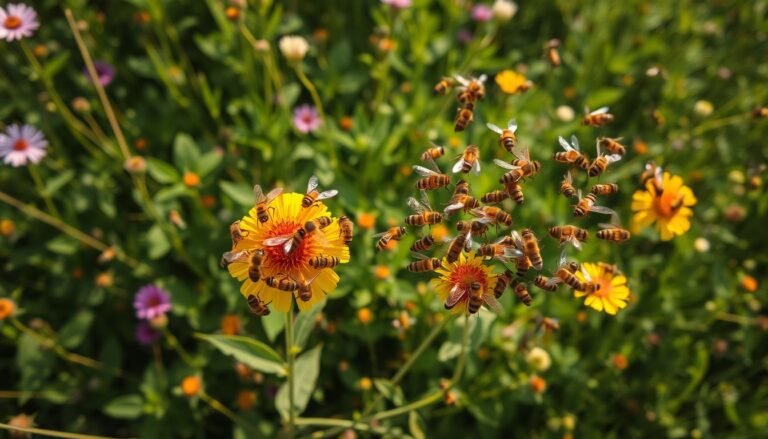
This article explains why provenance and trust matter for U.S. buyers and regulators. Provenance affects price, labeling, and consumer trust. Producers and labs need clear, practical tests that tie floral origin to product quality.
Traditional checks rely on taste, texture, and microscopic pollen counts per Codex Alimentarius. New research adds robust tools that use volatile profiles and targeted mass spectrometry to support botanical origin claims.
Recent studies have separated samples by origin using VOC fingerprints and multivariate models. One 2024 report even validated a unique compound specific to Bauhinia championii, with a targeted MS assay for quantitation.
Readers will get an accessible guide to methods, workflows, and how analytical evidence supports authentication and quality control. The goal is to translate complex spectrometry findings into actionable information for producers, QC labs, and regulators.
Key Takeaways
- Provenance drives value; reliable testing supports labels and market trust.
- Authentication pairs traditional checks with modern spectral analysis.
- VOC profiling and PCA-LDA can separate samples by botanical origin.
- A validated MS marker now links one floral source to a specific sample type.
- This article bridges technical research and practical quality decisions.
Research overview and scope of this article
New analytic strands pair broad volatile screening with focused mass spectrometry to support origin verification.
Objective: Consolidate evidence on VOC and compound markers, methods, and data workflows that U.S. labs can apply for botanical-origin quality control and labeling compliance.
This article reviews two recent study types. One is an HS-GCxIMS feasibility study that profiled VOCs across 58 samples (linden, acacia, rapeseed, silver fir, chestnut, manuka) and used PCA-LDA with 113 discriminant markers and manual VOCal peak labeling.
The other is a 2024 targeted mass spectrometry study that identified TDBF as a validated distinctive compound for Bauhinia championii. Both works draw on prior GC-MS retention-index strategies.
Scope and methods covered
- Feasibility VOC profiling with chemometrics for classification and out-of-sample forecasting.
- Targeted MS validation for single-compound quantitation and assay performance.
- Data handling: peak labeling, gallery plots, and dimensionality reduction.
| Study type | Samples | Key outcome |
|---|---|---|
| HS-GCxIMS VOC profiling | 58 diverse samples | PCA-LDA separation; 113 discriminants |
| Targeted mass spectrometry | Bauhinia championii sets | TDBF validated and quantified |
| Implementation focus | QC labs (U.S.) | Practical workflows and reporting guidance |
For a detailed methodological review, see this related article that discusses analytical frameworks and data practices.
Monofloral honey authenticity: background and drivers
Buyers pay a premium for named floral types, so proving provenance matters for price, labeling, and consumer trust. That premium creates strong incentives to deter mislabeling and fraud.
Organoleptic, physicochemical, and microscopic criteria for botanical origin
Codex Alimentarius permits a botanical indication only when the product comes predominantly from the named plants and shows matching sensory and lab traits.
Organoleptic checks look at color, texture, and aroma. For example, linden honey often appears light yellow to beige and has a menthol-like scent. These traits set expectations for origin verification.
Physicochemical tests include sugar profiling, electrical conductivity, optical rotation, pH, and HMF. Melissopalynology (pollen analysis) remains essential for botanical origin, but it is slow and labor intensive.
Food fraud risks and the value premium of monofloral types
Scalable laboratory screening helps bridge gaps. VOC profiling and targeted assays complement pollen analysis to flag suspicious samples quickly.
“Triangulating sensory, microscopic, and chemical data gives the strongest case for authenticity.”
For methodological context on automated screening and data workflows, see this botanical origin review.
Chemical markers in monofloral honey
Tracing botanical origin starts with broad volatile scans that reveal hundreds of candidate signals.
Markers are compounds or detector signals whose presence, absence, or intensity patterns help assign origin. They move the work from broad profiling to routine checks.
From untargeted discovery to targeted verification
Untargeted HS-GCxIMS profiling can detect many peaks—514 across 58 runs in one study—then researchers filter this set for practicality.
Feature selection reduced those peaks to 113 discriminants that separated six botanical types. That shortlist becomes a working panel for classification models.
Targeted mass spectrometry then confirms candidates. A separate study validated TDBF as a definitive marker for Bauhinia championii by showing botanical linkage and absence from other samples.
Combining untargeted discovery and validated targeted assays lowers false positives and raises confidence for routine QA and regulatory checks.
“A discovery-first pipeline gives labs a reliable path from many candidate signals to a few verified indicators.”
- Untargeted analysis surfaces composition differences across origins.
- Selected markers balance sensitivity and specificity for real-world testing.
- Validated targeted methods support quantitation and reporting thresholds.
For methodological context and implementation guidance, see this analytical frameworks.
Analytical methods: mass spectrometry, chromatography, and ion mobility
Combining drift-time separation and mass detection gives labs a practical route from discovery to quantitation. This layered approach links untargeted volatile profiling with focused mass assays to support authentication and routine testing.
Untargeted and targeted mass spectrometry for marker discovery
Untargeted workflows scan broadly to find signals. HS-GCxIMS runs with a static headspace and isothermal GC separated volatile patterns across 58 honey samples and produced 514 labeled peaks. Feature selection narrowed this to 113 discriminants.
Targeted mass spectrometry then confirms and quantifies candidates. For example, a validated assay measured TDBF levels tied to a single floral source, enabling reporting thresholds for QC.
Headspace GC coupled to ion mobility spectrometry (HS-GCxIMS) for VOC profiling
HS-GCxIMS offers low detection limits and drift-time separation that resolve coeluting gas signals. This makes it ideal for non-targeted VOC analysis of food matrices.
Correlating retention indices with GC-MS for compound identification
Retention-index matching with gas chromatography-mass improves identification where IMS libraries are sparse. Fifteen compounds—such as 2,3-butanedione and benzaldehyde—were verified by retention, reduced mobility, and reference standards.
“Identification confidence climbs when retention, drift, and MS data converge.”
| Method | Role | Key advantage |
|---|---|---|
| HS-GCxIMS | Untargeted VOC profiling | Drift separation; low limits; rapid screening |
| GC-MS (retention index) | Compound identification | Library matching; retention-index confirmation |
| Targeted MS | Quantitation/validation | Accurate measurement; assay performance data |

Bauhinia championii monofloral honey: identification of TDBF as a distinctive marker
A 2024 targeted study singled out 4,7,8-trimethoxydibenzo[b,d]furan-3-ol (TDBF) as a robust signal tied to Bauhinia championii. The compound was found both in the plant and in associated honey, but not in other tested honeys.
Discovery and botanical linkage
Discovery, botanical linkage, and absence in other samples
The study showed clear identification of TDBF in Bauhinia-derived material. Its absence across diverse samples gives the marker strong discriminatory power. This botanical link supports authenticity claims when TDBF is detected.
Targeted quantification and validation
Targeted mass spectrometry quantification and validation in honey samples
A validated mass spectrometry method quantified TDBF with calibrated standards, recovery checks, and replicate runs. The method reported accuracy, precision, and limits of detection suitable for routine QC.
“Presence of a plant-specific compound that is absent from other honeys strengthens origin assertions.”
Composition implications and lab integration
Plant metabolites can transfer into nectar and accumulate as traceable compounds. Labs can add TDBF to screening panels, use targeted assays for confirmation, and set reporting thresholds for product development and labeling.
| Aspect | Finding | Practical step |
|---|---|---|
| Discovery | TDBF present in Bauhinia and associated honey | Include in suspect screening lists |
| Specificity | Absent from other tested honeys | Use as a discriminatory marker |
| Validation | Targeted MS with calibration and replicates | Adopt for QC and reporting |
VOC-based classification of botanical origins with chemometrics
Combining peak intensities with supervised learning produces clear botanical groupings. Intensity features from 113 selected markers were extracted from 58 samples covering six types: linden, acacia, rapeseed, silver fir, chestnut, and manuka.
The workflow began with VOCal-assisted peak labeling of 514 peaks. Software converted these peaks into a feature table of intensities that feeds chemometric pipelines.
PCA reduced dimensionality so models focus on major variance components. Then LDA created discriminant axes that separate the six botanical classes while keeping results interpretable for lab reports.
Software logged preprocessing steps, scaling, and cross-validation to ensure reproducible analysis and traceable data handling. This made model results auditable for QA teams.
An out-of-sample forecast validated the approach: a store-labeled linden sample was correctly classified, while one declared linden was reclassified as rapeseed. External confirmation matched the model’s flag, showing practical value for authentication and targeted confirmatory testing.
Takeaway: pairing spectrometry data with chemometrics helps prioritize suspect samples and streamlines confirmatory assays, improving routine authentication and lab decision-making.
Identified marker compounds and their characteristics
Identified compound families—aldehydes, ketones, terpenes, and alcohols—recur across sampled types and form the core components used for classification.
Aldehydes, ketones, terpenes, and typical components
The study confirmed fifteen specific compounds by correlating HS-GCxIMS peaks with HS-GC-MS and reduced mobilities: 2,3-butanedione, 2-butanone, 2-pentanone, pentanal, trans-2-penten-1-ol, 2,3-hexanedione, hexanal, furfural, 1-hexanol, heptanal, α-pinene, benzaldehyde, 1-heptanol, nonanal, and decanal.
Note: these compounds are common across many types and rarely single-handedly identify a floral source. Instead, panels and intensity patterns are used to achieve reliable identification and classification.
Limits of current IMS databases and library needs
Many peaks remained unresolved because IMS spectral libraries are limited. Correlation with GC-MS and retention indices raised confidence for the confirmed list.
“Correlation with complementary instruments boosts identification confidence when database entries are sparse.”
Recommendation: expand standardized libraries and reference software datasets to improve routine identification and reduce ambiguity for food QA teams.
| Compound family | Representative compounds | Role for identification |
|---|---|---|
| Aldehydes | hexanal, heptanal, nonanal, decanal, pentanal, benzaldehyde | Contribute aroma; intensity patterns aid classification |
| Ketones | 2,3-butanedione, 2-butanone, 2-pentanone, 2,3-hexanedione | Volatile signatures; useful in panel scoring |
| Alcohols & furans | 1-hexanol, 1-heptanol, trans-2-penten-1-ol, furfural | Influence scent and thermal markers; confirmatory role |
| Terpenes | α-pinene | Floral/plant link; supportive, not definitive |
Data analysis workflow and software
A clear, repeatable workflow turns raw spectral peaks into actionable classification results. This section outlines practical steps for labs that want reproducible, auditable outputs.
Preprocessing, dimensionality reduction, and discriminant analysis
All 514 peaks from 58 GCxIMS runs were labeled using VOCal, then converted into a marker matrix for model input.
Preprocessing included baseline correction, alignment, and intensity normalization. Features with at least 5% variance were retained for downstream work.
PCA reduced dimensionality to principal components. LDA then used those components to build predictive separation across six classes. This combination keeps models interpretable while improving classification performance.
VOCal-assisted peak labeling, gallery plots, and variance thresholds
Gallery plots show side-by-side intensities by class, aiding feature choice and transparency for review. Software-generated plots make it easy to flag inconsistent signals.
Documenting software versions, preprocessing steps, and sample metadata supports reproducibility and audit trails. Store metadata with each run to help validation and future model updates.
| Step | Purpose | Outcome |
|---|---|---|
| Peak labeling (VOCal) | Convert spectra to features | 514 peaks → labeled matrix |
| Dimensionality reduction | PCA | Compact, orthogonal components |
| Discriminant analysis | LDA using ≥5% variance | Predictive class separation |

Takeaway: choose robust software and documented methods to make analysis repeatable and to integrate results into QA systems. For broader workflow guidance see this related review.
Quality control and regulatory alignment for the United States
U.S. regulators expect botanical origin claims to rest on measurable, auditable evidence that links product labels to source plants.
Botanical origin labeling must follow Codex expectations: the named floral source should predominate and match sensory, physicochemical, and microscopic traits.
Practical checkpoints for compliance
Translate Codex rules into routine QC steps: documented sampling, sensory notes, pollen analysis, and targeted spectrometry screens.
Use spectrometry (HS-GCxIMS or GC-MS) to flag suspect lots quickly and to support follow-up pollen work.
Complementing melissopalynology with spectrometry-based authentication
Melissopalynology remains the confirmatory method but is slow. Rapid VOC profiles and a validated marker assay reduce time to decision.
Pair results and keep linked records so decisions are defensible when label claims conflict with instrument data.
| Checkpoint | Role | Action |
|---|---|---|
| Sampling & documentation | Traceability | Record lot, origin claim, and chain of custody |
| Pollen analysis | Definitive botanical evidence | Use for confirmation of suspect lots |
| Spectrometry screens | Rapid QA | Run VOC panel and targeted marker assay |
| Label review | Regulatory alignment | Reconcile test data with declared floral origin |
“Documented, convergent evidence gives the strongest basis for truthful claims and defensible recalls.”
Practical implementation: from sample to decision
Good sampling practice sets the foundation for reliable gas-phase profiling and downstream decisions.
Sampling and controls. Collect random, representative samples with triplicate aliquots and at least one blank per run. Include blind duplicates and field controls to track variability. Document lot IDs, storage time, and temperature for traceability.
Headspace prep and handling
Headspace equilibration should use a static sampler with consistent temperature and salt addition to improve volatile recovery. Add sodium chloride to vials when matrices are viscous; vortex and allow defined equilibration time. Use clean glassware and seal vials to avoid losses.
Instrument settings and alignment
For GC-IMS, run an isothermal GC with a calibrated drift tube and stable carrier gas flow. Regularly inject retention standards and align drift-times with VOCal-assisted routines. For targeted mass spectrometry, follow validated scan windows and include isotope or internal standards.
Thresholds, validation, and reporting
Set marker thresholds using method validation: limit of detection, limit of quantitation, recovery, and precision checks. For TDBF, adopt the validated targeted MS method and report concentrations with uncertainty bounds.
“Flag samples that exceed set thresholds or show discordant profiles for confirmatory pollen analysis.”
Integrating into QA systems. Implement a decision tree that combines spectrometry outputs, retention-index confirmation, and pollen results. Log raw data, preprocessing steps, and final flags in the laboratory information system so regulatory reviews are auditable.
Challenges, limitations, and research gaps
Regional and seasonal variation drive major shifts in VOC fingerprints. Plant phenology, weather, and local forage mix change composition quickly. That variability makes reproducible analysis harder across years and geographies.
Matrix effects also matter. Different batches show varying viscosity and sugar profiles that alter volatile release. Labs must plan sampling to capture this range and avoid overfitting models to narrow sets of samples.
Enrichment trade-offs
SPME and other enrichment methods increase sensitivity and recover low-abundance compounds. But they add steps that reduce throughput and can bias relative intensities.
Choose enrichment only when targets require it, and validate that added complexity does not erode routine robustness.
Mass, data, and model considerations
- Models suffer drift; retrain across seasons and regions and hold back external validation sets.
- Maintain versioned preprocessing and document software and parameters for auditability.
- Plan for storage and compute needs when scaling sample throughput.
“Limited IMS libraries left many signals unresolved; collaborative library building is essential.”
| Gap | Impact | Action |
|---|---|---|
| Library coverage | Many compounds remain unidentified | Share reference spectra and expand collaborative databases |
| Validation scope | Models fragile across batches | Use cross-batch, cross-year study designs |
| Enrichment vs throughput | Trade-off between sensitivity and speed | Benchmark SPME vs direct headspace before deployment |
Recommended next steps: design multi-season studies, include blind external samples, and link spectrometry flags to confirmatory pollen work and field forage notes. For practical context on how plant sourcing affects nectar and composition see this foraging for nectar.
Conclusion
Conclusion. Convergent analytical workflows give labs a practical path to verify botanical origins for U.S. product claims.
Complementary spectrometry methods and chemometrics provide scalable, data-driven support for authentication. Targeted mass spectrometry validates distinctive findings such as TDBF, and VOC-derived panels help triage suspect lots.
Adopt standardized methods, shared data practices, and retention-index checks to align reports with Codex-guided quality and labeling. Authors and review articles must grow reference libraries and broaden validation across types and samples.
Next steps: integrate workflows, expand cross-seasonal validation, and report results so they map clearly to product claims and compliance needs.
FAQ
What is the main goal of research on chemical markers for monofloral honey?
The primary objective is to identify and validate specific compounds that reliably indicate a single floral source, enabling authentication of botanical origin, protecting product value, and detecting mislabeling or fraud using targeted and untargeted mass spectrometry approaches.
Which study types and timeframes are typically reviewed in these articles?
Reviews combine field sampling, laboratory analyses, and retrospective studies spanning recent decades. They cover untargeted discovery work, targeted validation, chemometric modeling, and method development using chromatography-mass spectrometry and ion mobility techniques.
How do organoleptic and physicochemical tests relate to spectrometric authentication?
Sensory assessment and measures like moisture, sugar profile, and pollen analysis (melissopalynology) offer initial evidence of origin. Spectrometric data provide molecular-level confirmation and can complement or challenge those traditional criteria for a stronger authentication case.
Why do certain single-flower honeys command a price premium?
Unique taste, geographic rarity, and consumer perception create demand. That premium creates incentives for adulteration and mislabeling, making robust authentication with chemical profiling and chemometrics essential for market integrity.
What is the workflow from untargeted discovery to targeted marker verification?
Researchers perform untargeted profiling to find candidate compounds, annotate features by retention time and mass spectra, then develop targeted assays (quantitative MS methods) to confirm presence, concentration ranges, and specificity across many samples.
Which analytical platforms are most effective for finding floral origin indicators?
Gas chromatography–mass spectrometry (GC-MS), liquid chromatography–MS (LC-MS), and ion mobility–coupled systems (GCxIMS) are widely used. Each provides complementary information on volatile and semi-volatile components important for botanical classification.
How does headspace GC coupled to ion mobility spectrometry (HS-GCxIMS) help profile volatile compounds?
HS-GCxIMS captures volatile organic compounds (VOCs) from the sample headspace, separates them chromatographically, and resolves isomeric or similar ions via mobility. This yields a fast fingerprint useful for pattern recognition and marker detection.
How are retention indices and GC-MS spectra correlated for compound ID?
Analysts compare measured retention indices with reference libraries and match mass spectra to databases (e.g., NIST). Correlating both parameters reduces misidentification and supports assignment of specific origin-related compounds.
Can a single compound, like TDBF identified in Bauhinia championii honey, serve as definitive proof of origin?
A distinctive compound that is absent from other honeys is powerful evidence, but robust authentication requires confirming its botanical link, reproducibility across seasons and locations, and targeted quantification to set thresholds and rule out false positives.
What validation steps are needed after discovering a candidate marker?
Validation includes targeted MS quantification across broad sample sets, method precision and recovery tests, assessment of matrix effects, and checking the marker’s absence in other floral types and potential contaminants.
How are VOC-based chemometric models used to classify botanical origins?
Researchers select discriminant features from VOC profiles, apply dimensionality reduction (PCA) followed by supervised classifiers (LDA, PLS-DA), and then test out-of-sample forecasting to evaluate how well models flag authentic versus misdeclared samples.
What performance can PCA-LDA achieve separating multiple floral sources?
Well-designed workflows using selected intensity features often achieve clear separation among several botanical origins, though performance depends on sample diversity, marker robustness, and preprocessing rigor.
How do researchers handle out-of-sample predictions to detect unauthentic labels?
They reserve independent test sets or use cross-validation to simulate new samples. Models that generalize well will correctly flag samples that deviate from trained origin fingerprints, prompting further targeted testing.
What classes of compounds commonly serve as origin indicators?
Aldehydes, ketones, terpenes, phenolic derivatives, and certain nitrogen-containing volatiles often correlate with floral sources. Their presence and relative abundances form characteristic profiles used in classification.
Are current ion mobility libraries sufficient for identifying all honey VOCs?
No. Existing IMS databases are limited. Expanding reference libraries with validated retention indices, drift times, and MS spectra remains a key need to improve confident compound annotation.
What data processing steps are essential before modeling?
Typical preprocessing includes baseline correction, alignment, normalization, and feature selection. Dimensionality reduction and discriminant analysis reduce noise and highlight the most informative markers for classification.
What tools assist with peak labeling and visualization in VOC workflows?
Software that offers VOCal-like assisted labeling, gallery plots, and variance threshold displays helps annotate peaks, compare patterns across samples, and prioritize candidate markers for follow-up.
How do US regulatory frameworks view botanical origin claims?
U.S. labeling requires truthful claims. Aligning methods with Codex Alimentarius guidance and national standards strengthens compliance. Spectrometric evidence can support botanical origin statements but must be documented and reproducible.
How should spectrometry complement melissopalynology for QA?
Pollen analysis provides direct botanical evidence, while spectrometric profiling offers molecular confirmation and rapid screening. Combining both increases confidence in origin claims and helps resolve ambiguous cases.
What practical steps are recommended from sampling to decision-making?
Implement a representative sampling strategy, include controls and blanks, standardize headspace preparation, use validated instrument settings for GC-IMS and MS, and report marker concentrations with decision thresholds integrated into quality systems.
What are common instrumental settings for reliable GC-IMS and MS analysis?
Settings vary by instrument, but reproducible temperature programs, calibrated retention indices, tuned mass spectrometers, and consistent headspace incubation parameters are critical. Method validation should document all parameters.
How should results and thresholds be reported in QA systems?
Reports should state quantified marker levels, analytical uncertainty, decision limits, and whether findings meet established botanical origin criteria. Integrating results with traceability records supports legal and commercial claims.
What are the main challenges and research gaps in marker-based authentication?
Variability from geography, season, and processing affects marker stability. Trade-offs exist between enrichment steps and throughput. More extensive reference libraries, interlaboratory validation, and standardized protocols are needed.