Last Updated August 26, 2026
Farmers seeking practical, research-backed steps can use native flower bands to support pollinators and boost crop outcomes.
Studies show retail seed sales can add revenue in the near term while increased bee activity often raises yields over several seasons. A Montana State analysis found retail seed sales profitable for small diversified farms and recorded over 200 native bee species using the plantings. Field research ties seed income to longer-term pollination gains.
Cornell work highlights landscape context: farms with 25–55% nearby natural land see stronger pollinator gains and higher strawberry yields. Elsewhere, prairie strips cut erosion and nutrient loss and act like “speed bumps” that slow runoff and improve infiltration.
This guide explains how to site, establish, and manage living edges that support bees, wildlife, soil, and water while fitting into farm systems and incentive programs.
Key Takeaways
- Retail seed sales can provide early farm revenue while ecological gains take hold.
- Landscape context strongly affects pollinator and crop responses.
- Prairie strips reduce erosion and filter nutrients, protecting soil and water.
- Expect yield improvements to grow over several seasons as pollinator communities build.
- USDA and conservation programs can lower startup costs and support adoption.
- Practical guidance links peer-reviewed research with on-farm steps for site selection and management.
- For flower choices and bee-friendly species, see resources on best plants for honeybees: best plants for honeybees.
Plan Your Wildflower Strips for Your Farm and Landscape
Begin by mapping nearby natural cover to see whether your landscape will amplify pollinator gains or simply attract unwanted insects.
This Goldilocks check uses the 25–55% rule from Cornell: farms inside that range tend to see more bees and higher yields. Outside it, plantings sometimes drew pests without boosting parasitoid wasps. Use that finding to decide scale and placement.
Locate strips where they help most
Place bands on field edges, low-yield areas, and along runoff paths to slow water and cut erosion. On slopes, align on contour to trap sediment. Positioning near equipment lanes preserves production.
Select species and mixes carefully
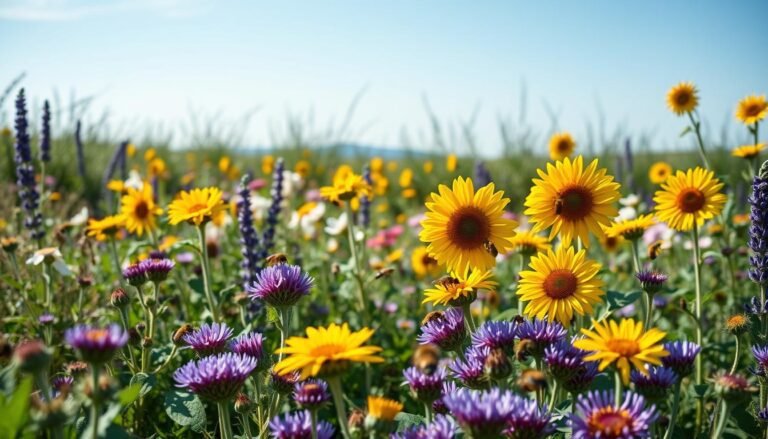
Choose native perennial mixes aimed at pollination and minimal pest attraction. Exclude species flagged by researchers—fleabane drew more pests in a New York study. Balance early, mid, and late bloom and add grasses for structure.
- Engage USDA CRP and state programs early for cost-share and incentives.
- Partner with seed suppliers and conservation groups to tailor seed palettes.
- Monitor bees, pests, and yield to refine plant lists and widths.
For regional seeding guidance see establishing a meadow and check recommended mixes at native bee-friendly plants.
How to Establish and Manage Wildflower Strips for Long-Term Success
Begin with a season of suppression to set soil readiness and cut the weed seedbank.
Site preparation: Use repeated shallow tillage or a stale seedbed approach. Where suitable, plant a cover crop to smother annuals. Aim for firm, clean ground before seeding native perennial mixes.
Planting methods and timing: Dormant late-fall seeding or early spring frost seeding helps many native flowers establish. Drill seeding with a native-seed drill gives better soil contact and even distribution across fields.

Year-by-year management: Manage aggressively in years one and two. Mow high to suppress annual weeds, spot-remove invasives, and allow perennials to build. Expect ecological functions and crop pollination gains to strengthen after three or more years.
Monitoring and harvest: Conduct transect walks and timed counts to track bees, insects, and pests. If pressure rises, adjust species mixes and structure rather than remove plantings. For seed income, follow cleaning, testing, and labeling steps; small farms saw retail seed sales pay off in a Montana State study while wholesale did not.
| Year | Key Actions | Indicators | Expected Outcomes |
|---|---|---|---|
| Year 0 | Weed suppression, soil prep, choose species | Clean ground, low weed cover | Higher establishment rates |
| Years 1–2 | Mow above seedlings, spot-weed, monitor insects | Increasing native flowers, few invasives | Structural stability, rising pollinator visits |
| Year 3+ | Selective management, seed harvest, record keeping | Stable plant communities, seed ripening | Soil protection, seed revenue potential |
For long-term management tips and protocol guides, consult this long-term management resource and practical seed-market notes at beekeeping benefits.
The benefits of planting wildflower strips: Evidence-based outcomes
Well-sited perennial bands deliver clear ecological returns for soil, water, and crop pollination. Field and landscape studies show these living edges change insect communities, cut runoff, and support birds while adding value to farm systems.
Pollinators and crops
Cornell’s multi-year work found that floral borders raised bee counts and improved fruit set when 25–55% of surrounding land remained natural. Outside that range, some borders attracted more pests without increases in parasitoid wasps.
Montana State researchers recorded 202 native bee species using plantings on diversified farms and noted that crop yield gains usually strengthen after three or more years.
Soil, water, and erosion
Prairie bands act like vegetative speed bumps: they slow surface flow, trap sediment, and boost infiltration.
Converting about 10% of row-crop acres to native perennials can cut erosion by roughly 95% and reduce nitrate and phosphorus runoff while storing carbon.
Wildlife and economics
Research in the Midwest found nearly threefold higher grassland bird density where native areas were present. Pollinator diversity also rose within the bands.
Farmers can secure early income from retail seed sales while longer-term returns show through improved pollination, better soil health, and lower input losses.
For further peer-reviewed support, see prairie-strip research.
| Outcome | Measured Effect | Timeframe | Practical note |
|---|---|---|---|
| Pollinator counts | Large increases where 25–55% natural land | 1–3 years | Site within landscape Goldilocks zone |
| Erosion control | ~95% reduction when ~10% acres converted | Immediate after establishment | Place on contour across slopes |
| Wildlife | Nearly 3x grassland bird density | 3+ years | Include grasses and native flower species |
| Farm income | Retail seed sales profitable on small farms | Early and ongoing | Combine seed sales with incentive payments |
Conclusion
Field trials across the U.S. show that well-placed wildflower bands deliver measurable farm and ecological returns over time.
For farmers, early revenue can come from seed sales while pollination and soil benefits build over several seasons. Converting about 10% of row acres to native perennials can cut erosion by roughly 95% and lower nitrate and phosphorus runoff.
Success is a practical way to align production with conservation: choose plants that favor bees, site bands in the right landscape, and use simple monitoring to track pollinators, pests, and yield. With cost-share programs and steady management, these living edges strengthen food systems and farm resilience as communities mature.
FAQ
What is the best place on my farm to set up a wildflower strip?
Choose low-yield field edges, runoff paths, and corners where crops perform poorly. These areas reduce competition with cash crops and act as buffers for sediment and nutrients. Aim for locations that connect to existing natural habitat to increase insect movement and ecological value.
How much surrounding natural habitat should be nearby for strips to work well?
Target landscapes with roughly 25–55% nearby natural cover. This “Goldilocks zone” supports robust pollinator and predator populations while allowing strips to bolster insect movement and crop pollination without needing large-scale restoration.
Which plant species should I use to support bees and beneficial insects?
Prioritize native perennial forbs and grasses suited to your ecoregion. Look for diverse mixes with early-, mid-, and late-season bloomers to provide continuous nectar and pollen. Avoid species known to harbor crop pests and consult local extension services for region-specific seed lists.
When and how should I prepare the site before sowing seed?
Suppress existing weeds with targeted tillage, cover cropping, or herbicide where appropriate, then create a firm, seedbed. Optimal timing varies by species, but many native mixes establish best with fall sowing or late winter surface broadcast into a clean seedbed.
What planting methods work best for native perennial mixes?
Use a broadcast spreader, drill designed for small seeds, or a no-till drill if residue is high. Combine larger grass seed with smaller forb seed at proper depth and use light packing or rolling to ensure good seed–soil contact. Calibrate equipment for small-seed mixes.
How do I manage strips in the first three years to ensure establishment?
Year one focuses on weed control: spot-treat annuals, mow high to reduce weeds, and avoid heavy disturbance. In year two, reduce mowing frequency to allow for forb growth while controlling perennials. By year three, shift to a targeted regime of burning, mowing, or grazing timed to favor natives and reduce aggressive weeds.
How should I monitor insects and measure pollination benefits?
Use transect walks, timed visual counts, or pan traps to track bee and hoverfly activity. Pair insect monitoring with crop yield checks near strips versus control fields to gauge pollination effects. Record observations annually to detect trends and adaptive needs.
Can a farm earn income from seed production or sales?
Yes. Once stands are established, some farms harvest and sell native seed wholesale or retail. Seed cleaning and certification add value but require equipment or contractor services. Evaluate labor, processing costs, and market demand before scaling.
Do these strips reduce erosion and improve water quality?
Deep-rooted native grasses and forbs slow surface runoff, trap sediment, and promote infiltration. Farmers and researchers report meaningful reductions in nutrient and soil loss when strips are placed along contour lines or headlands.
Will strips attract pests that harm crops?
Properly designed mixes favor pollinators and natural enemies like parasitoid wasps and predatory beetles, which can suppress crop pests. Avoid nectar sources that disproportionately support pest outbreaks and monitor for pest hotspots, adjusting plant composition if needed.
Are there U.S. cost-share programs to help install strips?
Yes. Programs like the USDA Conservation Reserve Program (CRP) and Environmental Quality Incentives Program (EQIP) provide technical and financial assistance for habitat establishment. Contact your local Natural Resources Conservation Service (NRCS) office for current options.
How large should each strip be to benefit pollinators and crops?
Widths of 6–24 feet can provide local habitat and connectivity; wider strips yield greater ecological function. Consider landscape context, available acres, and management capacity when sizing strips to balance production and habitat goals.
What maintenance schedule helps sustain floral diversity over years?
Rotate management: annual or biennial mowing, periodic prescribed burning, or light grazing timed after seed set preserves diversity. Remove invasive species promptly and conduct small-scale reseeding if forb cover declines to maintain long-term floral and insect benefits.
How long before I see measurable improvements in pollinator numbers?
You may notice increases in native bee activity within the first season for some species, but substantial community shifts and greater crop pollination effects often take 2–4 years as perennials mature and habitat complexity grows.
What records should farmers keep to evaluate strip performance?
Track planting dates, seed mixes and rates, management actions, monitoring data for insects and yields, and any seed sales. These records help assess ecological outcomes, economic returns, and guide adaptive management over time.