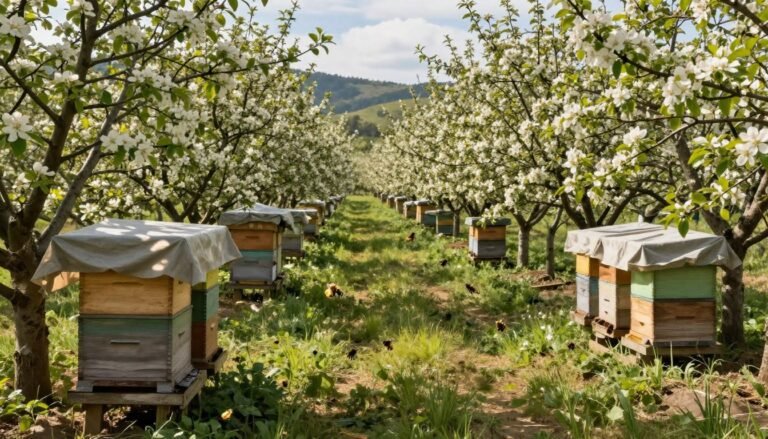
Apple production spans roughly 295,000 acres in the United States, and growers need clear strategies to protect yields. This introduction outlines practical steps to improve pollination across commercial orchard systems and boost fruit set.
Honey bees arrived in North America more than 400 years ago and now serve as the main crop pollinators. Professional growers rely on their activity to meet modern production demands.
Managing hive placement and colony strength helps ensure consistent pollination and higher fruit quality. This guide focuses on setting the right hive density, practical colony care, and monitoring so you can reduce risk and secure reliable harvests.
Key Takeaways
- Optimizing hive placement improves pollination and fruit set.
- Honey bees remain the primary pollinators for commercial fruit.
- Proper colony management supports consistent production.
- Right hive numbers reduce the risk of poor bloom coverage.
- This guide outlines steps to increase quality and yield.
Understanding the Role of Honey Bees in Apple Orchards
The way worker bees search for food drives pollination outcomes in fruit plantings. For growers, knowing when and how bees forage helps match colony management to bloom needs.
Foraging behavior varies by weather and colony makeup. Research shows roughly one-third of a colony’s workers forage at any moment. Flight climbs when temperatures rise above 65°F and winds stay under 10 mph. Cold, wet springs cut activity and lower fruit set.
Foraging Behavior
Bees switch tasks quickly. Some workers gather nectar for fuel, while others collect pollen for brood rearing.
Pollen vs. Nectar Collectors
Pollen collectors are more effective at moving pollen between flowers. Studies in related crops show pollen-gathering foragers dominate in certain trees—up to 80% in cherry plantings—boosting transfer efficiency.
- Key point: Aim for 20–25 visiting bees per tree during bloom to support good fruit set.
- Monitor colonies and weather to maximize bee activity during critical bloom windows.
- For practical colony management tips, see honey bee management for tree fruit and guidance on nectar-producing trees.
Assessing Colony Strength for Maximum Pollination
Before bloom, growers must confirm colony strength to protect fruit set and ensure uniform coverage. Inspecting frames and flight activity gives clear, fast guidance on whether colonies will meet demand.
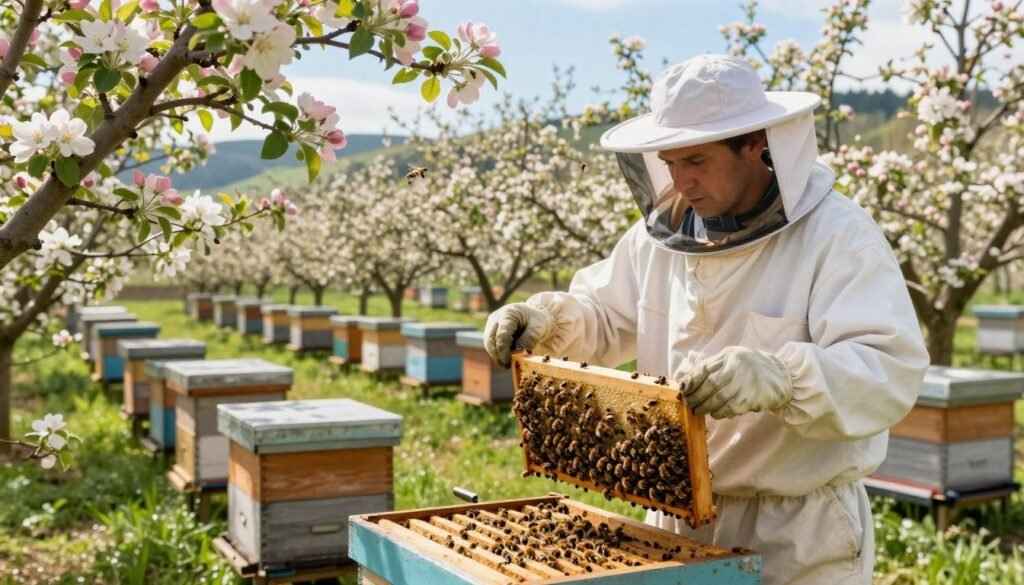
Use the six-frame rule: a colony with at least 6 frames of brood with bees covering those frames typically equals about 20,000 adult bees. That number is widely accepted as the minimum for an effective pollinating unit in tree fruit.
Watch flight counts at each entrance. Under warm, sunny conditions, aim for roughly 75 bees per minute entering each colony. Uniform traffic across sites shows balanced, healthy colonies ready to work the flowers.
“Weak colonies with low populations are of little value; strong colonies send more pollen collectors and improve set.”
- Inspect for 6 frames of brood and visually confirm bees to cover the frames.
- Count incoming bees for 30–60 seconds at mid-morning on calm days.
- Work with beekeepers to replace or boost colonies below the 20,000-bee benchmark.
Assessments protect production by reducing surprises during bloom. For standard methods and sampling protocols, consult the technical guidance at standard methods for pollination studies.
Determining Optimal Apple Orchard Pollination Hive Density
Proper stocking rates balance the large bloom counts in modern plantings with available foragers.
For most commercial blocks, plan on two colonies per acre as a practical target. This provides a safety margin during cool, wet springs when bees may not forage well.
Adjusting for high-density plantings
Intensive systems with 1,000+ trees per acre often need different numbers than older, wider-row designs. Match colony placement to rows and tree variety to cover more flowers during peak bloom.
Typical stocking ranges vary by region: one to 12 hives per hectare. Four hives per hectare is common and provides reliable coverage in many climates.
- One colony per acre might work in ideal years; two per acre gives insurance against bad weather.
- High-density trellised blocks may require extra colonies to match higher flower counts.
- Wind over 15 mph can halt foraging, so increase colony numbers when local conditions are poor.
- For early bloom crops like sweet cherry, ensure colonies have four frames of brood by early spring.
“Use stocking rates that match bloom intensity and local conditions to secure consistent fruit set.”
Consult specialists and regional studies to set final numbers; see research on stocking and management and guidance for supporting native pollinators for further planning.
For detailed technical data, review the Li et al. report and recommendations on supporting native bee conservation.
Strategic Grouping and Placement of Hives
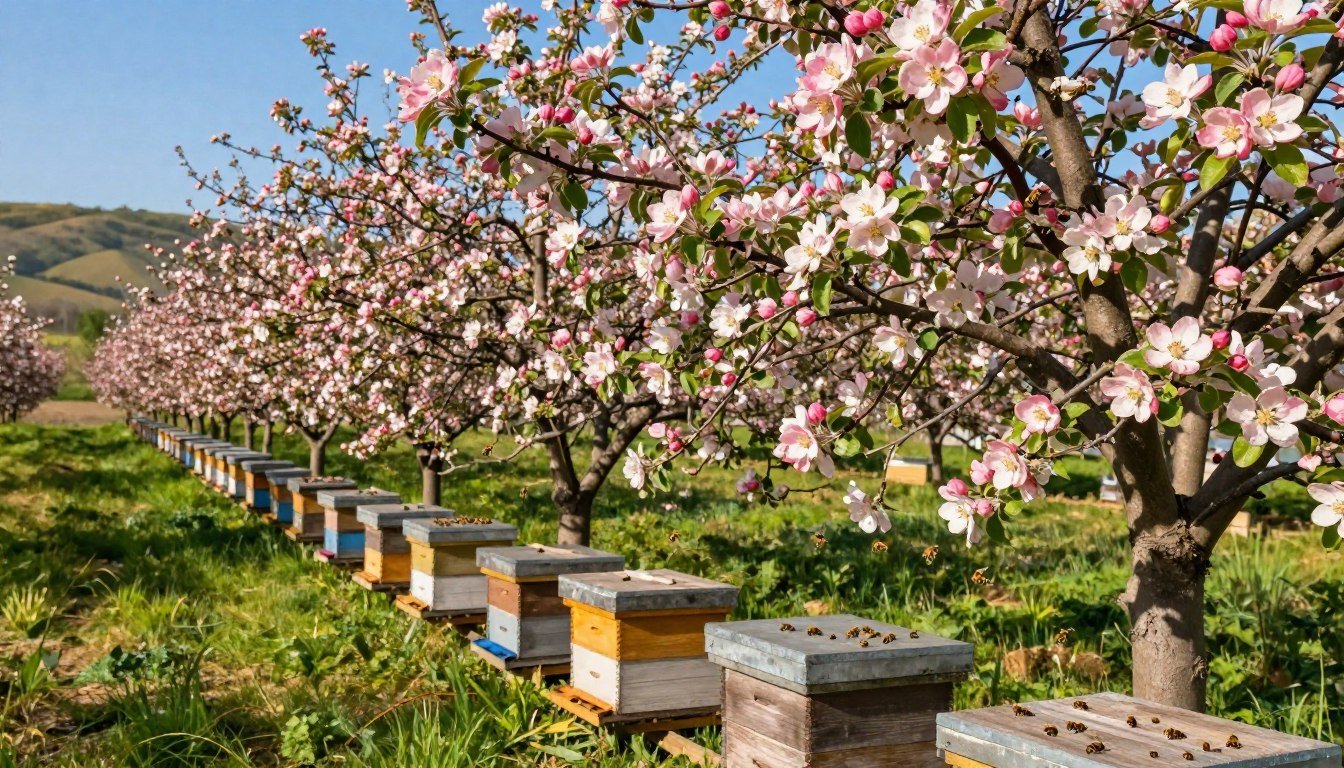
Strategic siting of colonies reduces gaps in coverage and raises fruit set in mixed-row plantings. Place groups of 4–6 hives at about 150-yard intervals for steady pollination across small to medium blocks.
In large plantings, use clusters of 8–16 colonies spaced 200–300 yards apart, beginning roughly 100 yards from the block edge. Choose warm, sunny, wind-protected sites — studies show flight activity rises about 50% in sun-exposed positions.
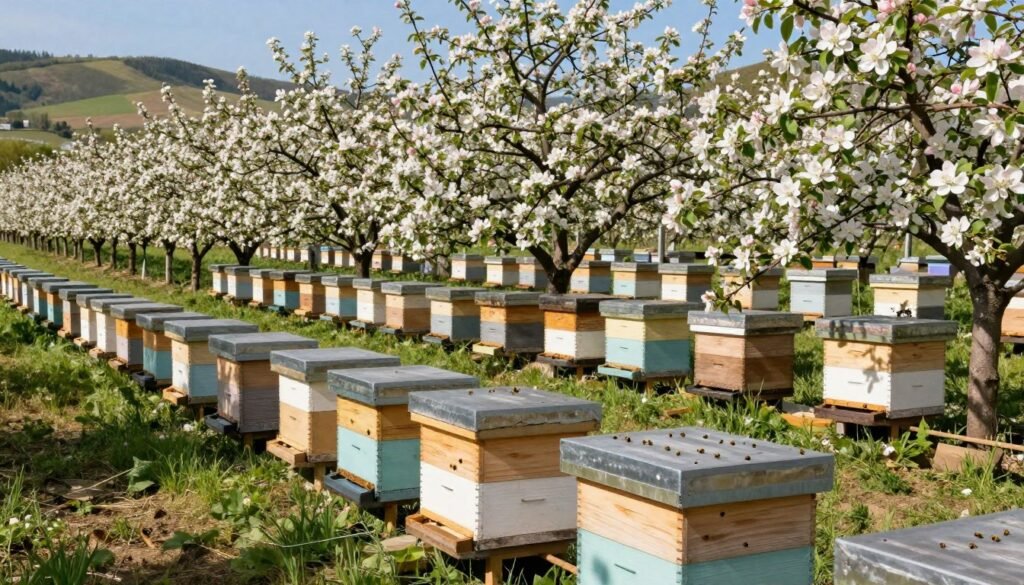
- Competition between groups encourages bees to move between trees, improving pollen transfer.
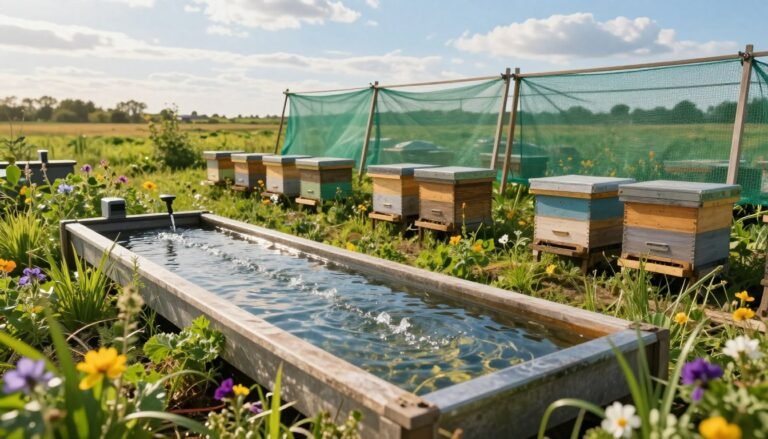
- Provide clean water within 1/4 mile and install windbreaks to limit flight disruptions.
- Place colonies closer to young trees with fewer blooms to boost set.
| Orchard Size | Group Size | Interval | Site Tip |
|---|---|---|---|
| Small/Medium | 4–6 colonies | ~150 yards | Sunny, sheltered locations |
| Large | 8–16 colonies | 200–300 yards | Start 100 yards from edges |
| Young block | Denser groups | Shorter intervals | Close placement to young trees |
“Proper placement of hives is a proven way to maximize the efficiency of honey bees in orchards.”
For further technical context, see strategic grouping research.
Timing Hive Introduction for Peak Bloom
Introduce colonies when the first king bloom reaches about 10% open flowers. This timing helps direct foragers to the target trees instead of surrounding weeds or wildflowers.
For pear blocks, wait longer. Because pear nectar is less attractive, bringing colonies as late as 50% bloom still provides useful visits without wasting forager effort.
Stagger deliveries over one or two days to replace bees that leave for more appealing blooms. Mow flowering cover or maintain sod strips between rows to reduce competition.
- Move colonies at least 1 mile between different fruit blocks to keep foragers on the intended crop.
- Coordinate timing with beekeepers and extension specialists for specific varieties and weather conditions.
- Proper timing increases the chance of good fruit set and efficient use of colonies during bloom.
“Introducing colonies at the right bloom stage is a low-cost step that yields measurable gains in fruit set.”
| Crop | Suggested Introduction | Reason |
|---|---|---|
| Apple | ~10% king bloom | Focuses bees on the crop early for maximum flower coverage |
| Pear | Up to 50% bloom | Nectar less attractive; later placement still effective |
| Multiple blocks | Staggered by 1–2 days; move >1 mile | Reduces forager drift and preserves numbers for target crop |
For practical steps to strengthen colonies ahead of these moves, consult guidance on boosting colony populations naturally at boosting colony population naturally.
Managing Pesticide Exposure During the Bloom Period
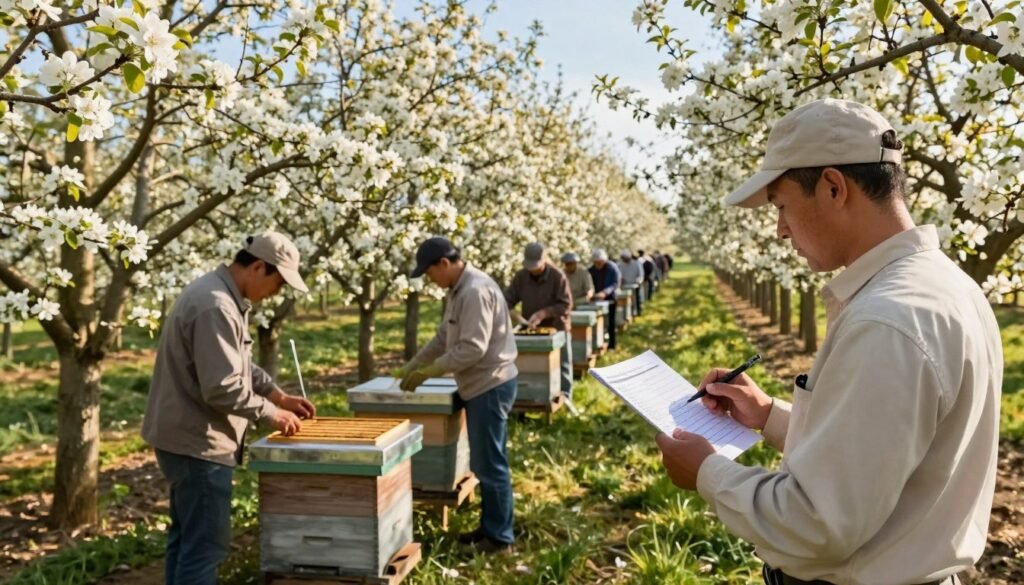
Spray decisions made in bloom windows often determine whether pollinators survive and whether fruit set will be reliable. Protecting colonies at this time requires clear product choices, careful timing, and strong communication between growers and beekeepers.
Identifying Toxic Pesticides
Some insecticide classes cause most bee poisonings. Organophosphates, N-methyl carbamates, and neonicotinoids carry high risk when present in nectar or pollen.
Systemic products applied before bloom can move into flowers later. That makes pre-bloom use a hidden source of exposure for foragers.
Minimizing Drift
Spray technique matters. Avoid spraying when wind is above safe limits and use low-drift nozzles.
Simple steps include treating at night or very early morning, reducing boom pressure, and keeping off-target blooms mowed to lower attraction.
Beekeeper-Grower Cooperation
Most incidents occur from lack of communication, not intent. Share schedules and remove bees shortly after petal fall to reduce risk.
“Open, timely communication between growers and beekeepers is the most effective way to prevent bee losses.”
- Modify pest programs to avoid spraying flowering crops or weeds.
- Consult regional guides (see best management practices) for practical steps.
- Review local extension bulletins (PNW 518 and 591) and consider renting services with clear timing; see rental and timing guidance.
Managing pesticide use, minimizing drift, and coordinating deliveries are essential to keep pollinators healthy and protect crop production.
Enhancing Pollinator Habitat and Floral Resources
Protecting and expanding non-crop flower areas gives growers a steady source of nectar and pollen beyond the bloom window.
Establish permanent wildflower meadows or prairie-style strips to supply summer and fall forage when the main crop is not in bloom. These areas also shelter nesting sites for wild bee species and other beneficial insects.
Mass-flowering cover crops such as buckwheat or sunflowers add quick forage where permanent plantings are impractical. Intercropping and polyculture help conserve water while offering diverse flower resources across the season.
Protect non-crop flowering plants from pesticide drift to preserve pollen and nectar that sustain pollinators and natural enemies like hover flies and lady beetles.
“Diverse floral resources increase resilience and support both managed colonies and wild pollinators.”
| Practice | Benefit | Funding Options |
|---|---|---|
| Wildflower meadows | Summer/fall forage; nesting habitat | CRP, EQIP, NRCS cost-share |
| Mass-flowering cover crops | Rapid nectar and pollen supply | Low-cost seed mixes; short-term option |
| Intercropping & polyculture | Year-round variety for bees; water-wise | Technical assistance; conservation grants |
For guidance on design and outcomes, review supporting pollinator habitat research at supporting pollinator habitat research. Enhancing habitat is a long-term investment that raises sustainability and boosts fruit production and honey yields over time.
Conclusion
Simple, repeatable steps on colony strength and site planning deliver steadier yields year after year.
Optimize numbers and placement to protect set and boost overall production. Pair strong colonies with healthy floral resources to improve visitation and fruit quality.
Prioritize clear cooperation with beekeepers to reduce pesticide risk. Use integrated pest management and create diverse habitat to support both managed and wild pollinators.
Monitor bloom timing and colony strength so you can make precise adjustments. For local habitat ideas like community garden support, see community gardens.