This section explains a full, end-to-end view of how honey moves from flower foraging to retail shelves in the United States. You will get a professional summary of hive biology, beekeeper roles, and commercial logistics that shape supply and quality.
In 2023 global output reached about 1.9 million tonnes, led by China and followed by the United States at roughly 62,855 tonnes. Those figures set expectations for market pricing and availability in coming years.
Readers will learn key terms and distinctions — bee vs. bees, hive parts, and how hives are organized for production and extraction. Compliance, testing, and sourcing risks that packers and beekeepers manage are also previewed.
Practical insights include value-added streams like beeswax and origin labeling, plus environmental and ethical trade-offs that influence buyer choice and policy.
Key Takeaways
- Get a clear map of supply chain steps from forage to shelf.
- Understand U.S. output in a world context and why it matters for price.
- Learn how hive biology and beekeeper practices affect quality.
- Know the compliance tests and sourcing risks to watch for.
- Spot value-added opportunities beyond raw jars, like wax and niche origins.
- Find actionable tips for working with suppliers and quality controls.
U.S. honey at a glance in the world market
Total output in 2023 reached about 1.9 million tonnes, and that scale matters because a few large origins shape global flows.
China remains dominant, supplying roughly 24% of global volume in 2023 (about 463,500 tonnes). The united states produced 62,855 tonnes that same year. Those totals place the country among the significant, but not leading, producers.
FAO data show regional shares that explain why Asia leads: Asia 44%, Europe 24%, Americas 19%, Africa 11%, Oceania 2% (2018 base). Wide forage areas, crop patterns, and large-scale beekeepers in Asia drive high volumes.
Concentration of supply affects price discovery and risk. When markets rely on a few dominant sources, liquidity can tighten after a bad season.
- Trade implications: dominant origins shape import needs and contract flexibility.
- Risk management: diversified sourcing raises value for packers and retailers.
- Production drivers: climate, plants, and beekeeper scale explain output swings.
For practical reference and supplier guidance, consult beekeepers resources that cover sourcing and quality practices.
From flower to hive: how honey bees make honey
Bees gather two main carbohydrates: floral nectar and honeydew from sap-feeding insects. Nectar arrives at roughly 70–80% water; honeydew can exceed 85–89% water. Each forager fills a honey stomach of about 40 mg before returning to the hive.
Nectar, honeydew, and the honey stomach
Enzymes from a worker’s hypopharyngeal glands begin breaking down sucrose into simpler sugars. Inside the hive, bees regurgitate droplets and form bubbles to boost surface area. That activity speeds evaporation and thickens the content.
Enzymes, regurgitation, evaporation, and capping
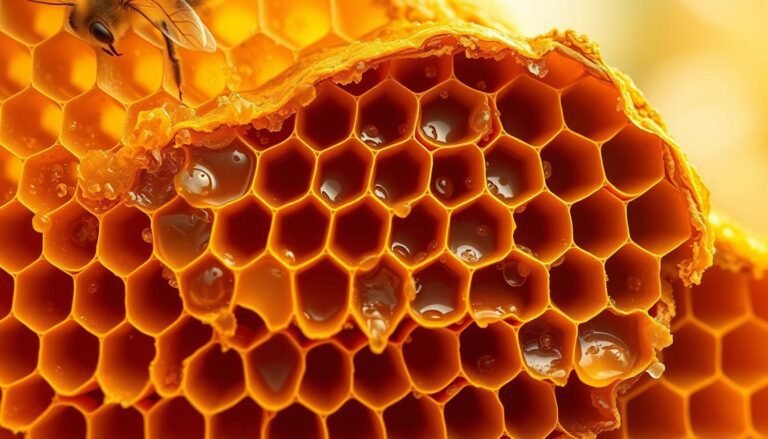
Colony ventilation and a steady ~35 °C temperature help remove water until moisture hits about 15.5–18%. Cells in the comb act as mini‑evaporation chambers. Workers then seal finished cells with wax caps to lock in stability.
Why acidity and low water preserve it
Low water, gluconic acid and hydrogen peroxide together inhibit microbes. This combination gives the product long shelf life if post‑harvest humidity is kept out. Stored reserves feed eggs, larvae, and adult bees during scarce periods, showing why this work matters for colony survival.
Beekeepers, hives, and management practices in American beekeeping
Choosing the right hive and timing space additions keeps production steady. Common U.S. systems use removable frames in Langstroth or similar boxes. Adding honey supers gives colonies room to store and lowers swarm pressure.
Hive types, supers, and preventing swarms for steady production
Removable frames let a beekeeper inspect brood, monitor stores, and harvest without destroying a colony. Adding supers during peak flows spreads brood and storage, which reduces swarm impulses and evens per-hive yields.
Seasonal management, feeding decisions, and overwintering
Spring buildup focuses on population growth; summer is for captures of nectar. Late-season checks decide if supplemental feed is needed.
Use sugar water or a candyboard to top up food when nectar is scarce. Apply feed before cold sets in to avoid contamination of marketable jars.
“Modern removable frames changed beekeeping by preserving colonies across years and improving long-term productivity.”
Placement near rich forage plants, regional climate, and pollen availability frame timing for interventions. Track capped cells and hive weight to know when to add or remove boxes.
- Brood nest care: keep colonies queen-right and balanced for foraging strength.
- Swarm control: space, splits, and monitoring cut losses.
- Overwintering: adjust insulation and food thresholds by area to reduce mortality.
Expect a multi-year learning curve to match local patterns and improve yields. For seasonal checklists and practical schedules, see honey bee management through the seasons.
Harvesting and processing: from beehives to retail honey
Safe harvest follows steps that protect colonies while securing clean comb for extraction. Beekeepers pacify bees with measured smoke to mask alarm pheromones and trigger a feeding response. Move slowly, lift frames by the top bar, and keep combs level to avoid spills and contamination.
Using smokers, removing frames, extraction and filtering
After removal, choose crushing or centrifugal extraction. Crushing yields higher short-term yield but damages comb for reuse. Centrifugal extractors preserve comb and speed processing.
Follow extraction with staged filtering. Coarse strainers remove wax chunks; fine filters keep pollen and aroma while clearing debris.
Moisture targets, crystallization, and texture management
Aim for 15.5–18% water before storage. Use a refractometer to confirm content. Crystallization depends on glucose versus fructose, water, and temperature.
Controlled seeding and chilling at 13–17 °C produce creamed texture. Store bulk in sealed tanks with minimal headspace and stable humidity to avoid fermentation. Warm crystallized jars gently below 40 °C to reliquefy without degrading enzymes.
“Clear processing choices preserve value and reduce waste across the supply chain.”
Quality, authenticity, and preservation standards
Accurate labeling and stable moisture are the twin pillars that keep jars safe and trustworthy. This section outlines the rules and tests that protect identity and shelf life.
Codex definitions and U.S. labeling
Codex Stan 12-1981 defines this sweet substance as made by honeybees from nectar or honeydew and transformed by enzymes. U.S. labeling follows that identity and expects truthful floral claims and clear origin statements.
Why humidity control matters
Keep water near 15.5–18% to prevent yeast-driven fermentation. Exposure to humid air raises moisture and shortens shelf life.
Preservation properties and processing effects
Glucose oxidase produces gluconic acid and hydrogen peroxide, which add antimicrobial strength. Gentle heat preserves those natural defenses; heavy heating reduces enzyme activity and dims flavor.
Practical controls and in-plant checks
- Sampling and refractometry to confirm moisture content and soluble solids.
- Sensory checks for off‑notes and visual clarity before release.
- Use sealed tanks and drums to limit humidity ingress during storage.
“Capped comb and careful handling set a baseline; lab evidence keeps product claims honest.”
Adulteration risks and modern testing in the United States
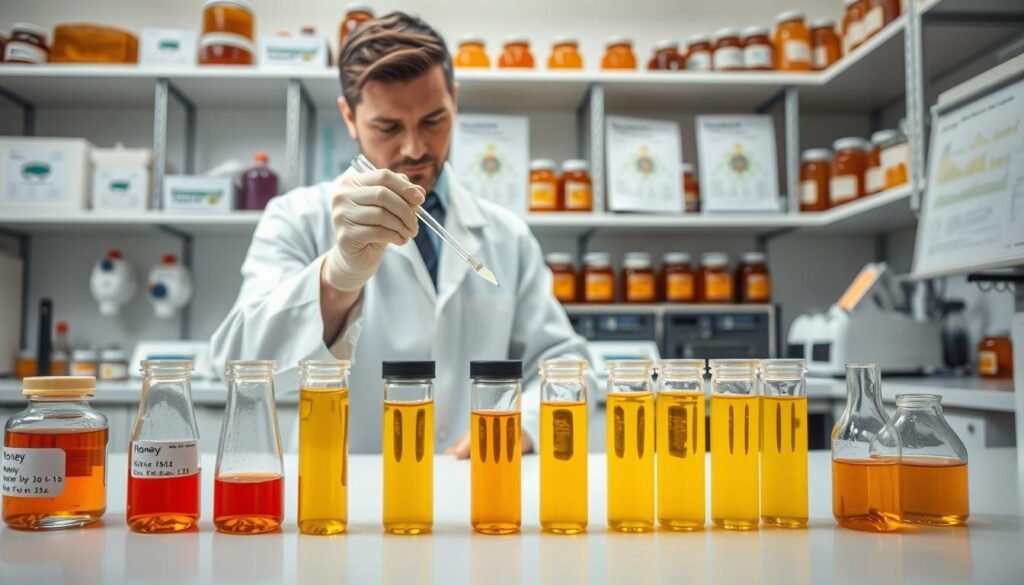
Adulteration with alternative sugars remains a major threat to product value and trust. Unscrupulous suppliers add clear corn syrup or plant syrups to match sweetness, color, and texture while lowering costs.
Common adulterants
Typical additives include high‑fructose corn syrup, cane syrup, rice syrups, and beet‑based sugars. These mimic viscosity and flavor but dilute origin and nutritional properties.
Isotope testing and its limits
Isotope ratio mass spectrometry (IRMS) compares carbon isotopes in sugars versus proteins. A mismatch flags C4 plant sugars such as corn or cane; detection can reach about 7% addition.
IRMS struggles with C3 syrups from some plants. For that reason, labs use complementary assays, not a single test.
Practical controls and industry view
- Packers’ workflow: document source, run isotopic screening, add targeted marker assays, and schedule third‑party checks.
- Supplier audits: batch sampling, trace docs, and corrective action plans for non‑conformance.
- Transparency: support floral claims with lab data to protect brands and beekeepers.
“No single method detects all fraud types; layered testing and ongoing research are essential.” — National Honey Board
Beyond honey: beeswax and other apicultural products
Clean cappings and well-rendered combs supply a high-value raw material used across cosmetics, pharmaceuticals, and candle makers.
Beeswax often earns more per kilogram than jarred sweet goods. About 40% of trade goes to cosmetics, 30% to pharma, and 20% to candles. In 2018 U.S. output was roughly 1,612 tonnes.
Purity matters. Residues from treatments or contaminated comb limit use for foundation in developed markets and push buyers to import high‑purity wax from other regions.
Processing, quality, and added value
Collecting cappings during extraction raises yield. Rendering, filtration, and optional bleaching lift appeal for specialty buyers. Certification, like organic, commands premiums.
- Storage: keep blocks dry and sealed to avoid dust and odors.
- Handling: avoid contact with treated equipment or old frames to preserve purity.
- Diversify: treat wax, propolis, pollen, and royal jelly as separate product lines.
“Treat wax as a strategic product line to diversify revenue and meet regulated demand.”
| Downstream Sector | Share (%) | Quality Focus | Implication for Beekeepers |
|---|---|---|---|
| Cosmetics | 40 | Color, low residues, processing | Filter and document source |
| Pharmaceuticals | 30 | Purity, traceability, testing | Use certified supply chains |
| Candles & crafts | 20 | Consistency, scent | Blend and standardize lots |
U.S. production, imports, and consumption dynamics
Domestic output has trended below consumption for several years, so imports fill recurring shortfalls. In 2023 production reached 62,855 tonnes, down from 69,104 tonnes in 2018. This gap keeps global supply central to retail availability and price stability.
Annual output versus demand
Annual shortfalls force packers to blend domestic lots with foreign bulk to keep shelves full. Inventory plans align arrivals with peak retail seasons and promotions.
Key import sources and implications
Major suppliers are India (~26%), Vietnam (~20%), Argentina (~19%), and Brazil (~13%). Origin mixes affect quality checks, pricing, and contract risk.
“Traceable source documentation and lab verification are essential to protect value and consumer trust.”
| Origin | Share (%) | Implication for buyers |
|---|---|---|
| India | 26 | Large volumes; tight testing for syrups |
| Vietnam | 20 | Competitive pricing; logistic timing matters |
| Argentina & Brazil | 32 combined | Stable bulk for industrial packs; seasonal swings |
Market players—from beekeepers to packers and distributors—coordinate harvest windows, import schedules, and promotional calendars. For a detailed trade report and grading context see grading standards. Diversifying sources reduces supply shocks and opens room for premium growth in domestic value chains.
Pricing and value: bulk honey versus niche products
Market value often depends less on volume and more on verified attributes and a story that resonates with shoppers. Bulk lots sell by weight and compete on cost. Niche jars earn premiums through origin, floral claims, and tested activity.
Premium drivers and proof points
Sensory differentiation and lab markers justify higher tags. New Zealand’s manuka shows how branding plus scientific data can lift small volumes into top value tiers.
Key levers:
- Verified activity markers and transparent testing.
- Single‑origin lots, limited releases, and floral naming.
- Clean supply chains and certification to back claims.
Commercial tactics for beekeepers and packers
Direct channels and specialty retail support margins. Clear packaging and storytelling teach buyers about floral source and stewardship.
“Stable premiums let producers invest in colony health and local forage.”
Risks include variable supply and authenticity checks. Align marketing with measurable properties so product promises match lab evidence and consumer expectations.
How the U.S. Honey Industry Works Across the Supply Chain
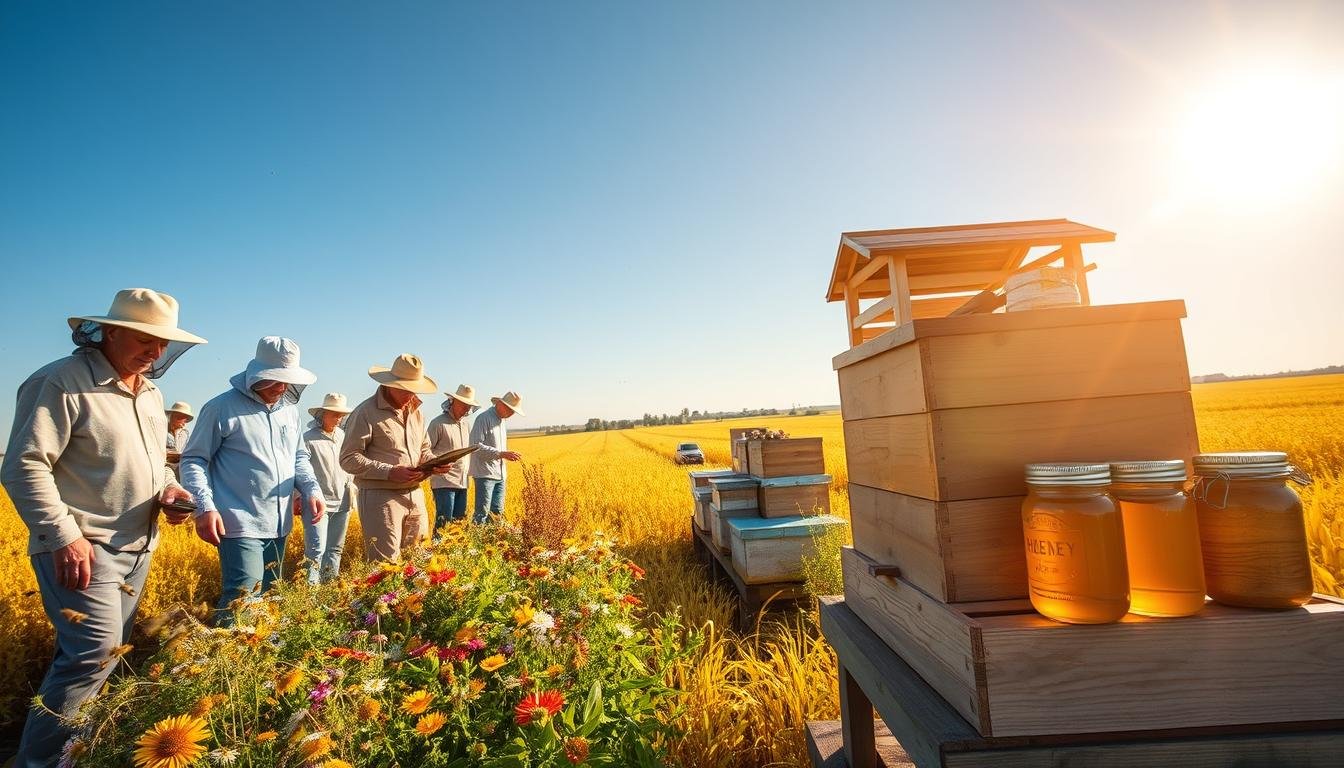
Operational handoffs — from beehives to bulk tanks — determine final product stability and traceability.
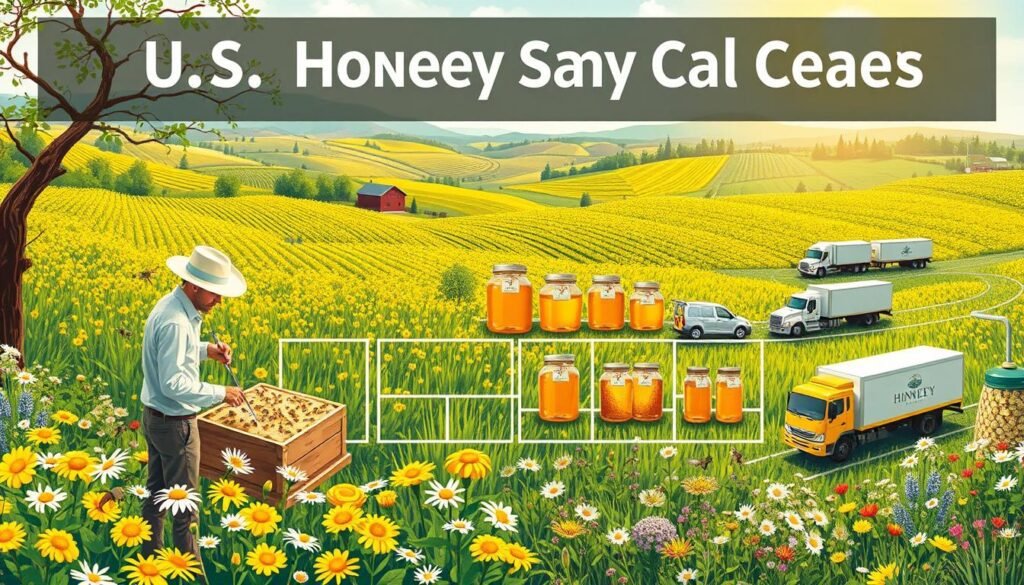
Inputs: bees, forage, and equipment
Critical inputs set seasonal capacity. Healthy bees, abundant forage, and intact hive gear limit downtime and cap yield.
On-farm production and extraction workflows
Inspections, timely supering, and measured smoker use keep colonies balanced and lower swarm risk.
Harvest uses crushing or centrifugal extractors, followed by staged filtering and moisture checks to meet 15.5–18% targets.
Packing, distribution, retail, and foodservice channels
Apiaries hand off bulk to packers via sealed tanks. Mix, filter, and control crystallization before jarging.
Palletized cases ship ambient; stable humidity and mild temps help shelf life for grocers and restaurants.
- Key checkpoints: moisture verification, accurate labeling, batch traceability.
- Data sharing: forecasts between beekeepers, packers, and distributors reduce stockouts.
- Continuous improvement: supplier audits, lab cadence, and corrective actions raise confidence.
“Collaboration across the supply chain optimizes cost-to-serve while safeguarding authenticity and quality.”
Regulatory landscape, standards, and market monitoring
Regulatory frameworks set trade rules, labeling expectations, and lab requirements that affect market access. Clear product codes, testing norms, and public reports help firms and regulators align on identity and quality.
Product classification and trade codes
Official classifications guide customs and tariffs. Natural honey is listed under CPC 02910 and HS 0409.00. Use these codes on invoices and permits to avoid clearance delays and mismatched duties.
Data reporting and institutional roles
National agencies feed production and trade numbers into central repositories. FAOSTAT compiles country-level output and trade flows. The European Commission publishes apiculture program reports that inform regional policy.
Codex standards set identity, composition, and labeling benchmarks used by many countries. Domestic guidance often mirrors Codex while adding local enforcement steps.
“Transparent records and harmonized codes improve cross-border comparability and consumer trust.”
- Documentation: batch records, origin paperwork, and lab certificates support claims during audits.
- Research links: regulator–lab partnerships refine tests to detect adulteration and residues.
- Market monitoring: ongoing reports feed policy choices that aid bee health and supply resilience.
| Area | Role | Practical action |
|---|---|---|
| Classification | Customs, trade | Apply CPC 02910 / HS 0409.00 on export/import docs |
| Standards | Codex, national agencies | Align labels and composition tests with published criteria |
| Monitoring | FAOSTAT, regional reports | Use datasets for sourcing and risk assessment |
Advice: match internal specs to recognized standards, keep records ready for audits, and subscribe to updates from Codex and national bodies. This reduces clearance friction and supports credible origin and quality claims.
Bee health, colony management, and agricultural connections
A colony’s stores and nutrition determine its ability to forage, resist pests, and meet pollination contracts. Bees use stored sugars as fuel for flight muscles, thermoregulation, and winter survival. Pollen supplies the protein and amino acids that support eggs, larval growth, and brood strength.
Energy, pollen, and brood development
Healthy bees keep hive temperatures near 35 °C to develop brood and process nectar. Adults and larvae rely on reserves when flowers are scarce, so adequate food frames reduce stress and mortality.
Management, monitoring, and pollination links
Good management uses weight checks, brood-pattern reviews, and mite control to maintain population stability. Diversified forage and planted flowering corridors smooth nutrition across seasons.
- Risk control: ample stores cut losses during transport for crop pollination.
- Agricultural value: reliable pollination raises crop yields and supports rural incomes.
- Stress response: disease and poor forage boost energy needs, making reserves critical.
“Balanced nutrition and vigilant management sustain colonies and reinforce their service to agriculture.”
Environmental and ethical perspectives shaping demand
Growing consumer concern now links production methods to planetary and pollinator health.
Selective breeding, routine sugar feeding after harvest, culling, and queen wing clipping draw ethical scrutiny from buyers and advocates.
These practices influence sentiment and purchasing, pushing some shoppers toward labeled alternatives and stricter supplier claims.
Wider ecological impacts
Concentrating managed colonies in limited area can reduce forage for wild insects and birds and alter local biodiversity balance.
Mass hive movements for pollination sometimes compete with native pollinators for nectar and pollen.
Mitigation and market responses
- Habitat plantings and seasonal stocking limits help relieve pressure on wild insects.
- Transparent labeling, regional sourcing, and carbon-aware logistics respond to import footprint concerns.
- Third-party audits and certifications validate animal welfare and environmental practices.
“Demand for responsibly produced jars is driving producers to invest in habitat, traceability, and better care.”
For practical guidance on sourcing and stewardship, consult detailed field resources such as a UC Davis white paper and a comprehensive beekeeping guide from a reputable trade site: UC Davis report and beekeepers resources.
Consumer trends, alternatives, and product innovation
Shifts in shopper values and diet choices are creating new paths for sweeteners and artisanal jars. Brands now must balance tradition with clear messaging and modern formats.
Vegan-friendly alternatives and positioning
Date syrup, maple, agave, molasses, golden syrup, and “bee-free” options are growing on shelves. Retailers can list them alongside jars to capture vegan buyers without abandoning core customers.
Offer sampler packs or paired recommendations to showcase complementary use and let people compare flavor and function.
Culinary uses and substitution cases
Chefs use jars for glazing, marinades, and dressings because of texture and aroma. Alternatives work in baking and beverages but may change browning and mouthfeel.
Label recipes with swap notes so cooks know when to expect flavor or texture shifts.
Mead revival and format diversity
Mead has returned as a craft category in the United States, from dry sippers to fruit blends and spiced metheglin. Producers use Saccharomyces cerevisiae and creative adjuncts to build approachable lines.
Low- and no-alcohol variants expand reach and keep traditional use alive for more people.
- Innovation: creamed, infused, and single-origin jars meet demand for distinct profiles.
- Merchandising: cross-sell with specialty cheeses, teas, and bakery items to boost trial.
- Storytelling: careful notes on floral terroir and ecological tales, like African honeyguide birds, add cultural depth when accurate.
“Clear labels, sensory training, and QA protocols keep new formats consistent and trusted by shoppers.”
Conclusion
Strong supply chains depend on healthy colonies, verified lots, and tight documentation from apiary to shelf.
This conclusion links field care, measured extraction, and layered testing into a single view of market readiness. Low water content and natural acidity give jars long stability when protected through storage and transport.
Global output reached about 1.9 million tonnes in the latest year while united states production was 62,855 tonnes. That gap shapes sourcing, pricing, and contract choices for packers and retailers.
Action points: invest in QA, data-driven forecasting, and supplier partnerships with clear specs. Balance bulk supply with niche lots to capture value and manage risk.
Collaboration among beekeepers, packers, and retailers, plus steady gains in bee health, forage access, and authenticity testing, will sustain resilience and support pollination services for agriculture.
FAQ
What is the current role of U.S. production in the global market?
The United States ranks among the top honey producers but does not lead global output. Regional producers in Asia and South America supply large volumes, while the U.S. contributes quality-focused and specialty honeys. Domestic production helps meet part of national demand, but imports fill the gap for bulk and varied floral sources.
How do honey bees convert flower secretions into honey?
Worker bees collect nectar or honeydew into a separate crop often called the “honey stomach.” Enzymes like invertase begin breaking complex sugars into simpler forms. Back at the hive, bees regurgitate and pass the nectar between nestmates while fanning airflow to evaporate moisture. Once reduced to low water content, workers cap cells with wax to age and store the product.
Why does honey resist spoilage?
Honey’s low water content and natural acidity create an environment hostile to most microbes. Enzymes also produce small amounts of hydrogen peroxide. These combined properties extend shelf life and make properly harvested honey remarkably stable without refrigeration.
What hive types and management practices are common among American beekeepers?
Many U.S. beekeepers use Langstroth hives with removable frames and add supers to increase storage space. Management techniques include swarm prevention, seasonal feeding, mite control, and strategic splitting or combining of colonies. Practices vary by operation size and regional climate.
How do beekeepers handle seasonal needs like overwintering?
Beekeepers assess colony strength, provide supplemental feed if stores are low, and insulate or reduce hive entrances to conserve heat. Some transport colonies to milder climates for winter or to follow nectar flows, while others rely on local forage and careful monitoring to get colonies through cold months.
What steps are involved in harvesting and processing honey?
Harvest begins with calming bees using smoke, removing frames, and uncapping comb. Honey is typically extracted by centrifugal extractors, filtered to remove debris, and settled to let air bubbles and fine particles rise. Processors adjust moisture and texture before bottling to meet quality targets.
How do processors manage moisture and crystallization?
Processors aim for a moisture content near 17% or below to reduce fermentation risk. To control crystallization, they may blend, warm gently, or tank-age honey to achieve desired texture. Floral source and sugar composition strongly influence crystallization behavior.
What defines honey quality and labeling in the U.S. market?
Quality standards draw on international Codex definitions and U.S. labeling rules requiring truthful origin and ingredient claims. Labels often state floral source, country of origin, and whether honey is raw or pasteurized. Regulatory bodies monitor key factors like moisture and contaminants.
What adulterants threaten authenticity and how are they detected?
Common adulterants include corn syrup, rice syrup, and other plant syrups that mimic natural sugars. Advanced tools such as isotope ratio mass spectrometry (IRMS) can detect some adulteration, though limits exist for blended or regionally similar syrups. Ongoing method development aims to close detection gaps.
What role does the National Honey Board play in authenticity issues?
The National Honey Board provides research, education, and industry guidance on quality, marketing, and testing. It helps producers and buyers understand authenticity challenges and supports initiatives that improve testing and traceability.
Besides honey, what products come from beekeeping?
Beekeeping yields beeswax, propolis, royal jelly, pollen, and live colonies for pollination services. Beeswax supports cosmetics, candles, and pharmaceutical uses, while other products serve nutraceutical and agricultural markets.
How does U.S. production compare to domestic demand and imports?
Annual domestic output covers only part of national consumption. The U.S. imports significant volumes from countries like Argentina, Mexico, and Vietnam to satisfy demand for bulk and specialty grades. This trade mix influences price and availability.
What drives price differences between bulk honey and niche varieties?
Price depends on volume, floral source, processing level, and branding. Single-origin, organic, and rare floral honeys command premiums due to limited supply and perceived quality. Bulk commodity honey focuses on cost competitiveness and consistent supply.
What inputs and steps make up the supply chain from hive to retail?
Key inputs include colonies, forage, feed, and hive equipment. On-farm steps cover colony care, honey supers placement, and extraction. Post-harvest includes filtration, moisture control, packing, distribution to retailers or foodservice, and marketing to consumers.
Which regulations and codes affect honey trade and classification?
Product classification relies on customs codes and standards that define honey types. Agencies like USDA and FDA oversee labeling and food safety, while international rules and trade agreements influence import and export procedures.
How important is bee health to production and agriculture?
Colony health directly affects yields and pollination services. Bees need diverse pollen for protein and energy sources from nectar. Healthy colonies support crop pollination, linking apiculture to broader agricultural productivity.
What environmental and ethical concerns shape consumer demand?
Consumers worry about selective breeding, intensive hive practices, and impacts on native insects and biodiversity. Ethical sourcing, habitat protection, and transparent practices influence purchase decisions and support conservation-minded brands.
How are consumer trends changing product innovation in this sector?
Demand for alternatives such as plant-based sweeteners and interest in mead or infused honeys spur new product formats. Brands experiment with value-added offerings and clearer provenance to meet changing preferences.