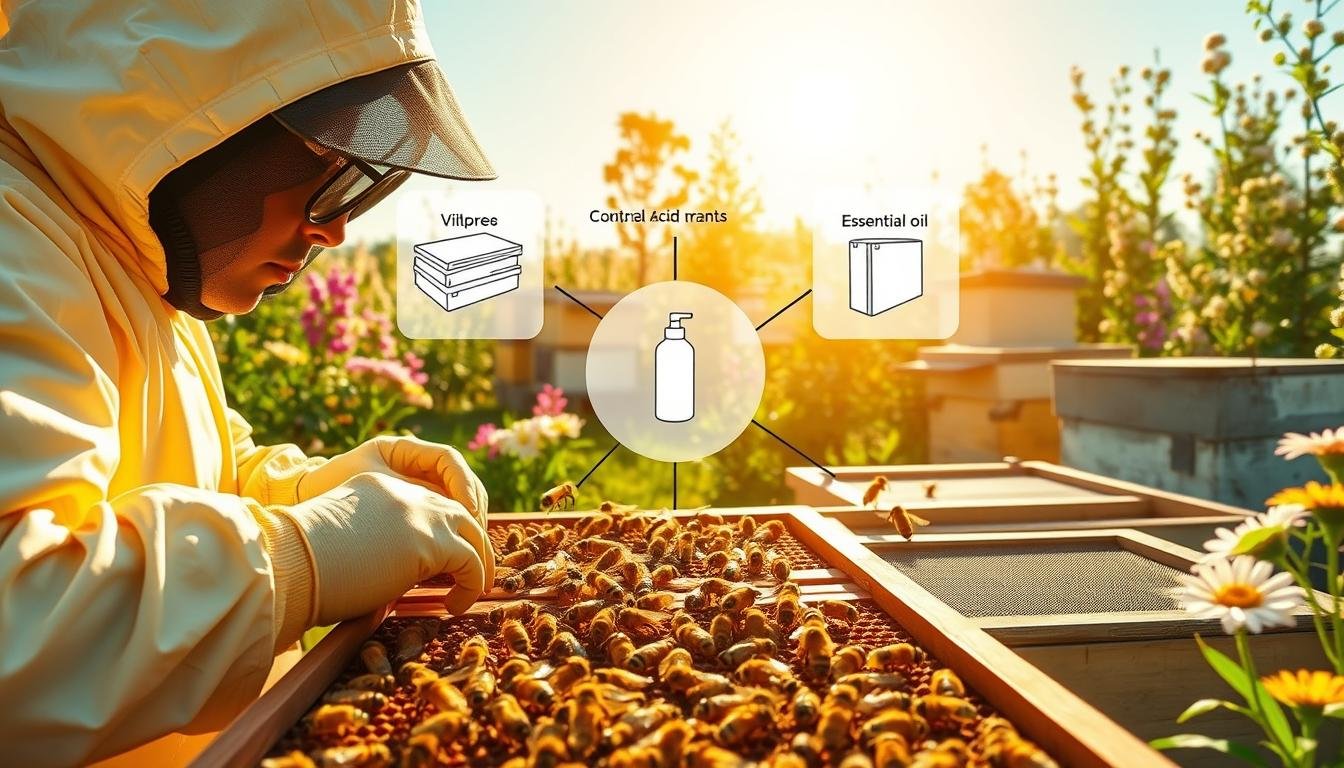
This practical U.S.-focused guide gives beekeepers a clear, seasonal framework to identify, monitor, and manage varroa mites in honey bee colonies.
Fast facts: these parasites jumped from Apis cerana to Apis mellifera in the late 1980s and first appeared in the Southeast in 1990. They remain the single greatest threat to hive health and have reduced many feral and managed stocks.
This article consolidates Integrated Pest Management into a step-by-step plan that fits American labels, seasonal cycles, and common products. You will learn how cultural, mechanical, soft chemical, and hard chemical approaches interlock across the year.
We stress monitoring first and treating only when thresholds justify action. That approach helps reduce resistance, protect colony strength, and keep honey quality high. For seasonal tasks and timing, see a concise calendar and checklist at seasonal beekeeping tasks.
Key Takeaways
- This U.S. guide shows a data-driven IPM plan for healthy bees.
- Monitor regularly; treat selectively to protect colonies and honey.
- Combine cultural, mechanical, soft, and hard approaches in rotation.
- Timing around brood cycles and honey flow is essential.
- Follow labels to reduce resistance and ensure safe management.
Understanding varroa mites today: biology, impacts, and why timing matters
Where and when parasites hide in a hive determines risk and shapes practical action. Most live under brood cappings, so knowledge of brood cycles is central to any sensible plan. Timing treatments around broodless windows improves outcomes and reduces colony stress.
How they reproduce in worker and drone cells
These parasites enter capped worker and drone cells to reproduce. Drone cells are larger and stay capped about 15 days, compared with ~11 days for worker cells.
That longer period lets mites produce ~2.2–2.6 offspring in drone cells versus ~1.3–1.4 in worker cells. Drone brood therefore acts as a population amplifier and explains why drone trapping can reduce numbers.
Damage to adult bees, brood, and virus spread
Mites feed on hemolymph and fat bodies of larvae, pupae, and adult bees, weakening metabolism and energy reserves. Winter bees suffer most when reserves drop before cold months.
“Viral titers rise with mite loads from spring through fall, and that correlation drives many colony losses.”
Visible signs include deformed wings, shorter lifespans, and poor overwinter survival. Because most mites hide under cappings while brood is present, monitoring adult bees before treating is essential to avoid unnecessary stress.
How to monitor mite populations before you treat
Accurate sampling is the bedrock of any successful IPM plan for honey bee yards. Standardized checks give beekeepers actionable information and reduce unnecessary treatments.
Sugar roll and alcohol wash: sampling adult bees and action thresholds
Choose a method based on accuracy and colony impact. Collect ~200 adult bees from frames with emerging brood for either test.
- Alcohol wash: place bees in a jar with alcohol, shake vigorously ≥30 seconds, pour contents through a mesh and count fallen mites. A common action threshold is ~2 mites per 100 bees.
- Sugar roll: use a mesh-lidded jar and 2–3 tbsp powdered sugar, roll for ~1 minute, sift out mites and return live bees. Expect thresholds around 10 mites per 200 bees.
Sticky boards and screened bottoms for mite drop counts
Set a sticky board under a screened bottom for 24 hours. Use mesh so bees cannot contact the board.
Counts between 60 and 190 over 24 hours often prompt action, depending on colony size. Log each reading to spot trends.
Drone brood inspection: when and how to use it
Find capped drone cells at brood nest edges, uncap, and inspect pupae. If >10% of drones are infested, treat that hive.
Sample at least 20% of hives in large yards and check monthly during growth seasons. Record levels, minimize disruption, and re-check after any treatment.
“Consistent sampling beats guesswork; good data keeps colonies strong.”
Integrated Pest Management (IPM) for varroa: building a year-round plan
Start with data. Regular monitoring sets action thresholds and keeps interventions targeted. Aim to keep populations below ~2 per 100 bees and only escalate when sampling shows persistent pressure.
Rotating approaches to limit resistance and protect hive products
Rotate active ingredients and tactics. Use cultural and mechanical steps first—resistant stock, brood breaks, and drone trapping—then apply soft treatments when needed. Reserve harder chemistries as a last resort to preserve long-term efficacy and reduce residues in wax and honey.
Setting thresholds and scheduling treatments by season
Spring focuses on monitoring plus cultural fixes. Summer requires frequent checks and targeted action if thresholds rise. In fall, treat before winter-bee production to improve overwintering survival. Winter offers broodless windows for safe oxalic applications where legal and practical.
- Verify every intervention with re-testing.
- Coordinate yard-level decisions to lower reinfestation risk.
- Document timing, products, and results to refine the plan annually.
“Monitoring, rotation, and timing make an IPM program both practical and sustainable.”
Cultural approaches that reduce mite reproduction
Practical husbandry can cut reproduction without adding residues. These steps slow population growth and give colonies breathing room before you use stronger options.
Resistant stock and traits to seek
Evaluate genetics first. Russian lines often show slower parasite growth and lower brood infestation.
VSH and hygienic stock remove infested pupae, while so-called “ankle biters” leave damaged mites on sticky boards.
Buy from reputable breeders, choose queens adapted to your region, and track performance over seasons.
Brood breaks: queen caging or temporary removal
Caging the queen (examples include Scalvini-style cages) or removing her for about three weeks interrupts reproduction.
This pushes parasites onto adult bees and increases grooming. Follow a brood break with a screened bottom and, if legal, an oxalic application to target adults.
Time breaks to avoid nectar dearth and to install a young queen ahead of winter buildup.
Small cell comb: evidence and practical use
Smaller cells (~4.9 mm) are hypothesized to shorten post-capping time and limit offspring. Trials show mixed results.
Small cell comb is not harmful, but treat it as a supplemental tactic rather than a standalone fix.
“Combine resistant stock, timed brood breaks, and careful comb choices to slow pressure and reduce reliance on chemicals.”

- Use genetics as a baseline to slow population growth.
- Pair brood interruptions with follow-up treatments for best effect.
- Record outcomes so you can refine strategies each season.
For an evidence-based reference on integrated programs, consult the HBHC varroa management guide.
Mechanical approaches you can deploy in the hive
Practical in-hive tools focus on removing high-value brood and encouraging natural fall. These options reduce population growth without adding residues and fit neatly into an IPM plan.
Drone brood trapping
Insert drone comb at the brood nest edge where workers tend drones. Add a frame or two of foundation cut for drone cells and check every 14–18 days.
Remove frames before drones emerge (drone development ~24 days total). Freeze or discard capped drone comb to remove offspring that develop under larger cells. This leverages the higher reproduction in drone cells (about 2.2–2.6 offspring) versus worker cells.
Screened bottom boards and ventilation
Screened bottoms let naturally fallen parasites exit the hive and reduce re-attachment. They also improve ventilation.
Use them as a supportive step—they lower return rates but rarely suffice alone. Pair screened bottoms with routine monitoring and other mechanical steps.
Powdered sugar dusting
Dusting with powdered sugar stimulates grooming and increases drop onto sticky boards. It helps monitoring and offers modest reduction.
Expect higher labor and brief disturbance. Use sugar as a supplemental tactic, not a sole solution, and combine it with screened bottoms and periodic drone trapping to extend intervals before stronger treatments.
| Approach | When to use | Key steps | Notes |
|---|---|---|---|
| Drone brood trapping | Peak drone rearing (spring–summer) | Insert drone frames at brood edge; inspect every 14–18 days; freeze/remove before emergence | Targets high-reproduction cells; stop when drone production falls |
| Screened bottom board | Year-round | Install screened floor; use sticky board with 1–2 mm mesh under screen for counts | Supportive; improves ventilation and drop rates |
| Powdered sugar dusting | Active season, non-honeyflow | Apply 2–4 tbsp sugar per colony over frames; repeat weekly if used | Labor-intensive; modest efficacy; best as supplement |
Practical setup tips: keep an extra box shim available for placing Apiguard later, and use a fine mesh sticky board (1–2 mm) for reliable drop counts. Coordinate mechanical steps across the yard to reduce reinfestation risk and protect brood viability by timing removals carefully.
For further reading on integrated approaches and evidence, see this recent review of bee health strategies.
Soft chemicals: organic acids, essential oils, and hop beta acids
Choosing the right soft chemical depends on colony status, ambient temperature, and whether supers are on the hive.
Formic acid penetrates cappings and can reach reproducing pests inside cells. Use labeled products like MiteAway Quick Strips in the temperature window specified on the label—roughly 50–85°F for best results. Higher temperatures risk brood loss and queen harm above ~85°F; below ~50°F efficacy drops. Some formic products allow application with supers when the label permits. Always follow label rules for honey flow and application duration (for example, a 7-day strip treatment where allowed).
Acid (vapor or dribble)
Oxalic acid works best during broodless periods. Apply by vaporization or dribble to target adult bees when little brood exists. Repeated use can harm larvae and shorten worker longevity, so limit frequency and follow label dosages. Use broodless timing to maximize effectiveness.
Thymol-based products
Thymol treatments such as Apiguard and ApiLife VAR do not penetrate cappings and rely on colony metabolism and temperature. Typical effective ranges are roughly 60–105°F for Apiguard and 64–95°F for ApiLife VAR. They can reduce brood area in spring and sometimes increase robbing or aggression. Use headspace shims and follow application intervals on the label.
Hop beta acids
HopGuard and similar hop beta acid options are safe for use at many times of year and perform best when brood is limited. They require repeated applications if brood is present and show variable efficacy across yards and climates. Check state regulations before use.
“Match product choice to colony condition, ambient temperature, and honey flow to protect bees and hive products.”
Practical checklist: wear PPE when handling acids and essential oils, monitor post-treatment with a wash or sticky board, and rotate active ingredients seasonally to preserve efficacy and reduce residues in honey and wax.
| Category | When to use | Key limits | Notes |
|---|---|---|---|
| Formic acid (MiteAway) | Spring–fall, during brood or short brood windows | Label temp window ~50–85°F; some labels allow use with supers | Penetrates cappings; risk of brood/queen loss if too hot |
| Acid (oxalic) vapor/dribble | Broodless periods (winter/early spring) | Avoid repeated use; follow dose and method | Best against adults; limited effect if brood present |
| Thymol (Apiguard, ApiLife VAR) | Warm periods, stable temps | Works within 60–105°F (product-dep.) and needs headspace | May provoke robbing; does not reach capped brood |
| Hop beta acids (HopGuard) | Shoulder seasons, low-brood times | Multiple doses needed with brood; state legality varies | Low residue; variable field performance |
Hard chemicals as a last resort: what beekeepers should know
When softer steps fail or timing windows close, licensed hard chemistries can provide a rapid population knockdown. Use them only after documented high readings and when other options are impractical.
Amitraz (Apivar): contact action and stewardship
Amitraz strips work by contact. Typical application is two strips per hive for about 44–56 days while bees move freely to distribute the active. Follow label instructions exactly.
Important cautions: metabolites can persist in wax and may interact with viruses to raise mortality. Resistance has been documented, so monitor post-treatment efficacy and avoid back-to-back reliance on the same active.
Legacy synthetics: residues and resistance risks
Fluvalinate (Apistan) and coumaphos (CheckMite+) once gave strong knockdowns. Over time, pests developed resistance and residues accumulated in comb.
Residues in wax can harm brood, affect queen and drone fertility, and contaminate honey. Many labels restrict use during honey flow and limit application near queen rearing.
“Weight short-term knockdown against long-term hive and product health before choosing a hard treatment.”
- Use hard products only after monitoring shows persistent high levels.
- Dispose of used strips per label; do not cut or alter strips unless the label allows.
- Test after treatment; if targets are not met, switch to a different mode of action.
- Rotate away from the same active to slow resistance development.
- Pair any chemical course with mechanical and cultural follow-up to reduce pressure long-term.
6. varroa mite control methods USA
Good beekeeping pairs clear thresholds with practical actions so interventions happen only when needed.
Monitor and sample
Test first. Use an alcohol wash (~2/100 bees threshold) or a sugar roll (~10/200 bees) for quick decisions.
Sticky boards over 24 hours give another view; 60–190 drops signals concern. Verify after any treatment.
Cultural controls
Choose resistant stock (Russian, VSH) and plan brood breaks of ~3 weeks to push parasites onto adults.
Small cell comb shows mixed results; treat it as a supplemental tactic, not a stand-alone solution.
Mechanical controls
Trap drone brood and remove frames before emergence to remove reproduction hotspots.
Screened bottoms and powdered sugar dusting support natural fall and grooming.
Soft chemical rotation
Rotate formic acid (MiteAway), oxalic during broodless windows, thymol products (Apiguard), and hop beta acids as seasonal tools.
Hard chemicals and timing
Use amitraz (Apivar) only when needed and follow label timing (44–56 days); monitor for resistance.
Treat before winter-bee rearing and avoid applications during honey flow to protect harvest quality. For an integrated reference, see methods to control varroa mites.
Honey flow and production: protecting your crop while treating
Protecting a crop of honey starts with choosing products and timing that respect supers and seasonal blooms.
Read each product label carefully: some formic formulations (for example, labeled Quick Strips) allow use with supers, while older pads or different pads prohibit application during a honey flow. Temperature windows on formic products still apply and affect both efficacy and queen safety.
Which treatments are compatible with supers on the hive
Hop beta acids are often permissible during nectar collection and are less likely to taint honey, but verify current registrations and label language for your state.
Thymol-based products such as Apiguard and ApiLife VAR should not be used with supers installed; they can change honey flavor. Avoid amitraz and legacy synthetics during flows—these require waiting periods before adding supers.
Follow label directions for waiting times after removing strips, trays, or pads. Those intervals protect product quality and meet compliance rules.
- Plan major treatments before or after peak nectar to reduce mid-flow interventions.
- If flows are staggered, split your apiary into cohorts so some hives are treated while others remain on full supers.
- Track super-on and super-off dates alongside treatments for traceability and buyer confidence.
“Protecting honey quality is both a compliance issue and a buyer-trust imperative.”
Finally, heed ambient temperature limits during honey flow. Even labeled treatments can harm brood or the queen if applied outside the recommended temperature range.
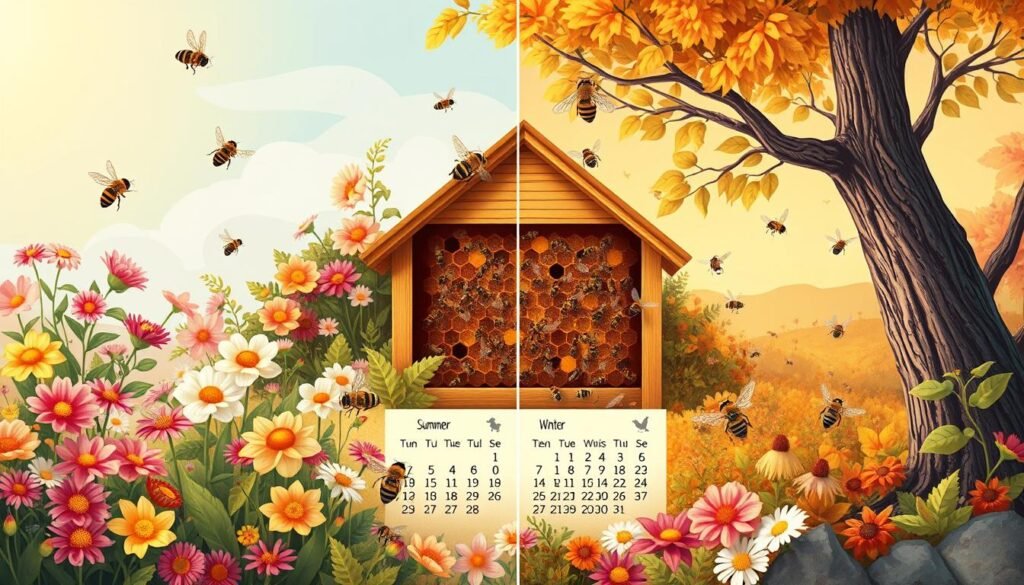
Seasonal calendar: when to act in spring, summer, fall, and winter
Plan your seasonal checks so action aligns with hive biology and local nectar flows. Use a simple quarterly cadence to keep monitoring on schedule throughout the year.
Pre-winter bees: fall focus for better survival
Late summer and fall are the critical time to reduce varroa and mites before winter-bee rearing. A lower load preserves fat bodies and boosts longevity.
Schedule a definitive treatment window of a few weeks as products require, and avoid main flows to protect honey production.
Broodless windows: winter and early-spring opportunities
Use the broodless period to apply oxalic treatments that target phoretic pests with high efficiency. Monthly alcohol wash sampling through growth phases helps spot rapid rises.
- Spring: baseline monitoring plus cultural steps.
- Early summer: increased checks during brood expansion.
- Late summer/fall: key decision point before winter bees form.
- Winter/early spring: broodless period for oxalic application.
“End-of-season reviews refine next year’s calendar and thresholds.”
For a detailed timing tool, consult a practical beekeeping calendar.
Preventing resistance and safeguarding colony health
Protecting chemical tools starts with smart rotation and good record-keeping across seasons. Rotate actives—formic, oxalic, thymol, hop beta acids—and use amitraz sparingly to delay resistance in pest populations.
Repeated use of one active speeds selection for resistant strains. That reduces future treatment options and raises risk to colonies and honey quality.
Integrate non-chemical tactics—drone trapping, brood breaks, screened bottoms—to lower selection pressure and extend the life of treatments.
Verify efficacy after treatment
Always re-sample after a course. If reduction falls short, stop that product class and switch modes of action.
- Record pre-treatment counts.
- Apply labeled treatment per instructions.
- Resample 7–14 days after completion.
- Log outcomes and adjust future plans.
“Post-treatment monitoring prevents prolonged exposure to failing products and protects colony health.”
| Action | Why | When | Notes |
|---|---|---|---|
| Rotate active ingredients | Slow resistance development | Season-to-season | Track per colony and yard |
| Integrate mechanical/cultural steps | Reduce selection pressure | Year-round | Drone trapping, brood breaks, screened floors |
| Post-treatment re-sampling | Verify efficacy | 7–14 days after treatment | Pivot immediately if poor results |
| Coordinate yard management | Lower reinfestation risk | Before major treatments | Align schedules across nearby apiaries |
Stay informed. Consult extension services and current efficacy reports to adapt plans. A data-driven approach preserves tools and strengthens long-term colony outcomes.
Safety, labels, and compliance in the United States
Regulatory labels and safety rules shape every treatment decision for hives and honey production. Read and follow EPA labels: they set application rates, temperature windows, supering rules, and disposal steps. The label is legally binding—misuse risks product contamination and fines.
EPA labels, temperature limits, PPE, and state restrictions
Protect bees and yourself. Typical PPE includes chemical-resistant gloves, eye protection, a respirator for vapors, and full skin coverage for corrosive acids or thymol-based products.
Temperature limits matter. Formic and other labeled windows prevent brood loss and queen harm. Follow the label to preserve efficacy and avoid harming colonies.
- Check state registrations and Section 18 allowances before purchase or application.
- Some products require pesticide applicator licensing—verify local rules.
- Avoid off-label substitutions; they can contaminate honey and wax and carry legal risk.
Best practices: store products locked and upright, transport in ventilated boxes, and dispose of used strips and packaging per label and state guidance. Log product name, lot, dose, dates, ambient temps, and super status for traceability.
“Seek training via extension services or licensing programs and consult state inspectors for up-to-date compliance information.”
These steps give beekeepers clear information to safely use products while protecting bees, hives, and honey quality.
Conclusion
Practical IPM blends routine sampling with low-impact steps before reaching for chemical options. This measure-first mindset helps beekeepers choose the least disruptive way to reduce pressure from varroa and mites while keeping bees strong.
Focus on fall timing to lower loads before winter. Treating ahead of winter-bee production preserves fat stores and boosts overwinter survival. Pair cultural and mechanical approaches with soft options when needed to protect honey and colony health.
Rotate active ingredients, re-test after any course, and follow labels, temperature limits, and PPE guidance. Keep tidy records of counts, dates, and outcomes to refine plans and show compliance for local regulations.
Use the Section 9 checklist as a practical roadmap. With discipline, seasonal timing, and data-driven choices you can reduce varroa impact, protect bees, and sustain long-term production.
FAQ
What are the basics of parasite biology and why does timing matter?
These external parasites reproduce inside brood cells, multiplying faster in drone brood than worker brood. That lifecycle creates peaks in population tied to the colony’s brood cycle and season. Monitoring during peak brood periods and before honey flow helps time interventions so treatments hit both phoretic adults on bees and mites protected under capped brood.
How do these parasites harm adult bees and the brood?
Feeding on developing pupae and adults weakens individuals and transmits viruses such as deformed wing virus. Infested colonies show reduced foraging, shortened lifespan of workers, slowed winter preparation, and higher colony loss without management.
How do I monitor infestation levels before treating?
Use sampling methods: sugar roll or alcohol wash for phoretic adult counts, and sticky boards or screened bottoms to measure natural drop. Compare results to action thresholds and repeat sampling across weeks to track trends before selecting treatments.
What’s the difference between sugar roll and alcohol wash sampling?
Both estimate mites on adult bees. Sugar roll uses powdered sugar to dislodge mites; it leaves bees alive but requires dry conditions. Alcohol wash gives a highly reliable count but kills the sampled bees. Use consistent sample sizes and convert counts to percent infestation to compare against thresholds.
When are sticky boards and bottom boards useful?
Sticky boards placed under screened bottoms give daily mite fall counts without handling bees. They’re useful for trend monitoring, post-treatment checks, and in winter when sampling adults is harder. Interpret counts over several days rather than a single morning.
How and when should I inspect drone brood for infestations?
Drone brood is highly attractive to reproductive females. Insert a drone frame, let brood cap, then remove or freeze the frame to remove many parasites. Inspect mid-to-late summer when drone rearing peaks for best effect.
What is Integrated Pest Management (IPM) for these parasites?
IPM combines monitoring, cultural, mechanical, and chemical tools timed across the year to keep populations below damaging levels while reducing chemical reliance. Key points: set thresholds, rotate active ingredients, and base actions on sampling rather than calendar alone.
How do rotations and scheduling reduce resistance and protect honey?
Rotating actives with different modes of action reduces selection pressure. Schedule treatments outside main honey flow when label allows, follow withholding times for supers, and choose products labeled safe with honey on to avoid contaminated crop.
Which genetic or cultural approaches lower reproduction rates?
Use resistant stock like Russian, VSH, or hygienic lines that remove infested brood. Implement brood breaks by caging or temporarily requeening to interrupt mite reproduction. Evaluate small cell comb critically—research is mixed, so pair with other tactics.
How does a brood break work and when should I use it?
Creating a broodless window—by queen caging, splitting colonies, or requeening—halts mite reproduction because no capped brood is available. Use in late summer or early fall to reduce populations before winter; monitor to confirm success.
What mechanical options can be deployed inside the hive?
Drone brood trapping, screened bottom boards, and powdered sugar dusting are common. Drone trapping removes many reproductive females. Screened bottoms increase natural mite fall. Sugar dusting can dislodge mites but requires repeated labor and is less effective as a sole tactic.
How do drone frames work and how should I handle them?
Add an extra drone foundation or frame in spring/summer to concentrate mites. After drone brood capping, remove and freeze or cut out the comb, then destroy or replace it. Repeat as needed during peak drone rearing to reduce overall population.
What are the soft chemical options and practical cautions?
Soft acids and essential oil products include formic acid (Mite-Away), oxalic acid (vapor or dribble), thymol-based gels (Apiguard, ApiLife VAR), and hop beta acids (HopGuard). Follow label temperature windows, avoid use during heavy honey flow unless allowed, and consider brood presence—some act across brood while others target phoretic mites.
When is formic acid appropriate and what are the limits?
Formic can penetrate capped brood and kill mites in cells; it works well in certain temperature ranges and during periods when supers are absent or label permits. Use caution with high temperatures and ensure proper applicator placement to avoid queen loss or colony stress.
How should oxalic acid be used safely and when is it most effective?
Oxalic acid treatments (vaporization or dribble) are most effective during broodless windows because they act primarily on phoretic mites. Observe label dose, wear PPE, and avoid use with excess brood. In winter or early spring broodless periods, oxalic is a strong option.
Are thymol products effective with honey supers on?
Some thymol preparations are labeled for use with honey supers or have specific withholding times. Thymol works best in warm conditions and can irritate colonies; follow label guidance on placement and timing to avoid reducing foraging or contaminating honey.
What about hop beta acids and variability in results?
Hop beta acids can reduce infestations but show variable efficacy across climates and colony conditions. Use them according to timing recommendations—often when brood is present—and monitor results to verify performance.
When should hard chemicals be used and what are the risks?
Synthetic acaricides like amitraz (Apivar) are effective contact treatments and can be a vital tool when infestations threaten colony survival. Use them as part of a rotation, monitor for resistance, and follow label instructions to minimize residue buildup in comb and honey.
Why avoid repeated use of older synthetics like fluvalinate or coumaphos?
Repeated use of these legacy synthetics has produced resistant populations and left persistent residues in wax and honey. Reserve such products only under guidance, rotate actives, and replace contaminated comb when practical.
What should I consider about honey flow and treatment timing?
Avoid treatments that risk contaminating honey during major nectar flows unless the product label allows supers on. Schedule control measures before or after flow, or choose labeled products compatible with honey production to protect crop quality.
When is the best seasonal timing for treatments?
Key windows include pre-winter treatment to improve overwintering survival and broodless winter/early spring periods for oxalic acid use. Summer interventions target population peaks; late-summer reductions help colonies store healthy bees for fall and winter.
How do I prevent resistance and check that treatments worked?
Rotate active ingredients with different modes of action, avoid repeated single-product use, and confirm efficacy with post-treatment sampling (sticky boards or washes). If a treatment fails, change the active class and reassess colony management practices.
What safety, label, and compliance steps must U.S. beekeepers follow?
Follow EPA-registered label instructions, observe temperature limits and withholding times, wear recommended PPE, and check state regulations. Proper recordkeeping, label adherence, and stewardship preserve efficacy and protect bees, honey, and human health.