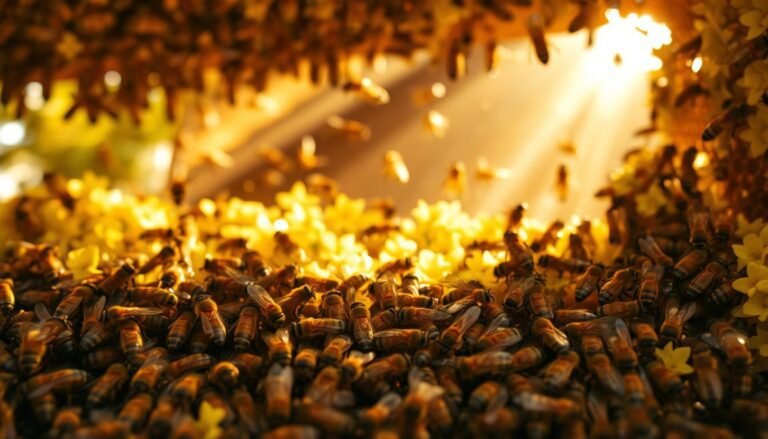
Understand the four main stages that guide how a honey bee develops: egg, larva, pupa, and adult. This short guide shows how each stage supports the hive and why timing matters for colony health.
Timelines shape population and work roles. Queens emerge in about 16 days, workers in 21 days, and drones in 24 days. A single queen lays up to 2,000 eggs per spring day, driving brood expansion and honey production.
The colony acts as a single organism. Tens of thousands of workers handle cleaning, nursing, guarding, and foraging as they age. Knowing these stages helps inspectors read combs, confirm a laying queen, and plan management by tracking days to emergence.
Key Takeaways
- Four stages — egg, larva, pupa, adult — form the core framework for reading a hive.
- Development time differs by caste: queen ~16 days; worker ~21 days; drone ~24 days.
- A single queen and tens of thousands of workers make the colony a coordinated unit.
- Eggs present during inspections confirm a laying queen and an active brood cycle.
- Workers shift roles with age to sustain the hive through seasons and time changes.
- Use stage knowledge to interpret combs, cappings, and overall hive condition.
Table of Contents
- How to Use This Guide
- Egg-to-Adult Timeline at a Glance
- Egg Stage
- Larva Stage
- Pupa Stage
- Adult Emergence
- Queen Bee Development
- Worker Bees
- Drones
- Lifespan by Caste
- Pheromones
- Swarming and Supersedure
- Seasonal Cycle
- Food and Fuel
- Beekeeper’s How-To Checkpoints
- Conclusion
How to Use This Simple Guide to the Honey Bee Life Cycle
Let this short guide steer your inspection steps and timing. It’s designed for practical beekeeping use so you can check brood, food, and behavior with confidence.
Know your terms: a colony refers to the group of bees, while the hive is the wooden structure. Keep that distinction when you log observations.
Use the guide as a step-by-step reference during inspections. Read frames from center outward for brood, then assess stores and comb condition.
- Plan inspection time around development timelines to predict emerging workers and avoid surprises.
- Spotting an egg confirms a laying queen; larval color and cappings show nurse and pupation status.
- Worker job changes by age help you decode hive activity; lots of guard work often signals strong flows or stress.
- Remember forager range: most flights stay within half a mile, though bees can go up to two miles.
For a deeper primer on hive structure and behavior, see this concise guide on the beehive and its inhabitants: inside and out of the beehive.
Egg-to-Adult Timeline at a Glance
A clear timeline helps you read combs and predict brood emergence.
The four stages at a glance: egg, larva, pupa, adult
The sequence is consistent across all castes: egg → larva → pupa → adult. Larvae grow fast, shedding their skin five times before workers seal the cell with porous wax cappings that start pupation.
Key timelines: queens 16 days, workers 21 days, drones 24 days
Memorize these times to schedule checks and anticipate population changes.
- Queens: about 16 days from egg to emergence.
- Worker bees: roughly 21 days to adulthood.
- Drones: close to 24 days before they emerge.
Workers chew through cappings when it’s time to emerge. Minor delays caused by weather or feed can shift these days, and gaps in eggs will ripple through the colony’s future strength.
For a practical timeline overview and tracking tips, see this concise external guide on tracking development tracking the life stages.
Subspecies pace differs: European vs. African honey bees
Development speed also varies by honey bee subspecies, not just by caste. European honey bees (Apis mellifera subspecies common in most U.S. hives) and African honey bees develop on slightly different timelines for every caste:
| Stage | European Honey Bee | African Honey Bee |
|---|---|---|
| Queen | 16 days | 14 days |
| Worker | 21 days | 19–20 days |
| Drone | 24 days | 24 days |
African queens develop about two days faster than European queens, which matters for anyone managing hives where both lineages are present — it affects queen-rearing timing and mating dynamics. (Source: Honey Bee Research Centre)
Egg Stage: How to Spot Eggs and What They Mean for the Hive
Spotting fresh eggs on a frame gives a quick, reliable snapshot of hive health. Eggs are tiny—about 1.7 mm—and sit upright at the bottom of a cell. That vertical stance makes them look like a grain of rice and explains why they can vanish when you view the comb straight on.
Practical viewing tips: light, angle, and comb position
Hold the frame with the sun over your shoulder and tilt it slightly. Focus on the cell base where eggs stand. Center frames usually hold the brood and eggs; food stores sit above or toward the edges.
Worker vs. drone cells and how the queen chooses
- Cell size: smaller worker cells get fertilized eggs; larger drone cells receive unfertilized eggs.
- One per cell: the queen lays a single egg in each spotless, polished cell prepared by workers.
- Read patterns: even egg distribution signals a productive queen; scattered eggs may warn of trouble.
- Timing: eggs hatch into larvae at about day three—schedule a follow-up to confirm larval feeding and brood health.
For deeper reference on beekeeping resources and practices, see this beekeeper’s resources guide.
Larva Stage: Feeding, Growth, and the Role of Nurse Bees
After hatching, tiny white larvae demand near‑constant feeding from dedicated nurses. Eggs hatch at about three days, revealing curved, snowy white larvae that grow fast and shed skin multiple times.
Nurse bees feed all young larvae royal jelly for the first three days. Only queen-destined larvae receive royal jelly beyond day three. Worker and drone larvae switch to worker jelly and bee bread, a mix of pollen, honey, and glandular secretions.

Practical checks and signs
- Healthy larvae: snowy white, glistening with food, curved in cells.
- Feeding protocol: universal royal jelly early, then transition for workers and drones.
- Growth pace: larvae can expand over 1,500× in five days before capping.
| Stage | Feed | Timing | Indicator |
|---|---|---|---|
| Days 0–3 | Royal jelly | Hatch to early larva | Snowy white, active nursing |
| Days 4–6 | Worker jelly / bee bread | Rapid growth | Glistening, full size before capping |
| Pre‑capping | Less visible feeding | ~Day 6 | Porous tan capping soon |
Watch nurse activity and check pollen and honey stores to ensure larvae fed properly. Strong nursing and ample food lead to healthier adult bees and a resilient workforce.
Pupa Stage: Metamorphosis Under Wax Cappings
When workers seal cells with porous cappings, the pupa stage begins under protective wax. Tiny larvae have already spun silk cocoons and now remodel inside the comb.
Inside the sealed cell, eyes, legs, wings, and internal organs form. Eye color shifts from pink to purple to black — a handy sign of progress before the adult chews out its cap.
“Tan, slightly domed cappings mean metamorphosis is underway beneath the wax.”
- Recognize the stage: tan, porous cappings over intact cells signal pupal development.
- Pupae spin silk cocoons that help shape the developing body and protect forming wings.
- Strong beeswax comb and solid cells guard pupae from chilling and pests; disturbances can set back emergence by several days.
- Uniform cappings predict a steady workforce that will convert nectar into honey and maintain hive tasks.
For a clear timeline and inspection tips on pupal health, see our guide to queen cell development, day by day. For the temperature, nutrition, and disease factors that can derail brood at any of these stages, see our guide to honeybee brood development.
Adult Emergence: From Capped Cell to First Cleaning Job
New adults emerge by chewing through wax cappings and begin work at once. The first task is sanitation: each new bee cleans the cell it left to make room for the next egg.
Timing matters: workers spend roughly 12 days as pupae and about 21 days from egg to free adult. Track emergence to forecast hive strength and plan inspections.
Early roles build capability. After cleaning, new workers move quickly to nursing and comb tasks. Their wings are fresh and they gain flight strength on in‑hive duties before foraging.
- Expect new adults to chew out of caps and immediately clean their birth cell.
- Use emergence timing to predict workforce numbers; day counts help schedule follow-ups.
- Inspect gently near emerging areas to avoid harming soft-bodied new bees.
- Consistent, contiguous patches of emerging brood indicate a productive queen and steady pipeline.
Practical note: summer workers live about 5–6 weeks, so a steady flow of new bees keeps brood care, comb building, and nectar work running at full speed.
Queen Bee: Development, Mating Flights, and Egg-Laying Power
The queen’s development and early flights determine a hive’s genetic mix and long-term strength.
Raised differently from workers, a future queen grows fast and larger. Workers build special, larger queen cells and feed the larva extra royal jelly beyond day three. This extended diet produces a bigger body and the reproductive glands she needs.
How mating happens and what she stores
About a week after emergence, the queen makes several mating flights to drone congregation areas. Each flight lasts 5–30 minutes and may reach roughly 100 feet high.
- She typically mates with 10–20 drones to boost genetic diversity.
- Sperm is stored in a spermatheca and can last for years, supplying fertilized eggs on demand.
Egg-laying pace and pheromonal control
A mated queen can lay up to 2,000 eggs per day in peak spring. Her pheromone blend, spread by contact and tarsal gland traces, organizes worker tasks and suppresses worker ovary development.
“The queen signal keeps the colony coordinated and reduces rival egg-laying.”
| Feature | Timing | Sign to Inspect |
|---|---|---|
| Queen cell & feeding | Larval days 0–6 | Large cell, royal jelly visible |
| Mating flights | ~7–10 days after emergence | Temporary queen absence; drone activity |
| Peak laying | After mating, spring peak | Tight brood pattern; many eggs |
Use egg-laying patterns to assess queen quality. For more on timing and stages, see how caste is determined in larvae.
Worker Bees: Age-Based Jobs From Nurse to Forager
Workers move through distinct job phases that keep brood fed, comb built, and honey stored.
Days 0-3: Clean the cell and prepare brood comb
New worker bees start by cleaning their birth cell and polishing comb. This work makes a safe spot for the next egg and keeps the hive sanitary.
Days 4-12: Nurse bees feeding larvae and tending the queen
Nurse activity peaks now. Nurse bees feed larvae royal jelly at first, then switch to worker jelly. Heavy feeding and steady brood warming show a strong nurse population.
Days 12-20: Wax glands, comb building, nectar curing, and guarding
Glands produce wax used for comb construction and capping. Workers also handle nectar, add enzymes, and fan to evaporate moisture until honey is ripe. Guards watch the entrance to stop robbing and pests.
Day 20+: Foraging for nectar, pollen, water, and propolis
By about day 20 most workers leave to collect nectar, pollen, water, and resins for propolis. Foragers can fly up to two miles and may wear out wings after roughly 500 miles of flight.
- Quick diagnostic: few nurses with many eggs predicts underfed larvae.
- Watch traffic: rising pollen loads signal a mature workforce collecting food.
Drones: Male Honey Bees, Eyes on the Sky
Male workers have one clear job — mate with virgin queens from other colonies.
Unfertilized eggs, large eyes, and mating flights
Drones develop from unfertilized eggs placed in larger cells. Their bodies are bulkier and their compound eyes are large to spot queens during fast aerial chases.
Flight behavior matters. Drones gather at shared drone congregation areas where they search for a passing queen. Successful mating is fatal for the drone; the reproductive organ detaches and the male dies immediately.
- Identify drone brood: larger cells and rounder adult bodies with big eyes.
- Drones exist mainly to mate, boosting genetic diversity across hives.
- Watch seasonality: colonies rear many drones in spring and cull them in fall to save stores.
- Eviction before winter is common; workers push out non‑productive mouths when resources dwindle.
- Too many drones can signal swarming prep or plenty of food; drone‑only brood in worker cells suggests a queenless problem.
“Drones contribute genes, not in‑hive labor; count them, but weigh them accordingly.”
Lifespan by Caste: How Long Each Bee Actually Lives
Development time and lifespan are two different clocks. The timelines above cover egg-to-adult development; once a bee emerges, how long it survives depends heavily on caste, season, and workload.
- Workers: about 4–6 weeks during the active summer season, when foraging and brood-rearing wear them out fast — but workers reared in late fall (“winter bees”) live 4–6 months, since they skip heavy foraging and cluster instead.
- Drones: roughly 4–8 weeks. A drone that succeeds in mating dies immediately after; one that never mates is typically evicted by workers heading into fall, once he stops being worth feeding.
- Queens: commonly 2–5 years, occasionally longer under good management — by far the longest-lived caste, since she is spared foraging and defense duties entirely.
Because lifespan swings so much by season and caste, a hive’s population is never static: expect rapid worker turnover in summer and a much slower-aging, longer-lived cluster over winter.
Pheromones: The Invisible Signals That Organize the Colony
Invisible chemical cues steer nearly every choice inside a hive. These scents let a queen, brood, and worker group coordinate without words.
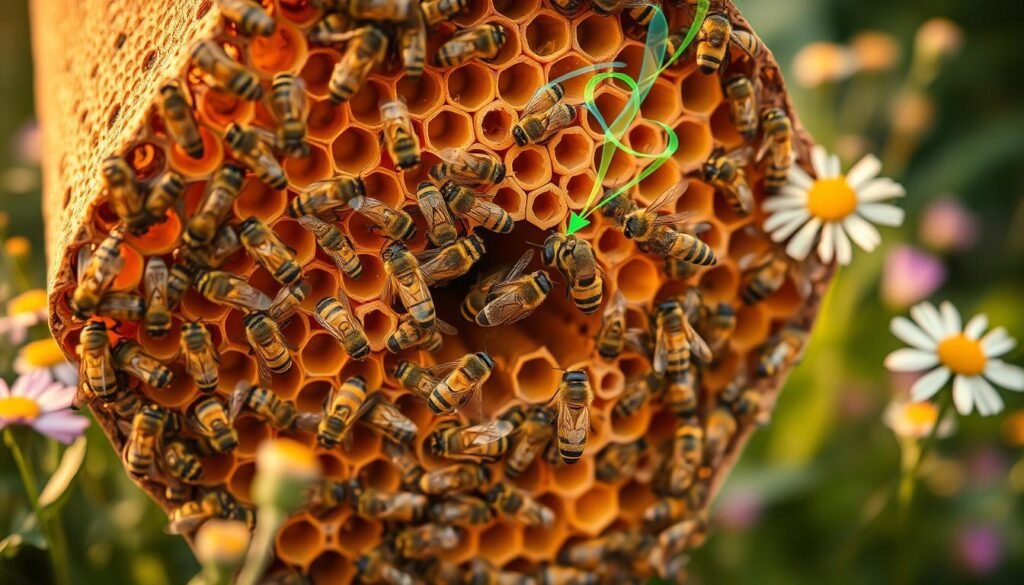
Queen signal: primer effects on worker behavior and brood
The queen’s blend of primer pheromones stabilizes social order. It reduces queen cell construction and blocks worker ovary development.
When that scent fades, workers may begin emergency queen rearing or supersedure in short order.
Worker alarm, orientation, and recruitment pheromones
Workers release releaser pheromones for urgent tasks. Alarm pheromone at a sting warns guards and can escalate defense quickly.
Orientation pheromone at the entrance helps returning foragers find home. Recruitment pheromones mark rich nectar or water so more workers respond fast.
“Pheromone signals keep thousands of bees moving together as one, adjusting to need and season.”
- Brood pheromones promote nursing and suppress worker laying.
- Manage stings and strong scents; they may trigger sustained alarm.
- Read clustering, fanning, and bearding as pheromone-driven clues when you inspect.
| Signal | Source | Effect |
|---|---|---|
| Queen signal | Queen gland blend | Suppresses worker laying; stabilizes brood pattern |
| Alarm pheromone | Sting/guard bees | Alerts guards; raises colony defensiveness |
| Recruitment scent | Foragers/workers | Directs workers to resources quickly |
Swarming and Supersedure: How Colonies Multiply or Replace a Queen
A crowded spring hive often shows the first signs of swarm preparation long before bees depart.
Swarming is the colony’s natural way to multiply. The old queen leaves with up to two-thirds of the workers, and remaining bees build large queen cells along frame edges. Workers feed selected larvae royal jelly to raise new queens.
Queen cups, piping, and birthright battles
Spotting queen cups at comb margins is an early warning. If cups become full-sized cells, the hive is likely preparing to swarm.
Piping is the high, thin sound a newly emerged queen makes. It often comes before she leaves cells or seeks rivals. The first queen out usually tries to kill sisters still in their cells to avoid conflict.
- Distinguish swarming vs supersedure: swarming multiplies; supersedure replaces a failing queen.
- Workers may secretly extend a worker cell and feed royal jelly when pheromone strength drops.
- Emergency supersedure only works if larvae are under three days old; act fast if you need to save the brood.
- Manage space—add supers or split colonies during buildup to reduce swarming triggers.
“Read wax work and queen cell placement to decide whether you’re seeing swarm prep or a quiet supersedure.”
Knowing these signs helps you choose the right way to intervene and keep your hive productive through the season.
Seasonal Cycle: What Changes From Spring to Winter
As the seasons turn, a colony’s priorities shift from growth to storage to survival. Spring brings rapid brood production when queens may lay up to 2,000 eggs per day. Strong nectar and pollen flows support fast expansion and new drones.
Spring build-up: brood explosion and new drones
Plan for expansion. Expect heavy brood, rising worker numbers, and many drones while forage is abundant.
Summer peak: heavy foraging and honey production
Early to mid-summer delivers peak nectar and pollen. Foraging surges and honey processing fill supers. Late summer flows drop and brood slows.
Fall prep: evicting drones and rationing brood
Workers evict drones and cut brood to save food. The colony shifts focus to making winter bees with longer lifespans and storing honey.
Winter cluster: heat, honey consumption, and survival
Bees cluster to keep the center near about 90°F and consume honey as fuel. Monitor stores and ventilation; below ~57°F bees can become immobile even with nearby honey.
| Season | Main Focus | Key Signs |
|---|---|---|
| Spring | Brood expansion | High egg counts; pollen incoming |
| Summer | Forage & honey | Heavy flight; full supers |
| Fall | Conservation | Drone eviction; reduced brood |
| Winter | Survival | Cluster heat; honey consumption |
Food and Fuel: Nectar, Pollen, Honey, and Bee Bread
Forager bees deliver crop loads that house workers convert into stable food stores. This team effort turns fresh nectar and pollen into energy and protein the colony can use through seasons.
How nectar becomes honey and why moisture matters
Foragers store nectar in a nectar sac that can reach about 90% of their body weight. They pass that load to house bees for enzymatic processing and evaporation.
Workers add enzymes from glands and fan the comb to reduce moisture. Honey is considered ripe when moisture is about 19% or less, then workers seal cells with wax cappings to prevent fermentation.
“Proper curing and capping keep honey stable for months or years of storage.”
- Follow nectar’s path: collected in the nectar sac, passed to house bees, enzymatically transformed, and evaporated into ripe honey.
- Target moisture: ripe honey is reduced to roughly 19% moisture or lower before capping.
- Understand capping: workers seal cured honey with wax in comb cells for long-term storage.
- Track pollen handling: foragers pelletize pollen, workers pack pellets into cells, and microbes plus fermentation create protein-rich bee bread used for brood feeding.
- Balance the pantry: honey fuels flight and hive heat; bee bread supplies protein for brood—both should sit near brood areas.
| Food | Source | Processed by | Storage form |
|---|---|---|---|
| Nectar | Foragers (nectar sac) | House workers (glands & fanning) | Honey (capped at ≤19% moisture) |
| Pollen | Foragers (pelleted) | Workers (packed & microbe activity) | Bee bread (cells near brood) |
| Royal jelly | Nurse glands | Nurse workers | Fed fresh to young larvae in cells |
Watch comb condition as a storage map: full, even cappings show good curing. Thin nectar flows or low pollen returns call for careful management or supplemental food.
For a concise reference on bee biology and brood needs, consult this bee biology primer.
Beekeeper’s How-To Checkpoints by Stage
A concise checklist helps a beekeeper turn observations into clear actions at every brood stage. Use these checkpoints during a routine inspection to confirm queen activity, larval feeding, and timing to emergence.
Egg check: confirming a laying queen and brood pattern
Look for upright, rice-like eggs in polished cells. Eggs present within three days confirm a laying queen.
Brood pattern matters. A tight, even patch suggests a strong queen; scattered or shotgun patches need follow-up.
Larval health: snowy-white larvae and proper feeding
Healthy larvae are snowy white and glistening with food. Check for active nurse workers and visible royal jelly on young larvae.
Poor “larvae fed” signs mean consider feeding, queen evaluation, or closer disease checks.
Cappings and timing: tracking days to emergence
Note porous, tan cappings over brood. Track expected days to emergence: 16 for queens, 21 for workers, 24 for drones.
Record the day you see capping to schedule follow-up inspections and avoid harming soft adults.
Reading pheromone clues: behavior shifts and queen quality
Watch worker behavior for pheromone-driven changes. Reduced queen scent may prompt workers to build queen cells for supersedure.
Act fast if you see new queen cells or sudden shifts in guard and nurse activity.
- Storage checks: confirm honey curing near 19% moisture and that pollen/bee bread surround brood.
- Cell diagnostics: many drone cells in worker areas can indicate queen trouble or laying workers.
- Action plan: add supers, equalize brood, or feed; document date, stage, and timing for follow-ups.
Conclusion
Translate what you see on a frame into timely action for better outcomes. Read eggs, larvae, and cappings as signals and connect those observations to season and days ahead.
Keep queens central in your notes: their pheromones and laying rates set the colony’s pace and predict workforce size. Track stage timing to plan splits, prevent swarms, and protect brood.
Mind food stores and honey curing. Foragers bring nectar and pollen that become bee bread and capped honey. Regular notes, clear timelines, and stage checks make hive management responsive and effective season after season.
FAQ
What are the four main stages of the honey bee development?
The brood progresses through egg, larva, pupa, and adult stages. Each stage has distinct needs: eggs are tiny and anchored in cells, larvae are fed by nurse bees, pupae metamorphose under wax cappings, and adults take on colony jobs from cleaning to foraging.
How long does it take for a queen, worker, and drone to develop?
Queens typically emerge around day 16, workers about day 21, and drones near day 24. These timelines reflect different feeding regimens and cell sizes that speed or slow development.
How can I spot eggs in the comb during an inspection?
Look closely at cell bottoms with a good angle and light. Eggs appear as tiny white rice-grain shapes standing upright. Worker brood is in regular cells; drone brood sits in larger cells.
How does a queen decide between laying worker or drone eggs?
The queen lays fertilized eggs in normal worker-sized cells to produce workers. She lays unfertilized eggs in larger drone cells; the cell size and stored sperm together determine caste.
What do nurse bees feed larvae and how does diet affect caste?
Nurse bees provide brood food made from glands and pollen called bee bread. All larvae receive royal jelly initially; those destined to be queens get extended royal jelly feeding in larger queen cells, which triggers queen development.
What happens during the pupa stage under capped cells?
Inside capped cells, the larva spins a cocoon and transforms its body—wings, legs, eyes, and organs form. This protected metamorphosis lasts until the adult chews its way out at the scheduled day for its caste.
What tasks does a newly emerged adult worker perform first?
Young adults clean and polish cells, feed brood, and tend the queen. As they age they develop wax glands, build comb, guard the hive, and eventually forage outside for nectar, pollen, water, and propolis.
How are queen cells different from worker cells?
Queen cells are larger, peanut-shaped structures hanging vertically from comb and receive continuous royal jelly. They are purpose-built to raise a reproductive female and are fed longer than worker cells.
What are mating flights and why are they important for queens?
Virgin queens take mating flights to drone congregation areas where they mate with multiple drones. Sperm is stored in her spermatheca for life, enabling sustained egg-laying and colony continuity.
How do pheromones influence colony behavior?
Pheromones act as chemical signals: the queen’s primer pheromones regulate worker physiology and brood rearing, alarm pheromones mobilize defense, and recruitment scents guide foragers to food sources.
What triggers swarming or supersedure in a hive?
High population, overcrowding, poor queen pheromone signal, or seasonal cues can trigger swarming. Supersedure occurs when workers raise replacement queens due to declining queen performance or injury.
How does the colony shift between seasons?
Spring brings brood expansion and drone production. Summer is peak nectar flow and honey storage. Fall sees drone eviction and reduced brood; winter involves clustering for warmth and consuming stored honey.
What’s the difference between nectar, pollen, honey, and bee bread?
Nectar is a sugary liquid collected from flowers and cured into honey. Pollen supplies protein and becomes bee bread after mixing with enzymes and fermentation. Honey supplies carbs for energy and winter survival.
What should be checked at each brood stage during an inspection?
For eggs, confirm a laying queen and consistent pattern. For larvae, watch for plump, snowy-white bodies and adequate food. For capped brood, note capping texture and timing to predict emergence dates.
How do workers’ roles change by age?
From day 0–3 they clean and prepare comb. Days 4–12 they act as nurse bees feeding larvae and tending the queen. Days 12–20 involve comb building, wax production, and guarding. After day 20 they typically forage.
What distinguishes drones from workers physically and functionally?
Drones are larger with big eyes and no stinger. They develop from unfertilized eggs and exist mainly to mate with queens. Colonies produce drones seasonally and may evict them before winter to conserve resources.