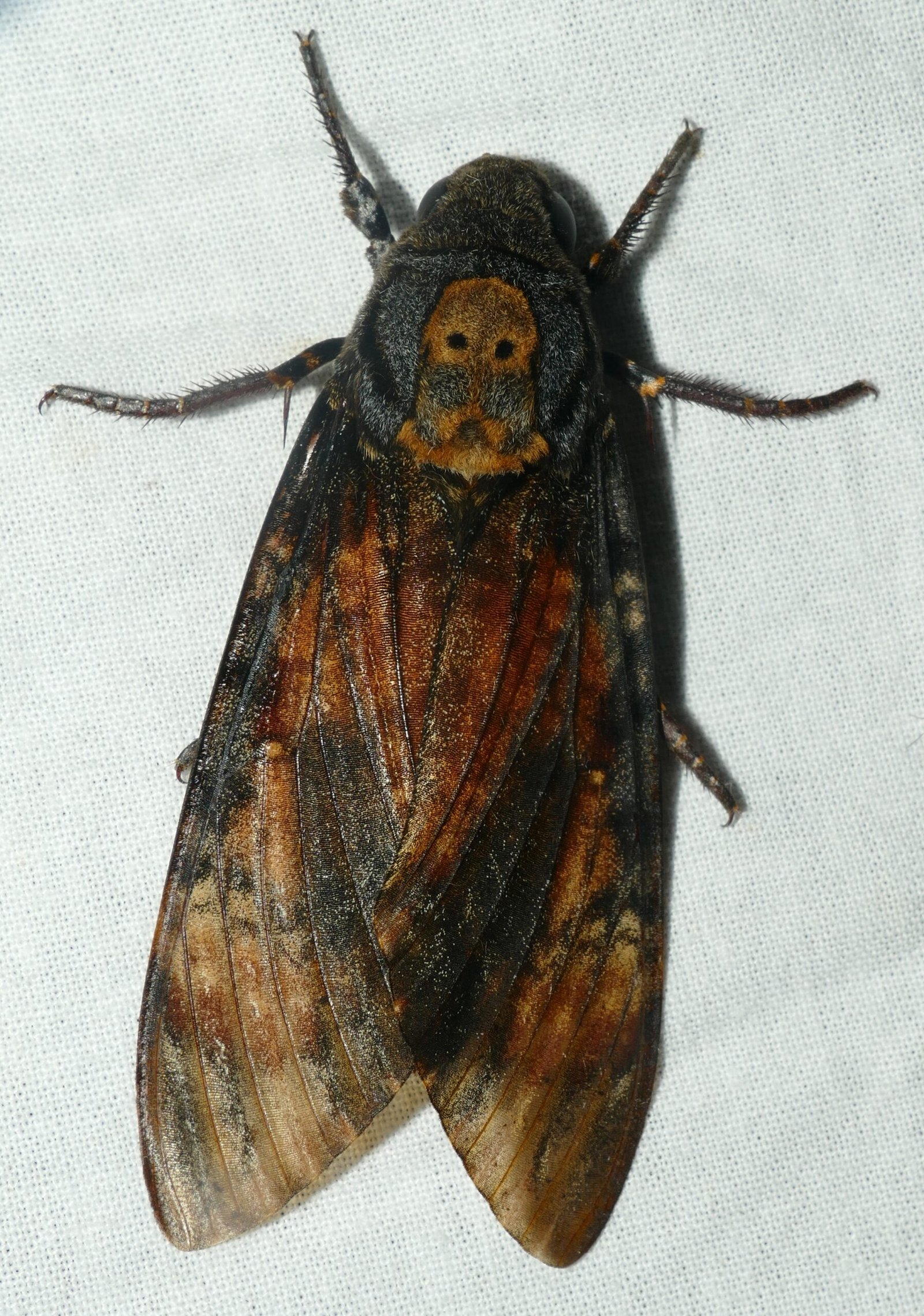
The death’s-head hawkmoth (Acherontia atropos) is a large Old World moth that sneaks into honeybee colonies at night, chemically disguises itself as a bee, and drinks honey straight from the comb — one of the only insects on Earth known to rob a beehive from the inside without ever being stung to death for it. Named for the pale, skull-shaped marking on its thorax, the moth has fed a lot of folklore over the centuries, but its real biology — a rare case of an insect fooling a honeybee colony’s entire chemical alarm system — is stranger and better documented than the myths around it.
Key Takeaways
- Acherontia atropos is the only moth confirmed to regularly enter and feed inside live honeybee (Apis mellifera) colonies, drinking honey and nectar directly from open cells.
- It avoids attack by chemically mimicking the cuticular hydrocarbons — the “scent signature” — of the bees themselves, so guard bees largely fail to recognize it as an intruder.
- A thick, tough cuticle gives it real backup protection: even a bee sting often can’t penetrate deeply enough to be fatal.
- The moth’s famous squeak, made by forcing air through its proboscis, was long thought to mimic a queen’s piping to pacify the colony; researchers have since found the moth actually goes quiet for hours after it feeds, which complicates that theory.
- Despite the drama, it’s a minor, occasional nuisance for beekeepers in its native range (Europe, Africa, and parts of the Middle East and South Asia) — not a significant economic pest like the small hive beetle or wax moth.
Table of Contents
- What the Death’s-Head Hawkmoth Actually Is
- How It Gets Past the Guard Bees
- The Skull, the Squeak, and the Myths
- How It Compares to Other Hive Intruders
- Should Beekeepers Actually Worry?
- Frequently Asked Questions
What the Death’s-Head Hawkmoth Actually Is
Acherontia atropos is one of three species in the genus Acherontia, all commonly called death’s-head hawkmoths for the skull-like pattern on the back of the thorax. It’s a genuinely large moth — wingspans commonly reach 9 to 13 centimeters — found across Europe, Africa, the Middle East, and into parts of southern Asia, though it doesn’t overwinter well in colder climates and is a seasonal migrant across much of its European range rather than a permanent resident.
Unlike most adult moths, which sip nectar through a long, thin proboscis, A. atropos has a short, unusually strong proboscis built for a different job: piercing straight into a beehive’s stored honeycomb and drawing honey directly from the cells, alongside feeding on damaged fruit and tree sap when honey isn’t available. Documented cases of the moth entering live colonies specifically to feed have been recorded across its range for well over a century, and it remains the clearest known example of a moth living, at least temporarily, as an uninvited guest inside a functioning honeybee nest.
How It Gets Past the Guard Bees
A honeybee colony defends its entrance aggressively, and an animal the size of this moth walking in past a wall of guard bees should, by every normal rule of hive defense, get stung to death almost immediately. It mostly doesn’t, for two compounding reasons.
The first is chemical camouflage. Guard bees identify nestmates largely by cuticular hydrocarbons — waxy compounds on the exoskeleton that function as a colony-specific scent badge. Research on A. atropos has found that the moth’s own cuticular profile closely resembles that of the honeybees it targets, letting it move through the hive largely unrecognized as a foreign body rather than triggering the mass-stinging response an obvious intruder would provoke.
The second is armor. The moth’s cuticle is notably thick and tough for an insect its size, and even when a guard bee does manage to sting it, the sting frequently fails to penetrate deeply enough to be lethal. Between the disguise and the built-in protection, the moth doesn’t need to avoid every sting — it only needs to survive the ones it can’t dodge.
The Skull, the Squeak, and the Myths
Two features of this moth have made it a fixture of folklore for centuries: the skull pattern on its thorax, and a loud, repeated squeaking sound it makes when disturbed, produced by forcing air out through its proboscis rather than through any vocal structure. In much of 18th- and 19th-century Europe, both were treated as omens of death or misfortune — the same superstition that later made the moth an obvious choice for the poster art of The Silence of the Lambs, whose fictional killer used it as a signature rather than any real entomological detail about the species.
The natural-history explanation for the squeak has shifted with the evidence. For years, the leading theory was that the sound mimics the piping calls a queen bee makes inside the hive, and that this queen-like signal helps pacify nearby workers. More recent behavioral observations complicate a simple version of that story: researchers have found that after the moth has fed on honey, it typically stops squeaking for several hours, which is the opposite of when a fresh, unfamiliar intruder would most need to bluff its way past a defensive colony. The squeak clearly matters to the moth’s survival inside a hive, but exactly how and when it helps is still an open question rather than a settled one.
How It Compares to Other Hive Intruders
Beekeepers already watch their hives for several other uninvited residents. Here’s how the death’s-head hawkmoth’s approach stacks up against the more familiar ones:
| Intruder | What it’s after | How it gets in | Typical threat level |
|---|---|---|---|
| Death’s-head hawkmoth | Honey, directly from comb | Chemical mimicry of colony scent, at night | Low; occasional and localized |
| Greater wax moth | Wax, pollen, and debris in comb | Slips into weak or unguarded colonies to lay eggs | Moderate to high in weak hives |
| Small hive beetle | Honey, pollen, and brood | Walks in past bees; hides in cracks between raids | High in warm, humid climates |
| Robber bees (from other colonies) | Honey stores | Exploits a weak or open entrance | High if unchecked; can collapse a weak colony |
The comparison points at the moth’s real distinguishing feature: everything else on this list either overwhelms a colony’s defenses through weight of numbers or targets colonies already too weak to fight back. The hawkmoth is the only one that gets away with walking in essentially uncontested, by tricking the colony’s own recognition system rather than beating it.
Should Beekeepers Actually Worry?
For most beekeepers, no — and that’s worth saying plainly, because the moth’s dramatic reputation outruns its practical impact. It isn’t classified as a significant agricultural or apicultural pest anywhere in its range, and reported hive visits are sporadic rather than a recurring seasonal problem the way wax moths or small hive beetles are. A single moth typically feeds and moves on rather than establishing any lasting presence in the colony.
Where it is documented most often — parts of southern Europe, sub-Saharan Africa, and South Asia, including a 2025 record of the moth robbing honey from managed hives in Punjab, Pakistan — beekeepers generally treat it the same way they’d treat any occasional nighttime intruder: a properly fitted entrance reducer on a strong, well-populated colony is the same practical defense that works against wax moths and small hive beetles, since it simply gives the moth less unguarded space to slip through. Beyond that, no specialized control measure exists or is considered necessary for a visitor this infrequent.
Frequently Asked Questions
Is the death’s-head hawkmoth found in the United States?
No. Acherontia atropos is native to Europe, Africa, the Middle East, and parts of South Asia. It is not established in North America.
Does the moth kill honeybee colonies?
No. It feeds opportunistically on stored honey during brief visits and doesn’t attack brood or workers, so it isn’t considered a colony-destroying pest the way small hive beetles or wax moths can be in a weakened hive.
Can the moth actually sting or bite people?
No. It has no stinger and doesn’t bite; its only real weapon is the reinforced proboscis it uses to pierce fruit skin and honeycomb.
Why is the skull marking there — is it a real skull?
It’s a natural pattern of pale and dark scales on the thorax that happens to resemble a human skull closely enough to have inspired centuries of superstition, not an actual bone structure.
Do bees ever succeed in killing it?
Sometimes. Its chemical camouflage and thick cuticle improve its odds considerably, but they aren’t a guarantee — a colony that does recognize the moth as a threat can still sting it enough times to kill it.