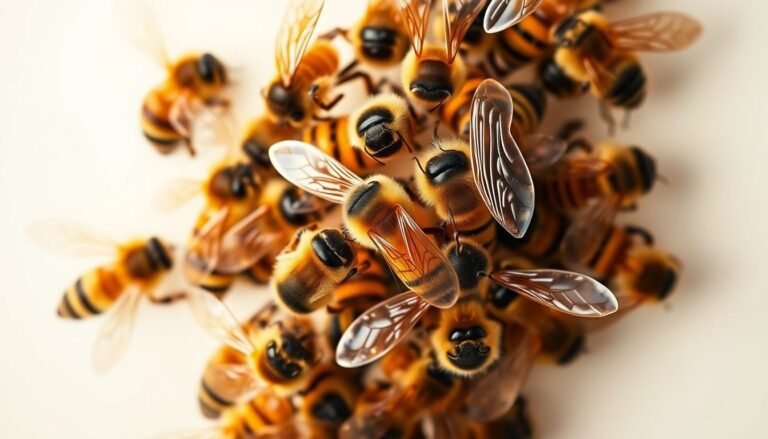
Honey bees transform from separate individuals into a true superorganism when cold weather arrives. The group forms a compact cluster that adjusts porosity and density to hold a warm core without any central control.
The outer mantle of bees densifies as ambient temperature falls and loosens as it rises. This layered arrangement traps air and uses countercurrent exchange so the core stays near 94–95°F during brood care and about 80°F when broodless. A 12-frame, roughly 6 lb cluster uses about 25 watts at 32°F, with peak efficiency near 40°F.
Individual insects reach chill coma near 5.5°C and tissues freeze below −2°C, yet the group keeps the outer surface above safe limits. The cluster also expands to shed excess heat or contracts to conserve it, responding to weather and seasonal change.
For US beekeepers, minimal disturbance, proper hive insulation and attention above the crownboard help support this adaptive system. For more on regional hive care, see beekeeping in different climates.
Key Takeaways
- Bees form a coordinated cluster that maintains heat without a leader.
- The mantle-core structure traps air and preserves a warm core for mobility.
- Energy use is low: ~25 W for a 12-frame cluster at freezing.
- Single individuals freeze much sooner than a group does.
- Cluster size and area shift to match ambient temperature and weather.
Scope, definitions, and why thermoregulation in winter clusters matters today
Across broad U.S. ranges, colonies rely on group-level heat control once flight ceases. Thermoregulation here means the colony’s ability to hold a warm core by forming a compact cluster that adjusts packing and porosity across varying temperature conditions.
We distinguish three scales: ambient temperature (air around the hive), hive-level temperatures (zones inside the box), and individual body temperature of bees. Each term will be used consistently in later sections.
This matters now because extreme swings in weather and regional environment differences across the United States raise the risk to colonies during low-foraging periods. When foraging stops at low temperatures, a colony must rely on honey stores and internal heat to survive.
The operational state in cold months is often broodless or low-brood, shifting toward brood rearing as conditions improve. Individual bees lose neuronal function below ~18°C, so the group compensates by generating collective heat and changing cluster size.
- Scope: This review explains mechanisms, temperature ranges, and responses that matter to beekeepers and researchers.
- Driver: Ambient temperature controls expansion, contraction, and energy use of the cluster.
From individuals to a superorganism: how colonies generate and conserve heat
Isometric flight muscle heating
Individual bees raise thoracic temperature by isometric flexing of flight muscles. This activity can push a bee’s thorax into the ~27–35°C range needed for flight and normal function.
Below about 18°C, neuronal signals drop and a bee cannot activate muscle heating. That threshold makes group-level warmth essential to keep each bee operable.
Surface area, size, and collective insulation
By forming a compact cluster, honey bees reduce exposed surface area relative to volume. The result is less conductive and convective heat loss to the hive and ambient air.
Heat produced by many small heaters accumulates in the nest space as the insulating mantle limits leakage. A 12-frame cluster needs ~25 W at 32°F to hold a warm core, showing high energy efficiency.
Large, volleyball-sized groups can overproduce heat. To avoid overheating, the mantle loosens and convective leakage rises, keeping interior temperature within a safe band.
| Metric | Single bee | Small cluster | 12-frame cluster |
|---|---|---|---|
| Thorax operating range | 27–35°C | 27–35°C (maintained) | 27–35°C (core) |
| Neuronal activation limit | |||
| Energy requirement | 0.01–0.1 W (per bee) | Scaled sum | ≈25 W at 32°F |
| Surface area effect | High loss | Reduced loss | Minimized loss |
Summary: Muscle-generated heat scales from bee to colony. Combined heating, reduced surface area, and mantle adjustments let colonies hold stable temperatures across seasons and dormancy events.
Inside the cluster: mantle-core architecture and temperature gradients
A dense outer mantle forms the first line of defense, with bees packing tightly and facing inward to trap pockets of air. This insulation reduces surface heat loss and creates a stepped temperature profile from the outside toward the center.
Dense mantle and countercurrent exchange
The outer layer is typically 1–3 inches thick. Temperatures at the surface can range near 9–18°C while the inside stays far warmer.
Countercurrent heat exchange helps: abdomens at the surface stay cooler while thoraces pass warmth inward. This preserves core heat and keeps outer bees above chill thresholds.
Core dynamics and heater bees
The core sits near 27–35°C, allowing movement, feeding, and access to honey and water. About 15% of bees act as intermittent heater bees, producing bursts of intense heat to warm nearby brood or relocating workers.
Overheating avoidance and convective leakage
When the colony risks excess warmth, the mantle loosens and the group expands. Increased surface area lets warm air vent upward through the hive, creating vertical asymmetry from buoyant flows and preventing overheating.
- Dynamic packing: Mantle density shifts with ambient temperature to balance insulation and loss.
- Resource access: Honey and water in the core support sustained heating and metabolism.
| Feature | Surface | Inner mantle | Core |
|---|---|---|---|
| Typical temperature (°C) | ~9–18 | ~18–27 | ~27–35 |
| Thickness / role | 1–3 in; insulation | buffer layer; exchange | mobility, feeding |
| Active heating | low; passive | intermittent heater bees | high activity; stores access |
Thermoregulation behavior in winter clusters
A colony holds distinct thermal set points that keep brood and workers functional during cold months.
Target set points and survival floors
Core temperatures center near 27–35°C, tightening toward ~35°C when brood is present to protect larvae. The outer mantle is held at or above ~8–10°C to prevent chill coma and permit movement.
Individual limits versus colony resilience
Single bees become semi-comatose near ~5.5°C and tissues freeze below −2°C. Neuronal activity drops under ~18°C, so lone individuals cannot sustain heat. The group maintains safe body temperature conditions that keep those same workers functional.
How ambient cues drive packing and heat control
Ambient temperature changes propagate as density shifts: the mantle tightens to conserve heat and loosens to shed excess. At very low air temps, colonies may overpack to preserve core warmth without rupturing structure as conditions warm.
Practical note: monitoring mantle temperature floors helps time minimal inspections. For deeper study see a detailed review or an applied guide on colony thermal control and a field perspective on winter cluster formation.
Physics of heat transfer: conduction, convection, and buoyancy in the cluster
When many bees pack together, their bodies and the air between them form a porous medium that shapes heat flow. Heat moves by solid conduction through thoraces and by convective currents that rise where warm air finds paths upward.
Active porous medium: permeability, Darcy flow, and vertical asymmetry
Permeability depends on packing fraction. Tighter packing lowers permeability and slows convective loss. Looser packing raises permeability and allows buoyant flow to vent energy.
Advection-diffusion of heat and the role of ambient temperature
Advection-diffusion equations capture how temperature spreads over an area and up the hive. Boundary conditions set by ambient temperature fix the surface packing fraction, so the system transmits external cues without a leader.
Key effect: small changes in porosity yield large shifts in heat transfer rate. Convective leakage through the top maintains core stability by letting excess heat and moisture escape toward the roof, while conduction keeps nearby bees warm and able to access honey or water.
| Process | Driver | Outcome |
|---|---|---|
| Conduction | Contact among bees | Evening of local temperature; supports core |
| Darcy flow (convection) | Permeability & buoyancy | Upward asymmetry; vents excess heat |
| Advection-diffusion | Ambient temperature boundary | Area-dependent spread; sets surface packing |
Behavioral pressure and porosity control: models that explain robust regulation
A local rule lets many simple actions create a stable, colony-scale result. Behavioral pressure Pb(ρ,T) sums how each bee reacts to nearby packing and temperature. Individual moves go from high to low Pb until the field equalizes across the cluster. This process yields emergent thermoregulation without any central coordinator.

Equalization of local pressure propagates ambient cues
The mantle adopts a natural packing fraction ρm(Ta) at the hive boundary. That surface fraction sets a Pb value that pushes inward. Local equalization then fixes packing fractions throughout. The result reproduces the observed mantle–core layout and stable temperature gradients.
Packing fraction, ρm(T), and overpacking at low temperatures
At low ambient temperature the model predicts overpacking: bees compress more tightly to raise core temperature. At higher ambient temperatures Pb relaxes, so the group resists breakup while venting excess heat. This framework matches recorded vertical asymmetry caused by buoyant flow and reconciles physics with behavior.
For deeper mechanistic detail, see a review on colony thermal control.
Metabolic rates, energy budgets, and honey consumption over winter
Cold-season energy budgets determine whether a hive uses stores slowly or burns through reserves fast.
Watts per kilogram and ambient temperature efficiency
Bees in a compact cluster show lowest metabolic rate near ~4–10°C ambient temperature.
At these temperatures watts per kilogram dip, so energy use is most efficient.
Estimated honey use over 152 days
A small 5-lb cluster can use roughly 36–71 lbs of honey across a 152-day period depending on the average metabolic rate.
By contrast, a 12-frame cluster maintaining ~94°F at freezing needs about 25 W continuously.
Brood onset and rising demand
When brood returns, the core setpoint tightens toward ~35°C. That raises daily heat demand and spikes honey consumption over days and weeks.
- Practical point: colder-than-average ambient temperatures at the edges of the efficiency band raise consumption sharply.
- Worker effects: higher burn rates shorten worker reserves and stress colony stability.
- Beekeeper action: check stores early and add feed if projected consumption exceeds available honey.
| Metric | Small (5-lb) | Medium (12-frame) | Driver |
|---|---|---|---|
| Typical energy use (W) | Scaled per bee; summed | ≈25 W at 0°C (32°F) | Ambient temperature & core setpoint |
| Estimated honey use over 152 days | 36–71 lbs | Varies; often >40 lbs if brood present | Metabolic rate changes with temp |
| Efficiency band | ~4–10°C ambient temperature | Lowest watts/kg; minimal consumption | |
Gas exchange, humidity, and respiratory constraints inside the mantle
Air movement through a tightly packed mantle is limited, creating a distinct respiratory microclimate around the core. This altered atmosphere helps colonies reduce energy use but raises moisture and gas-management challenges.
Reduced O2, elevated CO2: slowing metabolism to conserve stores
Measurements show O2 near ~15% and CO2 up to ~5% inside a dense cluster, versus 21% O2 and ~0.04% CO2 outside. Lower oxygen slows metabolic rate, helping bees burn less honey and extend survival.
Moisture management and dysentery risks
High humidity builds where airflow is low. Bees must manage internal water to avoid condensation and drip that can cause heat loss or wetting of the mantle.
Workers shuttle between the outer mantle and warmer core to evaporate excess water and process gut contents. This movement reduces dysentery risk and keeps the colony in a healthier physiological state.
- Balance: conserve heat while allowing enough ventilation to prevent CO2 buildup and moisture accumulation.
- Hive tips: use proper top insulation and avoid large, unnecessary openings that increase convective loss.
“Proper moisture and gas control inside the hive is as critical as honey stores for winter survival.”
Brood rearing: precision thermoregulation and neurological outcomes
Brood development depends on a very narrow temperature band near 34.5–35.5°C. Even a few tenths of a degree outside this range can change brain wiring and later tasks performed by workers.
Why the band matters
When temperature falls toward ~32°C or rises above ~36°C, larvae develop altered neural circuits. Adults may show reduced waggle-dance vigor and worse navigation during foraging.
How the core stays exact
The core becomes a tightly regulated brood nest. About 15% of workers act as heater bees, moving close to cells to raise local heat and protect larvae.
Thermal imaging finds brief thoracic body temperatures up to ~47°C in these heater bees as they generate intense warmth near brood. The rest of the cluster benefits from the warmed core.
Colonies must hold core stability while allowing enough ventilation through the hive to shed moisture and prevent overheating. That balance preserves precise brood temperature and supports later successful foraging by honey bees.
- Key point: small deviations in brood temperature change brain development and adult roles.
- Mechanism: ~15% heater bees locally generate heat to meet the setpoint.
- Outcome: precise brood control times resource allocation and brood onset during late season transitions.
Cluster size, shape, and time: contraction, expansion, and movement across stores
Cluster volume and shape shift dramatically as air temperature falls, reshaping how bees use space and stores. Formation typically begins near ~14°C and, with prolonged cold, the group can compress up to five-fold by about −10°C.

Volume and form across a cold snap
The mass tightens to reduce exposed surface and loss of heat. As weather warms, the insulating shell loosens and the occupied area expands to vent excess heat.
Moving to food and guarding the nest
Over time, the group shifts across frames to reach honey without losing the warm core. Isotherm data show a steep gradient: the core stays near ~80–90°F (broodless) with rapid drops within inches toward the hive walls.
- Practical: anticipate lateral movement and keep adequate stores along likely paths.
- Defense: warm-core bees can push outward quickly to defend the hive if disturbed.
Environment, hive materials, and insulation effects across U.S. climates
Regional climate and hive design shape how and when colonies stop foraging and form a compact cluster. In colder northern states, foraging often ends earlier as ambient temperature falls and storms arrive. In milder coastal or southern zones, bees may continue making short flights until lower thresholds. Local weather patterns — cold snaps, wet spells, or prolonged chill — set the practical date for clustering and reserve use.
Ambient temperature range and weather cues
When outside temperatures drop below typical flight thresholds, bees cease foraging and rely on stored honey. The ambient temperature at the entrance closely matches outside air, while temperatures rise nearer the cluster due to radiant and convective heat.
Materials, design, and top insulation
Polystyrene hives provide higher insulation, pushing the cluster toward side walls and changing heat loss pathways. Cedar hives tend to host central clusters because wood transfers more heat outward.
Open-mesh floors aid ventilation but can increase convective loss. Balance is key: pair mesh floors with targeted top insulation to prevent drafts while allowing moisture escape.
Use about 5 cm insulation above a perspex crownboard to limit condensation. Without a protected top, water can drip onto the cluster and chill bees, raising honey consumption and stress.
Practical guidance
- Match material choice to your regional environment and expected temperature swings.
- Prioritize top insulation over the crownboard to cut heat loss and prevent water drip.
- Keep mesh floors only where drainage and ventilation matter; compensate with added roof insulation.
- Better insulation reduces unnecessary heat loss and lowers colony energy use, preserving honey stores.
Implications for beekeeping practice: minimal disturbance, treatments, and timing
Plan any midseason treatment or inspection around cluster tightness and ambient temperature to limit harm. Small, noisy disturbances cause bees to break packing and spend valuable honey and body reserves to rewarm the core.
Do not rap the brood box. A quick, agitated buzz may sound alarming, but most colonies settle and return to conserving heat. Repeated tapping forces extra movement and raises consumption over days.
Oxalic acid choice depends on how tightly the cluster sits. Trickle applications suit very tight clusters, often below ~8°C, because the mantle restricts airflow and particles. Vapor works better when the group is looser and there is room for circulation.
Reading the cluster without opening the hive
Use varroa trays under mesh floors or a clear crownboard to infer cluster surface and position over several days. Trays show drop patterns and help you track movement without breaking the thermal envelope.
- Keep insulation over any clear top to prevent condensation and water dripping onto the bees.
- Match treatment timing to ambient temperature and cluster tightness so you do not force extra activity.
- Favor minimal opening; protect worker welfare and preserve honey and water access during cold spells.
“Treat the colony as a single organism—small disturbances have colony-level consequences.”
For practical field notes and detailed cluster guidance see the winter cluster.
Research frontiers and biomimetic thermoregulation strategies
Recent models show how local rules let simple actions produce robust, colony-scale responses to uneven temperature. These predictions explain vertical asymmetry, overpacking, and how colonies shift porosity across an ambient range.
Testing predictions under temperature inhomogeneities
Proposed experiments should impose controlled warm and cold patches and record packing, movement, and local set points. Thermal imaging already verifies heater‑bee hotspots and can validate model timing and magnitude.
Design lessons for adaptive insulation and porous systems
Key insight: adjustable porosity and permeability let a simple system generate heat, hold it, and vent excess on demand. Darcy‑flow ideas map directly to materials that tune airflow and moisture.
| Focus | Biological evidence | Engineered application |
|---|---|---|
| Local rules | Behavioral‑pressure equalization | Decentralized control algorithms |
| Porosity control | Dynamic mantle-core packing | Adaptive insulation panels |
| Heat & water | Heater‑bee bursts; moisture shuttling | Envelopes managing heat and water |
In addition to lab work, invite architects, material scientists, and ecologists to translate these effects. For applied hive context and further reading on honeybee temperature regulation see honeybee temperature regulation.
Conclusion
Conclusion
A clear takeaway: small, local moves by workers sum to a resilient system that balances conserving heat and controlled loss. The group holds a warm core while the outer mantle keeps outer bees above danger thresholds, adapting to varying temperatures near ~40°F for best efficiency.
Energy realities matter: honey is the sole winter food, and consumption climbs with brood rearing or extreme ambient temperature. Efficient clusters minimize honey use, but total needs vary with metabolic rate and season length.
Moisture and access to water, plus top insulation over the crownboard, reduce drip and heat loss. Keep inspections brief, time treatments to cluster condition, and place stores along likely movement paths to support foraging-free months.
Finally, the colony model suggests design opportunities: adaptive, porous, decentralized systems inspired by the bee cluster can guide future thermal technologies for buildings and devices facing variable weather.
FAQ
What is the basic goal of thermoregulation in winter bee clusters?
The cluster’s aim is to keep the central brood and core bees warm enough for survival and future spring development while minimizing honey use. Workers generate heat with their flight muscles and shift position to form a dense mantle that traps warm air. This balance preserves energy stores and keeps brood within a narrow, developmentally safe band.
How do individual bees contribute to colony-level temperature control?
Individual workers produce heat by activating their isometric flight muscles at rest. They move toward cooler zones to act as “heater bees” or pack tightly into the mantle to add insulation. These local actions scale up so the colony behaves like a single thermal unit, adjusting packing density and activity to match ambient conditions.
What temperatures do bees maintain inside the cluster?
The cluster typically maintains a warm core around 27–35°C to protect brood and core workers, while the outer mantle is kept above roughly 8–10°C to avoid chill coma in peripheral bees. These set points shift with colony state, brood presence, and external temperature.
Why is surface area-to-volume ratio important for a cluster?
A low surface area-to-volume ratio reduces heat loss. Larger, more compact clusters lose less heat per bee than small, spread-out groups. Bees alter cluster shape and density to optimize this ratio when ambient temperatures drop, conserving honey and extending survival time.
How does trapped air and mantle structure act as insulation?
The dense mantle of outward-facing bees creates a porous insulating shell that limits convective loss. Small air pockets and reduced permeability slow airflow and heat transfer. Combined with the inward-facing core and trapped air, this architecture significantly cuts conductive and convective heat loss.
What mechanisms prevent the cluster from overheating on warmer winter days?
On warm days the cluster expands, reducing packing density and increasing convective leakage. Bees can move outward, increasing airflow and surface area to shed heat. This passive expansion, sometimes aided by active fanning, prevents internal temperatures from rising above safe upper limits.
How do physical processes—conduction, convection, buoyancy—operate in the cluster?
Heat spreads by conduction through bees and comb, while buoyant flow and convective currents move warm air upward and out where permeability allows. The cluster behaves as an active porous medium: bees control permeability by packing fraction, shaping vertical asymmetry and Darcy-like flows that set temperature gradients.
What is behavioral pressure and how does it regulate the group without central control?
Behavioral pressure describes local responses to temperature and crowding that collectively propagate ambient cues across the cluster. Each bee follows simple rules—adjust packing or metabolic output—so the group equalizes conditions without a leader. This emergent control yields robust regulation across varied environments.
How much energy does a colony use over winter and what affects consumption?
Winter energy use depends on colony mass, ambient temperature, and duration of cold. Metabolic rates rise as temperatures fall; efficiency often changes around 4–10°C. A typical 152-day winter can require substantial honey stores; brood rearing later in season sharply increases consumption, so starting stores matter.
How do gas levels and humidity affect cluster physiology?
Tight clustering reduces oxygen and raises CO2, which can slow metabolism and conserve stores. However, elevated humidity and limited ventilation increase risks of moisture build-up and dysentery. Bees manage this by adjusting porosity and moving within the cluster to balance gas exchange and moisture control.
What temperatures are critical for healthy brood development?
Brood requires a narrow band near 34.5–35.5°C for optimal development. Deviations outside this range cause developmental and neurological consequences. Colonies maintain this precision by concentrating heat production and packing around comb areas with brood.
How much does cluster size and shape change with temperature swings?
Clusters can contract significantly as it gets colder—volume may decrease several-fold from mild to extreme conditions. At very low temperatures they compact tightly to reduce heat loss; when it warms, they expand and may shift within the hive to access honey or better microclimates.
How do hive materials and insulation influence winter regulation across U.S. climates?
Insulation quality, hive material, and local weather strongly alter heat loss. Cedar or well-insulated hives reduce consumption compared with thin poly boxes or open-mesh floors. Regional climate patterns and forage availability also affect when colonies stop foraging and how much reserve they need.
What practical changes should be made for winter hive management?
Minimize disturbance, maintain adequate honey stores, and time treatments carefully. Avoid excessive vibration or opening the brood box in cold spells. Use insulating crownboards or top insulation in colder climates and monitor cluster position with trays or a clear crownboard to ensure access to stores.
What research areas are advancing our understanding of cluster regulation?
Current work tests predictions about porous flow, temperature inhomogeneities, and behavioral packing rules. Engineers draw lessons for adaptive insulation and porous material design from cluster dynamics. Ongoing field studies refine models of energy budgets, gas exchange, and brood thermoregulation under real-world conditions.