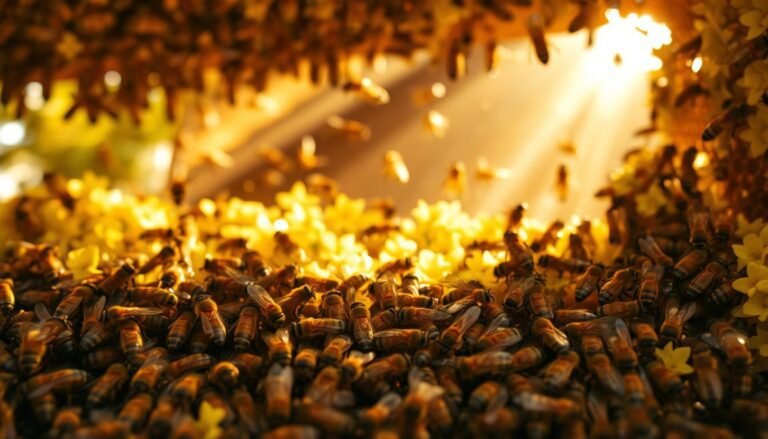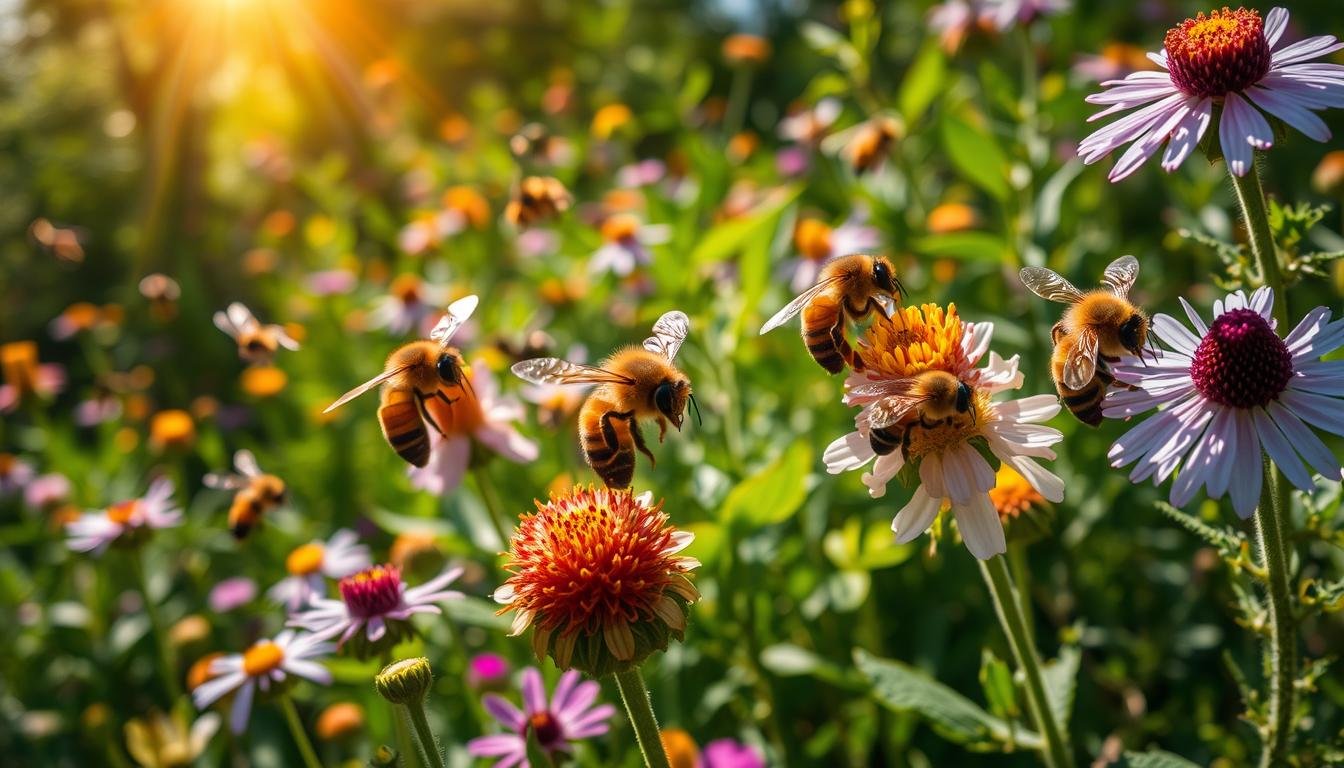
This beginner’s guide shows how wild pollinators keep food systems and wild plants moving across North America.
Utah alone hosts over 1,000 native species, and southern Utah rivals the U.S. East Coast in diversity. These insects pollinate roughly 70% of the world’s flowering plants and support billions in crop value each year.
This short guide explains how to tell a bee from a look‑alike, how different groups nest, and how pollen is moved from spring through fall. It frames the honey bee and honey bees as managed, non‑native livestock and shows why wild diversity often complements them in gardens and farms.
You’ll learn basic ID cues (hair, abdomen shape, foraging times), field‑tested gear (hand lens, nets, vials), and gentle handling tips used by naturalists. The article then covers anatomy and ID, social bumble groups, cavity and ground nesters, cuckoo strategies, seasonality, threats, and garden‑forward fixes.
Practical note: planting regionally appropriate plants, reducing pesticides, leaving some bare soil, and adding simple nesting options can boost pollinators immediately. For more inventory and monitoring resources, see USGS native bee work.
Key Takeaways
- Wild pollinators are vital to crops and wild plants across the United States.
- Simple ID tips and a hand lens help distinguish common groups.
- Managed honey bee hives complement, but do not replace, wild diversity.
- Small garden changes—plants, soil, nesting—yield big benefits.
- Diverse bee species increase resilience to changing bloom times and weather.
What Are Native Bee Species and Why They Matter Today
Wild pollinators are the animals that evolved with local plants and keep many natural systems and farms productive. They visit flowers to gather nectar and pollen, and in doing so they move pollen between blooms. This service supports wild plant reproduction and the food we grow.
Native bees vs. managed honey bees at a glance
Wild bees are diverse in size, shape, timing, and nesting. Many are solitary females that provision a single nest and deliver pollen directly to brood cells. Honey bees are large managed colonies kept in hives and moved for commercial pollination.
How wild bees boost fruit set and crop yields
Across 600 fields and 41 cropping systems, studies found fruit set doubled with wild-insect visitation compared to visits by a honey bee alone. This translates into higher yields and more stable production on farms.
- Mason bees excel in orchards; bumble groups enable greenhouse tomato pollination via buzz pollination.
- Specialists like squash foragers make cucurbit pollen transfer efficient.
- Habitat around fields—diverse plants and nesting places—supports wild activity and yield stability.
Practical note: pairing hives where honey and honey are desired with plantings and nesting sites that attract wild pollinators gives growers the best resilience against weather, staggered blooms, and shifting seasons.
Quick Identification: Telling Bees from Wasps and Fly “Mimics”
Field ID starts with the eyes and antennae, then moves to body hair and wing count.
Body, eyes, antennae, and hair: the key field marks
Look for a generally hairy body with branched hairs; true pollinators carry pollen in those hairs. Proportionate antennae and two pairs of wings are strong signals a insect is a bee.
Flies have one pair of wings, very large forward-facing eyes, and short antennae. Wasps tend to be glossy, nearly hairless, and show a narrow waist and a sharper abdomen profile.
- Fast checklist: hair, wing pairs, waist shape, and pollen-carrying hairs.
- Use the eyes and antennae: flies’ large eyes and stubby antennae give them away.
- Size clues: tiny sweat bees can be much smaller than a bumble bee; a carpenter bee rivals a bumble in bulk but has a shiny upper abdomen.
- Behavior: wasps hunt or scavenge; bees forage on a flower and return to a nest with pollen.
Common confusions: hover flies and yellowjackets
Color is misleading; black-and-yellow patterns appear across groups. Prioritize hair density, waist shape, and visible scopal hairs.
“Observe calmly and from a distance; disturbing a social nest can be risky.”
Inside a Bee: Basic Anatomy for Beginners
Start with three clear regions: head, thorax, and abdomen. These parts explain how a bee feeds, carries pollen, and builds nests. Use a hand lens and note short, direct features rather than tiny details.
Sex differences: females versus males
Females usually have a functional stinger and pollen-carrying hairs. Females build and provision cells, placing an egg on a pollen‑nectar loaf before sealing the chamber.
Males are often smaller, lack a stinger, have longer antennae, and may show pale facial hair. These contrasts help when you observe size, antenna length, and face patterns.
Pollen transport: scopa and corbiculae
Most solitary bees use scopa—dense hairs on the legs or underside of the abdomen—to carry pollen. In contrast, honey bees and bumble groups have corbiculae, flattened tibial baskets that form tidy pellets.
- Look at the eyes and antennae: eye position and segment length often differ between sexes.
- Note abdomen texture: glossy versus fuzzy helps separate carpenter-like from bumble-like forms.
- Observe mouthparts and tongue length to predict which flowers a bee can access.
Family-level patterns are useful in the field: Megachilidae often move pollen on the abdomen, while Apidae shows mixed leg structures. For quick field help and an illustrated guide to cells and nesting, consult this beginner field guide.
Native Social Cavity Nesting Bees: Bumble Bees
A single overwintered queen often starts a new underground colony each spring, using old rodent burrows or similar cavities.
Seasonal arc: The queen emerges, locates a cavity or abandoned burrow, and builds a small nest. She feeds larvae and rears the first workers. Once workers forage, the queen focuses on egg laying and the colony expands through summer.
Late summer brings males and new queens. Only mated queens survive winter by hibernating. These one-season colonies reset each year.
Buzz pollination and cool-weather service
Bumble buzz pollination uses rapid wing and thorax vibrations to free pollen from poricidal anthers, making these pollinators vital for greenhouse tomatoes and some fruit crops.
They forage in cool, cloudy conditions when many other bees stay inactive. This trait lengthens daily and seasonal pollination windows for wild plants and crops.
- Field ID: dense hair and a less glossy abdomen distinguish them from carpenter-like look-alikes.
- Habitat needs: access to ground cavities, spring forage for emerging queens, and undisturbed edges for nests.
- Support tip: leave small unmowed patches and plant early-blooming willows or shrubs for queens.
| Stage | What happens | Garden action |
|---|---|---|
| Queen emergence | Searches burrows, starts nest | Provide early flowers and undisturbed ground |
| Worker phase | Foraging expands colony | Maintain continuous blooms and forage diversity |
| Reproductive phase | Produces males and new queens | Avoid disturbing suspected nests; observe from distance |
“Keep a respectful distance near suspected burrows and avoid vibrations during peak season.”
Solitary Cavity Nesting Bees: Leafcutter, Mason, and Wool Carder
Several common cavity nesters provision individual cells inside pre-made cavities, each with a pollen-nectar loaf and an egg.
Leafcutter behavior and ID
Leafcutters select existing holes in wood, stems, or artificial blocks and line them with circular leaf pieces.
They build a sequence of stacked cells toward the entrance. Each cell is provisioned with pollen and sealed. Look for neat semicircular cuts on nearby leaves as a sign they are present.
Mason bees in orchards
Mason individuals are active in early spring and are prized orchard pollinators.
They often seal nest entrances with mud caps. These caps mark active holes in boards or natural burrows and signal good pollination timing for fruit trees.
Wool carder habits
Wool carder males patrol and defend flower patches. Females collect plant hairs, packing fibers into cavities to line soft cells for each larva.
- Megachilid hallmark: pollen clings to the underside of the abdomen, a quick field mark.
- Size and shape: stout bodies, broad heads; some mason members appear metallic blue.
- Females build and provision every cell; the larva develops inside sealed chambers.
- Activity windows: mason bees peak in early spring; leafcutters and wool carders peak mid-summer.
| Group | Signs at nest | Best season |
|---|---|---|
| Leafcutter | Leaf discs, stacked cells in holes | Mid-summer |
| Mason | Mud-capped entrances, early flights | Early spring |
| Wool carder | Plant fibers lining cavities; territorial males | Mid-summer |
Observation tips: watch from the side, do not block holes, and note materials—leaf discs, mud, or fibers—to identify users.
“Minor cosmetic leaf cutting usually signals a healthy local population helping garden pollination.”
Carpenter Bees: Large and Small
Carpenter bees show two clear lifestyles: bulky wood-excavators and tiny stem-nesters. You’ll notice differences in size, behavior, and where they make their homes.
Large tunneled nesters and nectar behavior
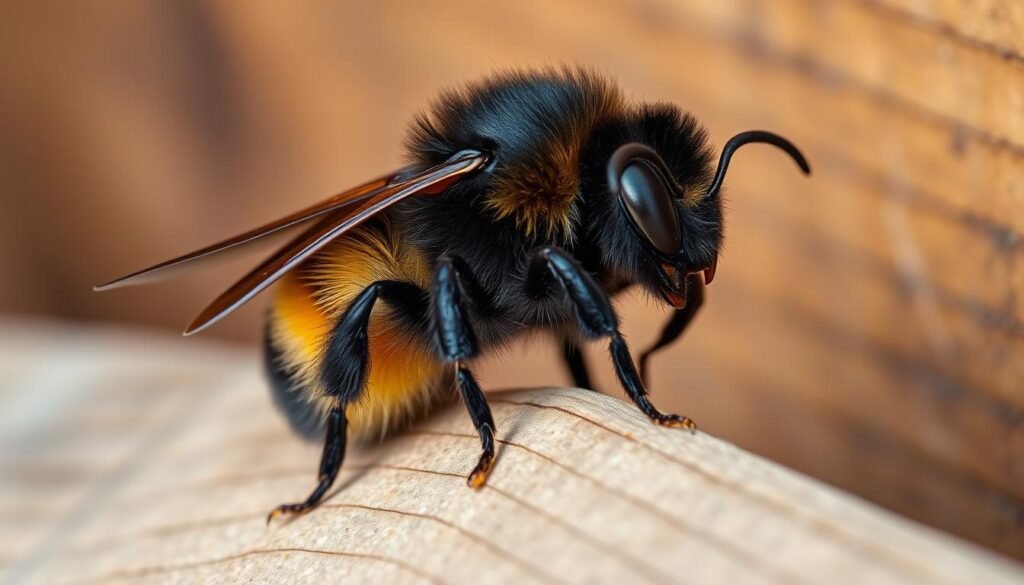
Field mark: a large carpenter often has a glossy, mostly hairless upper abdomen that sets it apart from a fuzzy bumble.
Females use powerful mandibles to bore tunnels in soft or weathered wood. They partition those tunnels into chambers, each provisioned and sealed for an egg.
When flowers have long tubes, a female may slit the base and sip nectar directly. This “nectar robbing” gives the adult food but bypasses pollen transfer.
Small stem nesters and maternal guarding
Small carpenter bees are about a quarter-inch and often show a metallic sheen. They prefer pithy stems—rose canes, brambles, and similar stalks—for nests.
Females sometimes guard the entrance until young emerge. This maternal behavior raises offspring survival in tight stem chambers.
- Look at abdomen texture and foraging: glossy back and direct tunneling point to large carpenters; tiny metallic size and stem use indicate small ones.
- Males may patrol territories in spring; they lack a stinger and are primarily defensive.
- Large carpenters visit sunflowers and daisies; small ones use diverse garden blooms.
“If structures are affected, sealing or painting exposed soft wood and offering alternate nesting blocks reduces conflicts.”
Solitary Ground Nesting Bees: Mining, Polyester, Digger, Sweat, Long-Horned
Many solitary females dig branching tunnels in bare or thin turf, creating chambers each stocked with pollen and an egg. These ground nesters form small networks of burrows that support local pollination for weeks each season.
Mining bees and lawn turrets
Mining foragers often appear in early spring. Small soil turrets or mounds in lawns mark active entrances as females provision cells. Turrets are temporary and usually harmless to turf.
Polyester-lined cells
Colletes females coat each chamber with a waterproof, bioplastic-like film. This lining preserves the pollen-nectar loaf and protects developing brood from moisture.
Fast diggers and mud chimneys
Anthophora are large, fast flyers. They visit spring blooms and sometimes build tiny mud chimneys at tunnel mouths to aerate and shield their nests.
Metallic and semi-social halictids
Halictidae show metallic colors or bands, and a few species nest in loose clusters. Multiple females may share an entrance yet each provisions her own chamber.
Long-horned specialists
Eucerini favor squash, sunflower, and native plants. Males with long antennae perch on stems at dawn; their foraging moves pollen across crops and wild flowers.
- Leave small patches of unmulched ground to help nests establish.
- Observe gently—note abdomen striping, size, and flight speed to tell families apart.
“Lawn turrets are a sign of healthy local pollination and usually need no intervention.”
Cuckoo Bees: The Kleptoparasites of Other Nests
Some bees skip nest building entirely and rely on other mothers to feed their young. This strategy—kleptoparasitism—lets certain females lay an egg inside another insect’s burrow or tube. The intruder does not carry pollen and so lacks scopa.
How they infiltrate nests and why they lack scopa
Wasp-like in profile, cuckoo individuals are nearly hairless. They look different because they never collect pollen to provision their own cells.
Many Nomada (a common group in the Apidae family) patrol low over bare ground. A scouting female waits until a host leaves, slips inside, and deposits a single egg on the host provisions.
When the cuckoo larva hatches it may kill the host larva and consume the stored pollen-nectar mass. Though harmful to individual hosts, these birds—sorry, these bees—play a natural role in healthy communities.
- Watch for wasp-like foragers near aggregations of solitary ground nesters.
- Hosts defend nests by guarding entrances and timing activity to reduce losses.
- Do not dig into burrows; observation from a distance preserves both host and parasite balance.
“Understanding cuckoo strategies deepens appreciation of nesting ecology.”
Native bee species
Across North America roughly 4,000 documented pollinators move pollen from spring through fall. Hotspots exist: Utah alone hosts over 1,000 documented species, showing how regional diversity concentrates in certain habitats.
Quick taxonomy to watch for: mason, leafcutter, wool carder, carpenter, mining, polyester, digger, sweat, long-horned, and cuckoo groups. Gardeners will most often see these foraging on a flower or returning to nests in wood, stems, or bare soil.
Color and form vary widely. Expect metallic green sweat types, fuzzy bumble and bumble bees, and glossy carpenter forms. These differences help with fast field ID and set realistic expectations for sightings.
Roles also differ. Social groups have a queen that starts and organizes a colony. Solitary females build and provision each cell alone. Meanwhile, a honey bee is a single managed species among thousands of wild pollinators.
Start a backyard log with photos and dates and consult local checklists to learn which species appear in your state. Small habitat tweaks—more flower variety, bare soil patches, and safe nesting features—can support a surprising array of pollinators nearby.
Honey Bees Are Not Native: Key Differences and Roles
Managed honey hives are common on farms, but they come from an introduced European stock with different needs than many local pollinators.
Colonies, hives, and quick ID traits
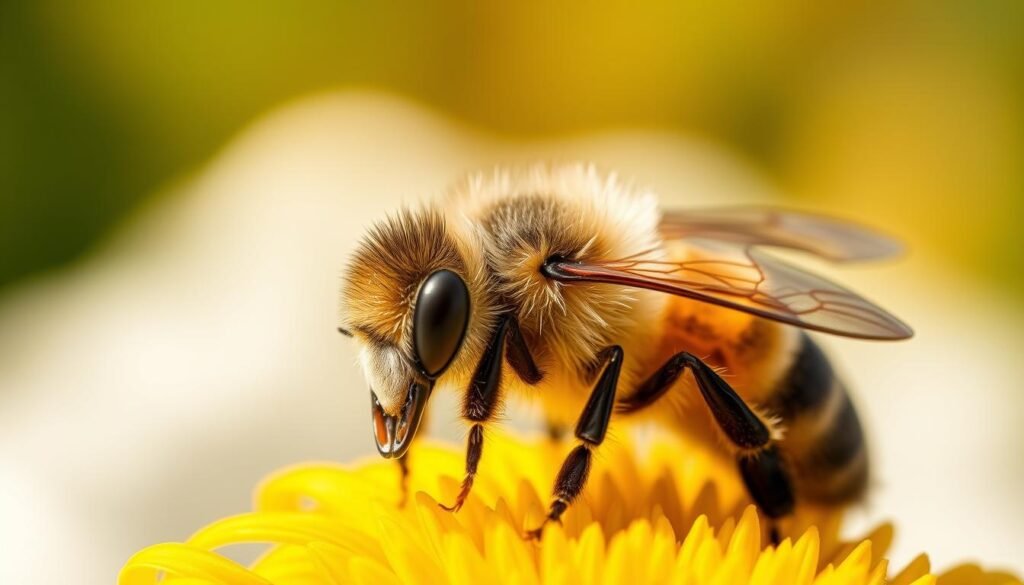
The western honey bee (Apis mellifera) is kept in Langstroth hives and managed as livestock for both honey and crop pollination.
Colonies can number in the tens of thousands and build wax comb inside cavities—attics, tree hollows, or rock holes.
Field ID tips: look for tiny hairs on the compound eyes, a squared front edge to the abdomen, and leg shapes lacking obvious tibial spurs. These traits separate them from many wild look‑alikes.
When to rely on hives versus wild diversity
Honey bees are excellent generalists and are moved to supply mass pollination for crops. They are portable and predictable during peak bloom.
Wild bees often excel on specific plants and forage when conditions are cool or windy. Using both approaches stabilizes service.
“Maintain hives where needed, and enrich field margins and nesting habitat to sustain diverse pollinators.”
Note: wasps lack pollen baskets and behave differently, and a bumble bee can be confused at a glance. Compare abdomen texture, banding, and flight to resolve IDs.
Seasonality and Life Cycles: When Bees Forage, Nest, and Emerge
Spring signals a quick turnover of pollinators as orchard specialists arrive first, then give way to a long summer cast of generalists.
Early spring brings mason arrivals timed to orchard bloom. These short-window foragers excel at fruit tree pollination and collect both pollen and nectar during brief flights.
At the same time bumble queens emerge, find nest sites, and start small colonies. By early summer workers dominate foraging and brood care.
Summer sees a shift: sweat and other solitary foragers peak on colorful summer flowers. Long-horned and leafcutter groups become common later in warm months.
Many solitary adults live only weeks. They provision sealed cells, so a single short adult window can produce the next year’s generation.
Honey hives can remain active from spring through fall where climate allows, extending pollination for crops and garden food when wild foragers pause.
“Track local bloom dates and note first and last flights—phenology helps bridge gaps.”
| Season | Leading foragers | Practical note |
|---|---|---|
| Early spring | Mason, emerging bumble queen | Provide early blooms and nesting sites |
| Mid summer | Sweat and solitary generalists | Maintain continuous flowers and sun patches |
| Late summer / fall | Leafcutter, long-horned, late generalists | Keep late blooms for brood provisioning |
- Weather matters: cool, cloudy days favor bumble foraging; heat shifts activity to mornings and evenings.
- Continuous bloom from early spring to frost supports steady food and successful brood rearing.
- Document your local calendar to plan plantings that bridge seasonal gaps.
Human Impacts: Habitat Loss, Pesticides, and Competition
Human land use has reshaped habitats, leaving many pollinators with fewer homes and food patches. This trend shows up in hard data: about 28% of bumble groups, 50% of leafcutter groups, and 27% of mason groups show documented declines.
Fragmented landscapes separate nests from rich floral areas. Isolated populations lose gene flow and resilience. Reduced continuity of blooms lowers reproduction success across local populations.
Pesticides harm navigation and brood development even at low doses. Diseases and parasites spread more easily where managed hives move frequently. Competition from exotic pollinators and crowded hives can intensify these pressures.
- Loss of bare ground through paving, plastic, and heavy mulch removes essential ground nest sites.
- Simplified plantings and monocultures cut pollen and nectar diversity and timing.
- Wasps are not the main cause here; land use and chemical stressors drive declines.
Practical note: reducing pesticide use and restoring connected, diverse plantings helps recovery. For a deeper look at the threats, see pollinator threats and drivers.
“Integrated habitat action at the community scale gives the best chance to reverse declines.”
How to Help: Bee-Friendly Gardening and Landscaping
A few small steps make a big difference. Reduce chemicals, add seasonal blooms, and offer simple nesting options to support local pollinators.
Reduce pesticides and leave some bare ground
Avoid insecticides and fungicides where possible. Use spot treatments only when pests threaten plant health. Never spray during peak bloom.
Leave small, sunny bare patches of soil free of mulch. Solitary females dig and provision cells in these bare areas.
Choose plant diversity for nectar and pollen across seasons
Plant a mix of regionally native plants plus a few non-invasive exotics to extend bloom into shoulder seasons. Staggered flowers supply steady nectar and food from spring through fall.
Include shrubs, perennials, and wildflower patches for structural diversity. Tolerate minor leaf cutting and stem cavities; these signs show functioning habitat for leafcutter, mason, and small carpenter bees.
- Clean and rotate bee hotels each season to limit disease and parasites.
- Leave standing stems over winter and trim in late spring so stem-nesting individuals emerge naturally.
- Provide shallow water or damp soil for mineral uptake and improved nutrition.
- Work with neighbors—schools and community plots multiply habitat and support more species.
“Pair diverse plants and clean nesting features with reduced chemical use for the strongest gains.”
Best Plants for Native Bees in U.S. Gardens
Choose a mix of regional natives and a few non-invasive exotics to supply steady nectar and pollen across the season.
Top native choices
Start with proven natives: California poppy (Eschscholzia californica), black sage (Salvia mellifera), purple sage (Salvia leucophylla), buckwheats (Eriogonum spp.), goldenrod (Solidago spp.), and phacelias (Phacelia spp.).
These plants deliver high-quality nectar and pollen and suit a range of soils and climates.
Helpful non-invasive exotics
Add select exotics such as rosemary (Rosmarinus officinalis), cosmos (Cosmos bipinnatus), coneflower (Rudbeckia and Echinacea spp.), asters (Aster x frikartii ‘Mönch’), and catmint (Nepeta x faassenii).
They extend bloom windows, especially in early spring and fall, and attract bumble, sweat, carpenter, and honey visitors.
- Plant in clumps or drifts so foragers can move efficiently and transfer more pollen.
- Mix tubular and composite flowers to match different tongues and body sizes.
- Match selections to local climate and soil—check state extension or plant societies for refined lists.
- Avoid double-flowered cultivars; choose single, open forms for better nectar access.
- Keep continuous bloom and leave some seedheads and stems to support nesters and late-season feeding.
“Diverse plantings reduce the need for chemicals and strengthen garden ecology for pollinators.”
Nesting Support: Bee Hotels, Blocks, and Natural Cavities
Well-designed nesting aids shorten foraging trips and raise brood success by keeping pollen and provisions close to the nest.
Safe hotel design and seasonal care
Provide smooth, clean holes in hardwood blocks or bundles of paper tubes. Drill a range of diameters—roughly 3/32 to 3/8 inch—to suit different bees.
Place units with morning sun and a roof or overhang for rain protection. Face them toward warm light but shield from prevailing winds.
Clean annually: remove liners, replace tubes, or retire old blocks to reduce mites, fungi, and parasitoids in cells. Limit each unit’s size; several small houses across a garden outperform one large hotel.
Stems, cavities, and ground: matching nests to users
Many local cavity users will use hotels, but several do not. Leave pithy stems at varying heights and small patches of bare soil so ground and stem nesters can establish a nest.
- Track materials at entrances—mud caps mean mason activity; leaf discs signal leafcutter use; fibers point to wool carders.
- Keep hotels near abundant flowers so foraging trips stay short and pollen delivery to brood improves.
- Avoid splintered holes and exposed straws; smooth wood and sealed tubes lower injury and parasitism risk.
“Rotate and retire older blocks; clean or replace liners each season to keep nests healthy.”
Regional Snapshot: Utah and North America’s Bee Diversity
High desert canyons and alpine meadows combine in Utah to create one of the richest pollinator landscapes in the nation.
Why Utah matters
Over 1,000 documented species occur in Utah, with southern valleys approaching the total diversity of the entire U.S. East Coast. That range comes from sharp elevation shifts, varied soils, and many plant communities that stagger bloom times.
Field basics for beginners
Learn family-level traits first. Recognizing repeated body patterns speeds ID in the field and reduces confusion between look-alikes.
Carry three simple tools: a 10–30× hand lens for close inspection, a soft insect net for careful capture, and clear vials or jars for brief viewing before release.
Handling, logging, and ethics
Handle gently: keep time in containers short, avoid heat or direct sun, and never disturb an active nest entrance. Note the plant visited and the date for each record.
- Watch for males roosting on stems or patrolling territories—these behaviors aid ID.
- Share records with local extension services or community science projects to improve regional data.
- Match plantings and habitat fixes to local elevation, precipitation, and soils for best results in your garden and beyond.
| Focus | Quick action | Why it helps |
|---|---|---|
| Tools | Hand lens, soft net, clear vial | Safe inspection and short-term study |
| Records | Log date, plant, behavior | Links sightings to phenology and habitat |
| Ethics | Ask permission on private land; avoid nests | Protects populations and landowner rights |
“Small, careful observations from many people build the data we need to support pollinators across North America.”
Conclusion
A small set of garden changes can multiply pollination services across a season. Plant layered, season-long flowers and avoid broad chemical sprays to get immediate gains for local bees and other pollinators.
Learn to spot form and behavior—knowing a forager, a queen, or a nest type helps you choose the right plants and siting. Leave some bare ground, standing stems, and clean hotel tubes to support ground and cavity nesters.
Remember: bumble bees provide cool-weather and buzz pollination, while many solitary groups deliver efficient, crop-targeted service. Honey bees remain useful partners where managed hives are needed, but broad support for wild pollinators stabilizes food and ecosystem benefits.
Start with a few plants and a small bare patch this season, keep simple records of what visits and when, and share your successes. For further reading and practical guides see beekeeping resources and books.
FAQ
What are the main differences between wild pollinators and managed honey bees?
Wild pollinators, including bumble bees, mason bees, and sweat bees, typically nest singly or in small social groups and forage close to nests. Managed honey bees live in large colonies inside hives and store honey for winter. Wild insects often provide more efficient pollination for certain crops like tomatoes and blueberries because of behaviors such as buzz pollination and foraging patterns that increase fruit set and crop yields.
How can I tell a bee from a wasp or a fly mimic in my garden?
Look at body shape, hairiness, antennae, and eyes. True bees usually have hairy bodies and pollen-carrying structures on legs or underbodies, while wasps are shinier and less fuzzy. Hover flies have large eyes and only two wings, not the four that bees have. Antennae length and facial hair also help separate bumble bees and carpenter bees from yellowjackets and syrphid flies.
What are the recognizable anatomical traits of female vs. male pollinators?
Females often have structures for carrying pollen, such as scopa (hairs on the abdomen or legs) or corbiculae (pollen baskets). Females may show a stinger (a modified ovipositor) while males do not. Males sometimes have longer antennae or distinctive facial markings and may behave territorially around flowers.
What is buzz pollination and which bees perform it?
Buzz pollination is when a bee vibrates its flight muscles while holding a flower, releasing pollen from poricidal anthers. Bumble bees are well known for this behavior and are particularly valuable in greenhouse crops and for plants like tomatoes and blueberries that require vibration to set fruit.
How do cavity-nesting solitary bees like leafcutter and mason bees use nests?
Leafcutter bees cut leaf discs to line stacked brood cells inside stems or holes, carrying pollen on underbelly scopa. Mason bees use mud to cap cells in preexisting cavities, such as hollow stems or beetle burrows. Both provision each cell with pollen and nectar before laying an egg.
Are carpenter bees harmful to wooden structures?
Large carpenter bees chew tunnels into untreated or weathered wood to create nests; repeated activity can weaken small structures over time. Small carpenter bees nest in pithy stems or twigs and do little structural damage. Painting or sealing exposed wood and using hardwoods reduces nesting.
What are ground-nesting pollinators and how do they nest in lawns or banks?
Ground-nesting insects, such as mining, digger, and polyester bees, excavate burrows in bare or sparsely vegetated soil to create brood cells. Some build mud chimneys or line cells with waterproof secretions. Leaving patches of bare, sunny ground helps support these important foragers.
What are cuckoo bees and why don’t they carry pollen?
Cuckoo bees are kleptoparasites that infiltrate the nests of other bees, lay eggs in host cells, and rely on the host’s stored provisions. They lack scopa and do not collect pollen, so they appear hairier or wasp-like and depend entirely on other nests for larval food.
How do honey bees differ from native wild pollinators in behavior and management?
Western honey bees form perennial colonies with thousands of workers, store large honey reserves, and are managed in hives by beekeepers. Wild pollinators are often solitary or form small colonies, have shorter seasonal activity, and require on-site nesting habitat. Use honey bees when you need mobile, controllable pollination; promote wild diversity to improve pollination stability and crop quality.
When during the year are different pollinators most active?
Activity varies by group: many orchard pollinators emerge in early spring, bumble bee queens appear early and found colonies, while solitary ground and cavity nesters peak from late spring into summer. Some long-season generalists continue into late summer and fall. Planting for sequential blooms supports foraging across seasons.
What human activities most threaten pollinator populations?
Habitat loss from development, pesticide exposure, fragmented landscapes, and competition from managed colonies reduce nesting sites and floral resources. Trends show declines in certain bumble bees, leafcutter, and mason populations where nesting and foraging habitat disappear.
How can gardeners provide effective nest and forage resources?
Reduce pesticide use, create flower diversity for nectar and pollen across seasons, and leave some bare ground and stems. Install well-designed bee hotels with appropriate diameter tubes, place them in sheltered, sunny locations, and clean or replace tubes seasonally to prevent parasites.
Which plants best support pollinators throughout the growing season?
Choose a mix of spring, summer, and fall bloomers. Good choices include poppy, sages, buckwheats, goldenrod, phacelias, and helpful exotics like rosemary, cosmos, coneflower, asters, and catmint. Diversity ensures continuous nectar and pollen for queens, females, and males.
How should I design and maintain a bee hotel to avoid problems?
Use solid blocks or tubes of varying diameters, ensure a back wall to prevent light through nests, mount hotels facing morning sun, and protect from rain. Clean or replace nesting tubes each year and remove signs of mold or parasites. Match cavity sizes to target cavity-nesting taxa like mason and leafcutter bees.
What regional differences exist in pollinator diversity, for example in Utah versus broader North America?
Regions vary widely. Utah hosts over 1,000 kinds of pollinators, while North America contains thousands across habitats. Local climate, floral communities, and soil types shape which groups dominate; using regional plant lists and local extension resources helps tailor habitat support.
Can observation and simple tools help me study pollinators safely?
Yes. Use a hand lens, insect net, and field guides for gentle observation. Handle organisms minimally and release them. Photographing with a macro lens helps with identification of features like antennae, scopa, and wing venation without disturbing nests or hives.