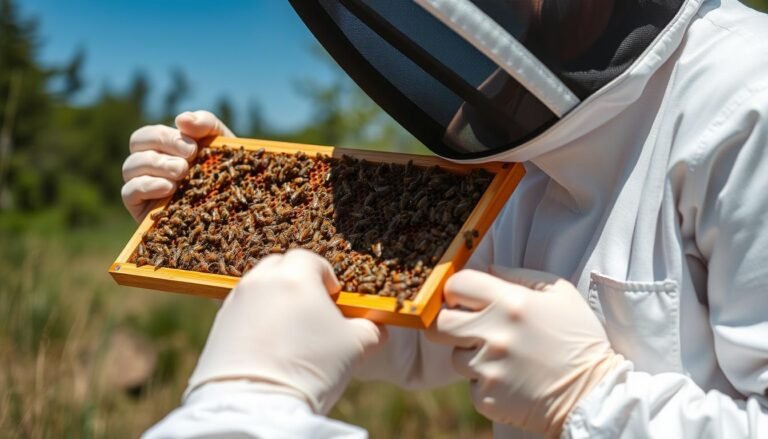
This section lays out a clear, data-driven view of how insect visitor communities are moving with a warming climate. Field studies across the Andes, the Snowy Mountains, the Southern Alps, New Zealand, and Arizona show a consistent bee-to-fly swap near a mean annual temperature of ~5.28°C. That narrow window (4.9–5.7°C) repeats across continents and signals real ecological change.
We synthesize past trends and models for 1,365 bee species under high-emissions scenarios to connect local observations with projected range gains and losses. Results indicate many bees face contractions, especially in Europe and Africa, while North America may see more expansions. These shifts matter for food systems and biodiversity because bees often deliver higher seed set where they persist, while flies dominate colder, wetter heights.
Key Takeaways
- Consistent thermal threshold: a ~5–6°C signal marks where bees give way to flies.
- Projected upslope moves of 200–400 m by ~2080 under +2–4°C warming.
- About 65% of modeled bee species show range contractions under SSP585.
- Regional outcomes vary: strong declines in Europe and Africa; mixed trends elsewhere.
- Early warnings appear first in mountains where small temperature changes reorganize communities.
Executive overview: past trends shaping current pollinator movements
Field gradient studies show a clear turnover: bee visits decline and flies increase near a cold mean annual temperature of ~5–6°C. This signal repeats across continents and elevation bands, making it a robust baseline for later projections.
Precipitation, humidity, and canopy cover modify this thermal response. Wetter, shaded sites often favor flies and reduce bee activity, while drier, open slopes support higher bee visitation and nesting.
The historical evidence links directly to modern species distribution models. Using harmonized BeeBDC records and MaxEnt under SSP585 (2070), roughly 65% of modeled bees show likely range declines. Europe and Africa face the strongest contractions; North America shows more mixed outcomes with notable expansions for many species.
“Model performance was strong (AUC 0.85–0.97; Boyce up to 0.93), giving confidence in continental-level forecasts.”
- Anticipate local contractions and compositional turnover even where some regions expand.
- Because bees often deliver greater pollination per visit, these shifts can reduce plant reproductive success.
- Evidence-based planning must couple climate signals with species- and community-level responses; see USGS guidance for climate data integration: USGS climate guidance.
Knowledge gaps remain for extreme hot or ultra-cold sites and for non-temperature drivers that co-determine outcomes. This overview integrates field ecology, WorldClim layers, and validated SDMs to provide a reliable base for the deeper dives that follow.
Key terms and scope: pollinators, migration, range shifts, and climate signals
Pollinators here refer to a functional group that includes bees, flies, butterflies, moths, and other insects. This report emphasizes bees because they disproportionately support crops and seed set.
We distinguish seasonal migration from gradual range shifts. Many movements reflect slow distribution change rather than long-distance seasonal travel.
Climate signals used in models include mean annual temperature, temperature seasonality, precipitation seasonality, and diurnal range. These layers feed species distribution models that combine cleaned occurrence data with WorldClim predictors.
The global dataset (BeeBDC) aggregates millions of records and supplies spatially filtered inputs for SDMs. Field gradients quantify a bee-to-fly turnover near 4.9–5.7°C, linking empirical and modeled outcomes.
“Defining terms and data limits up front improves interpretation of species responses and management choices.”
- Scope: global analysis with emphasis on mountain gradients and a U.S. policy section.
- Terminology: phenological mismatch, synchrony, and network stability guide later interpretation.
- Note: thermal physiology and life history make insects respond differently to the same climate drivers.
| Concept | Definition | Data source | Relevance |
|---|---|---|---|
| Pollinators | Functional group of flower visitors | BeeBDC, field surveys | Targets conservation and crops |
| Range shifts | Gradual distribution change | SDMs, occurrence records | Informs management |
| Climate signals | Temp, seasonality, precipitation | WorldClim | Drive suitability models |
| Network terms | Synchrony, mismatch, stability | Field studies, phenology data | Predict service impacts |
Drivers and mechanisms behind global shifts in pollinators
Drivers range from thermal physiology to microhabitat alterations. Together, these forces explain why some taxa decline while others rise along elevation and latitude.
Warming temperatures and activity windows
Rising temperatures change metabolic thresholds that set daily activity windows for each insect group. Warmer days can extend foraging for some species and exceed limits for others.
Empirical break: a ~5–6°C mean annual temperature marks where bee dominance gives way to flies. This reflects physiology: bees need warmer, drier microclimates to forage efficiently.
Precipitation, humidity, and habitat quality
Increased moisture often favors flies. High humidity boosts larval habitats and alters visitation rates, shifting community composition toward taxa that tolerate wet conditions.
Vegetation, canopy, and biotic interactions
Canopy cover cools and wets sites, delaying the bee-to-fly turnover upslope. Open slopes keep bees dominant higher than forested slopes.
Biotic interactions — competition for flowers, nest-site limits, and predation or parasites — amplify climate-driven changes. Bumblebees can persist at high elevations in some regions, offering partial buffering.
“Drivers rarely act alone; combined climate and habitat changes best explain observed turnover.”
- Warming by 2–4°C could push the transition ~200–400 m upslope by ~2080.
- Management should track which taxa provide services and protect a range of habitats across elevation bands.
Evidence from elevation gradients: the bee-to-fly transition around 5-6°C
Field transects from multiple mountain systems reveal a narrow thermal window that predicts community turnover. Regression of the bee-to-fly ratio against mean annual temperature yielded R² = 0.763 (p < 0.001) with a switch at 5.28°C and a transition window of 4.9–5.7°C.
Case studies span the Andes (600–3,600 m), the Snowy Mountains, the Southern Alps and Canterbury in New Zealand, and the San Francisco Peaks in Arizona. These independent datasets show the same core signal, strengthening confidence in the result.
How environmental factors alter local thresholds
Canopy cover and moisture shift the switch. Shaded, wetter slopes move the transition downslope; open, dry slopes push it higher. These factors change microclimate levels and thereby community composition.
Functional and plant implications
Flies can be abundant but often deliver lower per-visit pollination than bees. Where bees decline, some alpine plants may increase selfing or rely on wind pollination, altering seed set and network diversity.
“Targeted monitoring around the 5–6°C isotherms offers an early-warning indicator for community reassembly.”
- The quantitative fit (R² = 0.763) shows repeatable continental patterns.
- Projected warming (+2–4°C) could push communities ~200–400 m upslope by ~2080.
- Richness and abundance measurements support the turnover signal where sampled.
Migration patterns of pollinators (global shifts): what the data show
Observed trends show many insect communities moving upslope more often than they shift poleward. Mountain transects act as a practical space-for-time proxy that reveals rapid responses to a warming climate.
Long-term records and repeat surveys document that some bee groups expand into newly suitable bands while high-elevation flies lose habitat. These movements can outpace host plant range shifts, creating spatial mismatches between pollinators and plants.
“When pollinators arrive before or without their plants, visitation patterns change and seed set can decline.”
Mixed outcomes are common: mobile species with short generation times track temperatures quickly, while mountaintop specialists face range squeeze and higher extinction risk. Mapping MAT isotherms and moisture gradients alongside plant distributions highlights areas likely to become mismatch hotspots.
- Space-for-time: elevation gradients give empirical insight into future redistribution under +2–4°C warming.
- Functional risk: altered visitation can reduce seed set for plants dependent on specific pollinators.
Global projections for bees under warming scenarios
High-emissions forecasts produce a clear headline: most modeled bees lose core suitable climate space by 2070. MaxEnt runs with 6.89 million cleaned BeeBDC records project ~65% of 1,365 bee species to decline in high-suitability area under SSP585 (~+4.4°C).
SSP585 2070 outlook: contraction and expansion signals by continent
Continental results vary sharply. Europe and Africa face large average reductions (Europe −56%; Africa −51.4% for 44 species). North America shows mixed outcomes: 366 species increase (avg +48.2%) while 331 decline (avg −33%).
Smaller samples reveal similar imbalance. Australia: 9 increase (+16.3%), 97 decrease (−28.4%). South America and Asia include few big winners and many losers; some species show >100% range gains but most contract substantially.
Plant-bee synchrony risks and network stability
Range overlap alone does not secure service. Timing mismatches in flowering and bee emergence can destabilize pollination networks even where climates remain suitable.
“Expansions do not guarantee functional replacement—newcomer bees may not match local plant needs or phenology.”
- Headline: under this climate change pathway, roughly two-thirds of modeled species lose high-quality habitat.
- Ecological meaning: reduced suitability raises local extirpation and population stress risks.
- Management: prioritize monitoring species with steep declines and plants that rely on specialized bees.
United States focus: regional sensitivities and management context
Mountain sentinel sites across the United States show how small temperature shifts quickly reorder flower-visitor communities and services.
High-elevation areas are sensitive: slight warming or extreme precipitation alters microclimates and pushes bees upslope more often than they move poleward. These zones act as early indicators where community turnover and service loss appear first.
Mountain ecosystems as early indicators
Small thermal increases can reorganize nesting and foraging. Open slopes keep bees higher; shaded, wet slopes favor flies and reduce pollination service for many alpine plants.
Midwestern precipitation variability and pollination services
Variable rains in the Midwest suppress visitation and lower seed set during wet years. Farmers and genebanks in these regions face unreliable pollination windows and higher disease risk when moisture rises.
Implications for USDA genebanks and seed regeneration
USDA NPGS sites rely on managed insects like Apis mellifera, Bombus spp., and Megachile rotundata for regeneration.
Warming and changing precipitation complicate timing, reduce colony performance, and can increase pest pressures that affect seed resources and storage schedules.
“Site-specific planning and local monitoring are essential to align regeneration timing with emergent climate signals.”
- Prioritize microclimate management and diversified pollinator portfolios at genebank sites.
- Use local data to time flowering and regeneration to pollinator availability.
- Adopt adaptive irrigation and field design to limit excessive moisture impacts and disease.
- Share lessons across regions to anticipate shared vulnerabilities and practical solutions.
Phenological mismatches: timing shifts in flowering and pollinator activity
Shifts in timing between bloom and bee activity are creating measurable gaps in service at many sites. Rising temperatures change development rates so larvae, pupae, and adults reach life stages earlier or later than historical norms. That alters when a bee first forages and how long daily foraging windows last.
Thermal effects on development and colony dynamics
Heat stress cuts bumblebee foraging and lowers colony output. Honeybee hives divert workers to thermoregulation, which reduces both reproduction and foraging effort. These trade-offs change colony growth and seasonal resource collection.
Experimental warming on Megachile rotundata delayed phenology and reduced body mass, fat stores, and survival. Earlier or later emergence can misalign bees with peak flowering and reduce seed production for many plants.

Increased precipitation also drops visitation rates, compounding temperature-driven mismatches. Where bloom windows are narrow and pollinator redundancy is low, small timing errors sharply cut pollination efficiency.
- Mixed species responses—some advance, others lag—can destabilize networks without large range moves.
- Use degree-day models and bloom calendars to monitor and forecast emergence and flowering.
- Buffer timing uncertainty with diverse plantings, overlapping bloom periods, and microclimate management (shade, windbreaks).
“Targeted phenology monitoring helps align management actions with shifting seasonal cues.”
Elevation versus latitude: where and how pollinators are moving
Elevational tracking often outpaces poleward moves because mountain temperature gradients compress thermal change into short distances. That makes upslope responses faster for many cold-adapted insects when local climate warms.
Constraints for cold-adapted species and mountaintop endemics
Mountaintop endemics face habitat compression: as suitable bands rise, some have nowhere to go. Cold specialists like Bombus alpinus already show uphill shifts, signaling limited options under continued change.
Even modest warming (+2–4°C) can move suitable bands ~200–400 m upslope by ~2080. That alters community composition quickly and fragments populations at higher elevations.
Topographic bottlenecks and land-use barriers limit gene flow and dispersal. North-facing slopes and cold-air pools act as short-term refugia but rarely replace broad connectivity across altitude.
“Upslope moves are often faster but more constrained than latitude-based responses.”
Latitude shifts can be slower because of habitat loss, distance, and biogeography. Mapping elevational corridors and protecting connected altitude bands is critical to help at-risk species and sustain services. For approaches that integrate field data and modeling, see this overview on altitudinal responses: altitudinal responses and refugia.
- Steep gradients mean short moves can equal large thermal change.
- Refugia provide transient buffers but not permanent solutions.
- Conservation must prioritize fine-scale heterogeneity and connectivity across altitude.
Agriculture and plant genetic resources: safeguarding pollination under change
Genebanks and growers face rising operational risk as managed pollinator performance responds to warmer, wetter weather.
Honeybees and bumblebees shift effort to thermoregulation in heat. That lowers foraging and reproduction and reduces pollination during hot spells.
Alfalfa leafcutting bees emerge earlier with warming and show lower survival, raising the chance of mismatch with target plants. Increased precipitation further cuts visitation and seed set.
Managed pollinators: vulnerabilities and adaptations
Reduce thermal load: hive ventilation, north-facing placement, and shade cloths lower colony stress and sustain foraging.
Diversify resources: use mixed bee species, staggered releases, and backup suppliers to spread risk across different activity windows.
Operational adjustments for seed production and regeneration
Schedule flowering and releases using short-term forecasts and local phenology data. Coordinate IPM to protect insects while managing warming-favored pests.
“Monitor visitation rates and seed set, then iterate practices across sites to retain reliable pollination service.”
| Action | Target | Benefit | Notes |
|---|---|---|---|
| Shade cloth / water stations | Honeybees, bumblebees | Lower hive temperatures, extend foraging | Use during heatwaves and peak bloom |
| Staggered releases | Leafcutting bee cohorts | Reduce emergence–flower mismatch | Time releases to degree-day models |
| Diversified pollinator mix | Seed production blocks | Increase redundancy, stabilize service | Include managed and wild-friendly habitat |
| Performance monitoring | All sites | Adaptive management and data sharing | Track visitation, seed set, phenology |
Shared protocols and data exchange across genebanks improve resilience. Simple, repeatable metrics let managers compare outcomes and refine use of pollinator resources under climate change.
Pests, pathogens, and the pollinator-plant-pest triangle
In many regions, faster-breeding pests now outpace parasitoids and predators, complicating integrated management. Warming and more variable precipitation amplify pest pressure and raise disease risk for crops and wild plants.
Warming-favored pests and biological control challenges
Diamondback moth populations expand under higher temperatures while some parasitoid wasps contract. Spider mites breed faster and can overcome predatory mites when heat rises.
Vector-borne diseases and cascading risks
Psyllid- and mealybug-vectored diseases (for example, HLB, zebra chip) expand with warming and trade. Increased humidity and flooding also boost fungal and soil pathogens.
Trade-offs in agrochemical use and pollinator health
Pest surges drive higher pesticide use, which can harm managed and wild pollinators and reduce nectar and pollen quality.
“When pests gain climatic favor while enemies lose ground, management costs and ecological risk both rise.”
- Key impacts: weakened plants, poorer floral rewards, altered bloom timing.
- Management: monitor life-cycle acceleration, use selective products, and favor habitat refuges for beneficials.
- Coordination: align plant health and pollinator teams; prepare contingency plans for extreme precipitation years.
| Pressure | Climate factor | Consequence | Management option |
|---|---|---|---|
| Diamondback moth | Warming | Higher abundance; reduced parasitoid control | Targeted monitoring; selective insecticides; refuge strips |
| Spider mites | Heat, drought | Faster generations; predatory mite efficacy drops | Biocontrol research; crop moisture management |
| Psyllid/mealybug diseases | Warming, trade | Expanded vectors; crop disease spread | Quarantine, vector control, pollinator-safe options |
| Fungal/soil pathogens | Flooding, humidity | Worse plant vigor; reduced floral rewards | Drainage, resistant varieties, timed planting |
Economic and nutritional implications of shifting pollination patterns
Insect pollination underpins large parts of global agriculture. Estimates place animal pollination value between USD 195–387 billion, and insect pollination supports about 9.5% of the food humans eat directly. These figures show the scale of loss if services decline.
Risk to crop value and nutrient security from declining pollination
Nutrition links are clear: up to 40% of essential nutrients in diets are tied to insect-mediated services. In Brazil, pollinator-dependent crops supplied 47% of dietary nutrients in 2017. Losses in service could cause 8–30% drops in key nutrients for some populations.
Regional declines raise three direct problems: lower yields, poorer quality, and higher prices. Farmers and consumers face uneven impacts. Specialist crops like many fruits, nuts, and seeds suffer most when networks lose synchrony.
- Economic stake: quantify pollination in farm budgets and regional planning to justify habitat investments and monitoring.
- Nutrition safety: resilience measures—diverse plantings and phenology management—help protect dietary outcomes.
- Limits to substitution: managed bees cannot always replace wild services for specialized crops, so conserving bee species and functional diversity matters.
“Network instability and timing loss can amplify volatility in crop outputs and market prices.”
Integrate pollination metrics into agri-food risk assessments and offer incentives that align producer actions with conservation. For frameworks that value ecosystem services, consult work on economic valuation and food systems such as the economic valuation of pollination.
Data, methods, and research quality: how we know what we know
Transparent workflows and reproducible metrics let researchers separate broad signals from local noise. This section outlines core steps and quality checks that support continental forecasts.
Species distribution models and predictor selection
We cleaned and harmonized raw occurrence data from BeeBDC (18.3M records). The modeled subset contains 6.89M records after 35 km thinning and a minimum of 50 occurrences per species per continent, yielding 1,365 species for SDMs.
WorldClim baselines (MAT 1970–2000) provided temperature and precipitation layers. VIF filtering retained Bio2, Bio3, Bio4, Bio8, Bio13–15, Bio18–19 to control predictor levels.
Modeling workflows, validation, and interpretation
MaxEnt via FLEXSDM used presence‑background with pseudo-absences, 5-fold cross-validation, and classification thresholds (high suitability >0.7) to compute percent change. Performance: AUC 0.85–0.97, Boyce up to 0.93, and strong IMAE values.
“High metrics and cross-validation build confidence in broad-scale projections while acknowledging local uncertainty.”
- Thinning reduces spatial bias and overfitting, improving future generalization.
- Abundance signals often show clearer turnover thresholds than richness; both are reported separately.
- All performance assessments and model summaries are openly available for independent scrutiny; see the model performance summary.
Ongoing research must fill under-sampled regions and report rates of change to refine forecasts and support applied use.
Monitoring priorities: indicators and metrics for U.S. decision-makers
Practical metrics—visitation, pollen deposition, and seed set—translate climate signals into management actions. Focus monitoring where mean annual temperature is near 5–6°C to detect the early community turnover that precedes service loss.
Track phenology for key crops and wild plants alongside emergence and foraging of sentinel species. Pair these observations with local weather sensors so you can link short-term variability to biological responses.
Establish standardized transects in mountain and vulnerable areas for year-to-year comparability. Incorporate genebank regeneration records to find operational bottlenecks tied to timing mismatches.
Include pest and pathogen surveillance because these agents compound warming impacts on plant health and pollinator function. Use remote sensing to map canopy and vegetation indices that signal microhabitat shifts.
“Monitor functional indicators, not just presence. Seed set and pollen deposition show service outcomes managers need.”
| Priority | Indicator | Reason | Action |
|---|---|---|---|
| Thermal band surveillance | MAT isotherms (5–6°C) | Early warning of turnover | Annual isotherm mapping and transects |
| Functional metrics | Visitation, pollen, seed set | Direct service measures | Standard protocols, seasonal sampling |
| Operational links | Genebank regeneration data | Detect timing bottlenecks | Integrate records with local climate |
| Environmental context | Precipitation, humidity, canopy | Modulates activity under climate change | Install sensors; use remote sensing |
Budget for long-term monitoring and share data across agencies to accelerate learning and protect key resources and species under ongoing climate change.
Communicating uncertainty: data gaps, extremes, and model limits
Model projections rest on data that are uneven in space and time, so outcome ranges matter more than single numbers. This research gap is largest where elevational studies rarely sample ultra-hot or ultra-cold extremes and above‑treeline systems.
Species distribution models predict suitability, not demographic viability. SDMs can overestimate persistence when habitat, competition, and life‑history factors are missing from inputs.
Occurrence records show clear sampling bias. Spatial thinning and cross‑validation reduce bias but cannot fully fix sparse coverage in some parts of the world. That limitation raises uncertainty in regions with few observations.
Novel climates and rapid climate change create extrapolation risk. Models assume stationarity; when future conditions have no analogue, projections grow less reliable.
“Report ranges of outcomes and treat models as decision tools, not oracle statements.”
- Be transparent about geographic blind spots and extreme climates.
- Invest in targeted field studies (canopy, moisture regimes, pollination effectiveness) to close critical gaps.
- Use scenario planning and iterative model updates to test strategies across plausible futures.
Implications: communicate clearly what is known versus assumed, favor flexible, no‑regret policies, and update models as new data arrive to keep decisions grounded and actionable.
Conservation and policy responses: aligning actions with emerging trends
Policy and land action must secure connected habitat and microclimates that let species track rapid climate change. Prioritize corridors that span elevation bands so suitable zones can move upslope with warming. Models suggest protections for an extra 200–400 m of elevation where +2–4°C warming is expected.
Habitat protection across elevation bands and climate corridors
Protect and restore habitat from lowlands to ridgelines to keep movement pathways intact. Maintain nesting sites and floral resources across bands to support persistence. Use conservation easements and incentives on working lands to expand habitat for plants and pollinators.
Synchrony-focused management: flowering windows and emergence timing
Align planting schedules and variety selection to match bee emergence without raising early-season disease risk. Staggered plantings and mixed varieties can buffer timing errors and protect yield.
Regional strategies for resilience in pollination services
Tailor actions by region: mountains need connectivity and refugia; the Midwest needs precipitation-adaptive practices. Integrate pest and disease plans that protect pollinators and use selective controls and biological agents where effective.
- Support diverse pollinator communities (wild and managed) to reduce functional losses.
- Manage canopy and windbreaks to extend activity windows while monitoring disease risk.
- Embed monitoring in policy to trigger adaptive responses and fund applied research on plant–pollinator–pest interactions.
“Incentives that tie habitat outcomes to measurable pollination metrics help align conservation with agricultural goals.”
For practical relocation and managed-bee guidance, consult this bee relocation guide to align operations with conservation aims.
Conclusion
, A clear thermal breakpoint around 5–6°C MAT links field gradients to likely service outcomes for many bee-dominated communities. This central pattern shows how small temperature changes reorder visitors and alter pollination across mountains.
Model forecasts warn that ~65% of modeled bees will lose high-suitability area by 2070 under high-emissions scenarios. Regional results vary: severe contractions in Europe and Africa, mixed results elsewhere. These projected effects raise real risks for plant–bee synchrony and network stability.
U.S. priorities include mountain early-warning transects, Midwestern moisture management, and genebank timing resilience. Conserving functional diversity and managing for synchrony are core strategies that reduce loss and support crops.
Invest in more data, flexible management, and policies that protect elevational corridors and habitat on working lands. With targeted, evidence-based action, nature and agriculture can better withstand accelerating climate change.
FAQ
What main factors drive recent shifts in pollinator ranges and activity?
Warming temperatures, altered precipitation, and vegetation change are the primary drivers. Temperature shifts change activity windows and thermal tolerance for bees and other insects. Rainfall and humidity alter floral resources and nesting habitat quality. Land‑use change and canopy dynamics further modify available foraging and shelter, while biotic interactions — competition, predators, and parasites — reshape local community composition.
How do elevation and latitude differ as routes for pollinator movement?
Elevation changes can create rapid local shifts because temperature drops steeply with altitude, allowing species to track climate over short distances. Latitude shifts require longer dispersal. Cold‑adapted and mountaintop specialists face greater constraint at high elevations, while lowland species may expand upward or poleward where suitable habitat and floral resources exist.
Are there consistent global patterns showing pollinators moving to higher elevations or latitudes?
Yes. Multiple studies across North America, Europe, South America, and Australia document northward and upslope redistributions for many insect pollinators. However, local outcomes vary with habitat connectivity, land use, and plant responses, producing areas where pollinators outpace their host plants and create spatial mismatches.
What is a phenological mismatch and why is it important for crops and wild plants?
A phenological mismatch occurs when the timing of flowering and pollinator activity becomes misaligned. Warming can advance or delay plant bloom and insect emergence unevenly. These mismatches reduce pollination success, lower seed set and fruit production, and threaten crop yields and genetic resource regeneration if unmanaged.
How do temperature thresholds affect bee species across elevation gradients?
Bees have species‑specific thermal limits for development and foraging. As mean temperatures cross certain thresholds, cold‑adapted bees decline while thermophilic species increase. Around a 5–6°C community shift observed in some elevation gradients, bees give way to other insect pollinators like flies, altering pollination networks and plant reproductive strategies.
What do global projections suggest for bees under high‑emission scenarios like SSP5‑8.5 by 2070?
Models project both contractions and expansions regionally. Some temperate regions may gain suitable climate space, while tropical and montane specialists often lose habitat. Increased risk to plant‑bee synchrony and network stability is expected, with intensified pressure on endemic and range‑restricted species.
Which U.S. regions are most sensitive to pollinator shifts and why?
Mountain ecosystems act as early indicators because species shift upslope. The Midwest shows sensitivity to precipitation variability that affects floral resources and nesting conditions. These regional differences influence crop pollination services and the operational needs of USDA genebanks and seed regeneration programs.
How do pests and pathogens interact with climate‑driven pollinator changes?
Warmer conditions can favor pests and disease vectors, increasing exposures for pollinators and plants. Changes in host ranges and phenology can amplify outbreaks and complicate biological control. Management trade‑offs, such as increased agrochemical use, may further harm pollinator health if not carefully balanced.
What monitoring metrics best inform U.S. decision‑makers about pollination resilience?
Key indicators include species richness and abundance trends, phenology (flowering and emergence timing), network connectivity, and range boundary shifts. Standardized sampling across elevation bands and land‑use types, coupled with climate and floral resource measures, improves early detection of change.
What research methods underpin our understanding of pollinator range changes?
Species distribution models using climate layers like WorldClim, global bee occurrence datasets, and spatial filtering techniques form the modeling backbone. Field surveys across gradients validate model outputs. Interpreting abundance versus richness requires careful sampling design to avoid biased inferences.
How can agriculture and seed systems adapt to preserve pollination services?
Strategies include protecting and restoring habitat across elevation bands and climate corridors, managing flowering windows to maintain synchrony, diversifying pollinator communities (including managed species like honeybees and bumblebees), and adjusting seed production schedules. Operational changes in genebanks and regeneration protocols help safeguard genetic resources.
What are practical conservation actions to support pollinator health under climate change?
Prioritize habitat protection and connectivity, conserve diverse floral resources through the season, reduce pesticide exposure, and integrate climate projections into protected‑area planning. Targeted measures for mountaintop endemics and early‑flowering species improve resilience of networks and crops dependent on insect pollination.
Where are the largest data gaps and uncertainties in predicting pollinator responses?
Major gaps include fine‑scale phenology data, long‑term abundance records for many species, interactions with pathogens and pests under novel climates, and the capacity of landscapes to provide migration corridors. Model limits also stem from incomplete trait data and variable sampling effort across regions.