This practical introduction sets the stage for straightforward, seasonal guidance on raising strong queens and healthy colonies. It contrasts low‑input walk‑away splits with higher‑output grafting and on‑hive methods so a beekeeper can match effort to goals.
The development timeline matters: a new queen becomes an adult in about 16 days, while workers and drones follow longer schedules. That short window shapes cell handling, mating timing, and when a nuc is ready to accept eggs and larvae.
Queen quality drives honey production, disease resistance, and overwinter survival. Well‑mated queens (often 7–17 drone mates) support steady laying rates and stronger colony growth. This article will align methods, nectar flows, and weather to predictable outcomes and note common risks and mitigations.
Key Takeaways
- Match method to scale: walk‑away splits for simplicity, grafting for volume.
- Track the 16‑day development and early mating window precisely.
- High‑quality queens improve honey yields and colony resilience.
- Read colony signals—supersedure, swarming, or queen loss—to act in time.
- Synchronize nurse bees, pollen, stores, and drones to boost cell acceptance.
- Watch mating weather and manage risk points like early emergers.
Understanding Why and When Colonies Raise New Queens
Colony decisions to produce a replacement hinge on a few clear triggers you can spot. Supersedure, swarming, and sudden loss each produce different signals in brood, cups, and worker behavior.
Supersedure and gradual replacement
A failing queen shows spotty brood and a drop in pheromone spread. Workers then build supersedure cells higher on frames. This lets the colony raise a new queen without losing foragers or disrupting the process.
Swarm triggers and early signs
Overcrowding and brood nest congestion lower pheromone distribution. Watch for a surge in queen cups and the start of swarm cells near bottom bars. A cluster of capped swarm cells usually means a swarm is imminent.
Emergency rearing after queen loss
When a hive loses its queen, pheromones fall fast and workers become agitated. They select very young larvae and feed them exclusive royal jelly. Most queen cells appear within two days; a queenless colony may start ~20 and rear 12–15 to adulthood.
“Remove capped swarm cells with caution—doing so can cut off the colony’s replacement.”
Read brood pattern, check for eggs in cups, and note worker behavior to tell which pathway the colony follows. Keep inspections every 7–14 days during spring buildup and log dates and cell counts to predict emergence days and plan mating or intervention steps. Also verify brood health—diseases can mimic queen failure and change your approach.
For a practical inspection schedule and seasonal task list, see the seasonal inspection cadence.
Queen Biology, Development Days, and Timing That Drive Success
Precise timing of egg, larval, and pupal stages determines when to graft, move cells, or ready mating nucs. Queens reach adulthood in about 16 days, while workers and drones take longer.
Egg-to-emergence timeline
Map the stages: eggs incubate ~3 days, early larvae receive exclusive royal jelly, cells are capped near day 8–9, then pupation leads to adult emergence on day 16.
Use these markers to time grafting, finisher checks, and placement into mating nucs so virgins emerge with nurses and drones present.
Nutrition and caste determination
Exclusive royal jelly raises juvenile hormone by the third larval day and fixes queen caste. Workers get a mixed diet and develop different morphology and behavior.
Mating window, drones, and weather
Most new queens begin mating flights 5–6 days after emergence. Expect 1–5 flights over 2–4 days on calm afternoons. Typical mating involves 7–17 drones; about seven mates provide most colony benefits in honey production and disease resistance.
- Weather matters: cold, wind, or rain can delay mating; keep reserve cells or spare queens ready.
- Success signs: eggs and concentric brood patterns appear within 7–10 days after mating; otherwise re-evaluate.
For additional references and practical reading, see this beekeeping resources.
Walk-Away Splits as a How-To Method to Raise a New Queen
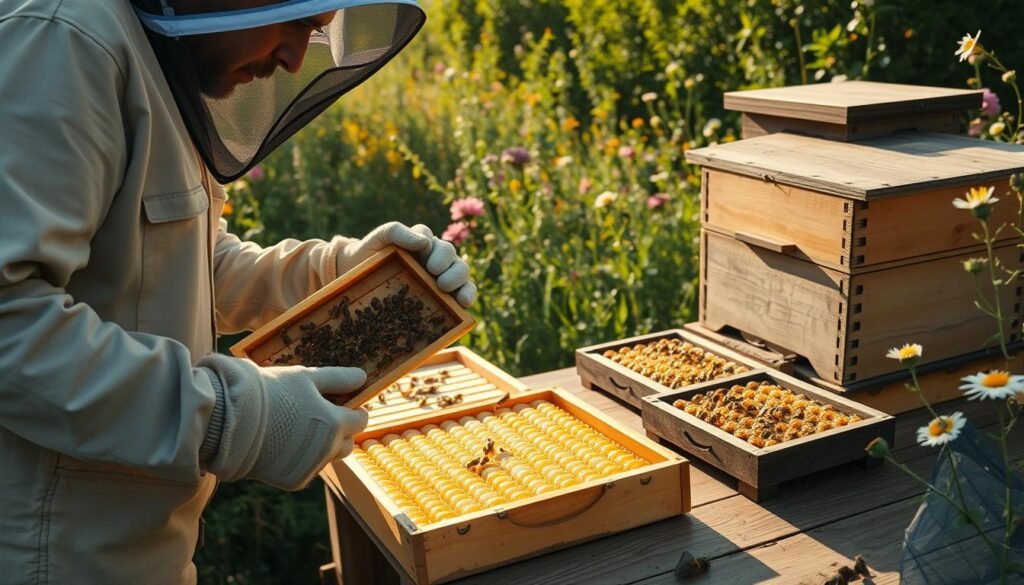
A walk‑away split shifts brood, stores, and nurses into a fresh box so the colony finishes the development of a new queen with minimal intervention. This low‑input approach works well during strong spring flows and when you want steady output without grafting.
Building the split: brood, pollen, honey, and nurse bees
Assemble a robust split with at least one frame of eggs and very young larvae, plus frames of open and capped brood, pollen, and honey. Back these with abundant nurse workers to keep brood temperature and feed developing cells.
Handling swarm cells vs. supersedure cells
Read cells carefully. Move the largest, most stippled swarm cell into the split and cull or redistribute extra cells to prevent multiple virgins fighting. Note location: bottom‑bar cells typically indicate swarm intent; higher cells often mean replacement.
Banking extra queen cells in cages for later use
If extra cells exist, place them in small cages inside a queenless, nurse‑rich, open‑brood “bank” box. That bank supplies resources and holds cells until you need more splits.
- Add a frame of fresh eggs when no cell is available so workers can raise a queen from larvae 4–20 hours old; expect eggs from her roughly day 23.
- Seed the split with open brood periodically to prevent laying workers and keep pheromones active.
- Close entrances before transport, ventilate, and consider relocating splits 2+ miles to reduce drifting back to the parent hive.
Inspect rapidly to confirm eggs or a laying female; if the new laying adult fails, recover by adding eggs, recombining by the newspaper method, or introducing a mated replacement.
Double Screen Setups for Swarm Control and Queen Rearing
A double screen creates a semi-isolated upper unit that encourages care for developing cells while limiting conflict with the original colony below.
How it works: The double screen isolates pheromones but lets warmth and odor rise. This keeps the upper box functional as a test unit while reducing immediate fighting or full separation.
Entrance orientation, nurse support, and recombining
Face the top entrance opposite the lower hive. This orientation encourages drift of nurse workers into the upper box to feed brood and tend a virgin during mating flights.
Build checklist for the upper box:
- Frames: one with fresh eggs, one or two with capped brood, and one with honey.
- Nurse density: transfer nurse-heavy frames to ensure temperature and feeding.
- Supplemental feed if nectar is light to protect production and cell development.
Decision flow: If eggs appear after expected mating, move the upper box as a new colony. If not, remove the screen to recombine and keep foragers and honey production intact.
“A screened trial lets you test new queens above a strong hive without losing spring momentum.”
| Goal | Top Box Setup | Inspection Cue |
|---|---|---|
| Test a virgin | Brood, honey, nurse frames, opposite entrance | Eggs appear within 7–10 days after mating |
| Reduce swarm pressure | Small split on double screen, fewer swarm cells below | Calm brood care vs. agitated, noisy workers |
| Quick recombine | Remove screen, reunite frames by newspaper method | Restored pheromone balance and resumed honey flow |
For a practical inspection schedule, see basic inspection cadence.
Step-by-Step Grafting Method for Raising Multiple Queens

Grafting offers a predictable, scalable route to raise many viable queens when timing and nurse support align.
Preparing the cell builder: Start with a five-frame builder. Center one frame with young brood and capped brood, add three frames of pollen and honey, and flood the box with nurse workers from 4–5 brood frames.
Selecting larvae and preparing cups
Confine the breeder queen day 1 to concentrate eggs. On day 3, graft 4–20‑hour‑old larvae that are barely curved. Use a lighted magnifier and Chinese grafting tool to lift each larva with a small spoon of royal jelly into pin cups spaced ~¾ inch on prepared bars.
Starter vs. finisher boxes and timing
Place bars in a densely populated starter box to stimulate feeding and initiation. After acceptance and initial tending, move bars to a finisher with steady food and nurses so cells are sealed.
- Inspect builders for rogue cells and remove older started cells before grafting.
- Keep graft bars warm, shaded, and covered; return donor frames promptly.
- Plan to move protected queen cells into mating nucs by day 14 to prevent early emergence in the builder.
“Rear more queens than you need; acceptance and mating vary, so extras protect production goals.”
| Step | Action | Timing |
|---|---|---|
| Select breeder | Confine queen to frame to concentrate eggs | Day 1 |
| Build starter | Five-frame builder, heavy nurses, pollen, honey | Day 2 |
| Graft | Transfer 4–20‑hr larvae into cups; keep warm | Day 3 |
| Finish | Move to finisher box; seal cells; transfer to mating nucs | By day 14 |
Align your schedule with local drone availability and weather. For expansion planning and scaling tips, see beekeeping expansion tips.
Timed Mating Nucs: From Protected Queen Cells to Laying Patterns
Timed mating nucs give you control over emergence, orientation, and an early read on laying success. Stage and paint each box exterior in different colors. Add unique landmarks so virgin bees learn their compartment. Stuff grass in entrances until you place cells.
Painting and orientation cues
Paint only exteriors. Color each side differently and add a visible marker. Place boxes near fixed features and at least 2 miles from donor hives to cut drift.
Day-by-day checkpoints
- Day 12–13: stock each compartment with three frames of open brood, stores, and strong bees.
- Day 14: install largest protected cells into nucs, then remove entrance grass.
- Days 23–28 from egg lay: inspect for eggs and a forming brood pattern to confirm mating.
Transferring new queens with cages
Move successful new queens into queenless splits for ~24 hours before introducing with cages. Use small protectors, marking pens, and gentle handling to avoid damage.
Checklist: cell protectors, cages, pens, record log. If eggs don’t appear, check presence, note weather delays, and deploy backup cells or mated replacements.
Assessing Queen Quality: Brood Pattern, Eggs, and Colony Behavior
A brief, well-timed check of eggs and capped cells gives an early read on colony strength. Inspect frames when bees fly, typically at or above 55°F, to avoid chilling brood and to see true pattern and activity.
Spotting a strong laying pattern and seasonal expectations
A strong laying pattern shows dense, concentric rings of brood with few empty cells. In season, capped brood may fill frames edge-to-edge. In winter, expect low brood and smaller coverage; this is normal.
Using adult population and nectar flow to gauge production
Match adult numbers to brood volume and local nectar flows. A large nurse population with expanding brood signals higher honey production potential and when to add supers.
- Inspection cue: find eggs by tilting frames with the sun at your back to confirm she can still lay eggs daily.
- Disease signs: discolored larvae or punctured cappings point to disease pressure, not just a bad laying pattern.
- Temporary dips: short dearths or cold days can reduce brood for a few days—confirm over multiple inspections before requeening.
“Combine pattern checks with disease inspections to protect production goals.”
| Assessment | What to look for | Action |
|---|---|---|
| Laying pattern | Dense concentric brood, minimal empty cells | Leave queen; monitor next 10–14 days |
| Low brood in season | Sparse frames despite warm weather | Check pollen/honey stores; consider feeding or adding nurse frames |
| Discolored or punctured brood | Off-color larvae, sunken/chewed cappings | Isolate signs, test for diseases, treat or consult lab |
| Adult-brood mismatch | High adults, low open brood during major flow | Super for honey, rebalance frames, or raise extra cells cautiously |
For detailed evaluation techniques and research-based guidance, see this practical review on evaluating queens.
39. queen rearing basics for U.S. beekeepers: A Practical Workflow
Start with a dated plan that ties each action to a clear calendar. This short workflow helps you move grafts, protected cells, and mating nucs on schedule and avoid lost windows.
Calendar at a glance: day 0 to day 28+
Day 0: graft or select eggs and larvae. Day 5–6: check acceptance. Day 8–9: expect capping. By day 14: move protected cells into mating nucs. Day 16: virgins may emerge. Day 23–28: confirm eggs and early laying to verify mating success.
Resource checklist: honey, pollen, nurse bees, drones
Must-haves: frames of honey and pollen, abundant nurse workers, drawn comb or open cups, and mature drones in the area before you start.
- Mating compartments, entrance reducers, cell protectors and cages.
- Label bars and boxes with dates to track transfers precisely.
- Feed lightly if nectar is scarce to protect brood temperature and cell development.
Manage congestion by adding space or drawn comb and timing splits to reduce swarming while channeling colony energy into production. Set acceptance thresholds (for example, percent of capped cells) to decide go/no-go and rear slightly more than needed, using banker units to hold extras.
For a full seasonal schedule, consult the beekeeping calendar to align dates with local flow and drone readiness.
Troubleshooting: Queen Loss, Laying Workers, and Requeening
Spotting a missing laying female early saves the colony from a long brood gap. Check frames for eggs first, listen for a low, “roaring” buzz, and scan for emergency cells starting within two days.
Diagnosing quickly and accurately
Fast diagnostics: no eggs, agitated worker behavior, and fresh emergency cells. If you find zero eggs over two inspections, treat as queenless and act to avoid adult losses and reduced honey yield.
Interventions: practical order
Try these steps, fastest to most certain:
- Introduce a frame of eggs or very young larvae to prompt nurses to raise a replacement.
- Recombine with a strong colony using the newspaper method to preserve brood and stores.
- Install a purchased mated female in an introduction cage; keep the box queenless ~24 hours before release.
Recognizing laying workers and salvage
Laying workers show multiple eggs per cell, drone-only brood and eggs on cell walls. Such colonies rarely accept a new mated female.
Salvage combs by shaking adults into a queenright hive and reuse frames cautiously after disease checks. Do not destroy capped cells if they are the colony’s best short-term recovery option.
“Track days since last observed eggs to choose the fastest, safest remedy.”
U.S. Conditions: Geography, Swarming Behavior, and Honey Production
Geography drives practical choices: timing, hive setup, and methods change from coast to mountain. Tailor queen work and inspections to local bloom calendars so new queens arrive before major nectar events and support strong honey production.
Temperate, tropical, and mountainous considerations
In temperate zones, plan rearing ahead of spring flows and watch for late frosts that delay mating flights. Tropical areas need ventilation and moisture control to prevent mold and heat stress. In mountains, protect against cold snaps and short flying windows; insulate boxes and time work around warm afternoons.
Swarm prevention: space management, cell checks, and timing
Prevent swarming by adding supers proactively during heavy nectar flows. Open space keeps the brood nest uncrowded and supports honey production.
- Tip the top brood box to scan bottom bars quickly for swarm cells.
- Use walk‑away splits or double screens when weather windows are short; scale to grafting in stable periods.
- Monitor drones seasonally—numbers rise before queen production and affect mating success.
“Count cells and schedule weekly checks during strong flows to act before swarming starts.”
Conclusion
Practical queen work blends biology, timing, and local weather. Align development windows with strong nurse populations, ample stores, and active drones to reliably raise new queens that boost colony health and honey production.
Choose methods—walk‑away splits, double‑screen setups, or grafting—based on goals and seasonal realities. Keep tight records so cells move on schedule and mating nucs are stocked at the right moment.
Evaluate laying patterns, brood health, and behavior to confirm queen quality and protect production. Test small changes, learn from local mentors, and scale what works across hives.
Plan your next cycle now: secure stores, nurse bees, and drone resources to strengthen your apiary and grow resilient, productive queen bees.
FAQ
What signals tell a colony to produce a new queen?
Colonies start raising a replacement when workers detect weak or absent pheromones, overcrowding, or queen injury. Look for queen cups, scattered brood, and reduced egg patterns. Swarming and supersedure both trigger queen cell construction, but their timing and placement differ.
How long does it take from egg to a new laying female?
From egg to adult emergence runs about 16 days for a queen, with larvae fed royal jelly and the cell capped roughly on day 8–9. After emergence, mating flights and sperm storage typically add 7–14 days before reliable egg laying begins, so expect a full cycle near 3–4 weeks under good conditions.
How does royal jelly change a larva’s development?
Nurse bees feed selected larvae abundant royal jelly, a protein- and lipid-rich secretion. This diet alters gene expression and physiology, producing larger ovaries and longer-lived queens. Nutrition, not genetics alone, determines queen versus worker development.
What is a walk-away split and when should I use it?
A walk-away split involves moving frames of brood, bees, honey, and pollen into a new hive box and leaving them to raise a queen from available young larvae. Use this method to prevent swarming or to expand colonies when you have adequate nurse bees and resources.
How do swarm cells differ from supersedure cells?
Swarm cells form along lower frame edges and indicate preparation to leave with part of the colony. Supersedure cells tend to appear near central brood when workers replace an aging or failing queen. Inspect cell placement and colony behavior to distinguish them.
What is the role of drones in queen mating and timing?
Drones provide the sperm a queen needs during mating flights, usually occurring when she is 5–14 days old. Successful mating depends on drone availability, weather, and geographic factors. Insufficient drone numbers or bad weather can delay or prevent successful mating.
How can I bank queen cells safely for later use?
Use queen cell cages or a protected nuc with plenty of nurse bees and food. Keep cells vertical and avoid jostling. Short-term banking (a few days) works best; extended storage raises mortality and reduces queen viability.
What is a double-screen setup and why use it?
A double-screen configuration separates brood and returning foragers while allowing nurse bee movement. It helps control swarming, supports queen rearing by concentrating nurse bees, and eases recombining colonies without immediate fighting.
When grafting, what larval age should I select and why?
Choose larvae less than 24 hours old for best acceptance in starter colonies. Young larvae are more likely to be reared as queens and accept the royal jelly diet. Using proper grafting tools and clean cups improves success rates.
What’s the difference between starter and finisher boxes?
A starter box contains strong nurse populations and open brood to accept grafts and begin cell development. A finisher box hosts capped cells and protects them until emergence, reducing cell loss and exposure to robbing or disturbance.
How do I introduce a newly mated queen to a hive?
Use an introduction cage with candy or a mesh barrier to allow gradual scent acceptance. Place the cage among brood frames and monitor for acceptance over 3–7 days, watching worker behavior and eventual egg laying as confirmation.
What indicates a good laying pattern and queen quality?
A strong queen lays compact, solid brood patches with few gaps and consistent egg placement. Seasonal expectations matter; expect larger patterns during nectar flows and smaller ones in dearth. Poor patterns suggest poor mating, disease, or age-related decline.
How can I detect queenlessness quickly?
Signs include spotty brood, absence of fresh eggs, and increased drone production. Workers may start building multiple emergency cells. Inspect frames for eggs and young larvae to confirm queen loss and act promptly to prevent laying-worker problems.
What options exist if a colony develops laying workers?
Laying workers produce unfertilized drone eggs and are hard to stop. Recommended actions include requeening with a mated queen, combining the colony with a strong queenright hive using the newspaper method, or using a frame of young brood to reset worker behavior.
How do geographic and climate factors in the U.S. affect queen rearing?
Temperate zones have distinct nectar flows and narrower mating windows; warmer or tropical regions can support year-round activity. Mountainous areas may limit drone congregation areas. Adjust timing, resource management, and swarm prevention to local conditions.
What basic calendar should I follow for raising a queen from day 0 to day 28?
Day 0: identify larvae or graft young larvae. Days 1–9: cell building and larval feeding. Days 10–16: capping and pupation. Day 16: emergence. Days 17–30: mating flights and onset of egg laying. Monitor and provide resources throughout.
What resources must I have before attempting queen production?
Ensure abundant nurse bees, frames with pollen and honey, access to drone-producing colonies for mating, and basic tools like cages, grafting tools, and protective equipment. Healthy stock reduces disease risk and improves success.
When should I purchase queens instead of raising my own?
Buy queens when time, weather, or local drone availability limits successful mating, or when you need specific genetics quickly. Commercial queens from reputable breeders like Brooks or Mann Lake can save time and increase reliability.
How do I prevent disease spread during queen rearing and transfers?
Use clean tools, avoid moving infected frames between hives, inspect for signs of pests and disease, and quarantine new stock. Regular hive hygiene and monitoring for Varroa, American foulbrood, and Nosema protect colony health.
What are common causes of mating failure and how can I reduce them?
Causes include poor weather, low drone density, or queen infertility. Improve outcomes by timing rearing to drone availability, using mating nucs in areas with known drone sources, and avoiding flights in cold or windy conditions.
How do I handle swarm prevention while raising queens?
Manage space with timely supering, perform regular inspections, remove excess queen cells if replacing a queen isn’t intended, and use splits to relieve congestion. Double-screen setups and timely brood manipulation also reduce swarm impulse.