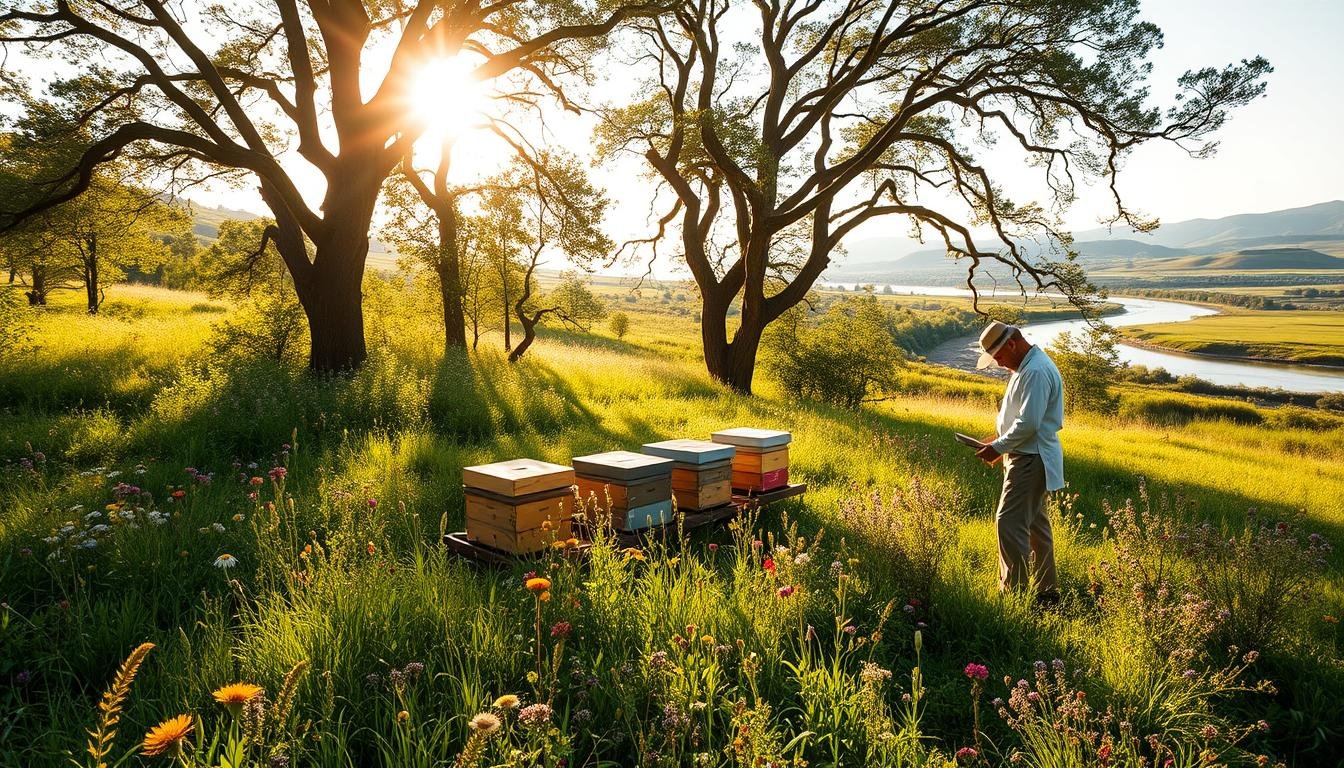
This guide helps U.S. beekeepers build a clear, repeatable decision process that balances honey goals and broader ecosystem health. It outlines placement, forage support, colony genetics, hive monitoring, and ethical steps that protect bee life and local pollinators.
Why act now: climate shifts and changing bloom times demand a systematic way to align choices to the environment and the wider world around your colonies. This guide offers evidence-based thresholds and bee-inspired communication rules to improve results over years.
Who benefits: backyard and sideline beekeepers, clubs, and groups seeking standardized knowledge and practical field tools. Expect clear metrics: survival trends, steady honey yield, fewer emergency interventions, and better forage near your hives.
Key Takeaways
- Use simple, repeatable rules for site selection and hive numbers to protect forage value.
- Track frames, brood cells, queen and drones to guide timely actions.
- Balance honey objectives with colony survival and local pollinator health.
- Standardize notes and annual review to improve results across years.
- Adopt evidence-based thresholds that reduce emergency moves and boost stability.
Why this guide matters now: aligning beekeeper goals with ecosystem health
A concise rule set helps prioritize survival, yield, and landscape value. This guide shows how to set clear goals so your choices support healthy bees and do not erode local habitat.
User intent and outcomes: balancing honey, colony survival, and environmental stewardship
What most beekeepers want: good honey returns, steady survival, and a healthy neighborhood for wild pollinators. Use a transparent decision framework that ranks survival first, honey second, and stewardship as a continuous aim.
- Recognize external pressures: volatile weather, pesticide exposure, and fragmented forage shorten response time and raise stakes for fast, clear decisions.
- Choose actions that stabilize forage and cut stress to improve honey quality indirectly while boosting long-term survival.
- Share knowledge with neighbors and growers and log simple metrics—survival rates, resource use, and honey variability—to measure value over time.
| Goal | Priority | Practical step | Metric |
|---|---|---|---|
| Colony survival | 1 | Reduce stocking density; add forage partners | Overwinter survival % |
| Honey yield | 2 | Timing of harvest; monitor resource use | Honey variability (lbs) |
| Landscape value | Continuous | Plant native flowers; share plans with growers | Local forage diversity |
For practical reference and further beekeeping resources guide, use this framework to act early. Small, diversified steps usually beat a single heroic move when conditions worsen.
Understanding hive minds: what colonies teach us about decisions and systems
Colony-level behavior gives practical lessons for how simple parts create complex, reliable systems. Bees operate without central control. Together they form an identity that guides work, memory, and response.
From superorganism to system: collective behavior, identity, and group intelligence
The hive functions as a superorganism: many individuals act as one. This group intelligence performs tasks no single bee could manage alone.
Historic work matters. Wheeler framed the superorganism idea. Wadey noted swarm identity and drift. Butler linked colony regulation to queen pheromones. Kevin Kelly later used network analogies to show how distributed nodes share knowledge.
- Emergent coordination yields efficient comb building, thermoregulation, and foraging.
- Collective memory stores profitable sources and threat cues across years.
- Drift—often by older foragers—shows why yard layout matters to protect hive identity.
Limits and risks: when groupthink undermines quality choices
Group intelligence can fail when signals degrade or dissent is suppressed. Guard bees may permit returners carrying resources, but poor cues still lead groups astray.
Practical takeaway: design your operation as a system. Align signals, roles, and information flow so the colony benefits from networked knowledge and human oversight.
“Distributed nodes share knowledge; the whole can be smarter than its parts.”
| Aspect | Colony effect | Practical action |
|---|---|---|
| Superorganism identity | Shared roles and memory | Keep consistent hive cues; minimize disruptive moves |
| Emergence | Efficient collective tasks | Observe patterns; copy reliable behaviors in yard layout |
| Drift | Wrong returns by older bees | Stagger entrances; vary hive markers to reduce mixing |
| Group limits | Signal decay and groupthink | Combine colony cues with periodic critical review |
Communication is everything: using bee information flow to guide your apiary
The colony’s information network runs on layers: dances, scents, and subtle vibrations. These channels let workers convert scattered forage into collective choices. Seeley’s work shows success grows from many honest interactions among individuals.
Waggle dance, pheromones, vibrations: multi-channel information exchange
The waggle dance encodes distance and direction to nectar and pollen with remarkable precision. Scouts repeat the signal so others verify the location before they commit.
Pheromones and substrate-borne vibrations spread cues through the hive. Together they mobilize colonies faster than any single channel can.
Actionable takeaway: build redundant, honest information pathways in your operation
- Favor honest signals: require corroboration before major action—two observers or one log plus one sensor.
- Build redundancy: back verbal notes with dated inspection records and shared digital logs to prevent data loss.
- Watch behavior: entrance traffic, dance frequency, and scent shifts are early warnings worth logging.
- Reduce signal pollution: avoid over-weighting a single report; seek cross-checks to prevent biased choices.
“Accurate, repeated signals let the hive choose well; biased signals degrade outcomes.”
For a deeper study on collective choices and honest recruitment, see Honeybee Democracy research.
Evidence-based decision-making: lessons from honey bee foraging research
Research in controlled arenas finds honey bees set dynamic thresholds that shape fast accepts and cautious rejections. These experiments show foraging choices depend on reward odds and cue clarity. That pattern offers a clear framework for field practice.

Speed-accuracy trade-offs and signal detection
Flight arena studies used colors tied to reward rates (100%, 66%, 50%, 33%, 0%). Bees weighed evidence and updated choices as samples accumulated.
Key result: fast accepts were often correct when signals were strong. Rejections needed stronger proof and were more error-prone when cues were weak.
Applying thresholds: when to accept or reject actions
Translate this into practice by defining what counts as a hit and what errors you can tolerate. Set dynamic gates: act quickly for time-sensitive tasks and demand more evidence for strategic moves.
- Prioritize repeatable forage signals: bloom density, nectar tests, and bee traffic.
- Log outcomes: track quick vs slow choices and their results to refine your threshold.
- Use simple sequential sampling: add observations until a preset criterion is met before final action.
“Treat provisional sites like a 66% example—sample more before full commitment.”
Making apiary decisions with ecosystems in mind
Start every action by checking the yard against a short, repeatable checklist that captures brood, stores, and bloom. A quick, consistent read reduces rushed interventions and keeps value for the local environment.
A step-by-step framework
- Assess conditions: inspect brood viability, queen signs, food stores, cells coverage, and nearby bloom using a frame-by-frame checklist.
- Define goals: set explicit targets for colony survival, honey yield, and ecosystem impact before choosing actions.
- Choose the lowest-impact way: prefer planting forage or shifting sites over immediate feeding or heavy interventions.
- Apply thresholds: record what evidence triggers action now versus a scheduled review; name the information source and responsible person.
- Run a risk screen: check effects on native pollinators, neighbors, and site ecology; proceed only if acceptable.
- Execute and document: log time, frames inspected, queen status, and expected outcomes for later review.
- Measure and review: compare results to goals, adjust thresholds, and update protocols.
- Communicate and institutionalize: share reasoning across the team and store protocols so systems retain value over time.
“Treat the yard as a learning system: clear records turn time into better choices.”
Site selection and hive placement: matching colonies to landscape and resources
Good placement starts with a map of flowers, water, and pesticide exposure across the bees’ range. A short, repeatable survey before placement reduces stress on colonies and nearby wild insects.
Flowers, nectar flow, and water: evaluating food systems and foraging range
Evaluate the forage base: record floral diversity, peak nectar times, and safe water access within the foraging range.
Anticipate seasonal shortages by choosing sites that host mid- and late-season blooms. Protect water sources near the site to lower foraging energy and keep bees out of neighbors’ pools.
Area capacity and numbers: avoiding overstocking to protect local insects
Right-size the site by matching hive numbers to area capacity. Only add a hive when forage evidence supports more colonies.
Use terrain and windbreaks for morning sun and afternoon shade to ease harsh conditions. Stagger entrances and vary orientation to minimize drift and disease transfer.
- Balance access and biosecurity: easy inspections plus adequate spacing.
- Communicate: coordinate spray schedules with nearby growers.
- Monitor post-placement: track entrance traffic, hive weight, and comb cells use over time.
“Match numbers to forage. Move or remove colonies when indicators fall below thresholds.”
Foraging ecology in practice: planning for food quality, diversity, and timing
Plan forage across the year so colonies never face sudden shortages. A short calendar and a few clustered plantings make the difference between steady growth and emergency feeding.
Seasonal blooms and gaps
Map bloom calendars to spot early, mid, and late flowers. Staged plantings smooth nectar flows and help avoid sharp dearths that reduce honey and weaken brood.
Coordinate with neighbors and land managers to create corridors. These connected hedgerows extend the foraging range and cut energy costs.
Native flowers and habitat patches
Prioritize native plantings that supply both pollen and nectar. Cluster beds into habitat patches so bees find quality food in fewer trips.
- Track returning pollen types and brood cell patterns as food indicators.
- Trigger supplemental feeding only after preset thresholds show low stores.
- Protect soil and water to maintain long-term flower quality.
| Planting Window | Example Species | Primary Benefit |
|---|---|---|
| Early season | Willow, Crocus | Spring nectar, supports first brood |
| Mid season | Sunflower, Clover | High nectar and pollen diversity |
| Late season | Aster, Goldenrod | Maintains stores into fall |
“Close the loop:” evaluate which plantings actually improved colony food and revise species lists each year.
Colony genetics and diversity: strengthening resilience for long-term survival
When queens mate with many drones, the hive gains adaptability that shows up as stronger brood and steadier survival. Genetic variety spreads risk and helps colonies resist disease and shifting weather.
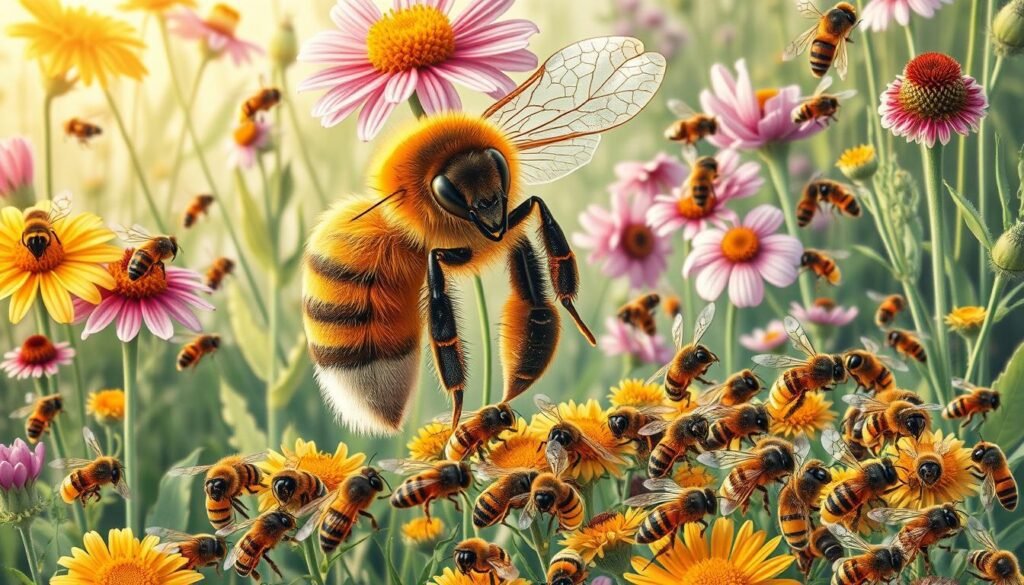
Value of diverse drones and queens
Prioritize queen lines known for stable brood pattern and hygienic behavior. A good queen improves honey and long-term quality more than a single big yield year.
- Frame the goal: increase genetic diversity so colonies adapt faster to disease and climate variability.
- Select queens carefully: choose stock with proven hygienic traits and steady laying over short-term gains.
- Value diverse drones: encourage mating with many drones to produce adaptive worker cohorts.
- Watch for queen failure: spot declining brood coverage, spotty cells, or drone-only laying early and requeen promptly.
- Time requeening: plan changes when nectar and weather favor quick acceptance to limit stress.
- Track outcomes: record lineage, disease incidence, and overwinter survival to refine choices.
| Trait | Benefit | Management action |
|---|---|---|
| Multiple mates | Higher disease resistance | Source queens from varied drone pools |
| Hygienic behavior | Lower brood disease | Test and select breeders |
| Staggered lines | Reduced collapse risk | Avoid single-line dominance |
“Strong queen pheromones support identity and cohesion; watch behavior during transitions.”
Monitoring the superorganism: reviewing colony health beyond honey yield
Small, frequent observations let you sense colony health before problems spike. Use short, consistent checks that combine frames, behavior, and counts. This keeps your review focused on long-term quality rather than a single harvest.
Brood pattern, queen quality, and drone presence: what frames and cells reveal
Inspect frames for continuous brood, worker-to-drone ratios, and cells coverage. Gaps, many drone cells, or spotty egg-laying point to queen issues.
Behavioral signals: foraging intensity, drift, and defensive responses
Watch entrance traffic and waggle cues to judge foraging. Note drift—often from older individuals—and record defensive spikes after disturbances. Alarm pheromone (isopentyl acetate) can prime behavior and skew readings after inspections.
Data cadence: weekly notes to track conditions, decisions, and results over time
Standardize information each visit: count frames of brood, nectar, pollen, and empty cells. Log acceptance or rejection of actions and why. Use weekly or biweekly reviews to spot trends and refine thresholds.
| Check | What to record | Action trigger |
|---|---|---|
| Brood & frames | Brood continuity, frame counts | Gaps >2 frames → evaluate queen |
| Behavior | Foraging traffic, waggle, defense | Sharp drop or alarm spike → investigate stores |
| Cells & drones | Drone ratio, empty cells | High drone % → consider requeening or genetics review |
“Consistent, honest reporting improves decision accuracy and long-term results.”
Risk management: preventing collapse and single points of failure
Early warning signs let you act before a colony loses momentum and collapses. Colony Collapse Disorder shows how broken communication and overlapping stressors can hollow hives quickly. A clear plan reduces the chance that one failure turns local trouble into total loss.
Early warnings: queen failure, communication breakdowns, and stress stacking
Identify leading indicators: spotty brood, weak pheromone signals, reduced dance activity, and erratic foraging. These signs warn that a hive is losing internal power and may need action.
Recognize stress stacking: poor nutrition, parasites, and pesticide exposure combine nonlinearly. Treat root causes early rather than patching symptoms.
- Reduce single points of failure: pre-plan requeening and spread resource frames across boxes.
- Build redundancy: duplicate equipment, cross-check logs, and train multiple helpers.
- Use time-based triggers: if a queen underperforms for a preset time, replace her before momentum is lost.
- Prioritize information integrity: cross-verify observations so one bad read doesn’t cascade.
- Stage interventions: start with the least invasive fix; escalate only after evaluation.
| Risk | Leading indicator | Action |
|---|---|---|
| Queen failure | Spotty brood, fewer eggs | Set 14–21 day trigger for requeening |
| Communication loss | Reduced waggle/dance signals | Increase inspections and cross-check with weight data |
| Stress stacking | Low stores, parasite signs | Address nutrition and varroa, avoid single-source forage |
“Honest, redundant information sharing lowers collapse risk; biased flows amplify it.”
Document near misses and stress-test your plan: ask how the operation responds if one hive fails, forage drops for weeks, or a key person is absent. Clear communication keeps responses fast and coordinated and protects honey, cells, and overall colony health.
Ethical trade-offs: balancing individual and group needs inside the hive
Scarcity exposes the trade-offs a hive accepts to preserve its collective identity. In low-food periods, colonies may evict drones and remove diseased workers. Those actions favor group survival over single members.
Resource scarcity decisions: learning from drones and worker behavior without copying ruthlessness
Observation helps, not imitation. Humans should note how bees act but avoid cruel shortcuts. Set ethical thresholds that protect both colonies and individuals when possible.
- Acknowledge natural behaviors: colonies prioritize the group and may expel drones under stress.
- Define your ethics: record limits on interventions that affect animal welfare and long-term value.
- Manage scarcity humanely: boost forage, reduce competition, and avoid measures that needlessly sacrifice individuals.
- Protect cohesion: reduce moves and flow disruptions that harm identity and trigger defensive reactions.
- Document and train: explain the rationale for any action and align helpers on acceptable practices.
| Situation | Colony response | Human alternative |
|---|---|---|
| Low stores | Drone eviction | Increase forage and feed reserves |
| Disease outbreak | Removal of sick workers | Isolate affected frames, treat and requeen if needed |
| Short-term dearth | Reduced brood production | Shift timing of interventions; protect cells and brood |
Measure success beyond yield: add welfare indicators to reviews and revisit policies over time. Transparent records and humane plans preserve both colony health and community trust.
Systems thinking for apiaries: from individual hives to regional ecosystems
Treat your yard as one node in a wider network where floral maps, land use, and weather shape outcomes.
Honey bee superorganism ideas show how emergent behavior outperforms single hive work. Honest information flows let small teams scale good choices across sites. That same concentrated power can strain local plants and native pollinators if stocking is too high.
Think across scales. Plan colony counts and forage projects so they help, not harm, regional biodiversity. Coordinate stocking with neighbors and stagger additions to reduce local pressure.
Group versus individual outcomes: aligning apiary power with local biodiversity
- Map flows: track resource inputs, honey harvests, and pollen types to find leverage points.
- Test pilots: run small trials, measure effects on native insects, then scale what works.
- Share formats: standardize notes so groups share knowledge fast across the landscape.
- Plan genetics: choose queen lines suited to the local climate to lower intervention needs.
- Monitor cells use and brood across the yard to spot system-level stress early.
| Focus | Benefit | Action |
|---|---|---|
| Local stocking | Protect forage | Coordinate numbers with neighbors |
| Shared data | Faster learning | Adopt common logs |
| Pilot tests | Lower risk | Measure native insect response |
“Small, aligned changes across yards yield bigger, lasting gains for bees and the wider environment.”
Operational honesty: accurate information improves collective outcomes
Network integrity rests on honest reports; biased signals steer operations toward poor choices. In honey bee colonies, honest scout recruitment leads groups to better nest sites. That same principle applies to any yard: accurate notes and consistent timing keep the team aligned.
Internal reporting and reviews: reduce bias to improve decision quality
Honest, multi-channel reporting underpins effective group choices. When observers record weights, brood, and behavior separately from interpretation, the system gains clarity.
- Establish honesty as policy: require factual inspection entries for frames, cells, queen status, and honey stores.
- Reduce bias: separate observation from opinion; use checklists and time-stamped logs.
- Structured reviews: hold regular sessions to compare notes, question assumptions, and align on actions.
- Dual confirmation: require two independent observations before high-impact interventions.
- Share results: publish outcomes so the team learns from wins and misses and improves future results.
- Train observers to recognize common behaviors and record consistent metrics over time.
“Calibrate enthusiasm to evidence: stronger proof earns stronger recommendations.”
| Practice | Why it matters | Action |
|---|---|---|
| Standardized checks | Reduces subjective reports | Use frame-by-frame checklist and log time |
| Multi-channel data | Cross-verifies signals | Combine visual inspection, weight, and notes |
| Scheduled review | Captures trends over time | Weekly review meeting and archive notes |
| Dual confirmation | Prevents single-point errors | Require two observers for major calls |
Close the loop: review whether reported information improved decisions and refine protocols accordingly. Over time, honest reporting builds shared knowledge that improves colony outcomes and preserves honey, queen health, and hive stability.
Seasonal playbook for U.S. conditions: decisions by time of year
Use a simple playbook keyed to bloom and weight so your choices match real hive signals, not the calendar. This keeps actions aligned to what the bees show and improves survival and honey quality.
Spring buildup — summer dearth — fall prep — winter survival
Spring: evaluate brood pattern, queen vigor, frames of food, and cells occupancy. Expand cautiously as flowers increase and nectar begins.
Swarm control: split early when clear signs appear. Faster action stops disruptive losses and protects long-term colony health.
Summer dearth: provide shade and water, avoid heavy honey harvests, and add targeted plantings to support foraging.
Fall prep: consolidate brood, confirm cells of stores, and assess queen performance. Treat problems while recovery time remains.
Winter survival: verify hive weight, insulation, and ventilation. Minimize disturbance and keep emergency food ready.
- Align plans to local bloom calendars and weather across your area.
- Watch nectar and flowers signals; super and harvest to flow, not date.
- Schedule season-bound reviews and keep a rolling log to refine the playbook.
| Season | Key checks | Trigger | Action |
|---|---|---|---|
| Spring | Brood, queen, frames | Poor brood pattern | Inspect queen; consider requeening |
| Summer | Weight, foraging, stores | Rapid store loss | Add feed; plant forage |
| Fall | Cells of stores, queen | Low cells occupied | Consolidate boxes; treat pests |
| Winter | Weight, ventilation | Low winter weight | Supplement food; reduce openings |
“Tune seasonal work to what the hive shows; data over dates builds resilient colonies.”
Community, policy, and shared knowledge: scaling good decisions
Neighbors, clubs, and agencies together amplify habitat value beyond any single hive. Build cross-sector partnerships to align planting, spray timing, and habitat preservation. Small, planned plantings near roadsides and fields add measurable forage across an area.
Partner locally: coordinate growers, gardeners, and agencies to reduce risk and extend forage. Share common inspection templates so knowledge travels across groups and years. Host short workshops to teach evidence-based methods and honest reporting.
Practical community actions
- Aggregate area data: map forage gaps and prioritize community plantings.
- Use policy levers: support incentives for pollinator-friendly practices and reduced-risk pest plans.
- Scale systems: replicate low-impact practices across operations to multiply value without multiplying harm.
- Coordinate emergency responses: share alerts on blooms, dearths, or disease spikes to sync mitigation.
“Club-level projects can deliver habitat value larger than any single operation.”
| Action | Who | Benefit | Measure |
|---|---|---|---|
| Shared inspection templates | Clubs & agencies | Faster knowledge transfer | Adoption across groups (count) |
| Community plantings | Growers & gardeners | Expanded forage | Acres restored |
| Policy incentives | Local government | Reduced pesticide risk | Programs funded / years |
For research on collective approaches and long-term landscape effects, see this community study at local landscape planning. Keep commitments public and track honey stability, cells use, and overwinter success to celebrate shared wins and sustain momentum.
Conclusion
Summarize seasonal outcomes so your bee work accumulates value across years. Keep short, honest notes that tie frames, brood, and cells to observable results. These records build real value over time and help your bees thrive.
Measure the long view: prioritize steady honey returns, healthier colonies, and fewer emergencies rather than one big season. Share findings so regional knowledge grows faster than any single hive can.
Pick one framework step to adopt this week and one partnership to start this month. For seasonal tasks and a simple checklist, see our seasonal beekeeping tasks guide.
Be honest in your notes: accurate observations and transparent decisions build trust and better outcomes. Thank you for your stewardship of bees and the wider world—please share what you learn so collective knowledge improves results for all.
FAQ
Why align beekeeper goals with ecosystem health now?
Aligning goals protects colony survival, improves honey quality, and sustains local biodiversity. Healthy landscapes provide diverse nectar and pollen, reducing disease stress on hives and improving long-term value for beekeepers and the wider environment.
How does user intent affect management outcomes?
Clear intent—whether prioritizing honey, pollination services, or conservation—shapes choices about genetics, stocking density, and interventions. Define outcomes first, then match practices like placement, monitoring cadence, and forage enhancement to those goals.
What can colonies teach us about group intelligence?
Colonies act as superorganisms: collective decision-making through waggle dances, pheromones, and task allocation yields robust responses to change. Observing these signals helps beekeepers adopt systems thinking and align management with natural behavior.
When does group behavior create risks?
Groupthink can push colonies into risky choices—like overforaging on poor resources or amplifying disease spread. Watch for synchronized stress signals, reduced foraging diversity, and narrow brood patterns as signs that the group is making suboptimal choices.
How should I use bee communication cues in my operation?
Monitor waggle dances for forage locations, track pheromone-driven changes like queenless behavior, and note vibration patterns that signal swarming or stress. Build redundant information pathways—visual checks, weighing hives, and regular inspections—to verify colony reports.
What actionable steps improve information flow on the farm?
Standardize inspection notes, weigh hives weekly, map forage patches, and keep simple records of queen status, brood pattern, and foraging intensity. Honest, timely data reduces bias and improves the quality of subsequent decisions.
How does foraging research inform practical choices?
Studies on speed-accuracy trade-offs show bees balance rapid decisions with reliable signals. Apply this by setting thresholds for actions—wait for consistent loss signals before requeening, or require repeated poor forage reports before supplemental feeding.
What is a practical threshold for management actions?
Use simple, repeatable metrics: persistent low hive weight over seven days, poor brood pattern across two inspections, or sustained low forager return rates. These thresholds prevent overreaction while catching real problems early.
What are the core steps in the recommended framework?
Assess site conditions, define clear goals, evaluate low-impact options, implement with monitoring, and review results. This cycle emphasizes resilience, minimal intervention, and alignment with local flora and fauna.
How do I evaluate sites and hive placement?
Prioritize shelter from wind, nearby diverse floral resources, clean water access, and sun/shade balance. Consider forage range and local carrying capacity to avoid overcrowding and negative impacts on other insects and crops.
How many hives are appropriate for a given area?
Match hive numbers to forage availability and seasonality. Overcrowding reduces food quality for bees and native pollinators. Start conservatively, monitor resource use, and adjust numbers based on measured forage flow and colony performance.
How do I plan for seasonal forage gaps?
Map bloom times, plant native flowers to fill gaps, and partner with growers or community gardeners. Stagger plantings to extend nectar and pollen availability through spring, summer, and fall.
Which plants most benefit bees and the ecosystem?
Native wildflowers, clover, goldenrod, and early-blooming trees boost nectar diversity and habitat patches. Diverse plantings support bees and other insects, improving pollination services and landscape resilience.
Why prioritize genetic diversity in colonies?
Diverse queens and drones increase disease resistance, behavioral flexibility, and long-term survival. Avoid overly uniform breeding; source queens from reputable suppliers and consider local stock adapted to regional conditions.
What colony signs should I monitor beyond honey yield?
Track brood pattern, queen laying quality, drone presence, foraging intensity, and defensive behavior. Frame-level observations and cell inspection reveal health issues earlier than weight alone.
How often should I record hive data?
Weekly notes provide a useful cadence to track trends without overhandling. Record weight, brood condition, queen status, forage returns, and any treatments to build an actionable dataset over seasons and years.
How can I reduce collapse risk and single points of failure?
Diversify queens, rotate apiary locations when feasible, maintain varied forage sources, and create redundancy in hive numbers. Early detection of queen failure or communication breakdowns lets you act before stress stacks into collapse.
What ethical trade-offs should I consider inside the hive?
Management choices often pit colony productivity against individual welfare. Favor practices that support brood health and genetic diversity rather than short-term yield gains that increase long-term risk.
How does systems thinking change apiary planning?
Systems thinking links individual hive outcomes to regional biodiversity. Plan stocking rates, forage enhancement, and interventions that support local insects and crops, not just isolated production targets.
How do I improve internal reporting to reduce bias?
Use simple templates for inspections, standardize terminology, and review data periodically. Honest reporting of failures and near-misses improves collective learning and decision quality.
What are seasonal decision priorities for U.S. beekeepers?
Spring focuses on buildup and queen quality, summer on managing dearths and pests, fall on honey harvest and winter prep, and winter on insulation and feed plans. Adjust actions to local climate and forage timing.
How can I work with community partners to expand habitat?
Partner with growers, extension services, and conservation groups to plant corridors, reduce pesticide risk, and align planting calendars. Shared knowledge and coordinated plantings expand forage and lower collective risk.
What simple metrics indicate long-term success?
Multi-year survival rates, steady or improving brood patterns, consistent honey quality, and positive effects on local pollinator diversity signal resilient operations. Track these alongside short-term yields for a full picture.