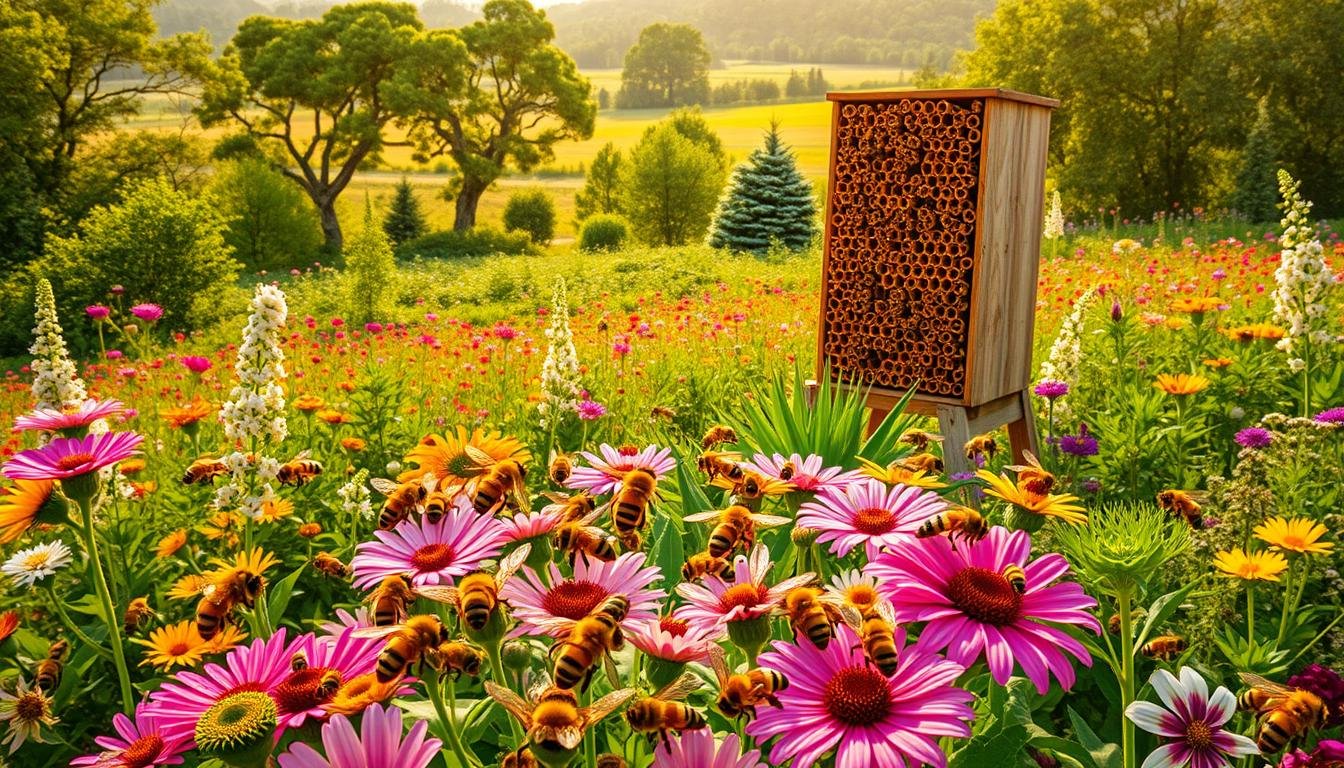
Pollination connects farms, forests, and daily meals. In the United States today, bees support crops, wildflowers, and the trees that rebuild forests. More than 20,000 species exist worldwide, with about 4,000 native to the U.S., so not only honey producers matter.
These insect partners affect 35% of global farmland and back 87 leading food crops. In the U.S., their pollination adds roughly $15 billion in crop value each year and supports over 130 fruits, vegetables, and nuts.
Their services extend beyond yields. They help regenerate maples, willows, and cherries, keeping forests healthy and wildlife fed. Declines in bee populations pose an urgent threat to supply stability, carbon storage, and soil protection.
This article previews species diversity, how pollination works, economic value, current stressors, and practical steps readers can take. For background on how these connections shape conservation and farming, see our about page.
Key Takeaways
- Bees link agriculture and forests through essential pollination services.
- Over 20,000 species exist; about 4,000 are native to the U.S.
- U.S. crop pollination by bees contributes roughly $15 billion annually.
- Their work supports forest regeneration and broader biodiversity.
- Declines in bee populations threaten food security and ecosystem health.
- Practical actions can help stabilize pollination services and local landscapes.
Bee ecosystem roles at a glance
From orchards to urban gardens, pollinators enable plant reproduction that underpins food and habitats.
What “ecosystem roles” means for bees and plants
Ecosystem services here describe the work insects do to move pollen so flowers can set fruit and seed. This service links farms, wildlands, and city gardens.
Bees act as keystone pollinators. They sustain reproduction for crops and native plants, which keeps forests and meadows productive.
Why this matters now in the United States
Pollinators affect about 35% of global cropland and support 87 major crops. In practical terms, one in three bites of food ties back to their work.
Healthy bee populations support yield, quality, and variety for U.S. diets. Their services also help soil stability, wildlife food, and carbon storage through plant growth.
- Services vary by region and season with bloom cycles and local communities.
- Disruptions—pesticides, habitat loss, and extreme weather—reduce pollination and plant recruitment.
- Land use and policy choices can strengthen or weaken these services nationwide.
| Service | Impact on People | Vulnerability |
|---|---|---|
| Crop pollination | Higher yields and better fruit quality | Pesticide exposure, monocultures |
| Wild plant reproduction | Forest regeneration and habitat support | Habitat loss, climate shifts |
| Soil and carbon benefits | Improved soil cover and carbon storage | Reduced plant diversity, extreme weather |
The many species of bees and why diversity matters
A wide mix of native pollinators keeps bloom seasons covered and seed set steady across landscapes.
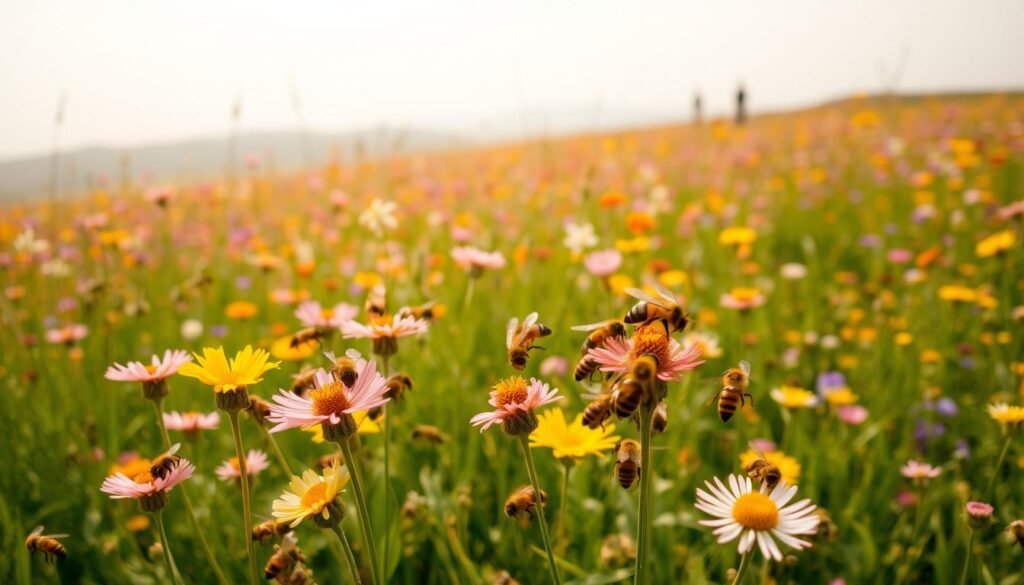
20,000 species worldwide, 4,000 native to the U.S.
The world hosts over 20,000 species, and roughly 4,000 native species live in the United States. These range from social bumble groups to solitary miners and leafcutters. Each group has distinct behavior, flight timing, and habitat needs.
Diversity of species vs. abundance: different plants, different pollinators
An abundance of one pollinator cannot replace many specialists. Research shows plant biodiversity depends on both abundance and species mix.
- Different species match flower shape, color, and bloom timing.
- Some forage early in spring; others peak later, so diversity buffers seasonal gaps.
- Nesting strategies—ground-nesting and cavity-nesting—need varied habitat features on farms and in towns.
Monitoring populations and tracking species composition helps managers adapt planting and pesticide practices. Conserving species diversity supports steady yields and reliable fruit set in specialty crops across U.S. regions.
For planting mixes and habitat planning that favor a wide array of native pollinators, see resources at Beekeepers Realm and the Forest Foundation family forest blog.
| Feature | What to provide | Benefit |
|---|---|---|
| Flower variety | Native plant mix across seasons | Continuous forage for many species |
| Nesting habitat | Bare ground patches and hollow stems | Supports ground and cavity nesters |
| Reduced pesticides | Targeted use, timed applications | Lower mortality, healthier populations |
| Monitoring | Regular surveys of species and numbers | Informs adaptive land management |
How bees power pollination and food systems
From blossom to harvest, pollination determines yield, quality, and variety in American food systems.
Pollinators affect 35% of agricultural land and many key crops
Pollinators influence about 35% of global agricultural land and underpin core produce such as almonds, berries, apples, and cucurbits.
One in three bites of food and over 130 U.S. varieties
Roughly one in three bites of food eaten in the United States depends on pollination. Over 130 U.S. crop varieties benefit from insect pollination, adding roughly $15 billion in annual crop value.
From pollen to plate: how behavior drives yields
Bees transfer pollen from anther to stigma, enabling fertilization and fruit formation. Adequate pollen deposition improves seed set, uniform fruit size, and shelf life.
Foraging traits—flower constancy, buzz pollination, and daily activity peaks—make bees efficient across diverse fields. Managed honey bees and wild pollinators complement one another to stabilize services when weather or bloom timing changes.
| Process | Effect on crops | Management tip |
|---|---|---|
| Pollen transfer | Higher fruit set and uniformity | Match hive placement to bloom |
| Foraging behavior | Consistent pollination across flowers | Provide floral diversity and hedgerows |
| Timing synchronization | Reliable yields across seasons | Plan plantings to extend bloom windows |
Maintaining healthy bees and pollinator habitat reduces production risk and supports long-term farm resilience. Healthy bee populations help keep food varied and affordable.
Beyond crops: bees, forests, and wild ecosystems
Pollination in wildlands ensures young trees recruit and diverse plant communities persist across forests. These processes link spring bloom to long-term habitat structure and wildlife food chains.

Tree and forest regeneration
Many trees depend on insect visits to set seed and spread. Species like red and sugar maples, willows, basswood, cherry, sweetgum, yellow poplar, and sycamore rely on pollination to renew stands.
- Bee-mediated pollination helps mixed-age forests persist by enabling seedlings to replace aging trees.
- Flowering trees anchor habitat for birds, mammals, and beneficial insects by providing food and nesting resources.
- Spring tree blooms give early nectar and pollen that sustain pollinators before crops flower.
About 75% of North American plant species depend on insect pollination, highlighting how central these visitors are beyond agriculture.
Supporting wildlife, soil health, and carbon storage
Greater plant diversity improves soil fertility, lowers erosion, and boosts water filtration. Robust mixed stands sequester more carbon over decades than simplified forests.
- Understory flowers and edge habitats provide continuous forage and nesting resources.
- Integrated practices — selective thinning and native understory plantings — increase light and floral resources for pollinators.
- Maintaining healthy bee populations strengthens landscape-scale biodiversity corridors.
Stewardship that widens floral cover and protects nesting sites delivers co-benefits for wildlife conservation, climate mitigation, and long-term forest resilience.
Economic value of bees in the U.S. and worldwide
Reliable pollination delivers measurable dollars to farms, processors, and grocery shelves every year.
In the United States, insect pollination supports about $15 billion in direct crop value and helps produce more than 130 varieties of fruits, nuts, and vegetables. When pollinator effectiveness is counted across supply chains, analysts estimate roughly $18 billion in added crop revenues each year.
$15B in U.S. crop pollination plus honey and wax revenues
Apicultural products add a measurable income stream. Combined honey and beeswax sales generate about $700 million annually across food, cosmetic, and pharmaceutical markets.
Those farm-gate figures multiply through packing, transport, and retail. Stable pollination reduces yield swings and quality losses, which helps growers secure contracts and plan investments in orchards and vineyards over multiple years.
Global economic contribution of pollinators
Worldwide, pollination services are a major component of food trade. Conservative estimates put annual global pollinator value near $217 billion, while FAO-derived ranges for pollinator-dependent crops sit between $235 billion and $577 billion per year.
- Specialty crop infrastructure: States such as California, Washington, Michigan, and Florida rely heavily on dependable pollination for exportable commodities.
- Long-term benefits: Consistent pollination improves planning, lowers risk, and supports multi-year returns on perennial systems.
Protecting pollination services is both an environmental and economic priority. Strengthening these services is a cost-effective lever for national food security and for keeping rural economies resilient. For deeper scientific background, see this report on pollinator health at pollinator health research.
What’s driving bee population decline
A web of agricultural, chemical, climatic, and biological pressures is driving declines in pollinator numbers.
Industrial agriculture and monocultures
Large-scale farming narrows floral variety and bloom timing. Monocultures limit pollen amino acid diversity and weaken colonies by creating seasonal forage gaps.
Reduced natural cover also fragments habitat, cutting nesting sites and continuous forage across landscapes.
Pesticides and neonicotinoids
Widespread pesticide use raises toxicity and causes sublethal harm to navigation and immunity.
Research shows neonicotinoids have increased agricultural toxicity to pollinators roughly 48-fold over 25 years, compounding long-term effects.
Climate and extreme weather
Heat waves, droughts, and floods disrupt foraging, nesting, and brood development.
Phenology shifts—earlier blooms or delayed flowering—can decouple floral resources from peak pollinator activity.
Parasites, pathogens, and the stress cocktail
Mites, larval infections, and viruses exploit colonies weakened by poor nutrition and chemical exposure.
Combined stressors raise mortality risk more than any single driver alone. Transporting hives for crops adds stress and disease spread.
| Driver | Primary effect | Management note |
|---|---|---|
| Industrial agriculture | Reduced floral diversity; seasonal gaps | Restore field edges and native strips |
| Pesticides | Acute and sublethal toxicity | Use targeted, timed applications |
| Climate extremes | Mismatch of blooms and activity | Plant diverse bloom windows |
| Parasites & disease | Higher colony loss when combined with other stressors | Integrate health monitoring and reduced transport |
Addressing these factors together is essential. For research-backed guidance on what drives decline, see the extension work on factors contributing to bee decline.
Colony Collapse Disorder and other risks
When thousands of workers vanish overnight, the consequences ripple through farms and forests. Colony Collapse Disorder (CCD) refers to the abrupt loss of worker bees while the queen, brood, and a few nurse bees remain. This pattern differs from expected winter losses because it removes active foragers and disrupts colony function quickly.
What CCD means for food security and pollination
CCD has multiple suspected causes. Pesticide exposure, pathogens, poor nutrition, transport stress, and changing weather are all implicated. These interacting factors make diagnosis and prevention complex.
Managed honey bees are vital for many high-value U.S. crops. Large CCD events reduce available pollination, which can lower yields, raise production costs, and strain supply chains.
- Early detection: monitoring and data sharing help identify warning signs.
- Best practices: integrated pest management and reduced chemical loads cut colony stress.
- Research needs: disentangling factor interactions and building resilient management are priorities.
Protecting bee health strengthens agricultural production and wild ecosystems alike.
Collaboration among growers, applicators, and beekeepers during bloom seasons is essential to lower seasonal risk and stabilize pollination services.
Regional context: native U.S. bees and habitat change
Native pollinators rely on a patchwork of meadows, hedgerows, and field margins that are vanishing fast.
Conversion of diverse land into uniform cropland, roads, and housing reduces seasonal forage and safe nesting sites for many species.
From wildflower meadows to farmland edges: shrinking habitats
Meadows, prairies, and field margins provide nectar, pollen, and nesting substrate such as bare soil and hollow stems.
Across regions, conversion to corn and soy, invasive plants, and turf replaces this variety. The result is fewer continuous blooms and strained bee populations.
International data are a warning: the UK lost about 97% of its wildflower meadows since the 1930s. The U.S. Fish & Wildlife Service notes similar habitat declines across North America.
How land management and urban growth impact pollinators
Municipal planning and roadside management can either shrink or expand pollinator corridors.
- Positive actions: diversified hedgerows, cover crops, and riparian buffers on working land strengthen networks between patches.
- Threats: urban expansion and infrastructure fragment sites and allow invasive plants to dominate, cutting floral diversity.
Climate shifts add stress by changing bloom timing across microclimates. Connectivity and varied plantings help buffer those effects.
Community science and local mapping can guide restoration, showing where to protect nesting substrates like bare soil, dead wood, and cavities.
Improved stewardship of private and public land delivers co-benefits such as erosion control, better water quality, and richer wildlife habitat.
Actionable ways to support bees today
You can boost local pollination by choosing the right plants and changing simple land practices. Small changes at home, on farms, and in public spaces add up fast.
Plant diverse, native species that bloom across seasons
Plant regionally native flowers and shrubs to provide nectar and pollen from early spring through late fall. Aim for a variety of bloom shapes and colors to serve many pollinators.
Open canopy and sunlight: forest and yard practices
Light and early-successional habitats sustain spring bloom. Responsible thinning and small canopy openings create sunny patches that flower-rich understories need.
Reduce or eliminate pesticides; choose targeted, expert-guided treatments
Avoid broad-spectrum pesticides when possible. If treatment is required, use timed, targeted applications guided by professionals to limit harm during peak bloom.
Provide nesting resources and plant trees
Leave patches of bare soil, dead wood, and hollow stems for nesting. Planting flowering trees expands major nectar sources and supports wider seasonal variety.
Community-level initiatives and policy support
Mobilize school gardens, roadside native plantings, and local ordinances that favor pollinator habitat. Join monitoring programs and tree-planting efforts to scale impact.
| Action | Primary benefit | Quick tip |
|---|---|---|
| Regionally native plantings | Continuous forage for many species | Mix spring-to-fall bloomers; see native guides |
| Reduced pesticide use | Lower acute and chronic harm | Consult extension or certified applicator |
| Nesting and trees | Improved nesting and major nectar sources | Keep dead wood, plant flowering trees, add bee hotels |
Small, cumulative actions—from meadow strips to targeted plantings—help stabilize local pollination services and strengthen bee populations. For planting ideas, see a guide to native bee friendly plants, and practical campaigns at help save the bees.
“Neighborhood efforts and informed land choices can restore diverse floral sources and resilient pollination.”
Conclusion
Investing in pollinator habitat protects crop value, forest seedlings, and neighborhood greens.
Bees and other pollinators drive pollination that supports over 130 U.S. crops and adds about $15 billion to farm value each year. They also help trees like maples and willows reproduce, which stores carbon and stabilizes soil.
Diverse species keep blooms serviced across seasons. That diversity buffers against climate shifts, disease, and the increased pesticide exposure tied to modern agriculture.
Take action: plant native flowers, reduce chemical use, keep nesting sites, and add flowering trees. Community programs and smart policy can scale these steps.
Protecting pollinators is both an environmental and food-security strategy; monitoring and research will help adapt management as conditions change.
FAQ
What does "ecosystem roles" mean for bees and plants?
It refers to the many ways pollinators interact with plants and habitats — transferring pollen, supporting seed set, and enabling plant reproduction. These activities sustain wildflower populations, forest regeneration, and crops that people and wildlife rely on.
Why does this matter now in the United States?
Changing land use, intensive farming, pesticide use, and climate impacts are reducing habitat and forage quality. That combination weakens pollinator populations, which threatens crop yields, food variety, and native plant communities across regions.
How many bee species are there and how many are native to the U.S.?
Scientists describe roughly 20,000 species worldwide, with about 4,000 native species in the United States. That diversity includes solitary and social species, each adapted to different plants and habitats.
Why does species diversity matter more than just abundance?
Different species visit different flowers, times of day, and habitats. High diversity ensures pollination for a wider range of plant species and improves resilience when some pollinator populations decline.
How much of agriculture depends on pollinators?
Pollinators affect about 35% of global agricultural land and contribute to roughly three-quarters of the world’s food crops. In the U.S., many fruits, vegetables, nuts, and specialty crops rely heavily on effective pollination.
What does "one in three bites of food" mean?
It means that roughly one-third of the variety in the human diet comes directly or indirectly from pollinated crops. Over 130 U.S. crop varieties benefit from pollinators, affecting nutrition and market diversity.
How do pollinators actually improve crop yields?
By moving pollen between flowers, they increase fertilization rates, fruit set, and seed quality. Better pollination often raises both quantity and quality of harvested produce.
Beyond crops, how do pollinators support forests and wildlands?
They enable seed and fruit production in trees like maples, willows, basswood, and cherries. That supports forest regeneration, wildlife food sources, and structural diversity that stores carbon and stabilizes soils.
What is the economic value of pollination in the U.S.?
Pollination services are estimated to add roughly billion annually to U.S. crop production, with additional value from honey, beeswax, and related products that support rural incomes and supply chains.
How do pollinators contribute to the global economy?
Worldwide, the services provided by animal pollinators support billions in agricultural output and underpin many industries tied to food, horticulture, and ecosystem services such as carbon sequestration and soil health.
What are the main drivers of pollinator population decline?
Key drivers include industrial agriculture and monocultures that cut floral diversity, routine pesticide exposure (including neonicotinoids), climate-driven extremes like heat and drought, and disease or parasite pressures that combine to weaken colonies.
What role do pesticides play in declines?
Pesticides can kill or sublethally impair insects, reduce reproductive success, and interact with pathogens to increase mortality. Repeated exposure and residues in pollen and nectar magnify long-term impacts.
How does climate change affect pollinators?
Warming temperatures and altered precipitation change flowering times and habitat suitability, cause heat or drought stress, increase extreme events, and can create mismatches between pollinators and the plants they service.
What is Colony Collapse Disorder (CCD) and why is it important?
CCD describes sudden, widespread losses of managed honey bee colonies where workers disappear or fail. It highlights threats to managed pollination services and raises concerns for food security and hive-based livelihoods.
How is habitat change affecting native U.S. pollinators?
Conversion of wildflower meadows to cropland, urban sprawl, and removal of hedgerows and field margins shrinks nesting and foraging sites. This loss fragments populations and makes recovery harder.
How do land management and urban growth impact pollinators?
Practices that remove floral diversity and nesting sites — like eliminating flowering field edges or excessive lawn maintenance — reduce available resources. Thoughtful planning and green infrastructure can reverse some impacts.
What practical steps can landowners and gardeners take to help pollinators?
Plant a variety of native, season-long bloomers; provide bare ground, stems, or nesting blocks for nesting; reduce or eliminate pesticide use; and incorporate trees and shrubs that offer nectar and pollen.
What forest and yard practices support pollinators?
Open canopy management to allow sunlight, retaining wildflower patches, and limiting intensive understory clearing all increase forage and nesting opportunities for many species.
How should pesticide use be managed to protect pollinators?
Use integrated pest management guided by experts, apply targeted treatments only when needed, choose less toxic options, and avoid spraying during bloom or when pollinators are active.
What community and policy actions make the biggest difference?
Supporting habitat restoration, planting pollinator corridors, funding research, and adopting pollinator-friendly agricultural incentives all scale impact. Local ordinances that protect wildflower areas and limit harmful chemicals help too.