Last Updated August 26, 2026
Habitat fragmentation splits once-continuous areas into isolated patches, changing how species move, breed, and survive. This division reduces connectivity and raises barriers to dispersal, which undermines population stability and long-term persistence.
Today, intensified human land use creates smaller, more isolated forest and habitat areas across the United States. Research shows fragmented areas hold about 12.1% fewer species than intact sites, and over 70% of remaining forest lies within 1 km of an edge where degradation accelerates.
These edge effects expose interior wildlife to heat, wind, invasives, and human pressures that lower habitat quality. Fractured environments disrupt mating, recolonization, and genetic exchange for colonies and metapopulations that need connected space for breeding and foraging.
This report pairs current snapshots with long-term experiments to guide conservation planning. It previews definitions, global extent, drivers, mechanisms, biological consequences, and practical solutions aimed at restoring connectivity where gains are largest.
Key Takeaways
- Fragmentation reduces species richness and connectivity, threatening colony viability.
- Most forested areas are near edges, increasing exposure to degrading forces.
- Loss of movement and gene flow raises extinction risk for isolated groups.
- Conservation must combine landscape-scale planning with local habitat restoration.
- Data and experiments together inform targeted actions for greatest connectivity gains.
Executive overview: present-day trends in habitat fragmentation and conservation risk
Today’s maps show interior forest blocks shrinking as margins push inward. Core areas are smaller and perimeter zones are expanding, raising exposure of native species to altered microclimate and human activities.
Key signals
Key signals: increasing edges, shrinking interiors, rising isolation
Global analysis reports that over 70% of remaining forest lies within 1 km of an edge, and nearly 20% is within 100 m. Small, isolated patches show the strongest biodiversity losses, with declines reported from 13–75% in different studies.
Why this matters now
Why this matters now for biodiversity, ecosystems, and communities
Isolation reduces movement and lowers the chance that local losses will be recolonized. This raises demographic and genetic risks that speed toward extinction for tiny fragments.
European assessments link transport networks and intensive agriculture to growing isolation, but targeted crossings can reduce road collision and reconnect habitat.
| Signal | Headline data | Conservation note |
|---|---|---|
| Edge expansion | 70%+ forest within 1 km of an edge | Prioritize interior restoration |
| Biodiversity loss | 13–75% species decline in fragments | Protect larger patches first |
| Drivers & fixes | Roads/agriculture; wildlife passages help | Use targeted analysis to guide action |
Bottom line: Rapid change has raised conservation urgency. Rigorous analysis and targeted action at edges, corridors, and nodes will deliver the best gains for species and people. For regional detail see the European assessment.
Defining habitat fragmentation versus habitat loss and degradation
When once-unbroken habitat becomes a patchwork divided by human land use, species face new limits on movement. This distinction matters for policy and action.
What fragmentation is and isn’t: area, isolation, and edge
Habitat fragmentation is the breaking apart of continuous habitat into separate patches. It differs from loss, which reduces total area, and degradation, which lowers habitat quality.
Three core components explain the process: reduced area per patch, increased isolation between patches, and more edges relative to interior. These drive different biological responses and management needs.
A highway that slices a forest can split populations and raise mortality even when nominal habitat acreage stays similar. Roads add crossing risk and block movement, isolating groups on each side.
| Term | Definition | Metric |
|---|---|---|
| Area loss | Reduction in total habitat | Hectares lost per year |
| Isolation | Distance between patches | Nearest-neighbor distance (m) |
| Edge proliferation | Higher edge-to-core ratio | Edge-to-interior ratio (%) |
Management should diagnose whether declines stem from area, isolation, edge effects, or interacting factors. Quantifying fragment size, distance to the nearest patch, and edge-to-interior ratios enables targeted conservation aligned with experimental evidence.
Global extent of fragmentation: from contiguous habitats to edge-dominated landscapes
A global pattern now places large shares of forest near edges, shrinking true interior habitat. More than 70% of remaining forest lies within 1 km of an edge, and nearly 20% sits within 100 m. These distances matter because many interior-dependent species need deeper core areas to persist.
Data snapshot: forest edge proximity and regional contrasts
The Brazilian Amazon still contains big blocks, but interior forest beyond 1 km fell from about 90% historically to roughly 75% today. By contrast, the Atlantic Forest shows a dramatic collapse: areas farther than 1 km dropped from 90% to under 9%, and most fragments are now under 1,000 ha.
The Congo Basin remains a crucial holdout of contiguous forest. Southeast Asia, New Guinea, and boreal zones hold more disjunct patches and smaller fragments, increasing local vulnerability.
Why size and distribution matter for action
Fragment size and arrangement strongly predict ecological outcomes. Small patches lose species faster, and high edge-to-core ratios alter microclimates and species movement.
- Most forest is edge-influenced, raising susceptibility to degradation.
- Protecting large interiors and reconnecting small fragments offers the biggest biodiversity returns.
- Spatial analysis guides where corridors, crossings, and restoration will best restore core habitat.
Primary drivers shaping fragmented landscapes
A mix of roads, farms, and extraction projects increasingly carves natural cover into smaller, isolated patches.
Urban growth and transport corridors
Roads, railways, and pipelines physically bisect habitat, increasing collision mortality and blocking animal movement. These corridors turn once-permeable land into hard barriers and raise edge-to-core ratios that change local conditions.
Resource conversion and water infrastructure
Agriculture and resource extraction replace hospitable matrices with hostile uses. Dams and diversions interrupt river continuity, cutting off migratory fish and riparian species from critical spawning and feeding areas.
Natural disturbances and climate stress
Fires, floods, and shifting rivers naturally create patchiness. Climate change increases the frequency and intensity of these events, deepening breaks in cover and accelerating isolation of remnant pockets.
Conflict and enforcement gaps
Armed conflict and weak governance permit unregulated clearing, illegal extraction, and poaching. This compounds other factors and leaves enforcement too thin to protect remaining areas.
“Transportation networks are a dominant driver, but targeted passages and bundling infrastructure can reduce new splits.”
Strategic response: prioritize avoidance, minimize new divisions, apply targeted offsets, design climate-resilient siting, and foster cross-sector collaboration. For detailed mitigation examples see the transportation mitigation review.
Core mechanisms: area loss, isolation, and edge effects
When patches get smaller, their ability to support stable populations falls quickly. Long-term studies show reduced area and greater isolation lower residency, movement, and recolonization. Abundance drops across birds, mammals, insects, and plants.
Isolation and reduced movement: barriers to recolonization
Isolation cuts immigration rates and weakens gene flow. Small, distant fragments rarely receive new individuals. That limits recolonization after local extinctions and raises extinction risk.
Edge effects: altered microclimate, vegetation, and predation pressures
Edge effects change light, wind, temperature swings, and moisture. These shifts favor pioneer vegetation and reduce large, late-successional trees. Nest predators often hunt near margins, lowering reproductive success for sensitive birds.
| Mechanism | Primary effect | Management response |
|---|---|---|
| Reduced area | Lower carrying capacity, higher extinction risk | Enlarge patches, secure cores |
| Isolation | Limited immigration and gene flow | Create corridors and crossings |
| Edge effects | Microclimate change, pioneer vegetation, higher predation | Buffer planting, edge restoration |
- Diagnose which process dominates: area, isolation, or edge.
- Use microclimate and seed-predation rates as early-warning indicators.
- Apply corridors, crossings, and edge buffering to restore functions.
How landscape fragmentation impacts colonies
Local breeding groups need enough connected habitat to find food, water, and mates. When usable area falls, group size drops and demographic risks rise.
Population size, breeding access, and dispersal constraints
Smaller patch size cuts the number of adults a site can support. Low numbers increase chance events can wipe out a group and make mate-finding harder.
Isolation limits movement between patches. Fewer immigrants means weak recruitment and slower recovery after losses.
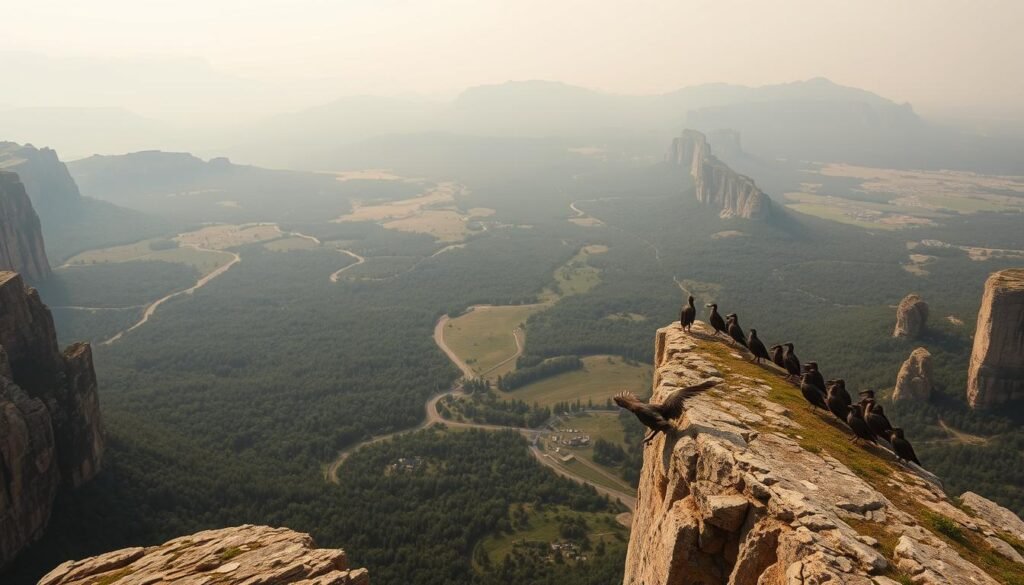
Sub-populations and genetic diversity: inbreeding and extinction risk
Split sub-populations often show reduced heterozygosity and more inbreeding. That raises disease vulnerability and the risk of local extinction.
Philopatric species are especially at risk when traditional nesting sites become inaccessible.
- Solution: design corridors and safe crossings to restore movement and gene flow.
- Monitor: track population structure and gene flow to test whether connectivity works.
- Plan: tailor corridor length and placement to species dispersal distances.
| Threat | Effect on group | Conservation action |
|---|---|---|
| Reduced area | Smaller local population size | Protect and enlarge core patches |
| Isolation | Reduced recruitment, inbreeding | Install corridors and crossings |
| Infrastructure mortality | Higher direct deaths (vehicles, fences) | Mitigate with passages and barriers |
Biodiversity consequences across taxa and communities
Breaking continuous habitat into smaller pieces often triggers rapid turnover in local species and community roles. Long-term studies record consistent declines in richness, with experiments showing losses from about 13–75% depending on biome and context.
Meta-analyses report fragmented areas hold roughly 12.1% fewer species than intact equivalents. That decline hides shifts in composition: interior specialists fall out while generalists and edge-tolerant species rise.
Species richness declines and community turnover
As large, old trees and late-successional plants disappear, plant communities shift toward pioneer types. This reduces structural complexity and the niches available to specialist species.
Community turnover can mask functional loss: total species counts may stay similar while the species that remain provide fewer key roles.
Trophic disruptions: predators, prey, herbivory, and seed dynamics
Edges change predator access and feeding patterns. For example, reduced bear presence in forest cores can allow herbivore increases that alter stream nutrient inputs and aquatic food webs—an instructive example of cascading change.
Edge proliferation also modifies seed predation and herbivory rates. In some sites seed predation falls while fledgling predation rises, disrupting regeneration and long-term biomass retention.
- Rates of biodiversity loss often accelerate over time, creating ecological debt.
- Managers should monitor both richness and composition to detect hidden functional losses.
- Restoring interior conditions helps retain sensitive species and stabilize communities.
Ecosystem functions at risk: biomass, nutrient cycling, and services
When habitat breaks into small pockets, the flows of nutrients and water that support plant growth slow and become uneven.
Carbon and nitrogen retention, productivity, and pollination impacts
Smaller patches often show lower biomass accumulation and reduced rates of carbon and nitrogen retention. That lowers long-term productivity and the capacity of an ecosystem to store greenhouse gases.
Edge-driven microclimate shifts change vegetation structure and species interactions. Pollinators move less through isolated patches, which can cut pollination rates and seed set for many plant species.
“Functional declines can lag years behind habitat change, creating an accrued ecosystem function debt.”
| Function at risk | Typical effect | Conservation response |
|---|---|---|
| Biomass accumulation | Lower live mass and wood density | Restore interior habitat to increase core area |
| Nutrient retention | Greater loss of carbon and nitrogen | Buffer planting and soil management |
| Pollination | Reduced visits and seed set | Connect floral patches and protect pollinators |
Functional losses weaken resilience to drought, fire, and disease. Active land stewardship that expands interiors and reconnects patches restores key processes and the services communities rely on.
Time-lagged impacts: extinction debt, immigration lag, and function debt
Present fragment patterns often forecast losses that appear only years later. Long-term experiments record a delayed cascade: species declines, slowed arrivals, and weakening processes that do not show up immediately.
Extinction debt describes species losses already set by current patch configuration. Studies report future losses from about 20% up to 75% over years to decades. In some cases, average loss exceeded 50% within ten years.
Immigration lag slows recovery. Small or isolated fragments accumulate new species more slowly. That limits rebound after disturbance and keeps richness lower than intact areas for long periods.
Ecosystem function debt means biomass, nutrient retention, and pollination often decline after a delay. Functions erode even when species counts seem stable at first.
“Time-lag dynamics show that current patch conditions foreshadow future biodiversity and function losses.”
- Assess debts with long-term monitoring and trend analysis.
- Prevent further isolation and enlarge key patches now to cut future losses.
- Model lag-aware scenarios and use them in planning; see a detailed review in connectivity analysis.
Tracking effect sizes and change rates over time gives early warning and makes proactive action more cost-effective than delayed responses. Safeguarding source patches and stepping-stone habitats reduces immigration lag and lowers the eventual extinction number across the landscape.
Sector and biome lenses: forests, grasslands, freshwater, and urban edges
Sectors from forestry to cities reveal how corridor loss reshapes species and services. This section summarizes biome-specific symptoms and practical fixes tailored to each setting.
Forests
Interior loss elevates edge influence. In tropical forest patches, reduced size and growing edges drive loss of large, old trees and shift communities toward pioneer vegetation.
That change alters insect communities and reduces functions tied to mature trees, such as high-canopy nesting and carbon storage.

Rivers and water
Dams and diversions sever river continuity and block fish migration. Flow-dependent habitats shrink and species lose access to spawning and feeding areas.
Grasslands and rangelands
Grassland corridors have narrowed across much of the United States. Wide-ranging species now face longer, riskier moves between seasonal foraging grounds.
Urban edges
Urban edges raise collision rates and limit access to water and food for wildlife. Green gaps and roads channel animals into dangerous crossings.
“Targeted, biome-specific reconnection restores movement and reduces mortality.”
- Design riparian reconnection to restore river flows and migration.
- Use grassland easements and stepping stones to link rangeland forage patches.
- Install canopy bridges and retain large forest interiors to protect mature trees and dependent species.
- Integrate land and water connectivity planning and add urban green infrastructure to soften edges.
| Biome | Main threat | Key action |
|---|---|---|
| Forest | Interior loss, tree dieback | Protect cores; canopy bridges |
| Freshwater | Blocked migration | Remove barriers; fish passages |
| Grassland | Corridor gaps | Conservation easements; stepping stones |
| Urban | Collision and resource loss | Green corridors; safe crossings |
Regional case snapshots: lessons transferable to the United States
Comparison and targeted analysis of international pilots reveals practical tools U.S. planners can adapt to reconnect habitat and reduce human-wildlife conflict.
Europe: hotspots, policy tools, and a practical example
Fragmentation is highest in Benelux, Malta, Germany, and parts of France. Scandinavia and the Scottish Highlands show lower pressure and offer reference models for preserving intact areas.
Policy instruments include formal defragmentation strategies, wildlife tunnels and overpasses, and bundling infrastructure to limit new divides.
A clear example is the Netherlands’ badger passage program. That initiative used culverts and fenced guidance to reduce road mortality and support population recovery.
Africa and Asia: corridors for wide-ranging species
Initiatives such as IFAW’s Room to Roam secure transboundary movement for elephants and other species. In India, designation of 101 elephant corridors aims to keep migratory routes open and cut conflict.
“Cross-border coordination and community stewardship are central to lasting corridor success.”
| Region | Main approach | Transferable lesson |
|---|---|---|
| Europe | Passages, bundling, policy | Prioritize retrofits at collision hotspots |
| Africa | Transboundary corridors | Co-management across borders |
| Asia (India) | Corridor designation | Use data to site protections and reduce conflict |
- Integrate connectivity into transport planning and permit reviews.
- Engage landowners for easements and local stewardship.
- Site crossings with movement and collision data to maximize benefit.
For U.S. management, combine community engagement, targeted retrofits, and policy frameworks that mainstream connectivity into environmental review. These steps help secure land and restore movement across the environment.
Connectivity solutions: from wildlife corridors to defragmentation policy
Targeted infrastructure retrofits and habitat rebuilding can turn isolated islands into functioning networks. Practical connectivity blends engineered crossings with habitat recovery and policy that prevents new breaks.
Corridors, crossings, and bundled infrastructure
Corridors provide safe movement paths; overpasses, underpasses, and canopy bridges reconnect core areas and cut road mortality.
- Design structures to fit species—large mammals need wide overpasses; small mammals and amphibians use culverts and tunnels.
- Bundle new roads and utilities to limit additional divides and reduce cumulative edge effects.
Restoration and rewilding to rebuild interior habitat
Rewilding expands cores and buffers edges by restoring native vegetation and removing barriers. This increases habitat quality and supports return of interior specialists.
Management processes: prioritizing fragments by size, isolation, and edge
Prioritize investments with a scoring framework that ranks fragments by size, isolation, and edge-to-interior ratios. Focus first on large cores and stepping stones that yield the biggest conservation return.
- Integrate connectivity into transport, energy, and urban land planning.
- Use telemetry, genomics, and collision data to align corridors with real movement paths.
- Apply adaptive management, public-private funding, and community governance to sustain long-term results.
“Multi-species, data-driven designs and inclusive governance deliver durable connectivity gains.”
Metrics to watch in the present: indicators for conservation management
Timely indicators make it possible to spot accelerating habitat loss and prioritize on-the-ground responses. Clear metrics let agencies link field actions to outcomes. Use a consistent set of indicators to guide management decisions and trigger rapid response when trends worsen.
Edge ratios, size distributions, and isolation indices
Edge-to-interior ratios signal interior loss. Standardize this metric to detect core shrinkage and prioritize core expansion.
Track fragment size distributions to find areas dominated by small patches. Use nearest-neighbor distances and graph connectivity as isolation indices. These measures show where stepping stones or corridors are most needed.
Movement, collision data, and population trends
Integrate telemetry, camera traps, and collision records to map real movement routes. Monitor wildlife-vehicle collision rates to site retrofits at hotspots.
Pair population trend data with connectivity metrics to assess demographic responses to management actions.
| Indicator | Key value | Use |
|---|---|---|
| Edge-to-interior ratio | % interior area by patch | Prioritize core restoration |
| Fragment size distribution | Number and size of fragments | Target landscapes dominated by small patches |
| Isolation index | Nearest-neighbor (m); graph score | Map corridor and stepping-stone needs |
| Movement & collision rates | Telemetry detections; collisions/year | Site crossings and evaluate retrofits |
| Population trends | Annual change in abundance | Link demography to management |
Practice tip: report the same number values consistently, set thresholds for action, and update land-cover change models regularly to keep management adaptive.
Conclusion
Fragmentation remains a central conservation challenge that shapes species, ecosystems, and communities across the landscape.
Current edge-dominated patterns and isolation foreshadow future declines if we delay decisive action. Time-lagged change means losses set today will appear tomorrow.
Addressing this challenge restores movement, breeding access, and genetic flow. Proven solutions include corridors, engineered crossings, defragmentation policy, and rebuilding interior habitat through restoration.
Prioritize fragments by size, isolation, and edge to use resources efficiently. Integrate connectivity into land and infrastructure decisions, sustain standardized monitoring, and foster cross-jurisdictional collaboration and community stewardship.
Protecting and reconnecting habitat now will stabilize biodiversity and ecosystem function and position the United States to lead with data-driven, scalable solutions.
FAQ
What is the difference between habitat loss and habitat fragmentation?
Habitat loss removes area outright, while habitat fragmentation breaks remaining habitat into smaller, isolated pieces. Loss reduces total area available to species. Fragmentation changes patch size, increases edges, and raises isolation, which alters microclimate, species interactions, and movement. Both reduce population viability but act through different processes and require different conservation responses.
Why do edge effects matter for conservation?
Edge effects change light, temperature, humidity, and wind at fragment borders, favoring invasive plants and predators and stressing interior specialists. These shifts reduce nesting success, alter plant regeneration, and accelerate biomass and nutrient loss. Managing edges—through buffers, restoration, or reducing disturbance—helps protect interior habitat and ecosystem services.
How does fragmentation reduce genetic diversity?
Smaller, isolated sub-populations experience less gene flow and more inbreeding. Over time genetic drift removes variation, lowering adaptive capacity. Reduced diversity raises extinction risk from disease, climate change, and stochastic events. Corridors, translocations, and larger protected areas help maintain connectivity and genetic exchange.
What are primary human drivers of fragmented habitats?
Major drivers include urban expansion, roads and railways, agricultural conversion, mining, and water infrastructure like dams. Resource extraction and development create new edges and barriers. Policy gaps and conflict can accelerate fragmentation by reducing enforcement and enabling unplanned land conversion.
How widespread is edge-dominated forest globally?
Recent analyses show a large share of remaining forests lie close to edges; over 70% of many forested areas occur within one kilometer of an edge. This pattern concentrates degradation, reduces intact interiors, and places most biodiversity at greater risk than simple area estimates imply.
Which species groups suffer most from fragmentation?
Forest interior specialists, large mammals with wide ranges, migratory fish blocked by dams, and species with limited dispersal suffer disproportionately. Pollinators and seed dispersers decline where plant communities change. Some generalist or edge-tolerant species may increase, shifting community composition and trophic dynamics.
What is extinction debt and why is it important?
Extinction debt describes the delayed loss of species after habitat changes. Populations may persist for years before collapsing due to reduced area, isolation, or degraded demographic rates. Recognizing debt motivates proactive conservation to prevent future losses rather than waiting for declines to become obvious.
How can connectivity be restored effectively?
Effective restoration mixes approaches: establish wildlife corridors and crossings, remove or retrofit barriers, reconnect riparian zones, and scale up rewilding to rebuild interior habitat. Prioritize actions using metrics like fragment size, isolation, and edge-to-interior ratios. Local stakeholder engagement and long-term monitoring are essential.
What metrics help managers track fragmentation impacts?
Useful indicators include fragment size distribution, edge-to-interior ratio, isolation indices, movement data from GPS tags, collision and mortality rates near infrastructure, and population trend monitoring. Combining remote sensing with field surveys yields the best picture for prioritizing interventions.
Are there effective policy examples for defragmentation?
Yes. The European Green Belt initiative and wildlife crossing programs in the United States and Spain show how planning, protected-area networks, and infrastructure design can reconnect habitats. African and Asian corridor projects for elephants and carnivores also demonstrate cross-border collaboration and targeted land management.
How do fragmentation and climate change interact?
Fragmented landscapes limit species’ ability to track shifting climate zones and reduce resilience to extreme events. Smaller, isolated patches hinder range shifts and genetic adaptation. Restoring connectivity and larger intact areas increases landscape resilience to climate-driven change.
What role do rivers and freshwater systems play in connectivity?
Rivers act as movement pathways for fish and many terrestrial species that use riparian corridors. Dams and channelization fragment these routes, block migration, and alter flow regimes. Protecting and restoring river continuity and floodplain habitats is critical for aquatic and linked terrestrial communities.
How should managers prioritize fragments for action?
Prioritize based on size, degree of isolation, edge severity, and species or ecosystem service value. Use spatial analyses to identify keystone fragments that boost connectivity and targets where restoration yields high return for biodiversity and carbon storage. Engage local communities to align conservation with livelihood needs.
Can small reserves still support viable populations?
Some small reserves can sustain populations of certain species, especially if they connect to larger patches or function as stepping stones. However, viability declines for area-sensitive species. Small reserves work best as part of a network that supports movement and genetic exchange.
What monitoring is most informative after interventions like corridors or crossings?
Track movement data (camera traps, GPS collars), species abundance and reproductive success, vegetation recovery, and collision or mortality rates. Long-term monitoring captures delayed responses and guides adaptive management to refine corridor placement and restoration techniques.