Pollination links plant genes across fields and orchards. Animal pollinators move pollen that reshuffles traits, and this process supports resilience in U.S. agriculture.
Honey bees and wild pollinators service fruits, vegetables, oilseeds, and nuts. Their visits affect seed set, fruit quality, and the genetic mixing that underpins long-term crop strength.
More visits often raise outcrossing rates, heterozygosity, and useful trait variety in managed systems. That shift has clear economic value: billions in crop output and higher stability for growers.
This article previews evidence from almonds, apples, cucurbits, oilseed rape, and sunflower. It also outlines colony genetics, queen breeding, semen import, and conservation tools that protect pollination-driven variation.
Key Takeaways
- Pollination drives gene flow that boosts crop resilience and trait mix.
- Both honey bees and wild pollinators are needed for strong genetic outcomes.
- Visit rates link directly to seed traits and hybridization in many crops.
- Economic stakes are high: pollination supports billions in U.S. production.
- Management, breeding, and policy can protect pollination-driven variation.
Pollination, gene flow, and why crop genetic diversity matters today
Pollen transfer by foragers reshapes gene pools and boosts adaptive traits in agricultural stands.
From anthers to stigmas: how cross-pollination reshuffles genes
Pollination is the movement of pollen from anthers to stigmas. Animal visitors, particularly bees, carry grains that enable cross-pollination and blend alleles among neighboring plants.
That mixing raises heterozygosity and adaptive potential. Sequential visits create pollen carryover, so one forager can link many flowers and expand effective neighborhood sizes.
Linking genetic variety to yield stability, quality, and resilience
Outcrossing typically increases when insects visit compared with wind or selfing. Higher outcrossing boosts seed viability, uniform set, and tolerance to pests and weather swings.
- Bees service about 87 high-value crops worldwide and improve fruit, nut, and oil quality.
- Without animal pollination, global production would drop roughly 5–8%.
- Diverse pollinator guilds sustain gene flow across fragmented systems and support steady supply chains.
Management note: gene flow yields resilience but can affect cultivar purity, so growers need informed practices to balance benefits and risks.
The role of bees in crop genetic diversity
Targeted foragers shift pollen between specific cultivars, driving useful genetic exchanges across fields.
Animal pollinators tend to move pollen with greater precision than wind or water. Bees carry focused loads between nearby flowers and can bridge distant rows. Wind dispersal is diffuse and unpredictable; that limits targeted gene flow among selected varieties.
Cross-pollination, seed set, and heterozygosity
Bee visits increase cross-pollination rates in orchards and row systems, which raises seed set and boosts seed number per fruit. More seeds often signal successful fertilization and greater allele mixing.
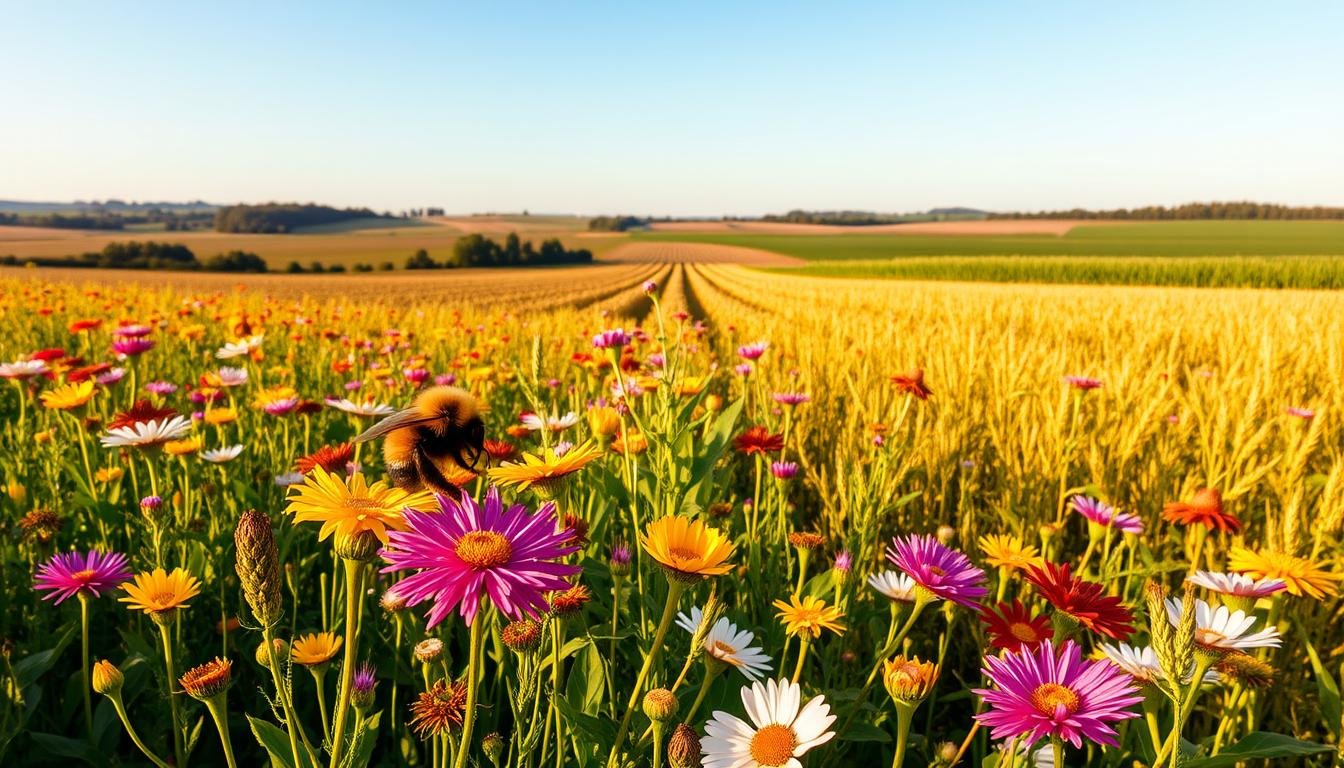
Managed hives combined with robust wild bee communities can raise hybrid prevalence dramatically — for example, a five-fold rise in hybrid sunflower when both groups are present.
- Floral traits like nectar and scent coevolved to guide foragers and enhance transfer efficiency.
- Hedgerows and field margins create movement corridors that shape pollen routes and gene flow at landscape scale.
- Where wind suffices (cereals), animal vectors matter less; specialty fruits, nuts, and many vegetables depend on insects.
Economic note: insect-assisted production fetches a higher per-ton value (about EUR 761) versus non-insect crops (about EUR 151), reflecting quality and genetic benefits.
Honey bee and wild bee synergy in driving plant genetic mixing
When managed hives and wild foragers work together, pollen transfer becomes both more frequent and more varied.
Complementarity means one group provides many visits while another adds varied foraging styles and timing. This mix doubles pollination rates in some studies and raised hybrid sunflower prevalence five-fold in U.S. trials.
Mechanisms include heterospecific pollen transfer, differences in floral constancy, and handling times that affect how much viable pollen lands on stigmas. Temporal and spatial niche partitioning broadens pollen networks across fields and hedgerows.
Mixed assemblages increase robustness: combined communities buffer seasonal declines and stabilize gene flow. Better habitat and semi-natural patches boost wild bee numbers and improve outcomes for managed seed production systems.
- Wild foragers can enhance cross-compatibility during staggered bloom periods.
- Some competition occurs, yet facilitation often yields net gains for hybrid formation.
- Policy incentives that fund habitat and monitor visitation help confirm functional synergy at site level.
Western honey bee and other key pollinators: characteristics that shape gene flow
Foraging ranges and recruitment behavior in honey colonies link distant plant patches and seed parents.

Apis mellifera at colony scale
Apis mellifera shows social foraging, waggle-dance recruitment, and strong floral constancy. These traits focus pollen transfer onto chosen cultivars and improve targeted outcrossing.
Colonies forage across several kilometers. That range connects blocks, hedgerows, and remnant habitat, so pollen moves farther than individual worker flights suggest.
“Honey bees contributed roughly USD 11.68B to U.S. agriculture in 2009, reflecting broad service value.”
Wild pollinators as complementary partners
Wild species vary in tongue length, body size, and nesting. This diversity expands daily coverage and floral handling styles. Together with managed hives, wild foragers stabilize gene flow under bad weather.
- A combined assemblage raised hybrid sunflower prevalence five-fold in field trials — a clear example.
- Colony strength timed to bloom windows boosts outcrossing; density affects stigma saturation and pollen carryover.
- Colony health and nutrition change foraging breadth and activity, altering patterns of gene exchange.
Practical note: monitor visitation rates and pollen deposition metrics to tune stocking and habitat supports for stable pollination services.
From visitation to variation: how bee behavior influences crop genetics
Foraging routes shape how far pollen moves and which varieties get mixed.
Distance, networks, and pollen carryover
Long flights and route fidelity expand a gene flow radius, letting single workers bridge rows and blocks. Repeated visits carry mixed-donor loads; each successive contact deposits layered pollen that raises heterozygosity potential.
Timing, weather, and outcrossing
Daily foraging rhythms and weather swings shift when and where pollination happens. Overlapping bloom windows across varieties align with forager routines to maximize outcrossing during peak activity.
- Core versus peripheral floral links set which cultivars get bridged.
- Resource pulses drive recruitment and steer pollen flow direction.
- Individual choices and colony-level dances diversify pollen sources.
“Linear increases in cucurbit yields with honey bee visits show a clear behavior-to-outcome link.”
Management levers include hive placement and habitat corridors to guide movement. Seed paternity assays help measure outcrossing and match observed behavior to genetic outcomes. Monitor stressors that shrink ranges; they constrain mixing and reduce adaptive growth.
Evidence from crops: almonds, apples, berries, oilseeds, and more
Field trials link visitor frequency to measurable gains in fruit set and seed traits across several species.
Tree fruits and nuts: seed number, fruit set, and hybrid signals
Orchard studies show seed count per fruit rises with visitation rates. More seeds often mean better fertilization and improved uniformity.
Almonds depend heavily on managed hives. One study found a 60% rise in fruit set and a 20% gain in kernel yield when honey bee access was optimized.
Watermelon, pumpkin, and cucurbits: dose-response with visits
For watermelon and pumpkins, fruit set, size, and seed number increased linearly with honey bee visits. This dose-response gives growers a clear stocking target.
Oilseed rape and sunflower: yield and seed trait improvements
Oilseed rape trials reported up to 37.5% higher yields where pollinators had full access. Sunflower hybrid seed production rose dramatically when wild and managed pollinators acted together.
- Apples: more seeds per fruit linked to better storage and market quality.
- Strawberries, cherries, blueberries: quality and sugar content improve with good pollination.
- U.S. relevance: cranberries and blueberries show clear production gains under active visitation.
| Crop | Key outcome | Reported gain |
|---|---|---|
| Almonds | Fruit set, kernel yield | +60% set; +20% kernel |
| Watermelon/Pumpkin | Fruit size, seeds | Linear increase with visits |
| Oilseed rape | Seed per pod, yield, oil content | Up to +37.5% yield |
| Sunflower | Hybrid seed efficiency | Up to 5× with mixed pollinators |
Practical note: regular field monitoring helps match colony stocking to target production and quality metrics. Good pollination management converts visits into measurable farm-gate value.
Economic stakes of pollination-driven diversity in the United States
Annual pollination services underpin billions in farm receipts across U.S. specialty production.
Value and scale: Pollination adds roughly USD 16 billion each year to U.S. agricultural production. About USD 12 billion of that stems from managed honey bee activity; wild pollinators contribute over USD 1.5 billion for a set of key crops, with apples alone valued near USD 1.06B.
Better seed set and uniformity lower field culls and raise pack-out rates. That improves farm revenue and reduces handling and storage losses.
Where dollars concentrate
High-dependency sectors include almonds, apples, blueberries, pumpkins, and several oilseed systems. These areas show both direct revenue gains and avoided costs such as reduced thinning and improved shelf life.
- Stable gene flow supports reliable year-to-year production and steadier supply chains.
- Market premiums follow better size, firmness, and oil profiles linked to good pollination.
- Demand for rental services grows as acreage and specialty mixes shift.
“Investing in habitat and hive management returns measurable economic and genetic dividends.”
Regional impact: Value concentrates in specialty regions, so rural economies and beekeepers gain when pollinator populations and resources are protected. Policy and on-farm investment remain high-return levers to secure long-term production and market stability.
Bee colonies, queen genetics, and within-colony diversity affecting plant outcomes
Genetic mix inside hives shapes worker behavior and seasonal service delivery.

Polyandry, colony health, and consistent pollination activity
Polyandry means queens mate with many males. That creates multiple patrilines and boosts within-colony diversity. Diverse worker teams resist infections better and sustain steady foraging during bloom.
Research links higher patriline variety to lower pathogen loads and faster colony growth. A healthy honey bee colony keeps flight rates reliable, which supports consistent pollination across acres.
Queen breeding practices and downstream effects
U.S. queen production concentrates on a narrow set of mothers. Fewer than 500 queen lines produce roughly 900,000 daughters yearly. That limited pool risks uniform susceptibility across colonies and the pollination services industry.
- Breeders who select for foraging vigor and brood timing help align hive activity with crop bloom.
- Record-keeping on lineages and field performance guides better stocking and breeding choices.
- Collaboration among beekeepers, breeders, and growers secures resilient systems and steady gene flow to crops.
“Robust foraging by diverse colonies creates stronger genetic mixing in fields, which benefits growers.”
Managed pollination systems and the beekeeping industry’s role
Coordinated movement of apiaries aligns colony strength with narrow bloom windows for high-value crops.
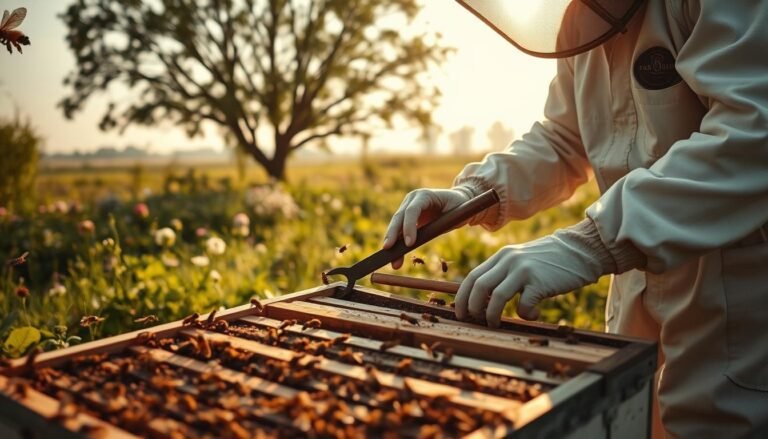
Migratory logistics require timing stacks: pre-bloom stimulation, rapid transport, and on-farm placement to match peak floral resources. Honey bee colonies are often boosted before early almond bloom to hit target activity levels.
Managed systems connect distant growing regions. This linkage promotes broad-scale gene flow and helps maintain cultivar compatibility across landscapes.
Service design and operational controls
- Service contracts set stocking densities, placement rules, and shared risk terms between beekeepers and growers.
- Placement strategies — edge rows, wind-buffered sites — influence pollen movement and outcrossing at field scale.
- Mitigation for stressors (transport fatigue, poor nutrition, pesticide exposure) preserves pollination performance and colony growth.
| Factor | Practical action | Impact on pollination |
|---|---|---|
| Timing & bloom tracking | Data-driven scheduling with weather and bloom models | Maximizes effective visits during peak receptivity |
| Stocking density | Agreed colonies per acre in contracts | Controls visit frequency and pollen saturation |
| Forage supplementation | Planting cover crops, hedgerows, feeding before/after service | Supports nutrition and recovery, sustaining services |
Almonds set the annual cadence: this largest pollination event shapes planning for many specialty crops. Coordinated scheduling across seasons keeps gene flow continuous and predictable.
Grower incentives and contingency plans for bad weather or transport delays help protect outcrossing targets and share risk fairly between growers and beekeepers. Learn more from trusted beekeepers at beekeepers.
Genetic resources of the honey bee: subspecies, stocks, and U.S. programs
U.S. beekeeping draws on several Apis mellifera lineages that differ in behavior, seasonality, and climate fit.
Historic stocks: Italian (ligustica) brought gentle foraging and broad distribution. Carniolan (carnica) added rapid spring buildup and cool-climate vigor. Caucasian offered long tongues and steady nectar handling for some specialty crops.
USDA-ARS introduced a Russian honey bee program to capture Varroa and tracheal mite tolerance. That work, combined with selective breeding, produced lines with documented resistance and stable field performance.
Import rules by APHIS limit live introductions, so semen import and controlled crosses now refresh genetics under quarantine. Responsible introduction balances new traits with biosecurity.
- Why diversity matters: varied stocks buffer multi-stressor systems and sustain consistent foraging across regions.
- Feral reservoirs declined after mite arrival, narrowing on-farm options and highlighting breeder importance.
- University–industry programs and USDA-ARS Russian Honey Bee program serve as critical sources for evaluation and distribution.
Action point: breeders, beekeepers, and industry partners must keep long-term records linking queen lines to field pollination metrics and regional fit to protect reliable services.
Modern breeding tools: semen import, instrumental insemination, cryopreservation
Instrumental insemination and frozen semen have reshaped how new traits enter U.S. queen programs.
Semen import offers a scalable, biosecure path to add desired genetics without live-animal movement. WSU and partners set up quarantine sites and APHIS permits enabled imports for A. m. ligustica, carnica, and caucasica.
Quarantine includes virology screening and biosafety checks. That limits pathogen risk and keeps new sources safe for national use.
Instrumental insemination and controlled matings
Instrumental insemination lets breeders pair specific drones with a targeted queen. Steps include semen collection, quality checks, measured insemination, and post‑mating monitoring.
Cryopreservation and repositories
Advances now preserve semen viability for long periods. Cryobanks store staged lots and enable sequential generation testing from frozen sources. Repositories hedge against genetic erosion and supply future breeding targets.
- Case example: Italian, Carniolan, and Caucasian semen cycles were integrated into U.S. programs under quarantine protocols.
- Breeder networks validate lines and distribute improved queens to commercial producers.
- Data tracking links field studies to pollination outcomes, improving selection for foraging vigor and colony health.
| Tool | Purpose | Benefit |
|---|---|---|
| Semen import | Introduce traits without live imports | Biosecure, scalable |
| Instrumental insemination | Controlled crosses | Targeted trait introgression |
| Cryobank | Long-term storage | Hedge against loss, staged releases |
“Investing in germplasm banking strengthens pollination security and supports resilient industry systems.”
Environmental pressures altering bee populations and pollination patterns
Sublethal chemical exposure and habitat loss combine to shrink foraging ranges and cut pollen links between fields.
Pesticide exposure and navigation impacts
Sublethal pesticides disrupt orientation and reduce effective foraging ranges. Workers carry less pollen and return less often, which limits cross-field pollen movement.
When pollutant loads and poor nutrition co-occur, colony activity drops faster than with a single stressor. That synergy weakens pollination reliability during critical bloom windows.
Habitat loss, fragmentation, and floral continuity
Urbanization and large-scale monoculture fragment foraging corridors and shrink floral resources. Fewer continuous blooms lower visitation rates and reduce outcrossing in nearby crops.
Compressed flowering calendars mean pollen sources are brief and homogeneous. This reduces allele mixing and can erode crop resilience over time.
- Adopt integrated pest management to cut exposure during bloom.
- Restore semi‑natural habitats and hedgerows to buffer declines.
- Plan for year‑round bloom to support steady forager activity.
Regional planning that aligns land use with pollination needs helps stabilize populations and maintain gene flow. For more on linking pollinators and genetic outcomes, see genetic diversity in bees.
Pesticides, infections, and multi-stressor impacts on bee colonies
Multiple stressors—parasites, pathogens, and sprays—compress colony foraging and make service delivery unpredictable.
Varroa, pathogens, and interactions with agrochemicals
Varroa destructor vectors viruses and weakens worker immunity, which cuts pollination activity and shortens forager life.
Field studies link pesticide exposure to higher pathogen susceptibility and faster colony decline. Russian honey bee lines show lower mite growth and can help reduce pressure.
- High disease burden lowers worker lifespan and disrupts consistent foraging during bloom.
- Early-season demands such as almond pollination expose colonies to tight schedules and spray overlaps, raising risk.
- Polyandry within queens buffers infections and promotes faster colony growth under stress.
“Monitoring mite loads and timing treatments reduces unexpected drops in pollination service delivery.”
Best practices include routine mite checks, targeted treatments, avoiding in-bloom chemical use, and shared spray schedules between growers and beekeepers. For detailed protocols and management guides, see recent research on multi-stressor effects and practical resources at beekeeping resources.
Designing farmscapes that protect bee activity and crop genetic diversity
Hedgerows and flowering strips act as highways that guide pollen between fields and varieties.
Create continuous bloom. Plant sequences that flower before, during, and after main crops. This keeps foraging activity steady and reduces forage gaps that shrink local pollinator numbers.
Provide nesting resources. Leave bare ground patches, bundle stems, and keep woody debris to boost wild bee nests. These simple features raise local populations and support cross-pollination near fields.
Diminish pesticide risk
Time applications outside peak activity and choose low-toxicity products. Use drift buffers and communicate spray windows with beekeepers and neighbors to cut exposure during bloom.
Integrate managed and wild pollinators
Match hive stocking to habitat quality. Place colonies near flower strips and hedgerows so honey bee foraging complements wild pollinator patterns and widens pollen networks.
- Design hedgerows and cover crops as corridors for pollen movement across land.
- Encourage neighbor coordination to extend pollination reach across landscapes.
- Use stigma saturation and seed set targets to gauge effectiveness and adjust hive placement.
| Design element | Practical action | Expected outcome |
|---|---|---|
| Continuous bloom | Staggered plantings and cover crops | Steady visitation rates; higher outcrossing |
| Nesting habitat | Bare ground, stem bundles, woody debris | Local wild bee increase; more diverse visits |
| Pesticide strategy | Timing, product choice, buffer zones | Safer foraging; improved navigation and service |
| Integrated stocking | Hive placement + habitat supports | Synergy between managed colonies and wild pollinators |
Measure and adapt. Track visitation rates, stigma saturation, and seed-set benchmarks. Adjust habitat elements and hive density based on results.
“Well-designed farmscapes convert pollination into measurable yield and quality gains.”
For practical design templates and integrated planning guidance, consult an implementation review at integrated crop pollination practices.
Research methods that connect pollination to genetic diversity outcomes
Careful methods link field observations to measurable genetic change and crop value.
Field studies and controlled trials combine to show how visitation patterns map onto seed paternity, heterozygosity, and trait shifts. Researchers use marker genes, fluorescent dyes, and pollen-load analysis to quantify pollen deposition and carryover during single visits.
Tracking pollen, paternity, and landscape movement
Seed paternity tests use microsatellites or SNP panels to assign paternal donors and measure outcrossing rates. That reveals donor diversity and effective pollen donors per fruit.
Landscape genetics links habitat features and corridors to effective pollen movement. RFID, harmonic radar, and direct observation map forager routes and tie movement data to genetic outcomes.
| Method | What it measures | Practical application |
|---|---|---|
| Fluorescent dyes & pollen loads | Pollen deposition, carryover | Estimate visit-level transfer and stigma saturation |
| Genetic paternity (SNP/microsatellite) | Outcrossing, donor richness | Quantify hybridization and inform isolation distances |
| Landscape genetics + GIS | Effective gene flow across habitats | Design hedgerows and corridors to boost mixing |
| Tracking tech (RFID, radar) | Forager routes, range | Link movement to pollen networks and behavior traits |
Experimental designs compare managed hives, wild communities, and mixed assemblages. Controlled colony genetics—using instrumental insemination and cryopreserved semen—lets researchers test how colony characteristics change pollination outcomes.
Economic linkage: combining genetic metrics with yield and quality data produces source values for services. This ties heterozygosity and allele richness to farm profitability and risk management.
“Open data and standardized protocols speed cross-site synthesis and practical adoption.”
For growers, on-farm monitoring that pairs simple visitation counts with periodic paternity assays helps translate studies into adaptive management for healthier systems and measured growth.
Conclusion
Sustained pollination by managed colonies and wild foragers powers steady gene exchange that underpins crop resilience.
Evidence across almonds, sunflower, apples, and cucurbits ties visit rates to seed set, hybrid formation, and quality gains. Combined honey and wild activity can multiply hybrid efficiency and raise production value, justifying investment in habitat and health.
Protect colony genetics, support queen breeding and germplasm tools, and apply integrated pest and habitat management to keep services reliable. Monitor visits and paternity to link on-farm practice with outcomes. For global and U.S. valuation and research backing, see this review on pollination benefits: pollination economics and impact.
Growers, beekeepers, breeders, and policymakers must collaborate to safeguard pollination-driven resilience and future production.
FAQ
What is cross-pollination and how does it reshape plant genes?
Cross-pollination occurs when pollen moves from one flower to another, often carried by insects like honey bees and wild bees. This transfer mixes genetic material between plants, increasing heterozygosity and generating new trait combinations. That reshuffling can improve disease resistance, yield stability, and adaptation to local conditions.
How do insect pollinators compare with wind or water for moving genes?
Insect pollinators visit specific flowers and often show floral constancy, so they typically move pollen among compatible plants rather than randomly. Wind and water disperse pollen more broadly but less selectively. As a result, animal pollinators tend to create targeted gene flow that influences crop hybridization and seed set more strongly than abiotic vectors.
Why does pollination-driven genetic diversity matter for yield and quality?
Genetic mixing affects traits such as fruit set, seed number, nutrient content, and stress tolerance. Diverse genetic backgrounds reduce risk from pests, drought, and disease, helping yields remain stable across seasons. For specialty crops, improved pollination can also enhance fruit uniformity and marketable quality.
How do honey bees and wild bees work together to increase genetic mixing?
Honey bees provide high visitation rates and long-distance foraging, while wild bees often visit different flower types and operate at different times of day. This complementarity expands pollen transfer pathways, increases cross-pollination, and supports a broader gene pool within and among fields.
What features of Apis mellifera shape gene flow in crops?
Apis mellifera colonies offer organized foraging, floral fidelity, and the capacity to cover large areas. Colony size and health influence how many flowers are visited and how far pollen travels. These traits make honey bees effective drivers of outcrossing in many commercial crops.
Can wild bee species significantly boost crop outcrossing?
Yes. Many wild bees, such as bumble bees and solitary bees, visit flowers honey bees may ignore. Their differing body sizes and foraging patterns can deposit pollen on different floral parts, increasing chances of successful cross-pollination and enhancing genetic diversity, as seen in sunflower studies.
How far do bees carry pollen, and why does distance matter?
Foraging distances vary: solitary bees may travel tens to hundreds of meters, while honey bees can range several kilometers. Greater distance increases gene flow between distant fields or wild populations, affecting crop hybridization and landscape-level genetic structure.
Do daily and seasonal foraging patterns change outcrossing rates?
Yes. Bees that forage at different times or peak during certain bloom windows can shift pollen exchange dynamics. Temporal variation influences which plants pair genetically and alters effective outcrossing rates across a season.
Which crops show clear benefits from bee-driven genetic mixing?
Tree fruits and nuts like almonds and apples, cucurbits such as watermelon and pumpkin, and oilseeds including sunflower and canola demonstrate measurable gains in fruit set, seed traits, and hybrid vigor tied to insect visitation. Managed pollination often increases both quantity and quality.
How much economic value does pollination add in the United States?
Pollination services contribute billions of dollars annually by improving yields and crop quality across specialty and field crops. Strong pollination markets, including migratory beekeeping for almonds, underpin significant portions of the horticultural economy.
Do queen genetics and colony diversity affect pollination consistency?
Yes. Queens that mate with multiple drones produce genetically diverse worker populations. That diversity supports varied foraging behaviors and resilience to stressors, promoting steady pollination activity and more reliable gene flow in crops.
What is migratory beekeeping and why is it important for crops?
Migratory beekeepers transport hives to pollinate large-scale crops at bloom, notably California almonds. This service supplies dense pollinator coverage during critical windows, boosting cross-pollination, seed set, and overall crop performance.
Which honey bee subspecies are common in U.S. agriculture?
Italian (Apis mellifera ligustica), Carniolan (A. m. carnica), Caucasian (A. m. caucasica), and Russian stocks are used for different traits like gentleness, overwintering, and Varroa tolerance. Maintaining diverse honey bee genetics supports reliable pollination across regions.
How do modern breeding tools help maintain bee stocks for pollination?
Techniques such as instrumental insemination, semen import under APHIS permits, and cryopreservation let breeders introduce and preserve desirable traits safely. Repositories and controlled breeding programs help sustain long-term pollination services.
What environmental pressures reduce pollinator populations and genetic mixing?
Pesticide exposure, habitat loss from land use change, fragmentation of floral resources, and disease combine to lower pollinator abundance and alter foraging. These stressors shrink opportunities for cross-pollination and reduce genetic exchange among crops.
How do pesticides and pathogens interact to harm colonies?
Sublethal pesticide doses can impair navigation and foraging, while parasites like Varroa destructor and viruses weaken immunity. Combined stressors magnify colony decline, decreasing visitation rates and the scale of gene flow to crops.
What farm design practices protect pollination and genetic diversity?
Creating diverse bloom sequences, preserving nesting habitat, and reducing pesticide risk near fields support both wild and managed pollinators. Integrating floral strips and hedgerows encourages continuous visitation and robust cross-pollination.
How do researchers link pollination to genetic outcomes?
Scientists track pollen movement, use seed paternity tests, and apply landscape genetics to map gene flow. These methods quantify how pollinator behavior and farm configuration translate into measurable genetic change in crops.