Connecting students to living pollinators offers clear, hands-on learning that links classroom standards to real life. Many children fear bees because of stings, so starting early helps build respect and lifelong appreciation.
Share simple facts to calm concern: a sting is a last-resort defense that can kill a bee, only female workers carry stingers, and one queen can lay up to 1,500 eggs per day. Bees can fly around 15 miles per hour, and honey plays a tasty role in sensory lessons.
Practical activities—honey tasting, waggle dance games, trivia, guest speakers, and even an observation hive or a 6-frame nuc—turn curiosity into scientific thinking. An in-hive webcam deepens observation and keeps students engaged while following safety protocols.
This guide maps a safe, stepwise approach from classroom demos to carefully planned on-campus setups. It shows how authentic experiences help students grasp how pollinators support the foods we eat and the world we share.
Key Takeaways
- Hands-on learning links facts to real-life pollinator roles.
- Clear safety facts reduce fear and promote calm observation.
- Classroom activities and guest experts boost engagement.
- Onsite observation hives and webcams extend inquiry safely.
- Lessons span science, art, ELA, and social studies for deeper learning.
Why Beekeeping Belongs in Today’s Classroom
Classroom encounters with bees turn abstract science into a clear, local story that shows students why pollinators matter for food and life.
Introducing a honey bee through short, guided activities helps children replace fear with respect. Simple facts — one queen per colony, only female workers have stingers, queens may lay up to 1,500 eggs per day, and bees can fly about 15 mph — stick with kids and spark questions.
Social-emotional gains follow. When children learn routines and safe observation, they feel more confident. That curiosity fuels deeper science skills: asking questions, noting patterns, and using evidence.
Equity matters. A classroom model lets every student see how a hive functions, even if they never visit a farm. Schools can start small and grow the program as interest rises.
| Classroom Approach | Activity Example | Student Outcome |
|---|---|---|
| Observation model | Short video or webcam of a colony | Improved attention and inquiry |
| Fact-based prompts | Quick trivia: queen, stingers, flight speed | Reduced fear; stronger retention |
| Cross-curricular ties | Reading about pollinators; math on hive counts | Standards alignment and real-world relevance |
| Stewardship lens | Class project on local pollinator plants | Environmental responsibility |
For teachers and administrators exploring a structured path, this guide and course list offers practical steps and training for classroom adoption: beekeeping courses and training. Framing bees as essential pollinators makes the subject matter a flexible instructional lens, not just a hobby.
Teaching beekeeping in schools: Planning, safety, and setup
Create a simple setup that protects learners while keeping observation authentic. Start with a brief plan that lists roles, schedules, and emergency steps. Clear routines help students follow safety norms and keep the hive calm.
Create a safe learning environment: movement, noise, clothing, and scent tips
“Bee slow” and “bee quiet” are practical rules: move deliberately and keep voices low to avoid alarm signals.
Safety tips include choosing light-colored clothing and avoiding perfumes or strong odors. Never approach active hives without protective gear.
Choosing tools and setups: observation hive, empty comb frames, and protective gear
For indoor demos, favor an observation hive or bring unused hive boxes and empty comb frames for tactile learning. A single-frame display or webcam gives safe, close up observation without crowding live colonies.
- Designate roles and set time windows for viewing to manage flow.
- Do a focused search for help: check a police swarm list, local clubs, or extension offices for experienced beekeepers.
- Budget over years: protective gear first, then demo tools, then a 6-frame nuc or camera-equipped hive if time and space allow.
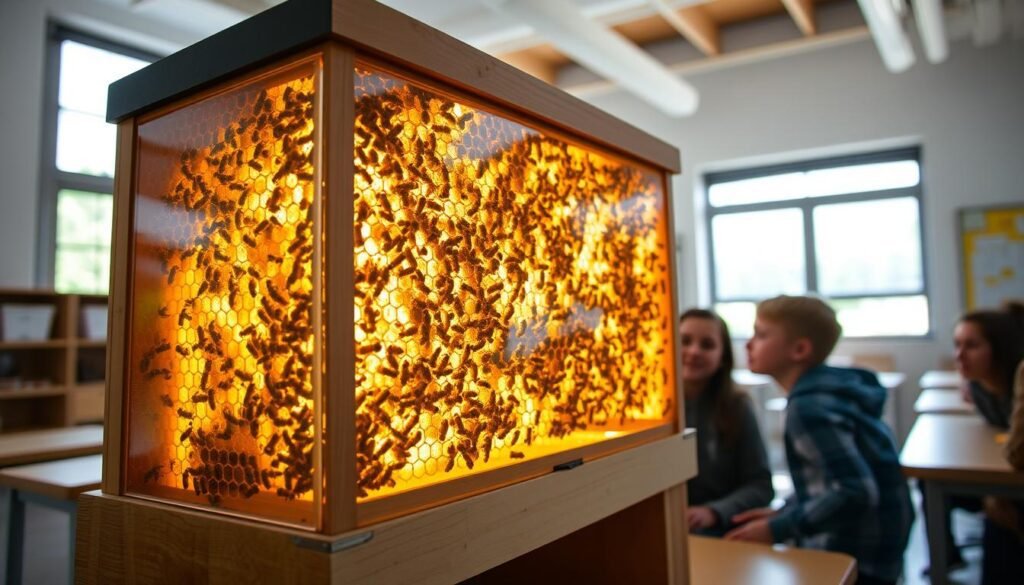
Document procedures and get family permissions that explain how observation differs from working a live hive. This keeps everyone informed and supports safe, repeatable experiences. For risk guidance and campus planning, see this practical resource: beekeeping on campus.
Hands-on classroom activities that spark curiosity and deepen learning
Start each lesson with a fast, hands-on demo that shows how a colony shares jobs and resources. Short, active starters help kids focus and set a rhythm for deeper work.
Basics: roles, queen, stingers, and eggs
Open with quick fun facts: one queen per colony, only female workers carry stingers, and a queen may lay up to 1,500 eggs a day. Use macro photos or simple cards so students can name parts and roles.
Pollination in action
Use paper flowers and colored pom-poms to model how nectar and pollen move. Link the activity to food and fiber crops so kids see real-world relevance.
Honey tasting lab
Offer tiny samples from local varietals: light clover and dark buckwheat. Have students rinse and record flavor and color notes. Discuss purity and where to source authentic honey.
Teach the waggle dance and play
Show a short waggle dance video, then let groups choreograph a waggle route. Add a music tie-in so students feel vibrations and map direction and distance.
Games and quick routines
Run a daily 10-minute Beeday with a quick trivia spinner, Queenspotting images, or a short category game. These micro-lessons keep vocabulary—pollen, nectar, brood—fresh.
“Hands-on play turns observation into evidence-based questions.”
For more structured lesson plans and ready-made activities, see Engaging honey bee STEM activities.
Bring in experts and elevate student experience
A visiting expert can turn classroom curiosity into hands-on discovery and real-world stories.
Start by finding local beekeepers and university contacts. Check a police swarm list, a regional club, or an entomology department. Confirm availability, format, and safety rules before scheduling.
Invite a beekeeper or entomologist: tools, hive boxes, and presentation ideas
Ask presenters to bring tactile items: unused hive boxes, empty frames, protective gear, and a frame with capped honey if possible.
Request a compact observation hive when feasible. That allows safe, close observation of live bees behind glass.
Use visuals that captivate: macro photos and clear flow
Macro images of brood, drones, festooning, and comb architecture hold attention better than text-heavy slides.
Coach guests to use short stories from years of experience and to build in time for student questions and Q&A.
- Identify an expert via clubs, extension offices, or university labs.
- Ask for tactile tools and a safety brief for each group.
- Use stations for rotations and a short, structured Q&A.

| Guest Role | What to Bring | Student Benefit |
|---|---|---|
| Beekeeper | Hive box, frames, protective gear | Hands-on equipment handling |
| Entomologist | Macro photos, life-cycle visuals | Deeper species and behavior context |
| Visiting team | Observation hive, capped honey frame | Safe live observation and tasting demo |
“Images anchor concepts; tools make ideas real.”
Capture learning by having students sketch a macro photo or annotate a frame diagram. End with a brief reflection on one surprising detail from the honey bee expert.
Assessment, presentations, and school-wide engagement
Guide students to build concise presentations that open with a clear outline and use visuals over text. Start by having each group define one main idea and a 60–90 second interactive moment, such as a quick game or a waggle dance demo.
Student-led presentations: structure, visuals, and audience-aware storytelling
Know your audience and adapt depth accordingly. Elementary viewers need images and analogies; older peers can handle data and comparisons. Teach students to rehearse transitions and to leave time for questions.
- Rubrics should value evidence-based claims, correct vocabulary (nectar, brood, worker), and clear responses to questions.
- Schedule short rehearsal windows with peer feedback to sharpen pacing and timing.
- Use weekly Beeday trivia and a rotating game to keep lessons fresh across the unit.
Expand engagement with a Bee Day of stations, timed sign-ups, and brief showcases for families. After the event, collect reflections and display a “how we learned” list with photos, outlines, and drafts so the whole school sees the learning process.
| Activity | Purpose | Time |
|---|---|---|
| 60–90s student presentation | Showcase main idea and evidence | 2–3 minutes per group |
| One-minute interactive game | Recapture attention; reinforce vocabulary | 1 minute |
| Beeday trivia rotation | Ongoing review across lessons | 5–10 minutes weekly |
| School showcase stations | Family engagement and peer audience | Sign-up windows (15–20 min) |
For structure templates and assessment ideas, see a practical capstone guide: presentation and assessment guide.
Conclusion
A small, well-planned unit lets kids meet bees safely and turns curiosity into confident learning.
Start with clear visuals and simple empty frames, then add an observation hive when the site and policy allow. This stepwise way replaces fear with reliable facts and repeatable routines for children and students.
Honey and pollinators tie science to daily life, so hands-on moments—tasting local honey, a waggle-inspired dance, or quick trivia—keep interest high and deepen understanding.
Partner with local experts and use vetted resources like beekeeping benefits to grow a safe, lasting program. Choose one simple start this term—an expert visit or a mini tasting—and build from there.
FAQ
What are the main educational benefits of introducing beekeeping to students?
Bringing honey bee topics into the classroom supports hands-on science learning, teaches life cycle and ecology concepts, and strengthens STEM skills like observation, data collection, and hypothesis testing. Students also gain lessons in responsibility, teamwork, and local food systems through pollination and honey production examples.
Why does beekeeping belong in today’s classroom?
Bees connect students with real-world environmental issues such as pollinator declines and habitat loss. Lessons on pollination, nectar and pollen flow, and hive health make abstract biology tangible and relevant to agriculture, conservation, and community science projects.
How do I plan a safe classroom experience with live bees?
Start with a risk assessment, secure parental permission, and screen for allergies. Use an observation hive or sealed display rather than open colonies. Set clear movement and noise rules, recommend neutral-scented clothing, and have a first-aid plan and epinephrine protocol for known allergies.
What protective gear and setups work best for student sessions?
For demos, an observation hive and empty comb frames offer visual learning without direct handling. If visiting active hives, use full veils, gloves, and smoker training for adult supervisors. Choose lightweight, breathable suits for summer sessions and store gear cleanly to avoid contamination.
How should I introduce hive roles and life stages to kids?
Use short, illustrated lessons on queen, worker, and drone roles, plus the brood stages: egg, larva, pupa, adult. Combine storytelling with quick activities—role cards or a life-cycle relay—to reinforce concepts without overwhelming younger learners.
What classroom activities show pollination and why bees matter?
Simple experiments like pollen-transfer stations, flower dissection, and nectar-sugar solution comparisons demonstrate pollination mechanics. Pair these with local plant maps so students see how honey bees affect food crops, fiber plants, and urban green spaces.
How can I run a honey tasting lab safely and educationally?
Source small, labeled samples from local apiaries and check for allergens. Teach students to observe color, aroma, and texture before tasting. Discuss how seasonality, local flowers, and hive practices influence flavor and color differences.
What is the waggle dance and how can I teach it across subjects?
The waggle dance is a bee communication behavior that encodes direction and distance to food. Use movement-based lessons in PE or music to mimic the dance, then analyze the “code” in math or geography exercises to integrate learning across curricula.
What quick games or trivia engage students daily?
Short activities like category spinners, Queenspotting identification challenges, and five-minute Beeday reflections keep interest high. Use a rotating set of facts—about pollen, honey, stingers, or hive architecture—to create predictable, low-prep moments of discovery.
How do I invite outside experts and make visits valuable?
Reach out to local beekeepers, university entomologists, or extension agents and provide a clear agenda and safety guidelines. Ask presenters to bring visuals, demo tools like hive boxes or macro photos, and time for Q&A and hands-on observation.
What visuals best capture student attention during lessons?
High-resolution macro photos of brood, drones, workers, and honeycomb structure reveal details students rarely see. Timelapse videos of comb building and close-ups of pollen collection add dynamism and support observation-based assessments.
How should student-led presentations be structured around bee topics?
Have students focus on a single question—such as pollination impact or hive roles—use clear visuals or an observation hive clip, and practice concise storytelling for peers. Rubrics should reward accuracy, audience engagement, and clear citations of sources.