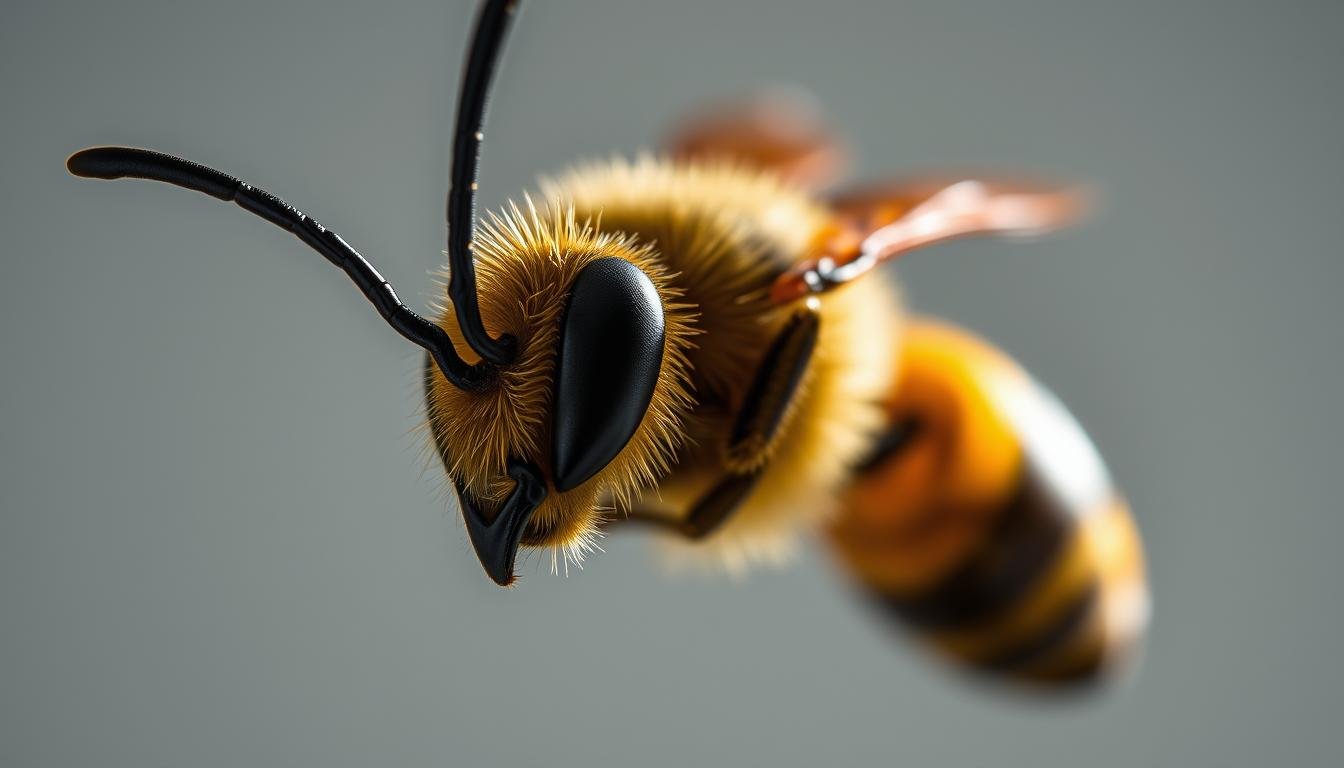
Sensory receptors in bee antennae map how a worker, drone, or queen reads the world. This short guide shows why the antenna is a survival-critical organ and how it shapes behavior.
The antenna houses dense arrays that detect smell, touch, vibration, humidity, temperature, carbon dioxide, electric fields, and polarized light. Muscles at the base give active control, so the organ scans and samples rather than passively resting.
At a glance: the scape and pedicel allow movement and house Johnston’s organ for vibration sensing, while the flagellum carries most of the sensilla. Drones show extreme specialization, with tens of thousands of placoid pore plates for tracking queen pheromones during flight.
Loss of the antenna causes severe disorientation and rapid mortality, showing how signals from this organ link to navigation, foraging, and social tasks across a colony. This guide follows a clear path: anatomy, sensilla types, detected modalities, behavior, and damage troubleshooting.
Key Takeaways
- The antenna is an actively steered organ that samples multiple environmental cues.
- Main regions: scape, pedicel (with Johnston’s organ), and a multi-segment flagellum.
- Drones carry far more pore plate sensilla, tuned for pheromone detection during mating flights.
- Antennal damage severs vital senses and disables normal colony roles.
- The guide uses microscopy and electrophysiology sources to match structure with function.
How this How-To Guide helps you understand bee antennae and their sensor suite
Use this guide to turn microscope images and field notes into clear maps of structure and function. It shows a practical way to match parts to tasks so you can read colony behavior from close-ups and field observations.
Match your goals to biology: communication, navigation, and foraging
Decide what you want to learn first: how colonies exchange signals, how foragers find flowers, or how navigation relies on airflow and light cues. Each goal narrows what to photograph and which sections to study.
Key outcomes
- Identify parts: scape, pedicel, and flagellum on workers and drones.
- Map sensilla to senses: pore plates for long-range smell; basiconic pegs at the tip for taste; trichoid hairs for touch and odor sampling.
- Interpret signals: link pedicel vibrations to waggle-dance decoding and pore plate density to olfactory range.
What you’ll need
- High-resolution annotated photos and cross-sections showing the pedicel and Johnston’s organ.
- Close-ups of the distal flagellum to spot basiconic and trichoid types.
- Multiple sources for name checks; see this quick start guide for practical references.
| Task | Image needed | Insight gained |
|---|---|---|
| Olfaction mapping | Flagellum surface, dorsal view | Pore plate density and likely scent range |
| Taste localization | Tip close-up | Basiconic peg distribution and contact sensing |
| Vibration analysis | Pedicel cross-section | Johnston’s organ structure and dance reception |
| Behavior link | Field photos at feeder | Correlate sensilla clusters with foraging choices |
Bee antenna anatomy: scape, pedicel, and flagellum explained
From the ball-and-socket scape to the multi-segment flagellum, each part plays a distinct role in orientation, vibration detection, and chemical sampling.
The scape and its muscles: controlled movement, nerves, and the “ball-and-socket” base
The scape attaches to the head via a flexible cuticle that forms a true ball-and-socket base. Two internal muscle sets and a pair of exterior muscles on the scape/pedicel joint give fine positional control.
Result: precise scans, probing motions, and steady contact during flight or walking. The central antennal nerve runs down the core and carries signals to brain interneurons.
The pedicel and Johnston’s organ: vibration and movement detection in the joint
The pedicel is the jointed connector that houses Johnston’s organ. A chain of scolopidia spans the distal scape into the proximal flagellum and converts tiny deflections into neural pulses.
These signals encode airflow, waggle-dance vibration, and wind deflection during flight. Workers and queens typically show ten flagellar segments, while drones have eleven and an elongated flagellum for more receptor surface.
Quick microscopy landmarks: look for the socket rim at the base, hair plates between scape and pedicel, and pore-plate fields on early flagellomeres.
- For a detailed anatomy primer, see a deeper look at bee anatomy.
- For functional notes on motion and detection, consult antennae function.
Sensory receptors in bee antennae: the sensilla you need to know
A range of sensilla on the flagellum creates a compact map of chemical, mechanical, and microclimate cues. Each morphological class has a clear role and a typical position along the flagellum.
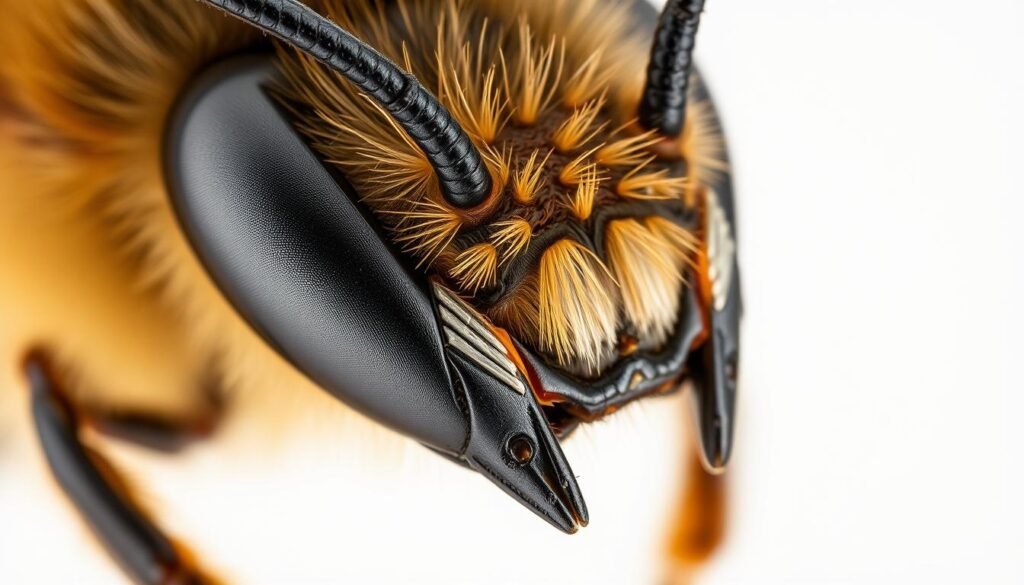
Placoid (pore plate) sensilla
Placoid plates are oval, high-surface structures packed with olfactory receptor neurons. Counts vary by caste: ~2,700 per worker, ~1,600 per queen, and ~16,000–18,600 in drones.
High plate density increases odor capture and lets bees parse complex blends such as queen pheromones during long-range tracking.
Trichoid sensilla
Trichoid are hair-like. Workers carry roughly ~3,000. Some act as mechanoreceptors; others serve olfactory roles (A-type subgroups). They sit in shallow depressions across segments.
Basiconic sensilla
Basiconic pegs cluster at the distal tip for contact chemoreception. They detect sugars, salts, water, and likely amino acids—critical when evaluating nectar and pollen.
Pit organs: coeloconic, coelocapitular, ampullacea
Pit types sense humidity and temperature; coelocapitular units (~45–60 at worker tips) likely add stress sensing. Ampullacea are rare and may detect carbon dioxide. Naming varies across studies, so cross-reference images when identifying types.
“Plate size and neuron count set the olfactory range; hair arrays and pit organs tune touch and microclimate cues.”
What bees detect: smell, touch, vibration/sound, humidity/temperature, CO2, and polarized light
Multiple signal types come together on the antennal surface to steer decisions at both individual and colony levels.
Smell is the dominant modality. Vast pore-plate arrays on the surface sample floral volatiles and pheromones. Drones carry many more plates to track queen scent during flight.
Touch comes from hair-like sensilla and contact pegs. These allow a honey bee to assess comb texture, line up for trophallaxis, and move through crowded frames without vision.
Vibration and sound are detected by Johnston’s organ and mechanosensitive hairs at the pedicel. Frequency, amplitude, and direction of dance-induced air movements let workers decode waggle signals.
Pit organs register humidity and temperature and guide hive climate control. Ampullacea and related pits likely sense carbon dioxide, so workers monitor carbon dioxide levels to trigger ventilation.
Antennae also pick up polarized light cues. That cue keeps foragers oriented when the sun hides. Bees actively orient antennae against wind and through air to improve signal capture.
| Modality | Main structures | Behavioral role |
|---|---|---|
| Smell | Pore plates, flagellum surface | Foraging, mating, social cues |
| Touch | Trichoid hairs, basiconic pegs | Comb assessment, trophallaxis |
| Vibration/Sound | Johnston’s organ, hair fields | Waggle decoding, flight sensing |
| Humidity/Temp | Coeloconic/coelocapitular pits | Thermoregulation, nectar drying |
| Carbon dioxide | Ampullacea and pit types | Ventilation, colony homeostasis |
| Polarized light | Flagellar photoreceptive pathways | Sun-compass navigation |
“Receptors operate as an integrated network, shifting weight among cues as tasks change.”
How to map receptor types to bee behaviors in the field and hive
You can map which antenna parts drive behavior by watching approach paths, antenna posture, and contact maneuvers.
Foraging and flight: Foragers detect floral volatiles while flying and use polarized light for navigation. Wind deflection on the flagellum is read by Johnston’s organ at the pedicel to correct course in turbulence.
Colony communication: Pheromones bind at pore-plate fields while mechanoreceptors and pedicel sensors capture waggle-dance vibrations and short-range sound. In the dark hive, tactile scans and vibration dominate task coordination.
Mating and caste differences: Drones have an extra flagellum segment and dense pore plates to locate the queen during mating flights. Workers use diverse tip sensilla for brood care, guarding, and food transfer.

| Behavior | Main antennal structures | Observed cue | Field tip |
|---|---|---|---|
| Foraging | Pore plates, flagellum tip | Floral volatiles, polarized light | Track approach relative to wind and scent plume |
| Flight stability | Pedicel (Johnston’s organ) | Airflow deflection | Note quick course corrections in gusts |
| Colony signaling | Mechanoreceptors, pore plates | Vibration, pheromones | Watch antennal scans around dancing workers |
| Mating | Extended flagellum, pore plate fields | Queen pheromone plumes | Observe drone approach angles in mating arenas |
Practical note: Record approach trajectories, antenna posture, and contact behavior to link structure to function in a clear, reproducible way.
Troubleshooting and edge cases: damage, species differences, and signal overlap
When an antenna is damaged, a hive member loses more than smell—flight, dance decoding, and routine tasks degrade fast.
When an antenna is damaged: Partial or complete loss quickly reduces olfaction, vibration sensing, and tactile sampling. Affected workers show disoriented flight, poor odor-tracking, and reduced ability to follow waggle signals. In the wild this often leads to rapid failure.
Vulnerability at the base and pedicel
Johnston’s organ and hair plates sit at the base and pedicel. Injury here removes airflow and movement cues that aid course correction and waggle decoding.
Signal overlap, modality loss, and species differences
When one sense weakens, bees compensate by relying on others. That shift can create ambiguous readings—humidity shifts may be misread as temperature or CO2 changes.
Species and caste differences change sensitivity and sensilla layout. Two individuals from different species or castes may react very differently to the same cue, so avoid broad generalizations.
“Confirm structure-function links with multiple sources and, when possible, electrophysiology.”
- Field checks: note asymmetric antennal posture, erratic odor tracking, or failure to follow dances.
- Colony effects: impaired antennae shift work loads, lowering efficiency in brood care, guarding, and honey processing.
- Hidden damage: nerve trauma along the antennal nerve can impair signaling even when the body looks intact.
- Environmental caveat: gusty wind or high background odors can mask subtle cues in intact animals.
| Issue | Signs | Action |
|---|---|---|
| Base/pedicel injury | Poor flight correction, missed waggle cues | Record behavior; compare with healthy workers of same species |
| Reduced olfaction | Failure to locate feeders, weak pheromone response | Test odor tracking under calm air; corroborate with sources |
| Neural impairment | Normal appearance, but poor movement sensing | Note persistent deficits; seek electrophysiological validation if possible |
Document: always record species, context, and movement patterns to tell true sensory loss from normal behavioral variation.
Conclusion
This conclusion links structure to survival: the scape with its ball-and-socket base and muscles, the pedicel with Johnston’s organ and hair plates, and the segmented flagellum loaded with sensilla form a single, precision sensing tool. ,
The flagellum’s pore plates give remarkable smell power—counts vary by caste—while trichoid hairs and basiconic pegs handle touch and contact tasting. Pit fields track humidity and temperature, and a few ampullacea likely monitor carbon dioxide to guide hive ventilation.
Across species the layout shifts, yet the functional blueprint holds: segments and surfaces tuned for flight, dance decoding, foraging, and mating. Even small damage at the base or pedicel can erode smell, movement sensing, and colony performance.
Practical takeaway: knowing where types sit on the surface helps observers interpret behavior and assess colony health from subtle changes.
FAQ
What parts make up a honey bee’s antenna and what does each do?
The antenna has three main parts: the scape at the base, the pedicel with Johnston’s organ, and the flagellum made of many segments. The scape anchors and moves the antenna using muscles. The pedicel houses Johnston’s organ, which senses motion and vibrations. The flagellum carries most of the sensory surfaces that sample air, contact cues, and microclimate near flowers and inside the hive.
How do bees use their antennae to find food and navigate?
Antennae pick up floral odors, wind direction, and tiny changes in humidity and temperature. Workers detect volatile compounds from flowers and follow scent plumes while flying. They also sense polarized light and air movement for orientation, and mechanosensory signals that help with precise flight and landing on flowers.
What types of sensilla are important on the flagellum?
Key sensilla include placoid (pore plate) types for strong olfaction, trichoid hairs for mechanical and some smell roles, basiconic sensilla for taste and contact chemoreception, and smaller coeloconic/coelocapitular kinds that monitor humidity, temperature, and carbon dioxide near the bee’s environment.
How do antennae help with colony communication and pheromone detection?
Antennae detect pheromones produced by the queen, workers, and brood. Olfactory sensilla on the flagellum respond to pheromone blends that regulate reproduction, foraging, alarm, and social cohesion. Antennal contact during trophallaxis and antennation transmits chemical signals and confirms colony status.
Can antenna damage affect a bee’s behavior or survival?
Yes. Loss or injury to one or both antennae reduces odor detection, impairs flight orientation, and weakens social interactions. A damaged antenna can make it harder for a worker to locate food, follow waggle-dance cues, or recognize nestmates, which lowers effectiveness in foraging and colony tasks.
Do drones, workers, and queens have different antennal features?
They do. Drones often have more placoid sensilla and larger flagellum segments to detect queen sex pheromones during mating flights. Workers have sensilla optimized for floral and social cues. Queens have antennae tuned to colony pheromones and reproductive signals. Segment number and sensillum density vary by caste and species.
How do antennae detect carbon dioxide and why does that matter?
Specialized sensilla can sense small changes in carbon dioxide concentration inside the hive. CO2 detection helps bees adjust ventilation, brood care, and clustering behavior. Workers use these cues to manage hive aeration and maintain brood health.
What tools and observations help map receptor types to behavior in the field?
Useful tools include close-up photographs of antennae, hand lenses or stereomicroscopes, simple odor assays, and behavioral tests near feeders or hives. Note movement patterns, antennal tapping during trophallaxis, and responses to introduced odors. Combining observation with documented sensilla maps clarifies which structures drive which behaviors.
How do environmental factors like wind, humidity, and temperature affect antennal sensing?
Wind and air currents change how odor plumes reach antennae, altering foraging efficiency. Humidity and temperature influence sensilla that gauge microclimate and can modify activity levels and foraging choices. Bees integrate these cues to decide when and where to forage and how to ventilate the nest.
Are there species differences in antennal design beyond honey bees?
Yes. Different bee species show variation in segment count, sensillum types, and density depending on ecological niche and social behavior. Solitary bees, bumble bees, and stingless bees display unique antennal specializations that reflect their foraging strategies, mating systems, and habitat requirements.