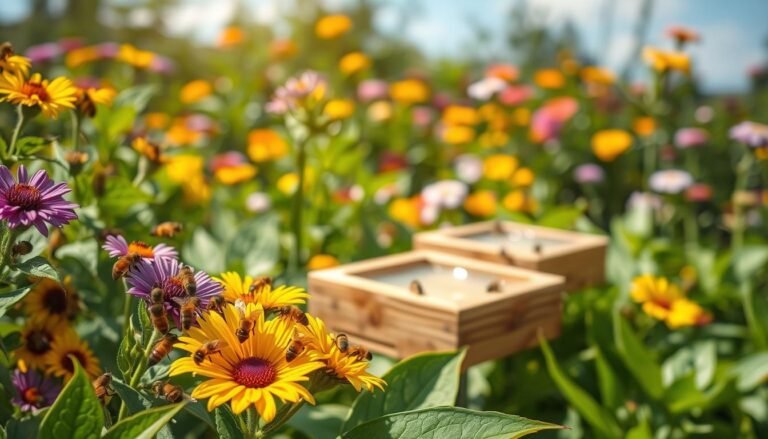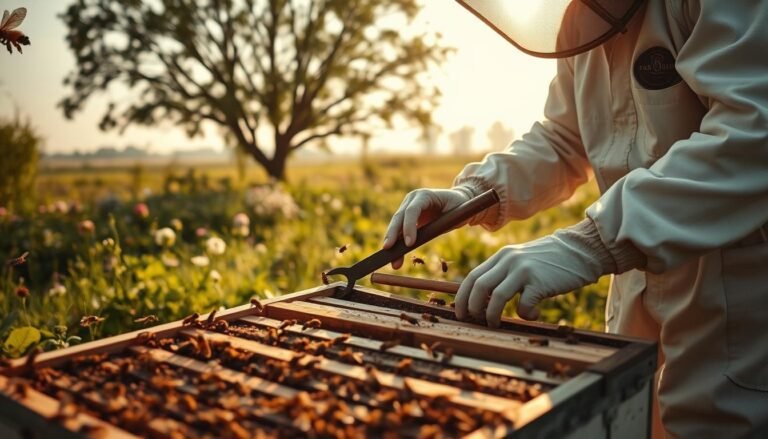
This section sets the stage for a focused study that pits bee-collected samples from Al-Ahsa, Saudi Arabia, against pure floral data from European families.
We summarize key findings in clear terms: alfalfa and date palm pollens had the highest protein and amino acid levels, while sunflower repeatedly ranked lowest. Methionine was the first limiting amino acid across all five KSA species.
The work also notes method effects: ion-exchange (IEX) usually gives higher totals than HPLC, except for cysteine. Family patterns show Boraginaceae with the richest totals and Malvaceae among the lowest.
Why this matters: amino acid composition and scores such as EAAI, Chemical Score, and Amino Acid Score predict diet value for Apis mellifera and shape colony health, learning, and resilience to stressors.
Key Takeaways
- Alfalfa and date palm bee-collected samples led in crude protein and total amino acids.
- Sunflower was consistently low in essential amino acids and overall quality.
- Methionine was the universal limiting amino acid across species.
- IEX vs HPLC changes reported totals; method reporting is essential for comparability.
- EAAI, CS, and AAS were used to benchmark nutritional value for honey bees and humans.
- Practical tip for U.S. beekeepers: diversify forage to cover limiting amino acids.
What readers want from a Pollen amino acid profile comparison
Readers want fast, number-driven verdicts that translate lab data into field action. Clear rankings show who leads on protein and total amino measures and who drags diet quality down.
Key rapid takeaways:
- Alfalfa: highest crude protein (20.23 g/100 g DM) and TAA (12.51 g/100 g DM).
- Date palm: highest TEA (5.35 g/100 g DM) and TEA% (42.87%).
- Sunflower: consistently lowest on essential measures — a notable outlier.
Method transparency matters. Report whether values come from IEX or HPLC because IEX typically reads higher and cysteine behaves differently between methods.
Quick-reference rankings and guidance
Use these thresholds to judge quality: EAAI above 75 = strong, 65–75 = moderate, below 65 = weak. Mix high-total species (alfalfa, Boraginaceae) with composition-complete sources to cover methionine and other limiting essentials.
| Metric | Top Species | Value | Practical action |
|---|---|---|---|
| Crude protein | Alfalfa | 20.23 g/100 g DM | Prioritize alfalfa in forage plans |
| Total essential (TEA) | Date palm | 5.35 g/100 g DM (42.87%) | Add date palm where regionally suitable |
| EAAI range | Several species | 62.03–78.00% | Target mixes to push EAAI >75 for brood support |
How this comparison is framed: datasets, taxa, and outcomes
To capture both ecological realism and botanical baseline values, two dataset types were analyzed side by side. One set used bee-collected samples from five dominant species in KSA; the other used pure floral samples across 32 European species in seven families.
Why the dual approach matters: bee-harvested pellets reflect real foraging mixes and include nectar and saliva, which can dilute protein concentrations or shift free versus bound fractions. Pure floral samples give the plant baseline and remove forager confounds.
Taxa and metrics
- Species-level head-to-head for alfalfa, date palm, summer squash, sunflower, and rape.
- Family-level aggregates (e.g., Boraginaceae, Malvaceae) to reveal phylogenetic signals.
- Outcomes harmonized: crude protein, total amino acids, essential amino acid proportions, EAAI, CS, and AAS.
| Dataset | Method | Key range | Practical note |
|---|---|---|---|
| Bee-collected (KSA) | IEX, 3–6 replicates | Field mixes, lower protein variability | Reflects forager nutrition; useful for apiary planning |
| Pure floral (Europe) | IEX & HPLC, ANOVA/perMANOVA | Boraginaceae 361.2–504 μg/mg; Malvaceae 136–243.1 μg/mg | Shows botanical potential; method effects checked |
| Method note | IEX vs HPLC | IEX > HPLC for totals (cysteine exception) | Report chromatography to enable comparisons |
Pollen amino acid profile comparison
The analysis centers on totals versus balance: which sources deliver high protein and which supply the limiting essentials bees need.
Two axes matter: absolute totals (total amino acids and crude protein) and proportional completeness (essential amino percentages, EAAI and AAS). High totals help, but missing essentials—especially methionine—cut usable value.
The synoptic ranking is clear. KSA bee-collected samples show alfalfa and date palm at the top for crude protein and total amino content. Sunflower sits at the bottom as a low-quality caution.
| Axis | Leaders | Laggards |
|---|---|---|
| Total content | Alfalfa, Boraginaceae | Malvaceae, Sunflower |
| Essential balance (EAAI/AAS) | Date palm, select Fabaceae | Several Boraginaceae with AAS<0.7 |
| Dominant residues | Aspartic, glutamic, glycine, leucine, lysine | Low methionine across species |
Interpretation rules: EAAI above ~75 implies good brood support; AAS near 1 meets benchmarks. High totals can mislead if one or two limiting essentials reduce utilization. Cross-method normalization matters—see method effects—so regional mixes and seasonality guide practical forage plans.
Data sources and analytical methods used in the study
We trace sample origins and lab workflows to show how method choices alter reported totals. The study used bee-collected and floral samples analyzed by two main chromatography approaches. Protocol transparency matters because prep steps shift measured levels.
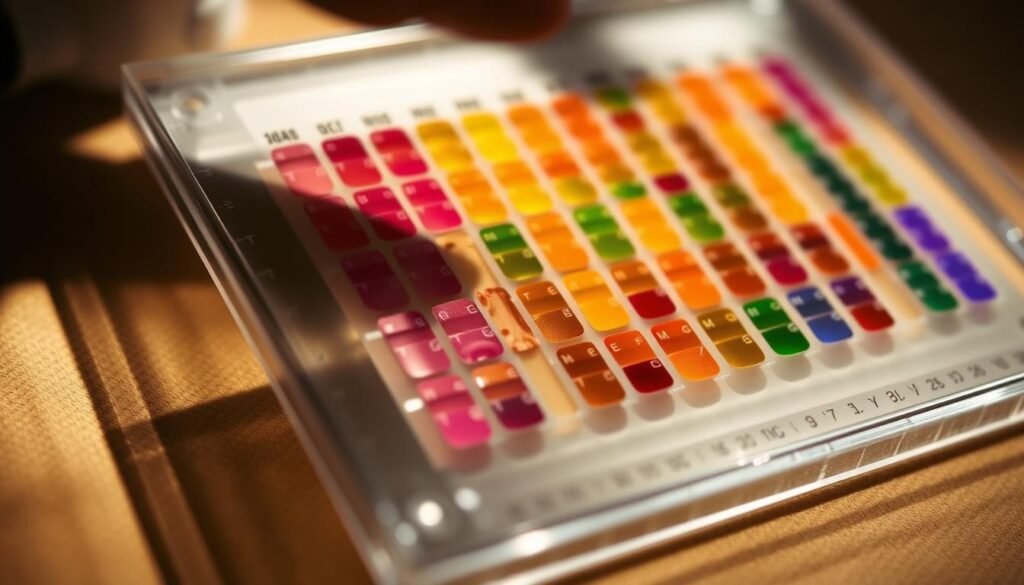
Ion exchange chromatography (IEX) protocol
IEX workflow: 6N HCl hydrolysis for 24 hours at 110°C with performic acid oxidation to protect sulfur residues, cation-exchange separation, and ninhydrin detection. This approach is robust for total and individual amino acids and reduces degradation of methionine and cysteine when oxidation is applied.
HPLC contrast and implications
Standard HPLC uses OPA/Fmoc derivatization and can underreport totals, especially for sulfur-containing residues. Across the European dataset IEX produced higher totals except for cysteine, where method effects diverged significantly.
Quality metrics: EAAI, CS, AAS
EAAI is a composite index vs egg protein (Oser/FAO) and complements single-limiting-AA checks. CS references de Groot for bees or FAO for humans. AAS denotes the limiting essential proportion vs de Groot; AAS = 1 means adequacy for bee needs.
Takeaway: report hydrolysis, oxidation, and chromatography when publishing so cross-study syntheses remain valid. Multiple metrics together give a reliable picture of nutritional quality.
Bee-collected pollen vs pure floral pollen: composition and content differences
Bee-harvested pellets and clean floral samples tell two different nutritional stories for foragers and researchers. Foragers mix grains with nectar and salivary secretions, which can dilute crude protein and shift free-to-bound amino balances. That change affects measured amino acid content and alters interpretation for colony diets.
Practical trade-offs: bee-collected samples (KSA pellets, ~25% trap efficiency) give realistic intake composites for hive planning. Pure floral samples give botanical baselines for planting and breeding choices.
Method and collection effects
“Report both collection and chromatography methods so comparisons remain meaningful.”
Chromatography choice matters. IEX consistently returned higher totals than HPLC across species and families, while cysteine often behaved differently due to oxidation and detection issues. Always note method when comparing results.
| Aspect | Bee-collected pellets | Pure floral samples |
|---|---|---|
| Representation | Real intake mixes for bees | Plant baseline nutrient capacity |
| Protein signal | Often diluted by nectar/saliva | Concentrated, cleaner protein levels |
| Analytical caution | Good for practical planning | Best for species-level comparisons |
Head-to-head: major KSA pollen sources compared
This head-to-head highlights which KSA forage sources deliver bulk protein and which supply more usable essentials.
Protein and total amino acid content: leaders and laggards
Alfalfa tops crude protein (20.23 g/100 g DM) and TAA (12.51 g/100 g DM), followed closely by date palm (19.77; 12.48). Rape and summer squash sit midrange. Sunflower records the lowest crude protein (15.19) and the smallest TAA (12.20).
Essential amino percentages and EAAI ranges
Date palm yields the highest TEA mass (5.35 g/100 g DM) and TEA% (42.87%), signaling a strong essential contribution despite not leading crude protein. Summer squash posts the top EAAI (78.00), showing favorable essential proportions versus the egg reference.
Sunflower as a consistent low-quality outlier
Sunflower scores lowest in TEA% (38.77) and trails on key essentials such as isoleucine, leucine, methionine, phenylalanine, and valine. Methionine is the first limiting amino across all five species, which constrains protein use even when totals look adequate.
| Metric | Top species | Value | Note |
|---|---|---|---|
| Crude protein (g/100 g DM) | Alfalfa | 20.23 | Highest total protein |
| Total essential (TEA g/100 g DM) | Date palm | 5.35 (42.87%) | Best essential fraction |
| EAAI (%) | Summer squash | 78.00 | Most balanced essentials vs egg |
| Lowest performer | Sunflower | Crude protein 15.19 | Consistently low-essential content |
Family-level patterns: Boraginaceae vs Malvaceae and beyond
Family-level nutrient fingerprints reveal clear quantity and composition trade-offs across taxa. Boraginaceae stands out for very high total amino counts (361.2–504 μg/mg). These levels make the family a major mass source for hive provisioning.
High totals do not guarantee balance. Several Boraginaceae and some Fabaceae showed essential deficits that produced AAS values below 0.7. That underscores a quality-versus-quantity dichotomy for hive diets.
Low totals and practical risk
By contrast, Malvaceae recorded much lower totals (136–243.1 μg/mg). When malvaceous blooms dominate a landscape, colonies may get bulk but lack usable essentials.
Implications and recommendations
- Balance plantings: mix Boraginaceae and Fabaceae with species known to meet essential thresholds.
- Watch method effects: IEX generally reads higher than HPLC; compare results only when chromatography is reported.
- Seasonal planning: stagger bloom times to avoid periods dominated by low-total families.
- Localize choices: cross-reference family leaders with native species lists to support regional bees and conserve resources.
| Family | Total range (μg/mg) | Key issue | Planting note |
|---|---|---|---|
| Boraginaceae | 361.2–504 | High totals; some AAS | Include selective species to fill essential gaps |
| Fabaceae | Varied, often high | Occasional essential deficits | Combine with composition-complete sources |
| Malvaceae | 136–243.1 | Low totals limit usable protein | Avoid landscape dominance; add higher-quality bloomers |
Essential amino acids: adequacy vs requirements (honeybees and humans)
Matching measured essentials to standard requirements reveals practical strengths and weaknesses across species. Use de Groot for Apis mellifera adequacy and FAO for human-relevant checks. These frameworks overlap but differ in lists and target ratios.
de Groot standards vs FAO standards: aligning expectations
de Groot lists ten essentials for honeybees; FAO includes additional sulfur/aryl donors for humans. Apply de Groot to judge bee diet adequacy and FAO when noting human-relevant markers like lysine and Phe+Tyr.
Which samples exceed bee requirements and where they fall short
Alfalfa, date palm, summer squash, and rape generally exceed de Groot targets for most essentials. Sunflower falls short on multiple essentials. Methionine is the universal first limiter across samples.
| Metric | Species strength | Key note |
|---|---|---|
| Lysine / Arginine / Trp | Date palm | Meets/ exceeds bee needs |
| BCAAs (Leu / Ile / Val) | Alfalfa | Strong contributor to protein use |
| Methionine / His | Summer squash | Methionine still often limiting despite relative lead |
Implications: TEA% (~39–43%) governs EAAI and AAS outcomes. Bees can mix foraged samples to approach de Groot ratios; managers should combine species that fill frequent deficits rather than rely on single sources.
Limiting amino acids and protein quality scores across samples
Narrow deficiencies in key residues set the ceiling for how bees use measured protein. A sample with high total protein still fails colonies when a first-limiting residue reduces digestible value.
Methionine as the universal first limiter
Methionine was the first limiting residue in all KSA bee-collected samples. That single shortfall lowers EAAI, CS, and AAS values even when totals look favorable.
Second-limiters and standard differences
Second-limit residues shift by standard. Under de Groot for bees, sulfur balance is critical. Under FAO human benchmarks, lysine or some branched-chain residues can become the next limiter.
“Report limiting residues explicitly to make forage planning actionable.”
Analytical handling of sulfur residues (methionine/cysteine) can change which amino shows as limiting. That affects management actions like supplementation or floral mixes.
| Aspect | Implication | Practical action |
|---|---|---|
| Universal first limiter | Methionine reduces usable protein | Include methionine-rich bloomers or supplements |
| Composite scores | EAAI/CS/AAS fall when a single limiter exists | Balance totals with composition-complete species |
| Method sensitivity | Sulfur AA quantitation varies by chromatography | Report hydrolysis/oxidation and method |
Field tip: time methionine-rich species to overlap brood peaks. Doing so improves protein use, brain development, and immune outcomes discussed later in the study.
Non-essential amino acids: abundant drivers of pollen protein quality
Non-essential residues make up the bulk of measured totals and shape how useful a sample is in practice. They strongly influence reported protein and overall composition, even when essentials remain limiting.
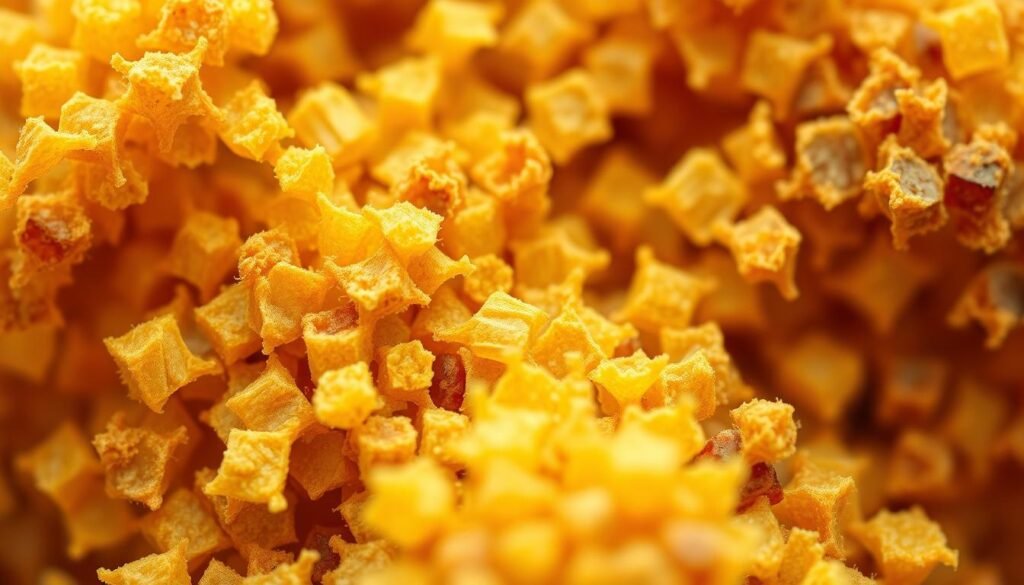
Dominant patterns and metabolic roles
Glutamic and aspartic acids top many lists. They act as nitrogen shuttles and help form protein structure, supporting rapid turnover in bee tissues.
Glycine and alanine often drive bulk totals. In KSA samples, summer squash led glycine (17.64 mg/g DM) and alanine (13.49 mg/g DM). Sunflower showed high glutamic (18.40) and serine (8.86), while rape had peak aspartic (16.46).
Functional and practical notes
Proline supports flight metabolism; alfalfa’s higher proline (0.68) can aid foraging energy. Still, abundant non-essentials can inflate totals without fixing essential shortfalls, so use quality scores when planning diets.
“Non-essential profiles complement essential checks and guide realistic diet mixes.”
Method effects alter measured asparagine/glutamine results; see method effects. Treat non-essential patterns as botanical signatures to pair energy-rich samples with essential-rich blooms for balanced hive nutrition.
Correlations among amino acids: what co-varies and why it matters
Correlation patterns reveal which residues rise and fall together across samples, giving quick cues to composition drivers. These links help predict overall quality from partial tests and guide practical mixing choices for hives.
Branched-chain and aromatic clusters
Leucine, isoleucine, valine, and phenylalanine form a strong positive cluster. When one is high, the others tend to be high too.
Implication: measuring one or two of these can often predict the rest, simplifying rapid field analysis and early quality screening of samples.
Serine and its linked residues
Serine shows robust positive links with histidine (r=0.69), threonine (r=0.50), and proline (r=0.70). This pattern suggests shared biosynthetic pathways or coordinated allocation during grain development.
That biochemical grouping can indicate which species deliver balanced content versus those that skew non-essential versus essential pools.
Alanine as a favorable signal
Alanine correlates positively with leucine (r=0.62), methionine (r=0.85), phenylalanine (r=0.52), and tryptophan (r=0.54).
Practical note: high alanine often flags species with stronger essential representation, making it a useful marker when rapid decisions are needed.
Negative links and trade-offs
Glycine shows negative associations with cysteine, isoleucine, methionine, valine, tyrosine, and glutamic acid. Arginine correlates negatively with methionine, alanine, aspartic acid, and proline.
These negative patterns likely reflect allocation trade-offs in grain composition. If one residue pool is enriched, another may be depleted.
Why this guides mixing: co-variation highlights complementarities and redundancies. Avoid combining species that co-vary in the same deficiency. Instead, pair sources that fill each other’s gaps to raise EAAI and AAS.
“Correlation structure usually holds across methods, even when absolute values shift.”
| Pattern | Key residues | Practical action |
|---|---|---|
| Positive cluster | Leu, Ile, Val, Phe | Use single markers to predict branch-chain levels |
| Serine group | Ser, His, Thr, Pro | Target species with this signature for balanced biosynthesis |
| Negative trade-offs | Gly vs Met/Ile/Val; Arg vs Met/ Ala | Mix to offset antagonistic patterns |
| Method stability | Correlation matrix | Integrate into predictive AAS/EAAI models despite method shifts |
Research next step: build predictive models that use these correlations to forecast EAAI from limited assays. That will help landscape planners and beekeepers optimize bloom mixes for healthier bees.
Nutrition in context: implications for Apis mellifera colony health
Bees need varied diets to turn floral offerings into brood food that supports colony growth.
Essential shortfalls in key residues reduce brood production, weaken immune responses, and shorten worker lifespan. High total protein intake cannot fully compensate when a first-limiting residue, like methionine, is missing.
Foragers respond behaviorally. Honey bees mix collections from multiple sources to approach de Groot ratios. That behavior helps colonies meet requirements when single samples are incomplete (AAS <1).
Suboptimal single-source reliance and diet mixing behavior
A diet dominated by low-quality bloomers—sunflower being a classic example—lowers EAAI and AAS during peak brood rearing. Beekeepers should avoid reliance on such sources in critical periods.
- Planting strategy: ensure overlapping bloom of complementary species to smooth daily intake variability.
- Methionine priority: include local species or supplements that cover recurring shortfalls.
- Monitoring: track colony growth and pollen intake composition to validate forage changes using EAAI and AAS metrics.
| Risk | Colony outcome | Practical action |
|---|---|---|
| Low essential completeness | Reduced brood, weak immunity | Mix plantings; add supplements |
| High total but limiting residue | Apparent abundance, low usable protein | Blend high-total families with complete sources |
| Temporal forage gaps | Brood stress during peak periods | Diversify apiary sites or stagger bloom |
“Measure both totals and composition to guide landscape and hive decisions.”
From pollen to brain: how amino acid intake shapes honey bee neurobiology
Adult bees fed natural forage show rapid shifts in brain chemistry during the first 11 days after emergence.
Evidence: cage trials found pollen-fed workers at Day 7 had ~54% higher cysteine and ~4% higher isoleucine versus deprived peers. Some residues (lysine, threonine, tryptophan) were lower with early feeding, and profiles changed again by Day 11.
Mechanism: these building blocks act as neurotransmitter precursors and support synaptic plasticity in mushroom bodies and antennal lobes. Sulfur residues such as methionine and cysteine likely exert outsized effects on neural function.
Nosema ceranae infection altered energy metabolism and reduced olfactory-guided behavior, linking nutrition, parasite load, and learning. Methods were rigorous: GC‑MS and HPLC/PDA with tailored hydrolyses for tryptophan, cysteine, and arginine ensured valid biochemical inference.
“Dietary access to balanced pollen influences brain chemistry and, in turn, foraging efficiency and colony fitness.”
| Measure | Change (pollen-fed) | Practical implication |
|---|---|---|
| Cysteine (Day 7) | +54% | Supports sulfur metabolism and neural repair |
| Isoleucine (Day 7) | +4% | May aid protein synthesis in developing brain |
| Olfactory learning | Reduced with Nosema | Ensure nutrition to buffer parasite effects |
| Method rigor | Targeted hydrolyses | Improves confidence in behavior links |
Next steps: field validation using PER assays and targeted forage mixes will link lab results to colony outcomes. For practical beekeeping, prioritizing balanced food sources that supply sulfur-rich residues is a defensible strategy.
For a broader view on neural plasticity and metabolic links, see this neural plasticity review.
Method matters: why chromatography choice changes results
Chromatography and hydrolysis steps drive much of the variation seen in reported results. Labs using ion‑exchange (IEX) routinely reported higher total values than HPLC in this study (six species, F=30.203, p<0.01). That pattern held across families and field samples.
Chemical reasons: derivatization efficiency, detector response, and oxidation sensitivity explain much of the gap. HPLC derivatization (OPA/Fmoc) can underreport sulfur residues, while IEX with performic acid protection preserves cysteine and methionine signals. Tryptophan needs separate alkaline hydrolysis for reliable detection. Arginine quantitation benefits from targeted cleanup and standards.
Practical guidance: prefer IEX when feasible and always publish hydrolysis, oxidation, and standard recoveries. When synthesizing mixed-method literature, run sensitivity analyses or apply correction factors. Relative species ranking is often stable despite shifts in absolute numbers, but AAS and EAAI can move when limiting residues are misquantified.
| Report item | Why it matters | Recommended detail | Action for meta-analyses |
|---|---|---|---|
| Chromatography type | Alters totals | IEX or HPLC + settings | Stratify results by method |
| Hydrolysis/oxidation | Protects sulfur residues | Acid vs alkaline; performic acid use | Apply correction or sensitivity tests |
| Internal standards | Controls recovery | Names and concentrations | Weight studies by recovery rates |
| Special workflows | Tryptophan/Arg/Cys handling | Separate hydrolysis or derivatization notes | Flag results that lack special handling |
“Transparent method reporting enables reliable synthesis and better decisions for bees and habitat planning.”
For a detailed methods comparison, see the discussion of IEX versus HPLC methods.
Practical guidance for U.S. beekeepers and conservation planners
Targeted mixes of high‑total and composition‑complete bloomers reduce risks from single‑source forage. Many species show good protein mass but lack key essentials, with methionine commonly limiting. Plan plantings that combine quantity and balance to raise usable food value for colonies.
Prioritize diverse plantings to cover methionine and other gaps
Choose regionally adapted seed mixes that hedge against sulfur shortfalls. Stagger bloom dates so brood peaks overlap with high‑quality forage.
Targeted species mixes: balancing totals with complete profiles
Combine families: pair Boraginaceae species (high totals) with summer squash–type bloomers that score well on essential completeness. Avoid overreliance on sunflower‑like sources that lower overall adequacy.
“Mix species to turn bulk protein into usable nutrition for brood and foragers.”
| Goal | Action | When | Expected result |
|---|---|---|---|
| Methionine coverage | Add sulfur‑rich bloomers or timed supplements | Brood peaks | Higher usable protein |
| Continuous forage | Staggered seed mixes with native species | Spring–Fall | Reduced seasonal gaps |
| Landscape coordination | Align plantings with crop calendars | Before main nectar flows | Better colony resource use |
| Monitoring | Track brood metrics and sample composition | Monthly | Validate and adapt mixes |
Practical tips: supply water near apiaries, integrate conservation programs, and use targeted supplementation focused on sulfur residues when diversity is limited.
Key takeaways for researchers: reporting standards that enable comparisons
Standardize reports so datasets from different labs can be combined and compared. State chromatography type, hydrolysis temperature and duration, derivatization, and internal standards.
Be explicit about sensitive residues. Report separate methods for tryptophan, cysteine, and arginine and note any performic oxidation or special hydrolysis.
Core recommendations
- Label each sample as bee-collected or pure floral and explain collection context.
- Provide totals, per-residue values, TEA%, and identify the first limiting residue.
- Use and document EAAI, CS, and AAS with clear reference standards (egg, de Groot, FAO).
- Include replication, ANOVA/MANOVA or perMANOVA results and deposit raw chromatograms and tables for meta-analysis.
- Run cross-method calibration studies and report family-level aggregates as well as species-level results.
“Transparent methods and open data turn diverse lab results into practical guidance for beekeepers and conservation planners.”
| Item | Required detail | Practical benefit |
|---|---|---|
| Chromatography & hydrolysis | IEX/HPLC, temp, time, oxidation | Enables cross-study harmonization |
| Residue-specific methods | Tryptophan, Cys, Arg handling | Accurate limiting residue ID |
| Scoring & metadata | EAAI/CS/AAS, sample type, replication | Clear quality benchmarks for bees and managers |
| Data access | Raw chromatograms, processed tables | Facilitates meta-analysis and calibration |
Conclusion
For managers, the central lesson is actionable: match high-yield bloomers with essential-complete sources to raise usable protein for hives.
This study’s analysis shows alfalfa and date palm lead on total content while summer squash scores best for essential balance. Sunflower remains a low-quality outlier and methionine is the universal first limiter. Laboratory method choices (IEX > HPLC except for cysteine) changed reported levels, so report methods when sharing samples and results.
Practical value: use family trends—Boraginaceae for mass, Malvaceae cautiously—and design mixes that pair totals with balanced amino acids to support brood, cognition, and colony resilience.
Action now: standardize analytics, map regional species to these findings, and partner across beekeepers, researchers, and planners. Prioritize sources that pair high totals with complete essentials, and complement low-quality outliers.
FAQ
What does this study compare and why does it matter for honey bee nutrition?
The study compares bee-collected samples with pure floral collections across species and plant families to assess protein and essential amino acid composition. This matters because amino acid supply—especially limiting ones like methionine—affects colony growth, brood development, and foraging behavior. Clear, method-aware data help beekeepers and conservation planners choose floral mixes that fill nutritional gaps.
How do analytical methods change reported amino acid content?
Ion exchange chromatography (IEX) typically returns higher total values than HPLC due to differences in hydrolysis and detection. Specific residues such as cysteine and tryptophan require special handling; arginine can also vary by method. Studies should report method details so readers can interpret totals and quality scores accurately.
Which crop pollens tend to provide the best overall protein and essential amino acids?
Among the crops analyzed, alfalfa, date palm, and summer squash usually rank high in total protein and essential amino acid percentages, while sunflower often shows lower totals and poorer quality. Quality varies by metric, so combine total content with scores like EAAI and Chemical Score for a fuller picture.
What are EAAI, Chemical Score (CS), and Amino Acid Score (AAS), and why use them?
These are metrics that compare sample amino acid composition to a reference requirement (bee or human). EAAI gives an overall index of essential nutrient adequacy, CS highlights the most limiting residue, and AAS provides proportional comparisons. Using all three clarifies both total supply and limiting factors.
How common is methionine limitation and what are its consequences?
Methionine emerges as the most frequent first limiting residue across taxa and methods. Shortfalls can reduce protein synthesis efficiency in larvae and adults, lowering brood success and colony resilience. Planting species that raise methionine availability helps mitigate this constraint.
Do bee-collected samples differ nutritionally from pure floral pollen?
Yes. Bee-gathered loads often contain added nectar and saliva, which can dilute or alter measured protein and amino acid patterns. These additions can elevate some non-essential residues while changing totals, so distinguishing collection type is essential for meaningful comparisons.
Which non-essential residues dominate pollen protein and what do they indicate?
Glutamic acid, aspartic acid, glycine, alanine, and proline are frequently abundant. Their levels reflect botanical origin and processing; for example, Boraginaceae often shows higher totals driven by these residues. High non-essential content can inflate total protein but does not replace essential nutrient needs.
How should U.S. beekeepers use these findings when planning forage plantings?
Prioritize diverse plantings that complement methionine and other essential shortfalls. Mix species that score high in total content with those offering balanced essential profiles. Focus on documented high-quality taxa (e.g., alfalfa mixes) and avoid reliance on single low-quality sources like sunflower alone.
How do bee amino acid requirements compare to human standards?
Bee requirements (de Groot) differ from FAO human references in relative needs for residues such as histidine, lysine, and valine. Some samples meet bee thresholds but fall short of human-relevant standards for particular residues like phenylalanine plus tyrosine. Cross-species comparisons require careful reference selection.
What correlations among residues should researchers note?
Branched-chain and aromatic residues often covary positively, while glycine, arginine, and cysteine show negative links with several others. Understanding these clusters helps predict which floral assemblages will deliver complementary profiles and which combinations may still leave gaps.
What reporting practices improve comparability across studies?
Report the analytical method (IEX vs HPLC), hydrolysis conditions, sample type (bee-collected or floral), and scoring metric used (EAAI, CS, AAS). Provide raw residue concentrations alongside percentage and score summaries to enable meta-analyses and robust cross-study comparisons.
Can single-source diets meet colony needs, or is mixing necessary?
Single-source reliance often produces essential amino acid shortfalls; colonies naturally diversify foraging. Diet mixing increases the likelihood of meeting methionine and other limiting residues, supporting brood and adult health especially during resource-scarce periods.